Genesis 1-4 (Page 4)
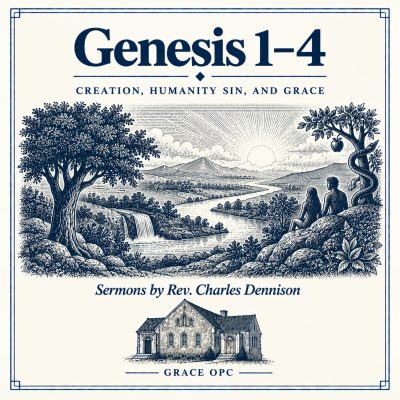
God breathes life into mere dust, and man’s move from wilderness to garden already pictures the move from earth to heaven. Even ‘the east’ points to Christ, a reminder that eschatology must be our first consideration in the history of salvation, not an afterthought.
Genesis grows more specific moving from chapter 1 into chapter 2, and Eden itself turns out to point toward the Paradise of Revelation 22. The real differences between the two get traced out, both of them finally about communion and fellowship with God.
The ten sections of Genesis get mapped before dwelling on a single shift in chapter 2: ‘God’ becomes ‘Lord God.’ That change in name marks God’s own sovereignty over space and time turning into real intimacy and nearness to man.
Where the Synoptic Gospels treat creation implicitly, John makes it explicit from his very first verse. Creation joined to Christ becomes new creation, and John 1:1-18 traces a life found only in, with, and through him.
Any supposed separation of Sabbath from worship gets challenged, reading Job 38:7 alongside Genesis 2:1 to show the two bound together from the start. Offering spiritual sacrifices of praise is already implicit in the preaching embedded in Genesis 2:2.
The Presbyterian history behind the Sabbath’s move to the first day of the week gets traced, grounding both work and rest in God’s own example. Our need of the Sabbath is not negotiable, and how we keep it says something real about what we believe.
The priorities built into the created order itself get laid out: God first, then time, place, corporate mankind, and the relation of male and female. Man cannot discover that true order by introspection, only by looking outside himself to God’s own testimony.
Liberal, conservative, and orthodox readings of the ‘us’ and ‘our’ in Genesis 1:26 are surveyed, landing on the Trinity as the only reading that holds. Man can understand the invisible God only by faith in Christ, the same light John says is now shining in us.
Returning to the three kingdoms and three kings of creation, the live debate over whether technology itself is good or bad gets taken up. Various sects err through a flat Biblicism, before Psalm 8’s astonishing claim closes things out: in Christ, we are exalted above the very heavens.
Three kingdoms turn up under three kings in the sixth day’s creation, with man given a remarkably exalted position among them. Only by holding to the living Word, amid the evolution-versus-creation debate, can we keep ourselves from slipping into paganism.