
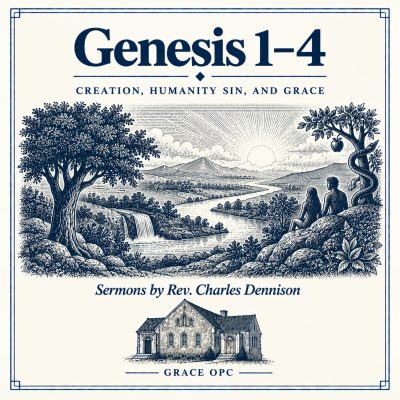
Genesis 1-4
Closing the series, God’s power is on full display in creation out of nothing, the same impossible act by which he saves us. Even here, God subjects himself to his own creation, a theocracy that begins with the Creator’s own submission.
The church has largely failed to see history’s priority over space in the creation account, a gap corrected here through biblical and covenant theology drawn from Exodus 13:8 and Colossians 3. Preaching itself must apply that same eschatological priority.
The consequences of the fall play out fully across Genesis 4, with God’s deliberate absence from man’s evil ways establishing faith as our only real access to him. Seth’s calling on the name of the Lord marks a real turn, one Joel later echoes for the whole world.
Genesis 3:23-24 and 4:16 together identify the Tree of Life with God’s own perpetual presence. God, righteous men, and Christ himself are each pictured as a tree, and it is Christ who finally takes us to that tree.
Earthly institutions are fundamentally separate from heavenly ones, and the family is no exception to that rule. Because none of them are eternal, none of them may be allowed to become idols, however good they are in their place.
Common grace is traced as extended even to Cain, then a sharp line gets drawn: the work Christians do for the world serves the city of man, not the city of God. Cain’s naming of Enoch is a vain attempt at a memorial that will not last.
Common grace is already at work in Genesis 4:17’s account of marriage, even among Cain’s own line, and its sanctity. Children remain a real blessing even to an unbelieving world, and life itself begins at conception, plainly assumed in this text.
The full magnitude of Adam’s, Eve’s, and Cain’s sinfulness is measured before the point lands: common grace exists finally to serve special grace, not to stand alongside it as an equal. Cain’s exile east of Eden contrasts with the righteous, who dwell eternally in God himself.
The church itself symbolizes a sanctuary, an eternal rest reserved for the elect, against which Cain’s motive for killing Abel stands out starkly: the inheritance. Even so, God’s coming to Cain afterward carries a real eschatology of common grace extended even to the wicked.
A direct line runs from the PCUSA’s abandonment of church discipline, and even Machen’s own failure to discipline, back to the order already structured into Genesis 4. Discipline is a biblical concern the OPC cannot afford to treat lightly.