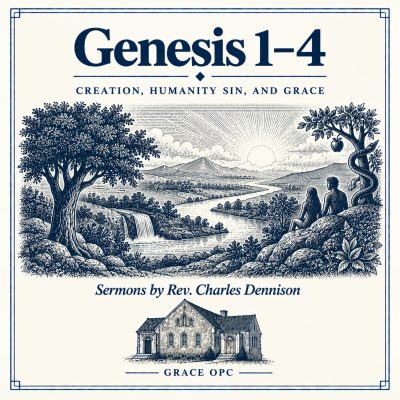
This sermon is from the Rev. Charles G. Dennison sermon archive, part of the “Genesis 1-4” series, and was preached at Grace Orthodox Presbyterian Church in Sewickley, PA, during a worship service on Sunday, May 17, 1992.
We begin our reading this evening in the book of Revelation, chapter 22. hear the word of God. And he showed me a river of the water of life, clear as crystal, coming from the throne of God and of the Lamb. In the middle of its street and on every side of the river was the tree of life, bearing twelve kinds of fruit, yielding its fruit every month, and the leaves of the tree were for the healing of the nations. And there was no longer and there shall no longer be any curse, and the throne of God and of the Lamb shall be in it, and his bondservants shall serve him, and they shall see his face, and his name shall be on their foreheads. And there shall no longer be any night, and they shall not have need of the light of a lamp nor the light of the sun, because the Lord God shall illumine them, and they shall reign forever and ever.”
And he said to me, These words are faithful and true. And the Lord, the God of the spirits of the prophets, sent his angel to show to his bondservants the things which must shortly take place. And behold, I am coming quickly. Blessed is he who heeds the words of the prophecy in this book. And I, John, am the one who heard and saw these things. And when I heard and saw, I fell down to worship at the feet of the angel who showed me these things.
And he said to me, Do not do that, for I am a fellow servant of yours and of your brethren, the prophets, and of those who heed the words of this book. Worship God. And he said to me, Do not seal up the words of the prophecy of this book, for the time is near.
And let the one who does wrong still do wrong, and let the one who is filthy still be filthy, and let the one who is righteous still practice righteousness, and let the one who is holy still keep himself holy. Behold, I am coming quickly, and my reward is with me, to render to every man according to what he has done. I am the Alpha and the Omega, the first and the last, the beginning and the end. Blessed are those who wash their robes. that they may have the right to the tree of life and may enter by the gates into the city. Outside are the dogs and the sorcerers and the immoral persons and the murderers and the idolaters and everyone who loves and practices lying.
I, Jesus, have sent my angel to testify to you these things for the churches. I am the root and the offspring of David, the bright morning star, and the Spirit and the bride say, and let the one who hears say come, and let the one who is thirsty come, and let the one who wishes to take the water of life without cost. I testify to everyone who hears the words of the prophecy of this book, if anyone adds to them, God shall add to him the plagues which are written in this book. And if anyone takes away from the words of the book of this prophecy, God shall take away his part from the tree of life and from the holy city which are written in this book. He who testifies to these things says, Yes, I am coming quickly. Amen. Come, Lord Jesus. The grace of the Lord Jesus be with you all. Amen.
Then the Lord God formed man of dust from the ground and breathed into his nostrils the breath of life, and man became a living being. And the Lord God planted a garden toward the east in Eden, and there He placed the man whom He had formed. And out of the ground the Lord God caused to grow every tree that is pleasing to the sight and good for food, and the tree of life also in the midst of the garden, and the tree of the knowledge of good and evil. Now a river flowed out of Eden to water the garden, and from there it divided and became four rivers.”
Again, our God, we would look to you and know that the word that you give will in fact build us up. That building may come by way of correction in us, and Father, we would have that spirit that would welcome that correction. Father, we know too that this word comes as encouragement. with those certainties that we belong to you, that we are in fact the children of God. And we do ask, Father, for the effectiveness of your word to be apparent to us, not only in our own souls as we who believe are built up in the knowledge of those things that pertain to life, but also, Father, as those who do not believe are convicted and converted and brought to that knowledge of the true God and his Son. We do pray these things now, looking unto you, for Christ’s sake. Amen.
We have said that as we move into this second chapter, we are dealing with a unit. a unit that begins with the fourth verse of that second chapter and will conclude with the 26th verse of the fourth chapter. And we have said that this unit focuses on God’s original fellowship with man, a fellowship, a communion tragically broken by the fall into sin. Well, does the Westminster Shorter Catechism say in describing the misery of that estate into which man fell, all mankind by their fall lost communion with God. There is a priority in that catechism answer to this matter of communion and fellowship with God, as if the Westminster Assembly were placing proper emphasis upon this particular dimension. We have then our theme, that theme recognized by our tradition, our heritage, the Westminster Assembly itself underscoring that theme. We have also pointed out ways in which this portion of Genesis reinforces a particular theme of fellowship and communion.
We move from that prologue, Genesis 1 through chapter 2, verse 3, into this section, and we see generalities about God, about man, about place or location, give way to specifics about all three. God, generally identified as Elohim, gives way to an identification as Yahweh, Elohim, the Lord God. Man, generically identified in Genesis 1, now is identified specifically and differentiated. He is Adam, and there is also woman, Eve, eventually named, and also a number of others who are specifically named. And the broad sweep of the creational cosmos laid out in front of us in Genesis 1 is now localized specifically in the garden in Eden, with mention made of many more specific places and geographical entities. We have places named, we also have rivers, and we also have set before us specifically what is called the presence of the Lord.
Now, at the same time, as we have noted previously, the specifics of that prologue in Genesis the opening chapter through the third verse of the second chapter with regard to time and history, and what happens on each specific day gives way to broad generalities with respect to time. Those specifics, then, mentioned as we move into this first major section of Genesis from Genesis two four through Genesis four twenty six. We have said that this movement. this movement from specifics about time and what happened on the specific days of the week in the creation cycle in Genesis 1, we have said that as we move from those specifics about time to these broad generalities, that there was set before us then the suggestion of that final great movement when this world shall move into the broad timelessness that is in view in the end. This means that as we move from the prologue into the first section here, the first major section of Genesis, it says, if we are given a forecast with respect to the movement that shall take place, A movement that will mean that the specificities with regard to time will fall away, and the generalities with regard to time will be in place.
In fact, a timelessness will be in place, and that with respect to the specific place or location in which we shall ever be with the Lord, in fellowship and in communion with him. Not without reason, then, has Eden, this garden that is now to be described for us in the second chapter of Genesis, not without reason, then, is this Eden, this garden of God, called paradise. And that because we see in it the suggestion of the coming, perfect, never-ending, paradise of God. It is specifically this place, this place called paradise, to which Jesus has gone.
I will not repeat for you the opening verses of John chapter 14. You could probably recite those to me. But I will remind you of the instances in which the word paradise appears in the New Testament. It is this place that Jesus promises to the thief on the cross. Luke chapter 23 verse 43. Jesus tells that sinner who has confessed him there from his cross today thou shalt be with me in paradise.
Paradise is mentioned by the Apostle Paul, 2 Corinthians 12 verse 4, he speaks about paradise, that place which is above. It’s a text that is important with respect to location, because you see, as we will As will become apparent to us as we move through this message, many people are identifying paradise specifically with some place in this creation or a restored place within this creation. Paul is saying in that passage, 2 Corinthians 12, And I know how such a man, verse 3, whether in body or apart from the body, I do not know, God knows, was caught up into paradise and heard inexpressible words which a man is not permitted to speak. This is a transcendent realm to which Paul refers. We have the glorified Christ making specific mention of paradise in Revelation, the book of Revelation, chapter 2, verse 7.
This is the glorified Christ’s message to the church at Ephesus, and at the conclusion of that message to the church at Ephesus, Here is what the glorified Christ says. He who has an ear, let him hear what the Spirit says to the churches. To him who overcomes, I will grant to eat of the tree of life which is in the paradise of God. Specifically now, the glorified Christ promises to those who overcome a participation in the paradise of God.
If you have any doubt about the relationship between the Garden of Eden and the eternal paradise of God, look at that verse and notice specifically the mention of the Tree of Life. Notice also the commendation that is given by the glorified Christ to those who overcome that language deliberate For it contrasts the condemnation that overtook Adam and Eve, who did not overcome. The Eden of the original creation is therefore bound to the eternal paradise of God.
You might recall that the language and images of Eden will return at the end of the book of Revelation. We have read from that this evening. You will note the language of chapters 21 and 22 at the conclusion of this book of Revelation. The word paradise is not used in these chapters, but clearly that to which Jesus referred from the cross, that to which the Apostle Paul referred in 2 Corinthians 12, and that to which the glorified Christ referred earlier in Revelation, the second chapter, is in view. Notice the opening of the twenty-second chapter. The river of the water of life is spoken of. There is mention made here also of the tree of life.
These features of the eternal state then connect the paradise of God, the eternal paradise of God, with the garden of Eden, and compel us to conclude that that garden which God made in the original creation was like unto the paradise which is above, actually fashioned after it. It is important for us to understand, however, this being of great importance, that that Garden of Eden was like unto paradise. We might even call it paradise because the tie between it and paradise itself is so strong.
But Eden is not, in the final analysis, that garden planted by God is not, in the final analysis, the paradise of God in its reality. Eden lacks permanence. It lacks the permanence assigned to paradise. Paradise is eternal. Eden is not. Furthermore, Eden partakes of the earthy. It is of the earth. And as all things earthy and earthly, it is provisional and preparatory. It pictures for us In many of its features, the final state of heavenly glory, but it is not that final state.
God communes with man in Eden, but his visits in the Garden of Eden are occasional. He comes and he goes. Man lives in moral righteousness in Eden, but he may fall from that moral righteousness. We know, do we not, in the eternal paradise of God, communion with God, with us, is both constant and direct, while we live in a moral righteousness which cannot be lost, ever.
So it is that we see this transition from Genesis 1 to Genesis 2. is like the transition from this world, even if it were an Eden, to the next. The emphasis then falling upon a timeless, perfect, unlosable fellowship with God, and that our ultimate blessing. Now there is one more way that the telling of things in Genesis 2 communicates to us with respect to this matter of the theme of fellowship and communion, and that being the ultimate destiny of man.
In Genesis chapter 1, you notice how the creation is prepared over six days, and then comes the appearance of man. We have to wait to the latter part of that first chapter, verse 27, for the creation of man. Man is created. And he appears, to be sure, as creation’s crown, the very pinnacle, the chief exalted stone of the pyramid of creation. But here, in Genesis 2, we move quickly, suddenly, to man’s creation. It is almost as if we had a deliberate development where that which was last, in Genesis 1, becomes first in Genesis 2. The second account of the creation now sets man foremost from the very outset.
God, therefore, does not so much create an environment, then create man and set him in it, as he creates man and prepares a habitation where he and man may commune. We have a forecast in this development of things, in this presentation of things, we have a foretaste of the eternal state in which communion with God becomes so all-consuming that the particulars of that estate become secondary to the fellowship and communion itself.
Actually, it is precisely here that so many people stumble and fall in their conceptions of glory. They try to portray glory in terms of the quality of bliss, or the particulars of heaven, or the particulars and the specifics of the eternal state, almost as if they were eclipsing The foremost concern, namely fellowship and communion with God.
How many people have you heard say that they have no interest in a place where all you do is sit upon fleecy clouds and strum harps forever? Such a place doesn’t interest them at all. And in place of such a conception, they conceive of something all by themselves. And they spin these conceptions upon the world. They tell you about how there are going to be fields planted, there are going to be harvests still. They concentrate on the particularities of the creation and tell you, yes, it’ll still be there, it’ll be perfect. And they focus so much upon these things that fellowship and community with God is completely eclipsed.
It’s not even a consideration at all, as if communing with God forever was something that was this too worthless. If we’re going to talk about heaven, let’s talk about the gold in the streets. Let’s talk about the gems, let’s talk about the perfections of the city. If we’re going to talk about heaven, let’s talk about the transformation of the creation, the new heavens and new earth in such a way that earth actually overshadows heaven and becomes heaven itself.
Why is it that people are so disinterested in communion with God? Why is it that communion and fellowship with God doesn’t interest people, but when you start talking about dirt and trees and rivers and streams and hills and mountains and clouds, everybody seems to perk up. Is it because communion with God is so abstract? These things being so concrete.
Now this isn’t to diminish the creation and its value whatsoever, but it is to place before us the supreme concern. Surely we are told there are these aspects of the eternal state and they are described for us in Revelation chapters 21 and 22. But set in the midst of that is this restored perfect unending fellowship with God, which is so consuming that Nothing else can be compared with it. May our longing for God be such that we are able to put all of these other models in their proper place, so that we do not allow them to eclipse our love for Him and our desire to be with Him. And may it be that as we live our lives keeping this as the foremost thing of all, we are satisfied in the great day with the knowledge that we are in fact brought into his presence by his grace, there to dwell with him forever. O God, we ask that we may thirst for you, we may hunger for our God, that we may know where we may be satisfied in that in the gospel and the gospel alone. May we be certain, Lord, that even the garden, as it was planted by you, was meant as a temporary patterned after the paradise which is above, that paradise to which you would eventually bring your elect, they then to commune and fellowship with you there forever.
And may we glory, Father, in what you have done in order to procure for us so wonderful an estate, to welcome us into that estate. For you have done nothing less than to give yourself in your own precious Son, whose death has meant the forgiveness of our sins and the restoration of fellowship with you. We glory in you.
The sermon text provided above is derived from the sermon audio recording making use of generative tools. It has not been manually edited. While transcription tools have a high degree of accuracy, the output may include generative textual, punctuation, and/or formatting errors.