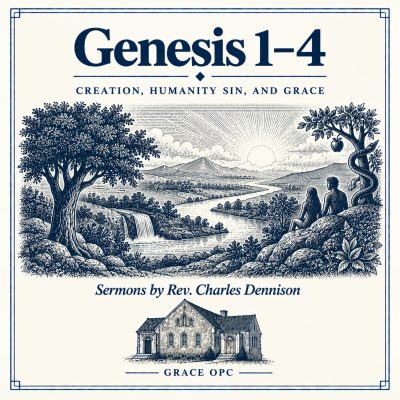
This sermon is from the Rev. Charles G. Dennison sermon archive, part of the “Genesis 1-4” series, and was preached at Grace Orthodox Presbyterian Church in Sewickley, PA, during a worship service on Sunday, March 22, 1992.
Our scripture reading begins in Hebrews 4. Listen to the word of God. Therefore, let us fear lest, while a promise remains of entering his rest, any one of you should seem to have come short of it. For indeed we have had good news preached to us, just as they also, but the word they heard did not profit them, because it was not united by faith in those who heard.
For we who have believed entered that rest, just as he has said, As I swore in my wrath, they shall not enter my rest.” Although his works were finished from the foundation of the world. For he has thus said somewhere concerning the seventh day, and God rested on the seventh day from all his works. And again in this passage, they shall not enter my rest. Since, therefore, it remains for some to enter it, and those who formerly had good news preached to them failed to enter because of disobedience, he again fixes a certain day called today, saying through David, after so long a time, just as has been said before, today, if you hear his voice, do not harden your hearts. For if Joshua had given them rest, He would not have spoken of another day after that.
There remains, therefore, a Sabbath keeping for the people of God. For the one who has entered his rest has himself also rested from his works, as God did from his. Let us, therefore, be diligent to enter that rest, lest anyone fall through following the same example of disobedience.
For the word of God is living and active and sharper than any two-edged sword. and piercing as far as the vision of the soul and spirit of both joints and marrow, and able to judge the thoughts and intentions of the heart. And there is no creature hidden from his sight, but all things are open and laid bare to the eyes of him with whom we have to do. Since then we have a great high priest who has passed through the heavens, Jesus the Son of God, let us hold fast our confession. We do not have a high priest who cannot sympathize with our weaknesses, but one who has been tempted in all things as we are yet without sin.
Let us, therefore, draw near with confidence to the throne of grace that we may receive mercy and find grace to help in time of need.” Thus the heavens and the earth were completed in all their hosts. By the seventh day God completed His work which He had done, and He rested on the seventh day from all His work which He had done. Then God blessed the seventh day and sanctified it, because in it He rested from all His work which God had created and made.”
Our God, we know that there are many things in your word that we are slow to hear. We ask, Father, that we might hear all that you have to say and that we might be found obedient, willing in our hearts to follow after you and to become as you are. We ask this, that righteousness might prevail, that it might prevail in us. and that sin might be defeated, through Jesus Christ, who is himself the victor over sin and death on our behalf. Amen. that we Presbyterians have made too much of the Sabbath, that we have insisted upon a continuing value to the Sabbath and the commandments that pertain to it.
A century ago, Most Presbyterians in this country would have been quite shocked by our flippant, what they would judge to be flippant, references to the Sabbath as Sunday. To this very day, those who are raised in Reformed Presbyterian circles have been known to insist upon calling the Lord’s Day the Sabbath, religiously avoiding the use of the word Sunday.
You may know some old United Presbyterians who hail from the same stock. They too may still, in their vocabulary, hold a special place for the term the Sabbath and avoid the use of the word Sunday. There is an old United Presbyterian, she wouldn’t appreciate that adjective, in our congregation, Marian Gilmore, my aunt. I myself am an old United Presbyterian.
That’s the church that I came from, but if you were ever to speak to Marian about Sunday, she would not call it Sunday, she would call it the Sabbath, and she would not call it Sunday school, she would call it Sabbath school. In large measure, the strong Presbyterian influence that was abroad in this country in the eighteenth century and the nineteenth century as well brought tremendous pressure to bear upon our society at large. The pressure carried over in some measure, carried over into this present century, the twentieth century, and was part of the world in which many of us grew up. I know that the examples abound with respect to this matter generally, and you could tell your own stories, but in my experience In the fifties, and I’ve mentioned this to you before, my experience during the fifties in our neighborhood, even though very few in our neighborhood were actually Christians, nobody, and I mean nobody, mowed their lawn on Sunday, and no one washed their car.
It just was not done. And of course, we have witnessed an unraveling, have we not, with regard to matters that were informed by Presbyterian conscience over the last thirty years. The unraveling has been quite rapid. This unraveling has been the result of the widening gap between the Church and our society. on that common bond between our society and the Church. That gap has widened and it seems to be, in many respects, unbridgeable.
There is the disappearance of Presbyterian influence. He can match that with the refusal on the part of many, many Presbyterians, even conservative Presbyterians, to defend their heritage, and especially to refuse to defend their heritage when it comes to this matter of the Sabbath day. At the same time, we have witnessed in this century the triumph of certain religious traditions that have never taken any thought for the Sabbath. They claim that the Sabbath is wholly and completely part of the old administration that has been done away with, part of the Jewish administration which has been left behind and is no longer applicable to us. I want you to know that I launch into this message tonight with no delusions.
I know that for some in this church, even though they’ve been here for a long time and they’ve sat under my ministry for many, many years, that for them I might as well be beating a dead horse. And they’re the dead horse. I do know, however, that God can raise the dead, and my hope is that by root of the continued preaching of the word, even these dead horses may be raised. I know with respect to this matter that there are people in this church who know full well what the Bible teaches. They know full well what the Confession says, they know full well what the Catechism says, they may have even memorized the Catechism with respect to the Sabbath day commandment, but they simply are not going to allow the Bible or the Confession or the Catechism to get in the way of their doing what they want to do. That’s just the simple fact. I also know that in this church, in addition to the dead horses, there are some who are more like tortoises. That is, they’re moving in the right direction. They’re moving in the right direction. They have good biblical conviction. It’s just taking them a long time. to get things out of the way and get where they know they ought to be.
One of the things Presbyterians traditionally, historically, have held on to When they have been at their best in defending their heritage, in defending their position on the Sabbath day, one of the things that they have held on to is this text in Genesis chapter two, verses one through three.
Our Presbyterian, at his best, will argue Despite the power of this text, despite its applicability, no Presbyterian at his best will argue that the Sabbath remains unaffected by the coming of Christ. The Presbyterian will point out the change of the day. He will make a great deal out of that fact. He will set before you, as does the Confession, as does the Catechism, That fact, that the last day, which was the special day of the Jewish week, has given way to the first day, which is the special day in the Christian week. And so it is, the Presbyterian will make much of Christ’s resurrection, which occurred on that first day of the week, an event which preaches within its context the Sabbath’s fulfillment as well as the consummation, preaching both the beginning and the conclusion of God’s works at once. The Presbyterian will point out the early church’s practice He will point out to you the fact that the church gathered on the first day of the week.
That point is spelled out for us in Acts chapter 20, verse 7. As the church in Troas did that, it is also reinforced by what Paul says in 1 Corinthians 16, verse 2, as he instructs the Corinthian church on the first day of the week, to set aside their offerings and gifts. This is underscored further by what is found in the book of Revelation, the first chapter, the tenth verse, as John says that it was on the Lord’s Day that he was in the Spirit. The day which he has in mind is the first day of the week, called the Lord’s Day, specifically because on that day Christ rose.
The Lord was raised. The Presbyterian will also point out to all who will listen. The Presbyterian, at his best, will point out to all who will listen how the day, the Sabbath, is delivered from the Jewish sacrificial cycle, and most particularly how we are delivered from the observance of days and months and seasons and years as Paul invades against in Galatians, chapter four, verse ten.
He will point out specifically how we have been delivered from festivals, new moons and Sabbath days, Colossians 2.16. As it is apparent from these passages in Paul, the sacrificial cycle has in fact been broken by the final, climactic sacrifice of Christ.
The maintenance of the Sabbath, in keeping with the spirit of the Old Testament order, has been done away. Yet at the same time, as Hebrews chapter four, verse nine, tells us plainly, there remains a Sabbath keeping, a Sabbath observance for the people of God. That’s the proper translation of that verse. The word there used for Sabbath rest is not specifically Sabbath rest at all, as it is translated in many translations. Rather, that verse is best translated, there remains a Sabbath keeping, a Sabbath observance for the people of God.
And it is at this point, then, that the Presbyterian, speaking at his best, becomes most insistent And he does so because he has grasped this fundamental point. The Sabbath obligation rests upon the fact that we stand shy of our final rest in glory and are compelled to labor to work towards the entrance into that rest that has been promised us, that rest spoken of in the eleventh verse of the fourth chapter. them to enter into that rest, and as long as that striving is applicable, there remains for the people a Sabbath-keeping until that day arrives itself.
It is not without reason, then, that the Presbyterian, at his best defending his heritage, points out with special emphasis a passage like Genesis This text calls attention to the essential order of God’s creation. It is suggestive of the fact that as long as this creation endures, there will be a Sabbath. As long as this creation endures there will be a sound. But, of course, the full implications of this text go even deeper. Those implications are drawn out for us, in part, by the fourth commandment that appears in Exodus chapter twenty, verses eight through eleven. The fourth commandment makes much of God’s example.
God worked six days and then he rested. Man bound to God is to follow suit. He also is to work six days and rest one. There is then this principle of imitation that is essential to our understanding of the Sabbath. We are in fact to imitate God. But even beyond this matter of imitation is the issue of work and rest, these two going together. For you see, the command sets before us not just the obligation to rest on the Sabbath, it sets before us the obligation to work. and the responsibility with respect to the one necessarily involves a responsibility with respect to the other. This means, then, as long as this creation exists, man is obliged to work, and as long as he is obliged to work, he is obliged to rest. Now, he can work and he can rest in imitation of God, or in disobedience to God, he can make up his own schedule and determine what is right for him in his own eyes. There is more.
As we push with respect to this text in Genesis chapter 2, endeavoring to plumb its depths, we are reminded, of course, of Jesus’ treatment of the Sabbath as he reflects upon the Sabbath and the gift of the Sabbath to man. Jesus debates the Pharisees. We have the record of it in Mark chapter 2, in parallel passages, at the end of that chapter, verses 27 and 28. The Pharisees have misunderstood. They have concluded that man has been made for the Sabbath. Jesus says, no, that the Sabbath has been made The Sabbath is itself instituted after man and for man.
It is given to man for his good. It is given to man as a blessing. In fact, according to God’s wisdom, man as man stands in need of this special blessing of the Sabbath. By his very nature, man stands in need of this Sabbath. He stands in need of this gift which God gives. Man, as he is created and as he is defined by God, as he is presented scripturally, stands in need of this specific gift.
Why, it’s almost as if man really can’t be all that he’s intended to be without the gift of the Sabbath, without the blessing that it confers. Man’s existence, then, is tied to the Sabbath existence which comes subsequently. The gift bound to the man, and them together interlocked. And insofar then as man himself is not made to cease to exist by the efforts and works of Christ, no less is the Sabbath made to cease to exist.
The Sabbath serves and blesses man as long as man exists, and that is a blessing, a service that extends even into eternity, into the eternal Sabbath. According to God’s wisdom, you need the Sabbath. So much do you need it that eternity itself is described as a self.
I certainly hope that You are no dead horse when it comes to this matter of the Sabbath, but alive to the word of God. It may well be that you’re struggling. It may be that you’re in agony, even, with respect to the Sabbath and its observance, and what you should be doing with respect to the Sabbath. may well be that you are the tortoise pointed in the right direction, inching your way along, but making progress, and I hope that is true. But please, I ask this of you, if you are sensitive to what the Word of God is saying on this matter, if your conscience is alive to the Word, in this respect Please, for the good of your souls, and for the well-being of your pastor, and the well-being of your elders, please, I plead with you, don’t become defensive. I am here as a servant of the Word, and if you are struggling within yourself, if you are fighting with certain matters with regard to your obedience and devotion, I am set here by God in Christ’s name to be of help to you, and I will endeavor to be a help to you to the fullest extent of my energy. But it is a little difficult, you will admit, when the matter comes up and the issues addressed, to find in front of me a barrier that is absolutely impenetrable. A heart that is thoroughly resistant.
My job is to prod you. My job is also to encourage you. It does create some rather humorous images, doesn’t it? A pastor with a stick prodding a tortoise. The labor which I perform is labor in love. Nothing less than that is in view with respect to the labor that your elders expend on your behalf.
So rather than being defensive and even argumentative, resistance pleading special cases hear the Word, embrace it, take it to heart sincerely, listen, grow to the end that the Sabbath of the Lord our God, the Sabbath with all of its blessings, would afford you great comfort and consolation.
How merciful you are, Lord, looking upon us in our condition. We who in our lives are tempted to react defensively to that word when it is presented to us. O Father, may we instead turn to you, willing to receive of your word to live by it, to delight in it, unto the end that we may delight in you. Forgive us, Lord. Help us, our God. Be with those, especially, who are young and sometimes confused as to why it should be different for them than from all those they see around them. We pray, our God, that you would help us in our thinking and in our living. For Christ’s sake.
The sermon text provided above is derived from the sermon audio recording making use of generative tools. It has not been manually edited. While transcription tools have a high degree of accuracy, the output may include generative textual, punctuation, and/or formatting errors.