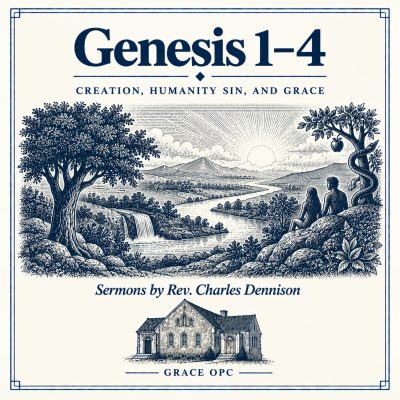
This sermon is from the Rev. Charles G. Dennison sermon archive, part of the “Genesis 1-4” series, and was preached at Grace Orthodox Presbyterian Church in Sewickley, PA, during a worship service on Sunday, April 5, 1992.
Now we are reading from John’s Gospel, the first chapter. This is John’s Gospel, the first chapter, a familiar passage, beginning with verse 1. In the beginning was the Word, and the Word was with God, and the Word was God. He was in the beginning with God.
All things came into being through him, and apart from him nothing came into being that has come into being. In him was life, and the life was the light of men. And the light shines in the darkness, and the darkness did not comprehend it. There came a man sent from God whose name was John. He came for a witness that he might bear witness of the light that all may believe through him. He was not the light that came that he might bear witness of the light. There was the true light which coming into the world enlightens every man. He was in the world and the world was made through him and the world did not know him.
He came to his own, and those who were his own did not receive him, but as many as received him, to them he gave the right to become the children of God, even to those who believe in his name, who were born not of blood, nor of the will of the flesh, nor of the will of man, but of God.
And the Word became flesh and dwelt among us. and we beheld his glory, glorious of the only begotten, from the Father, full of grace and truth. John bore witness of him and cried out, saying, This is he of whom I said, He who comes after me has a higher rank than I, for he existed before me. For of his fulness we have received grace upon grace.” for the law was given through Moses. Grace and truth were realized through Jesus Christ. No man has seen God at any time, the only begotten God, who is in the bosom of the Father. He has explained him.”
I thought it appropriate at this time, in our consideration of the doctrine of creation, to deal with this New Testament passage that specifically relates to that subject. I think that some of you are aware of the fact that each gospel pays its own form of tribute to the opening chapters of Genesis.
What is laid between the lines in the first three Gospels, Matthew, Mark and Luke, is made explicit by John. There are things that are veiled, seemingly, in the synoptic Gospels, that is, Matthew, The veil seems to be ripped away with the gospel of John. You might recall the veiled reference in Matthew’s gospel. The very first verse of that gospel goes like this, the book of the genealogy of Jesus Christ. I’ll give you the phrase there, the book of the genealogy of Jesus Christ. Well, that phrase is lifted almost word for word from Genesis chapter five, verse one, and is reflective of the phrase that is used repeatedly throughout the book of Genesis.
So even Matthew is taking us back As I said, each of the Gospels has its own way of paying tribute to the opening chapters of Genesis. But what might be somewhat veiled, somewhat even obscure, becomes overt and explicit in John. Could anything be more direct than what we read in the opening line of John’s Gospel. In the beginning was the Word.
Of course, we recognize that this is merely a reflex to and a reflection upon what we find in the opening statement of the Bible in Genesis 1 verse 1. I hardly have to point this out to you. You know this very well. But what is the point? Why do we find this pattern In the New Testament, this reflection by the gospel writers upon the opening chapters of Genesis. The point is none other than this.
In and with the gospel of Jesus Christ, we meet the goal of the creation through a recreation, through a recreation. The Gospels then present us with these lines so as to draw our attention to the creation and its goal in order to proclaim to us that the goal of that original creation is now met in and through the gospel of Jesus Christ, new creation. But establishing that, the general theme of the new creation, the gospel takes up the specific question of this One in whom and through whom the new creation is brought about, spelling out for us then His identity. Who is this One through whom the new creation is effected? as it was with regard to the general theme of creation, so now with the identity of the One through whom that new creation is brought about.
The first three Gospels, the Synoptic Gospels, lay the identity of this One, as it were, between the lines where in fact the Gospel of John is most explicit and open. Yes, This one who is presented to us in the first three Gospels is fully human. He is at the same time also divine, but his divinity comes to us seemingly in veiled fashion.” I’ll point out Matthew’s Gospel again in this regard, the first chapter of his Gospel.
We have the account of the angel’s approach. to Joseph when Joseph is confused as to what he should do concerning Mary. The angel says to him, Joseph, son of David, do not be afraid to take Mary as your wife, for that which has been conceived in her is of the Holy Spirit.
Verse 21, And she shall bear a son, and you shall call his name Jesus. for it is he who will save his people from their sins.” Now, there’s no explicit identification of Jesus at that point with God, but there is certainly an inference that can be drawn from that passage that Jesus is none other than God. We see that not only from the fact that Jesus means, that is, The name Jesus means Jehovah saved, we see it as well from the corollary statement when the angel says that he shall save his people, whose people? Jehovah’s people, being Jesus’ people, which means Jesus is Jehovah. He shall save his people from their sins.
The reference isn’t explicit, it is inferred, but it is there nonetheless. This one, through whom new creation is effected, yes, is fully human, amazing, but also completely divine. But if this matter is somewhat veiled in the first three Gospels, the veil again is ripped away in the fourth, in John’s Gospel. Look at that fourteenth verse once more of the first chapter of John. you have the explicit statement there with respect to his humanity. This one who is identified as the Word becomes flesh. There the humanity is in view, but as is established with regard to the Word, this one is also fully, completely divine. We have that through the exposition and the declaration of what has been said by the Apostle John in the opening of this gospel, verses 1-5. Here is the classic, overt, explicit declaration of this one’s divinity. Is humanity there to be sure? But here, explicitly stated and declared, is divinity.
It may strike you as something of an odd construction, because John, as it were, begins where the others do. Mentioned is the Word, not Jesus first of all, not even the Son of God. The Word is mentioned. As we start out in verse 1, “…in the beginning was the Word,” and we are here operating at the level of inference, are we not? Well, we’re comparing this statement with what we see in Genesis one one, where we hear in the beginning, God. So if we match these two passages up, we have the word then replacing God. It is by way of inference that we conclude at this point in the verse that the word is God.
But that’s not explicitly stated as that, is it? We move on to the next phrase. from in the beginning was the Word to and the Word was with God. Still, it’s not explicit. It sounds as if the Word is standing alongside of God, corollary to God, placed beside God. The statement implies proximity. It doesn’t come out and declare unequivocally that the Word is God. There is something of an objective status here with respect to the Word, as the Word stands, as it were, apart from God. We’re moving in the direction of a more explicit statement, but we haven’t arrived there yet.
There is a proximity, there is this objective standard or status of the Word with respect to God. The Word, at this point, has a form of utility. It’s viewed in terms of its usefulness with regard, with respect to God. The Word was with God, useful to God. standing in this objective status with respect to God, proximate to Him, employed by Him. But then, in the final phrase of the verse, there is the out-and-out statement, the Word was God.
It’s almost as if the arrangement is deliberate. In effect, taking you where you may have been left in the synoptic Gospels and bringing you to the point where John wants to lead you, and that in the clear light of day with the explicit statement that the Word was God. No equivocation at all. No question about it. His instruction further, though, in this opening for John’s gospel. There is instruction further for us, and that has to do explicitly with John’s choice of the term word.
The term is an ideal choice for John’s purposes, for the term suggests communication. and that which stands beside God, with God, for the effecting of God’s word, that which goes out from God by which he achieves his purposes, is his word. The Word can then stand in this objective relationship to the person of God. The Word itself can stand in that objective relationship as if it were beside God, useful to God, employed by God to effect His purposes. But that which can in effect be external to God, that is, go out from God, is also internal to him, the interior to God, with respect to the eternal self-communication that takes place within God. Do you not have a parallel with respect to Your word is able to go out from you to affect, as it were, your purpose, your intention, but you simultaneously are able to communicate within yourself to carry on an internal conversation. The word can stand objectively to you. It can also be interior to you. by whom this new creation is brought about is, yes, human, but by declaration now explicitly, so wonderfully explicitly from John’s gospel, God truly and fully.
The point being, of course, that as God himself created this previously, So now God again creates afresh. No one else. God himself is the one who is at work to recreate, to make anew. This message is of greatest importance you see, the focus will not simply fall upon creation per se, but upon you, as you are the work of God, created again.
As you are born afresh, your faith faith, so we are told, even by John in this opening chapter, a testimony, a testimony to you of your rebirth. We have then the theme of the new creation, we have that one through whom the new creation is brought about, but we also have set before us what in fact is the center of that new creation, or the goal of the original creation, to which now that creation is brought by way of the new creation effected through and in Jesus Christ and his gospel.
What is that center? What is that goal? Can you pick it out in the opening lines of John’s gospel? Can you pick it out from John 1, 1-18? Would you not conclude that that goal, that center, is nothing else but life? but life, life which is in fact light for man. In him was life, and that life meant to be the light, the illumination for man.
Light then conferred through gift of grace, truly We are made to be children of God, are we not? If, in fact, we believe that faith being worked in us, we who are born not of blood, nor of the will of the flesh, nor of the will of man, but of God Himself, life from God, life with God.
The center, then, is life. This life as qualified in the Word itself, by the Word and the description that is given to us of the Word, that description filled out for us throughout this opening section of John’s Gospel. The Word identified specifically in that one who is described as the only begotten of the Father. This one, then, who is the only begotten of the Father, identified as Son, stands in relationship to God and has within himself the life that is intended as the center and goal of the created order originally, and now stands as the center and the reality of that goal to which the creation originally pointed and is fulfilled in the new creation.
What is this life, then? It is not specifically, then, that life which is internal to God himself, as if we were gaining the life of God when we come to the center of the created order and its intention and what is at work for us in the new creation. Specifically, it is that life which is found in fellowship with God, that life that is found specifically in God’s presence. The original intention then of the creation was for man to be brought into an environment in which he would be in fellowship with God in such a real in such a permanent sense that he could never lose that fellowship, so that he would never depart from God’s presence, so that God would never depart from him.
This kind of life The Word, or this One who is described as the only begotten of the Father, has within Himself. He has this life of fellowship in Himself, and it is specifically this life that is to illumine man in his condition. And if man lacks this illumination, he simply does not understand the purpose and the intention for the goal of life.
This sort of life, then, brings us to a plane which is above the line and order of this creation. This life is eternal life. It finds its origination and its end in the heavens. It is specifically this light and the light that emanates from it that the darkness attempts to extinguish and obliterate.
Blind men don’t see it. But you’ll see it. Do you not? You understand, don’t you? You comprehend. You realize the goal, the objective of the original creation. You know through the work of God’s Spirit in you what it is that the new creation confers upon you. Is that not testimony to you that you are begotten of God, that you are a child of God, that you are already participating in a fellowship with God that will not be ended, that cannot be interrupted, that will never cease? that God would make these things plain to us, if in fact we do not see and do not comprehend. And what shall we say about the lengths to which God will go in order to restore the goal and intention of his original creation, the lengths to which he will go personally in order to bring about his new creation and set you with him in that new creation for permanent fellowship with him. He sends his son. He gives one up. He sacrifices his son. So dear are you to healing. that he will give up the one he loves most in heaven for you, the one he loves most in the earth.
That being the case, considering this great love And the life that has now been given you in the new creation, how ought you to live? Our God, we thank you for the very patterns that we see as we move from the original creation to the new creation. We rejoice in the revelation of your Son, how you have made the first and now make the second. And, Lord, we thank you for the testimony with regard to ourselves. As we did not contribute to our original creation or our place within it, neither do we contribute to the second creation and our place within it. For this is all of you. Our faith being the testimony that we have been worked upon by you and brought into the new creation for perpetual, unending fellowship with you in life eternal.
Father, we ask that our faith may be strong, the grace of your Spirit may work well within May we indeed hold fast to this confession that we have made. Bless us, we ask, Lord. And may the fellowship we know now increase in brilliance as we understand better and better, and bring about the day, our God, when we with all your children will stand before your presence and glory in you and in the Lamb.
The sermon text provided above is derived from the sermon audio recording making use of generative tools. It has not been manually edited. While transcription tools have a high degree of accuracy, the output may include generative textual, punctuation, and/or formatting errors.