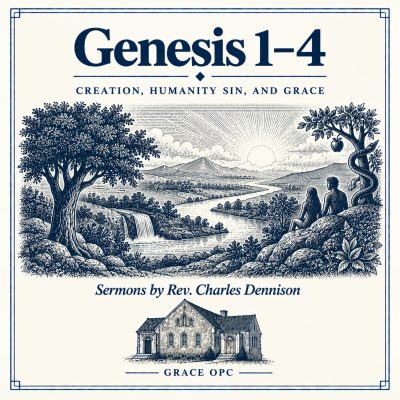
This sermon is from the Rev. Charles G. Dennison sermon archive, part of the “Genesis 1-4” series, and was preached at Grace Orthodox Presbyterian Church in Sewickley, PA, during a worship service on Sunday, February 2, 1992.
We begin our scripture reading tonight in Psalm 8. Listen to the word of God. O Lord, our Lord, how majestic is thy name in all the earth, who has displayed thy splendor above the heavens. From the mouths of infants and nursing babes thou hast established strength, because of thine adversaries, to make the enemy and the revengeful cease. When I consider thy heavens, the work of thy fingers, the moon and the stars which thou hast ordained, what is man that thou dost take thought of him, and the Son of Man that thou dost take care of him? Yet thou hast made him A little lower than God, and thus crown him with glory and majesty. Let us make him to rule over the works of thy hands.
Thou hast put all things under his feet, all sheep and oxen, and also the beasts of the field, the birds of the heaven and the fish of the sea, whatever passes through the paths of the sea. O Lord, our Lord, how majestic is thy name in all the earth.
Then God said, Let the earth bring forth living creatures after their time, cattle and creeping things and beasts of the earth after their time. and it was so. God made the beasts of the earth after their kind and the cattle after their kind, and everything that creeps on the ground after its kind, and God saw that it was good. Then God said, Let us make man in our image according to our likeness, and let them rule over the fish of the sea and over the birds of the sky and over the cattle and over all the earth. and over every creeping thing that creeps on the earth. When God created man in his own image, in the image of God he created him, male and female he created them.
And God blessed them and said to them, Be fruitful and multiply and fill the earth and subdue it and rule over the fish of the sea and over the birds of the sky and over every living thing that moves on the earth. And God said, Behold, I have given you every plant yielding seed that is on the surface of all the earth, and every tree which has fruit yielding seed. It shall be food for you. And to every beast of the earth, and to every bird of the sky, and to everything that moves on the earth which has life, I have given every green plant for food, and it was so. And God saw all that he had made, And behold, it was very good.
And there was evening and there was morning the sixth day. But we come at last in our study of the first chapter of Genesis to the account given here on the sixth day. We realize in arriving at this point that the stage has been set well for what we encounter here.
Creation’s kingdoms had been created during the first three days of creation. Creation’s kingdoms had been created during the first three days of creation. On day one, the day and the night. On day two, the heavens, or the sky, together with that act of God by which he separated the waters that were above the firmament from the waters that were below the firmament. And day three, we are told, on that day the dry land appears with its vegetation. So here, in these first three days of creation, are creation’s kingdoms, day and night. the heaven and the seas, and finally the dry land. You notice, as we move through those first three days, that the appearance of the dry land on the third day crowns God’s creation of the kingdom’s spheres. It says, if there is an apex reached with the third day and the creation of the dry land.
The second three days set before us the creation of the various creation kings, or lords, or governors, so that the kings of day four matched the sphere of day one, and the kings of day five matched the kingdoms of day two. And as we would expect, the kings of day 6 match the kingdoms of day 3. But notice once more, at day 6, what we saw in day 3. The account of the kingdoms peaked in day 3. Likewise, the account of creation’s kings peaks in day 6. and specifically in the account of man’s creation.
Man, then, is the crown of God’s creating work. As such, man sits naturally in an exalted position. His rule and responsibility do not merely extend over the domain of the dry land that was established on day three. In fact, it seems as if the creation of the beasts, which also appear on day six, is meant to perform the function of ruling over the dry land that was spoken of on day three, much like the birds and the fish that are spoken of on day five are to rule over, respectively, the sky and the seas. means then that man’s creation is all the more unique. For in the account that we have of the sixth day, man’s creation is distinct from the creation of all the other creatures, even the creatures that are created on that day. He is distinct from those creatures. Because not only will he rule and have responsibility for the kingdom of the dry land, but he will have rule and responsibility over all of the kingdoms that have been created by God.
This insight adds weight to the biblical objections to evolutionary theory. take into account the two parts recorded for us of God’s activities on that sixth day. The first part describes the creation of the beasts, the animal kingdom, the animal world, and these creatures are most properly the rulers of the dry land The kingdom that was established on the third day. God’s benediction appears in the account, verse 25, when it says to us that God saw that it was good, and this marks the end of the first part of the account with respect to that sixth day. But the record doesn’t end there. It continues.
The second part speaks about the creation of man. creation of man as a unique being, distinct even from the beasts created on the sixth day, man is destined for the highest position among God’s creature kings. He is granted dominion over all the works of God’s hands, over all the dominions, over all that God has made day one through day six. God’s supreme benediction, therefore, is reserved for this point, not just because God concludes His work now, but because man is in view. The crown of His work stands upon God saw all that he had made, and behold, it was very good.”
The evolutionists would deny all of this. Even the theistic evolutionists must compromise the biblical account. According to evolutionist theory, man develops from other forms of life to become what he is. Judged by the canons of historical and scientific veracity, so they say the biblical account cannot be accurate. It cannot be true.
But have you noticed the evolutionary theory has itself evolved. Originally, the evolutionists were willing to accept man’s acquired superiority because of man’s intellectual attainments, because of man’s spiritual capacity, according to some. He rose above the other forms of life, even his previous ancestors. Therefore, as evolved, man is unique. This is classic evolutionist teaching. However, more recent thought has now created a crisis within the evolutionary community.
Who is to say that man is unique? Who is to say that man is superior, that man has an innate claim to dominion? Who is to say that other forms of life have not also evolved, that they do not have a uniqueness to themselves? but the status that they have achieved doesn’t boast of its own superiority, its own claim to dominion. At the very least, so it is now said, there must be an equality for all reality within the physical universe.
And this, now being held As dogma amongst modern-day progressive evolutionists, man’s uniqueness is completely overturned. He isn’t unique at all. So here is that many of the ecologists, many of the animal rights people, on a collision course not only with biblical doctrine, but with classical evolutionary doctrine. I hope that we are all able to perceive the ever-paganism of both positions, be it the classical presentation of evolutionary theory for its modern offshoot Classic evolutionism is the paganism of the right, and this paganism of the right preaches a doctrine of human uniqueness unto the end that man might achieve the status of superman.
That is the goal in view. That is the hope in vision. Modern ecologies, ecologists, and ecologism is the paganism of the last. and it preaches its doctrine of the equality of all reality to the end that it might be recognized that all reality is divine. All reality is divine. The uniqueness of man is gone, God himself is out of the picture, all reality is raised to the level of the divine.
Is it any wonder, then, that in our time—and who would have thought twenty years ago, thirty years ago—is it any wonder that in our time that we are witnessing amongst the ecologists and the rights groups the resurrection of ancient pagan religions and idolatry? that we are witnessing the resurrection of nature worship.
Now, I’m not an alarmist, and I don’t like to doze upon the spectacular. I don’t like to grab you by your mental lapels and shake you up with another shocking story. I don’t like to introduce things by saying to you, well, have you heard about such and such? But a major tragedy is overtaking the Church of our time. because there is increasing evidence day by day that the paganism and the idolatry that I have just described is multiplying even within the walls of Christendom.
A church meeting in Australia in which the gathering is told that kangaroos A women’s meeting in the Midwest for Presbyterian women, in which a Native American declares that Jesus Christ is completely unnecessary because of the resources that are at our disposal.
Man is not in need of salvation. We have what we need. We look out at the world. Our gods are before us. We find them in the stones, in the trees, in our ancient practices. Oh, that God’s people would love him. and in loving him, believe him. And believe his word and the revelation which he has given of himself in the creation account. Let us hold to the record that is there.
Let us hold to the uniqueness of man’s creation. with a face up to man’s subsequent fallenness, a fallenness that expresses itself even in the tragic paganism that has taken hold of man in our day. A paganism which would make man, on the one hand, a god over all of the world, or on the other turn, all of physical reality. into divinity, equal to, if not superior to, man himself. But above all, let us hold fast to the living word of God, Jesus Christ, from whom our unique identity has been restored. And may we glory in this one, who brings to us the undeserving who brings to us, we who are the undeserving, that eternal world in which God is always believed, always trusted, always revered, and always worshipped.
We rejoice in the revelation that we have at the opening of the Bible, O Lord, and we receive it as your word. We ask, Father, that our reflection upon it may be mature and determined. May we grow by root of our reflection upon it and our interaction with it. We ask, Father, that we may see ourselves better holding fast to that revelation, but that we might see you all the better, and marvel at your power, marvel at your strength, marvel at your glory, and marvel at your love. hear us through Christ, the very one by whom the image of God has asserted itself afresh and been renewed in us.
The sermon text provided above is derived from the sermon audio recording making use of generative tools. It has not been manually edited. While transcription tools have a high degree of accuracy, the output may include generative textual, punctuation, and/or formatting errors.