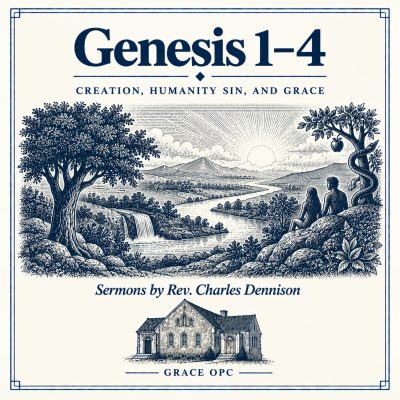
This sermon is from the Rev. Charles G. Dennison sermon archive, part of the “Genesis 1-4” series, and was preached at Grace Orthodox Presbyterian Church in Sewickley, PA, during a worship service on Sunday, April 18, 1993.
We are beginning this evening our reading with Psalm 49. Psalm 49, the word of God, “‘Hear this, all peoples, give ear, all inhabitants of the world, both low and high, rich and poor together. My mouth will speak wisdom, and the meditation of my heart will be understanding. I will incline my ear to a proverb. I will express my riddles on a harp. Why should I fear in days of adversity when the iniquity of my foes surrounds me?
Even those who trust in their wealth and boast in the abundance of their riches, No man can by any means redeem his brother or give to God a ransom for him, for the redemption of his soul is costly, and he should cease trying forever, that he should live on eternally, that he should not see the pit.
For he sees that even wise men die, the stupid and the senseless alike perish, and leave their wealth to others. Their inner thought is this, that their houses are forever and their dwelling places to all generations. They have called their lands after their own names. Man in his pomp will not endure. He is like the beasts that perish. This is the way of those who are foolish and of those after them who approve their word.
As sheep, they are appointed for Sheol. Death shall be their shepherd, and the upright shall rule over them in the morning, and their form shall be for Sheol to consume so that they have no habitation. God will redeem my soul from the power of Sheol.
He will receive me.” Do not be afraid when a man becomes rich, when the glory of his house is increased. For when he dies, he will carry nothing away. His glory will not descend after him. Though while he lives he congratulates himself, and though men praise you when you do well for yourself, he shall go to the generation of his fathers. They shall never see the light. Man in his pomp, yet without understanding, is like the beasts that perish.”
Then turning to Genesis chapter 4, verse 17. And Cain knew his wife, and she conceived and gave birth to Enoch. And he built a city and called the name of the city Enoch, after the name of his son. Our God bless us for obedience to you, that obedience that is known through submission to you.
O God, may that submission itself be born of our love. Surely you have loved us first, even when we did not love you. But now, O God, we have been born again, and we do confess that we love you, our God, and would submit ourselves to you, trusting you. understanding that you have our well-being at heart and design nothing for us that shall not work for our good. Lord, may we be enabled to hear your word this evening, that our lives may be molded and shaped by this word. May it be our God that we carry your word in our hearts. and live by it throughout the week.
We ask this for the sake of Christ, the living word. Amen. In our last message on Genesis 4, that’s been some time ago now, we made mention of the fact that this verse, verse 17, Genesis 4, gives testimony to God’s common grace. Here, the excommunicated came. Note that.
The excommunicated Cain, though cut off from God and in fact living under God’s judgment, is preserved within a context of God’s mercies. For instance, as we look at the text, we see that Cain is preserved within the context of the mercies that are attached to the estate of marriage. Cain is given progeny, he is given a seed, the process of which, the very fruit of which, gives testimony to the continuing graciousness of God, a graciousness that is extended even to the wicked. God causes his sun to shine upon the unrighteous and righteous, his rain falls upon both, this being a common grace.
Now, likewise, the remainder of this verse, and the mention that it makes of the city testify to the same end. There is that in the city and about the city now mentioned that will in fact testify to us about God’s graciousness. The city then is going to operate on the level of the first institution mentioned, the institution of family and marriage. Therefore, we need not think of the city simply because it is mentioned in connection with Cain and his seed as being evil in itself. City then is not evil in itself any more than the family is evil in itself, or marriage.
These matters then pertain to the realm of God’s common grace. There is benefit to be found in these aspects of reality for all of God’s creatures. The city becomes an arena for commerce and for community, for collective enterprise, for communal security even, and for the restraint of evil.
Now, I know you may be thinking, It’s been a long time since cities could be defined along the lines that I just described. Arenas in which it seemed as if God’s common grace had the upper hand. To be perfectly accurate, there is a sense in which cities never could be described in the way I’ve just described them. I’m bold in my assertion.
Cities, no less than the institution of the family, bear the mark of God’s common grace, they being a principal means by which man is preserved and through which he is enabled then to develop, as he might, within this world. Order rises. The family speaks of order, the city also speaks of order. Order rises then in connection with the city, and that by God’s design. Order rises within the fallen world, and that for man’s common good. A couple of things can be said further about this whole matter. First is this, that we might see the limitation that is set upon the city as the city is itself set within the order of this creation.
The city serves its purposes within the realm of God’s common grace. The city serves its purposes within the realm of God’s common grace. The city and its world of politics is not, nor can be, of God’s special grace. The city of man, therefore, even as that city bears the mark of God’s common grace, the city of man has its value.
We as Christians, we as believers in God, we as citizens of an entirely different city and its order, need not hesitate to speak of that value which the city in the arena of man has. We need not hesitate even to labor in the interests of the value which the city of man has. This means that we who then work within the city of man need not think of our labor as being useless, meaningless. Our labor has value because in our labor, in our work, we are affirming the value which the city in God’s ordination does in fact have. There is the realm of politics. Can Christians be politicians? Yes. Yes, they can. But they must approach that task with what Dr. Van Tilde called epistemological self-consciousness.
You can’t be naive with regard to the order of that city in which you labor. nor can you be ignorant of the value assigned to that city by God. You cannot make that city into something other than what it is. It must then become clear to us that while the city of man does have a positive virtue and value, The city of man is not, nor can it be, the city of God. Earth is not, and it cannot be, the city of God.
Now, it is precisely at this point that much Christian thinking even some Christian thinking well intended. I do not say all Christian thinking is well intended. But it is precisely at this point that much Christian thinking goes wrong. There seems to be something in the air breathed by many Christians that resents and resists the polarization the biblical polarization between the city of God and the city of man. There seems to be something in the air breathed by many Christians that then drives these saints to both deny the fundamental difference between the two cities, and even to work to achieve the impossible, that is, to make the city of man into the city of God. Now this is the stuff out of which the deepest forms of frustration are born. But even though that is true, and too many people realize too late that that is true, it is also the stuff out of which Christian utopianism is born.
We are going to make the world over. That is our goal. That is our agenda. That is what we are here to do. That is our purpose. This is also the stuff out of which much millennialism is made. Triumphalism, socio-political activism, all in Christ’s name.
I believe that it is at this point that certain of our dear and beloved Dutch friends went wrong. I also believe that it is at this point that certain of our Scotch and Scotch-Irish friends went wrong. And I most certainly believe that it is at this point that our dear, beloved Covenanter friends have made a fundamental mistake.
For the Covenanters believe, extending the image from city to nation, that the nations as political entities are the realm of God’s special grace. That is, they are to be redeemed as nations. Thus the city of man becomes the city of God. And the inherent polarization set out for us in Scripture, resolved for us only in the blessings of eternity, are claimed to be resolved on the plane of this creation and in this world.
Let me reiterate my point then. The city of man has its value, and we must appreciate that value, even its political value. to the point that we can, yes, rightly, justly engage ourselves in that political domain. But the city of man is not, nor can it become, the city of God. It will not happen. You see, the city of man belongs to the order of this world.
And as it does, it becomes an arena in which God’s common grace operates. While the city of God belongs to the world of God’s special grace, the former is earthly, The latter is heavenly. But a second thing we must say further about this whole matter is this. Even God’s common grace works compound the guilt of those who are benefited by that common grace while failing to acknowledge its source. And the compounding of this guilt works itself out in that evil that confounds the value that lies within this arena of common grace, so that the value is not seen and even lost from view. Thus, the city of man though bearing the stamp of God’s common grace, becomes a realm in which man himself is enshrined, in which he is exalted, in which he becomes like a god, with the city his domain. That domain and his own identity self-defined expressions of his own hostility to the God to whom he owes his life. This is precisely what we see in the case of King. In fact, it is this reality that now overtakes the narrative given us here in Genesis 4 so thoroughly to the point that it seems as if the testimony to common grace is nearly obliterated.
You have to read between the lines to pick up the message about common grace. builds his city after the birth of his son. The city and the son lie upon a continuum. They belong to the same order of thinking as far as Cain is concerned. They are connected by their name. Cain will do with the city that he builds what he has done with his son in naming him. Even though that child is a testimony to God’s graciousness to Cain, in his sin, Cain gives the boy a name that will define his own depravity. He calls the child Enoch.
The name means memorial, or dedicated one, or dedication. But what, possibly, could the naming of that child mean in Cain’s mind? To whom or to what does that name refer? It most certainly doesn’t refer to God, as if the child were dedicated to Him. Nor can the name stand as a memorial to the child in the sense that the child is a dedication to himself. Instead, the child with this name becomes a memorial to his father, to Cain.
The child stands as dedicated to him. And as such, the child now becomes the symbol of his father’s aspirations. This child then becomes an extension of the father in time, and a guarantee of the father’s longevity. It is the same with regard to the city. Cain names the city after his son, and in this act extends to the city his convictions concerning his son. As the son becomes a memorial to Cain’s permanence, so also does the city.
Now you know why we read Psalm 49. Now you see it. You understand whose mind is being described in Psalm 49? It’s the mind of Cain. And did you hear what was said in the 11th verse of that 49th Psalm? Their inner thought is this. What’s going on in Cain’s mind as he names his son, as he names the city? Their inner thought is this, that their houses are forever, and their dwelling places to all generations. They have called their lands, no, their sons, their city, after themselves, by their own names.
In Cain’s use of the name Enoch, he has in mind specifically a dedication, a memorial, now, from which God is excluded. In Cain’s mind, it is a simple matter of tit for tat. God has excommunicated me, I have excommunicated God. So much is this to the forefront in what we read in Genesis 4, that it seems obvious from the inspired narrative that this is the fact that we are not to miss.
There is the prevailing positive value of the city. of the political structure, of the institutions of this world, all of these giving testimony to God’s common grace. But in the midst of even these testimonies to God’s graciousness, there rises the line of Cain, the line that hates God. with every ounce of its energy the world is mine the world is mine my life is my own and I will not give them up It is now the prevailing strength with respect to this commitment within the city of man, despite the wonderful positive evidences of God’s common grace, that drives us to cry out all the more for that full revelation of the eternal city, that city that has foundations. whose builder and maker is God.
Let us pray. Our Father, do bless us, your children, even in this world order as we would understand the positive values of those institutions and entities which are set before us as testimony to your common grace. Enable us, Lord, to do well with our attitudes that we might even see these matters clearly to the benefit of those who don’t see them at all. And yet, Lord, as we witness the triumph of the spirit of Cain in the city of man, may we also, because of our faith, acknowledge your great sovereignty and the truth of the gospel, that we are brought to an even greater city still, one that cannot be ruled by wickedness by unrighteous men, but one that is eternal in the heavens. a dwelling place into which all who are dedicated to you shall be brought. Forgive us, Lord, in our confusions. If we make the city of man into the city of God, if we have aspirations in that direction, if We believe that in fact is what should take place, have we then become guilty of a form of idolatry whereby we have transformed something that pertains to this temporal order into that which belongs to the eternal order. Oh God, preserve us. from that. And at the same time, Lord, to give us energy, dedication, love in our service even within the city of man to the benefit of those with whom we live. We pray it to your glory and
The sermon text provided above is derived from the sermon audio recording making use of generative tools. It has not been manually edited. While transcription tools have a high degree of accuracy, the output may include generative textual, punctuation, and/or formatting errors.