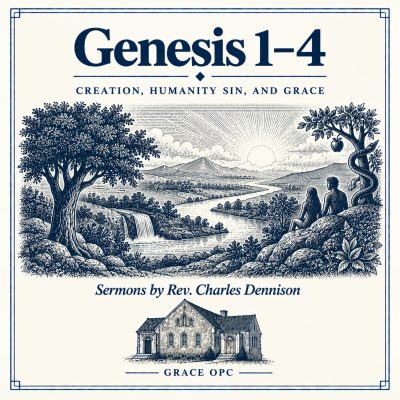
This sermon is from the Rev. Charles G. Dennison sermon archive, part of the “Genesis 1-4” series, and was preached at Grace Orthodox Presbyterian Church in Sewickley, PA, during a worship service on Sunday, May 16, 1993.
First of all, Colossians chapter 3, Colossians chapter 3. My friend, you have been raised up with Christ, keeping the things above where Christ is, seated at the right hand of God. Set your mind on the things above, not on the things that are on earth. For you have died, and your life is hidden with Christ in God. When Christ who is our life is revealed, then you also will be revealed with Him in glory.
Therefore, consider the members of your earthly body as dead to immorality, impurity, passion, evil desire, and greed, which amounts to idolatry. For it is on account of these things that wrath of God will come. And in them you also once walked when you were living in them.
But now you also put them all aside, anger, wrath, malice, slander, and abusive speech from your mouth. Do not lie to one another, since you have laid aside the old man with its practices, and have put on the new man who is being renewed to a true knowledge according to the image of the One who created him. A renewal in which there is no distinction between Greek and Jew, circumcised and uncircumcised, barbarians slave and free man, but Christ is all. those who have been chosen of God, holy and beloved, put on a new heart of compassion, kindness, humility, gentleness, and patience, bearing with one another and forgiving each other. Whoever has a complaint against anyone, just as the Lord forgave you, so also should you. And beyond all these things, put on love, which is the perfect bond of unity.
And let the peace of Christ rule in your hearts, to which indeed you were called in one body, and be thankful. Let the word of Christ richly dwell within you, with all wisdom, teaching, and admonishing, one another with psalms and hymns and spiritual songs, singing with thankfulness in your hearts to God. And whatever you do in word or deed, in the name of the Lord Jesus, giving thanks through him to God the Father. In Genesis 1 verse 1, in the beginning God created the heavens and the earth. Let’s go together now. Go together.
Help us, O Lord, help us in all matters of worship. We do pray, Father, that you would help us in all matters of our lives, but presently we ask that you would assist us so that you would have our full attention. Oh Lord, only with us, with your spirit’s blessing, concentrate fully upon you and what you have to say to us. In this day in which your word has been preached, may your people be blessed and blessed wonderfully, and that through a faithful proclamation of that word which you have given to them. Truly, we are helped by your word. Our comfort, our whole comfort, our whole spoken of, clearly spoken of, We embracing that comfort and hope, our souls benefiting in leisure. Through us, Lord, for the sake of Christ, our Savior, in whose name we pray.
We are coming to the end of our study of Genesis 1 through 4, and we are now embarking on the beginning of our summing up of things. Our study has been an uncommon one. Not that we have wished to avoid many of the debates that arise from consideration of these chapters, such as a detailed investigation of the issue of evolution, a subject that we did, as you recall, deal with, but not quite quickly. Now has been, then, an uncommon study of these chapters, one that has concentrated upon the literary questions and also upon the theological. As far as the literary questions are concerned, we have noted a clear division that occurs in this material.
That division is noted and set before us in the early verses of chapter 2 in Genesis. so that the four chapters before us divide in the square. The first section is Genesis 1 verse 1 through chapter 2 verse 3. The second section then is set off for us by the opening of that fourth verse in the second chapter, which begins, This is the account of the heavens and the earth when they were created. So that the second section runs from that fourth verse in the second chapter to the conclusion of the fourth chapter. Now, although these two sections record along the way similar material, such as the creation of man and woman, We have concluded that they, in their distinctiveness, were not in any way contrary, but complementary. Each section presenting doctrine unique to that section. Each section then serves its own purpose. It serves a unique theological end. It is in keeping with a specific theological design.
Thinking then about the doctrine underscored in the first section, Genesis 1, 1 through chapter 2, verse 3. We saw that this first section majors on the theme of time, and the categories that would be then historically conditioned. We have the opening of such in the beginning. The first consideration of Scripture, the lead thought in this section, pertains to time and to history. Chapter 2, verse 4, to the end of that fourth chapter, we see that the theme of time gives way to the theme of place. Set before us are the specifics with regard to place. Topography. But we’ll note the priority. that this theme of time and history matters, and how the theme of space and place is subordinated to that prior consideration. Who notes them? Who notes them?
The references to time in Genesis 1.1.2.3.
But those references are very specific. Even the opening of Genesis 1 is specific. There is a specificity underscored, as the beginning is mentioned. Remus Russo, reference to a particular day. the first day, the second, the third, and so on to the seventh. Once more, the specifics with regard to time underscored. But you will note that these specifics with regard to time in this opening section of Genesis give way to specifics with regard to space in the second section.
So it is, time references, historical references in the second section become quite general and inexact. Section two then reverses the arrangement we found as things opened up for us in the beginning section. Section one, specific with regard to time, indefinite with regard to place. Then section two, quite definite with regard to place, but indefinite with regard to time. To them, the theme of section one is seen to have a priority over the theme of section two.
That is, time, history, has priority in God’s word over place. In the way God has laid out the accounts of creation for us, time and history has priority over place. But what does God mean by such an arrangement? What’s the point of such an arrangement? The point is not that God creates time before he creates space or place.
Rather, the point is that the history factor, the time factor, As it testifies to the ethical works of God, the ethical workings of God, His mighty acts, His mighty deeds, has a priority for the right understanding of His Word and that fellowship which He would have with His creatures.
The point is that the history factor, the time factor, as it testifies to the ethical works and workings of God, his mighty deeds, his mighty acts, has a priority for the right understanding of God’s Word and a right understanding of that fellowship that he has with his preachers. Will the Church get it right? When will the Church take its cue from the way in which God has ordered His own Word? When will the Church itself accept The priority of the historical category.
This arrangement by God, then, underscores the fact that the revelation about him and communion with him are given at the very first instance and historical frame. That is, the revelation about him and communion with him are conditioned by his own historical actions.
I will be bold. not even his word. As he would give that word to us, we being time-bound preachers, stand apart from the historical setting over which he is sovereign, which he himself has established. And if we are to say that the heart of Section 2, Genesis 2-4 through 4.26, is place, and as we look at that consideration of place as it signals communion with God, Not even this communion with God stands apart from the historical setting which God in His sovereignty has established. Not even this communion with God stands apart from the mighty historical action of God.
And why stress this with such fervency? Because there are tendencies within the people of God, within the Church of Jesus Christ, that carry us in other directions. The tendency to consider God’s Word as abstracted from His mighty historical action turns doctrine into method and philosophy, an exercise in the explanation of timeless and eternal principles. with which the Word of God is supreme, they are disinterested, disinterested. Secondly, the tendency to consider communion with God as abstracted from God’s mighty historical action turns Christian existence into mysticism, an exercise in the generation of religious ecstasy devoid of objective historical content.
I have become an evangelist of biblical theology, and that’s not without reason. I am bound by Scripture and Scripture’s emphasis. If you want religious metaphysics, please find yourself another church. If you want a philosophy of ethics, please find yourself another church. As long as I’m here, you’re not going to get it from me. I have become an evangelist for biblical theology.
It is biblical theology that has insisted, at least in its Reformed and Orthodox sense and formulation, it is biblical theology that has insisted upon the priority of history to topography. has seen that our reflection upon God and our interaction with Him are determined by God’s concrete historical action, His mighty deeds, His works. It is reformed and fortified in biblical theology with its appreciation for the historical nature of Scripture that has insisted that the Church see her life in and out of and against the background of God’s mighty historical acts. Christian living from this perspective is not so much, if ever, the application, a swear word in my vocabulary, the application of abstracted ethical categories, of religious ideas, or theological propositions to our lives. Instead, the proper Christian living is that living that is defined by God’s mighty historical action, as we come to see ourselves as participating in that action.
First celebration of the Passover. We have one Lord speaking to Moses. As to what is to transpire in connection with the celebration of the Passover, verse 8, and you shall tell your son on that day, saying, It is because of what the Lord did for me when I came out of Egypt.” Now, that was in about 1400 B.C. What do you think the Jewish father said at about 600 B.C.? I tell you, he said the same thing. But the child may well object. Dad, you weren’t even there.
How can you say this is what the Lord did for you when you came out of Egypt? You are a participant in the event. That is the fundamental level at which proper biblical living is to be understood. You are a participant in the event. The event defines your identity. And that forecasts in the conclusions of creation. And it defines your character. Because this event has taken place, this is how you live. Because you are a witness to that event, this is how you live. Do you understand now why I read Colossians 3 for you one more time? The opening of that chapter speaks about the history of Christ and your involvement in that history. When Christ died, you died. When Christ was raised, you were raised.
It is the event you say. in which you have become a participant, and it is that event that defines for you now your identity and even establishes your character. This is also why the Covenant is so precious to those of us of Reformed conviction. Because it is the covenant that emphasizes participation.
You are not a spectator to these things. You are a participant in them. You’re not standing on the sidelines doing all of this. You’re involved right in the middle of it. When you read the Bible, you’re reading a book about you. You’re in it. And at the same time, it catalogically defines. So then, covenant, so precious to us a Reformed conviction, emphasizes participation. Covenant does not emphasize the imported Greek notion of application. Do you hear it? Do you sense the difference? Do you see what the theory of application does?
Here’s the event over here. Here’s the Word. You’re standing over here. What you must do is make that Word an event applicable to you where you live. Here’s the event in the Word, and you’re standing here, and the Word pulled you into it. God’s sovereignty over more underscored. If you insist on the application method, you will engage in some form of self-preservation.
It’s my life and my time on my terms, and God must accommodate himself to me. But the emphasis now upon the historical as it is set forth in the opening verse of Genesis 1 also sets before us the parameters of that historical consideration. but also the manifest. God’s sovereign over those, that beginning and the end. As the creation in progress day by day to its appointed end in the Sabbath, so the wide-angle lens of God’s revelation sets us within the context of time moving from creation to consummation.
The historical novel takes priority. But with it, there is also the priority, and that, by necessity, of the technological This historical process, this historical reality is not open-ended. It is not interminable. It has a conclusion, an ending. And that end is broadcast in the conclusion of creation’s first week. So as that week ended with its Sabbath, so the history of the world in its entirety ends in the consummate Sabbath.
The historical then takes priority, but with this priority, There comes, by the nature of the case, the eschatological. The end is brought into view. So that the entirety of the historical cannot be understood apart from the eschatological that asserts itself in history. You will not understand time unless you grasp the end of the time, back to which time is needed, history. It’s moving. We are then, by nature, we being creatures, we being limited, time-bound historical beings, and at the same time, eschatologically defined.
That’s what the first question and answer of the Catechism are all about. What is the chief end of man? That’s an eschatological question. Man’s chief end is to glorify God and enjoy Him for ever. The marvel of the Gospel, as surely is spelled out for you in Colossians chapter 3, is that despite our sin, Our monumental unworthiness.
God who preserves history and our eschatological glory. And in the fullness of time, he sends his son for the purpose of summing up all the ages. and granting to us a new beginning in a new creation in the Spirit, who already confers upon us in preliminary form that marvel, that marvel of our end, that marvel of that glory reserved for us unto the day in which we will be filled in the age to come.
Let’s pray. Save us, our God, from even those well-intentioned souls who would set before us the stumbling block so that we would not understand the force, power, and direction of your word, Lord. May we understand, then, Lord, that your word comes to us, even that communion that we cherish comes to us within the context of that historical framework which you have established over which we are sovereign. In this, Lord, may we then give priority to the mighty acts of our God, and see that your mighty acts even take precedent over our ideas.
So mold and shape us then by your sovereign power. And these acts that you have performed, which now because of sin speak to us of redemption. O Father, may we understand that our salvation means that we are participants in these mighty deeds. That these wonderful acts are constitutive for us. that they define us and that they establish our character. You are blessed, you are living, you are active, and we are yours.
The sermon text provided above is derived from the sermon audio recording making use of generative tools. It has not been manually edited. While transcription tools have a high degree of accuracy, the output may include generative textual, punctuation, and/or formatting errors.