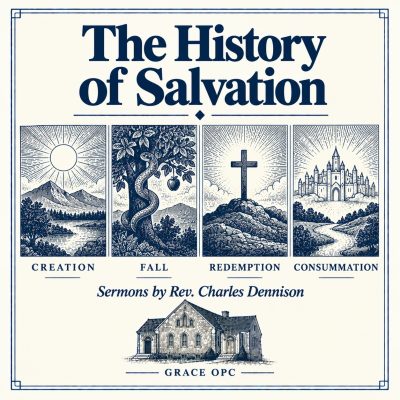
Sermon Series: The History of Salvation

  • Samuel and the Coming Kingdom

    Samuel and the Coming Kingdom

    This sermon is from the Rev. Charles G. Dennison sermon archive, part of “The History of Salvation” series, and was preached at Grace Orthodox Presbyterian Church in Sewickley, PA, during a worship service on Sunday, April 22, 1990.

    About this sermon

    Samuel marks a monumental turning point in redemptive history, citing Acts 3:24’s own estimate of his significance for the structure of Old and New Testament revelation. The covenant is already at work in Jonathan’s friendship with David, all of it anticipating the coming kingdom.

    More sermons from 1 Samuel · Browse all sermons

    Sermon transcript

    Tonight we come to the book of first Samuel. And we will start our reading chapter one. We will be reading from the nineteenth verse of the first chapter. Through verse ten of chapter two. Here the word of God. Then they arose early in the morning and worshiped before the Lord and returned again to their house in Ramah.

    And Elkanah knew Hannah, his wife, and the Lord remembered her. And it came about in due time after Hannah had conceded that she gave birth to a son, and she named him Samuel, saying, Because I have asked him of the Lord. Then the man, Elkanah, went up with all his household to offer to the Lord the yearly sacrifice and pay his vows. But Hannah did not go up, for she said to her husband, I will not go up until the child is weaned, and I will bring him that he may appear before the Lord and stay there forever.

    And Elkanah, her husband, said to her, Do what seems best to you. Remain until you have weaned him. Only may the Lord confirm his word. So the woman remained and nursed her son until she weaned him. Now when she had weaned him, she took him up with her with a three-year-old bull and one ephah, a flower, and a jug of wine and brought him to the house of the Lord in Shiloh although the child was young. And they slaughtered the bull and brought the boy to Eli.

    And she said, Oh, my Lord, as your soul lives, may the Lord as your soul lives, my Lord, I am the woman who stood here beside you praying to the Lord. This boy, I prayed and the Lord has given me my petition, which I asked of him. So I have dedicated him to the Lord As long as he lives, he is dedicated to the Lord, and he worships the Lord there. Then Hannah prayed and said, My heart exalts in the Lord. My horn is exalted in the Lord. My mouth speaks boldly against my enemies because I rejoice in thy salvation. There is no one holy like the Lord. Indeed, there is no one besides thee, nor is there any rock like our God. Boast no more so very proudly. Do not let arrogance come out of your mouth. For the Lord is a God of knowledge, and with Him actions are weighed.

    The bows of the mighty are shattered, but the feeble gird on strength. Those who were full hire themselves out for bread, but those who were hungry cease to hunger. Even the barren gives birth to seven, and she who has many children languishes. The Lord kills and makes alive. He brings down to shield and raises up. The Lord makes poor and rich. He brings low. He also exalts. He raises the poor from the dust. He lifts the needy from the ashy to make them sit with nobles and inherit a seat of honor.

    For the pillars of the earth are the Lord’s and he set the world on them. He keeps the feet of his godly ones, but the wicked ones are silenced in darkness. For not by might shall a man prevail. Those who contend with the Lord shall be shattered. Against them he will thunder in the heavens. The Lord will judge the ends of the earth, and he will give strength to his king and will exalt the form of his anointing.” Then turning over to chapter sixteen. Beginning with verse one.

    Now, the Lord said to Samuel, How long will you grieve over Saul since I have rejected him from being king over Israel? Fill your horn with oil and go, I will send you to Jesse, the Bethlehem knight, for I have selected a king for myself among his sons.” But Samuel said, How can I go? When Saul hears of it, he will kill me. And the Lord said, Take a heifer with you and say, I have come to sacrifice to the Lord. And you shall invite Jesse to the sacrifice, and I will show you what you shall do. And you shall anoint for me the one whom I designate you.”

    So Samuel did what the Lord said and came to Bethlehem. And the elders of the city came trembling to meet him and said, Do you come in peace? And he said, In peace. I have come to sacrifice to the Lord. Consecrate yourselves and come with me to the sacrifice. He also consecrated Jesse and his sons and invited them to the sacrifice. Then it came about when they entered that he looked at Eliab and thought, Surely the Lord’s anointed is before me, is before him.

    But the Lord said to Samuel, Do not look at his appearance or at the height of his stature, because I have rejected him. For God sees not as man sees, for man looks at the outward appearance. But the Lord looks at the heart. Then Jesse called Abinadab and made him pass before Samuel. And he said, Neither has the Lord chosen this one. Next, Jesse made Shammah pass by. And he said, Neither has the Lord chosen this one. Thus Jesse made seven of his sons pass before Samuel. But Samuel said to Jesse, The Lord has not chosen thee. And Samuel said to Jesse, Are these all the children? And he said, There remains yet the youngest, and behold, he is tending the sheep. Then Samuel said to Jesse, Send him, bring him, for we will not sit down until he comes here.

    So he sent and brought him in. Now he was ruddy, with beautiful eyes and a handsome appearance. And the Lord said, Arise, anoint him, for this is he. Then Samuel took the horn of oil and anointed him in the midst of his brothers. and the spirit of the Lord came mightily upon David from that day forward, and Samuel arose and went to rain.

    Our father, we thank you for your word, which coming to your people in might and in strength, for by it your people are made strong and they are enlivened. We ask, Lord, that we may rejoice at the proclamation of your word today, that your blessing may rest mightily upon those who proclaim that word truly. May those churches that revere the word be strengthened themselves, and though they be weak and apparently ineffectual in the eyes of the world, may you make them strong, and may their honor be revered in heaven. We ask this in Jesus’ name.

    Amen. Now if you want some exciting reading, if you want some thrilling tales, if you want moving accounts, turn to the book of 1 Sam. Great stuff. Magnificent personalities portrayed for you. The complexity of Eli. The even more remarkable complexity of Saul. Have you been intrigued by him? This rather striking individual who begins so well and ends so poorly? What of the mystery of Saul? What do you make of it?

    There are the stories that are compelling and attractive in themselves, the capture of the Ark, the Ark’s sojourn in the land of the Philistines, God’s dealings with the Philistines, the restoration of the Ark, Samuel’s personage the power of God manifest in him, then the rise of David, a little shepherd boy against a giant. The complexities of that relationship between Saul and David David, the hounded and the hunted, the one who is persecuted, though the anointed of the Lord, the one who suffers for the sake of the anointing that he bears, and then the most remarkable figure of all, John.

    The crown was his. The throne was his. And he gave it up. Because he saw in David the very form of the one who was to come. The Book of First Samuel ends on that tragic note of the death of Saul and Jonathan. But the note really doesn’t end. Its echo is heard into the opening of Second Samuel, when word is brought to David about the death of Saul and his son. Then, one of the most remarkable of all the Psalms, the Lament of David, for Saul the king, and for Jonathan the one he loved, above all others. Well, here is the stuff of life and death, of sin and salvation, the stuff of grace and glory. Hardly anything in the Old Testament as magnificent as this.

    But what is it all about? What’s going on in 1 Samuel, and why does it seem to stand out in the pages that record Old Testament history? What makes it so unique, so power-packed, so attractive? What is it about 1 Samuel that draws us to it? There is this fact. The book of 1 Samuel signals for us a change. A radical and monumental change for the people of God. This is commented on even in the New Testament. Samuel is mentioned in the New Testament, you may want to turn to Acts chapter four. I’m sorry, it’s Acts chapter three. And here you have one of the messages of Peter. And there is the citation with respect to Moses in verse twenty two.

    Moses said the Lord shall. Raise up for you a prophet like me from your brethren to him you shall give heed in everything he says to you. It shall be that every soul that does not heed that prophet shall be utterly destroyed from among the people.” And then in the 24th verse, “…and likewise all the prophets have spoken.”

    From Samuel and his successors onward also announced these things. Samuel, his appearance, marks a transition. He is spoken of here by Peter as that one in whom a transition is effected for the people of God from Samuel onward. There is specifically then this focus upon that which would be accomplished in the days of Peter and the other apostles. So, Samuel, and first Samuel then, the book of the Bible, signal for us a change, a radical shift in the life of the people of God. And this is apparent to us as we reflect upon the circumstances surrounding the rise of Samuel himself.

    For the period of the judges must, in fact, come to an end. It must, in fact, reach an end point. Do you recall the conclusion of the book of Judges? The last verse of the 21st chapter of that book, in those days there was no king in Israel. Everyone did what was right in his own eyes.

    That’s a circumstance that cannot go on. It cannot be allowed to continue. Israel is a divided nation, embroiled in tribal factions. She is divided also because of the moral degeneration that has overtaken the nation as a whole. The nation is facing moral collapse. Not only is there this raging individualism that is expressing itself, in the people and in the tribe, but you have it focused at Shiloh. There Eli presides, but not just Eli, you recall, his sons as well, Hophni and Phinehas. I don’t think I have to tell you again about the lives and the actions of Hophni and Phinehas. and Phineas.

    Priests of God who were who were despicable in every respect vile vile man. Administratively then religiously the leadership of Israel was corrupt thoroughly corrupt you can read about it as you complete the second chapter of first and go on from Hannah’s prayer and read about the corruption. In effect, Israel was failing at every level locally and at the tabernacle where the arc was where Eli presided. The priesthood had failed. Eli though a man of God himself was tragically inept when it came to dealing with his own children.

    He exerted no influence upon them. He could not control them. They were wreaking havoc upon the life of the people. The sin of these sons of Eli appears to be. So there you have it. You see, the period of the judges has reached a terminal point. A change must come.

    The situation is so desperate that God must act or Israel is We could compare the situation in Israel at this time to the situation for the world in the days of Noah. If God does not act, the world is lost in the days of Noah. And if God does not act here at this time, Israel is lost. And if Israel is lost, God’s program is jeopardized and his promises fall to the ground.

    It is, then, a circumstance, a situation that cries out for God’s action. But there are also other angles to this whole matter of the monumental shift that we find in this book. Not just the matter that Israel is facing dissolution because of its corruption because of it. There is the matter of God’s wisdom and the way in which he has structured the way he is building. What of the structure of Old Testament revelation as a whole. It is threefold. First of all, you have God acting concretely in history so as to save his people. And you have the record concerning that saving activity.

    God acts to save his people in the monumental circumstances and actions surrounding the exodus. He delivers his people from the enemy, from the Egyptians. He rescues them by his power and through his grace. And after you have this constitutive, redemptive action on the part of God, he then grants to his people a time in which they are led by remarkable, charismatic leadership. Men extraordinarily blessed, raised up seemingly spontaneously for the occasion.

    So after that redemptive act, there follows a period in which you find the remarkable leadership of figures like Joshua and the judges. But that period must give way to another, for you can’t live at the level of that charismatic explosion and spontaneity.

    The time for building comes, you build upon that foundation, and thus, there is the evidences of a permanent order that takes shape within the life of the people of God. So you move from redemptive event to charismatic leadership to the building of the structure in which the people of God will then live the days of the monarchy, the kingdom.

    Three-fold structure, saving event, charismatic leadership, and then the building of the edifice into which God’s people will be incorporated for kingdom. This threefold structure that we find in the Old Testament is repeated for us in the new in a much more compact fashion. Do you see how we move from the Gospels, the record of God’s saving God’s great mighty saving act that is even greater than that saving act performed for Israel when he delivered the Israelites from the Egyptians. So the gospel gives you the record of the saving event. Then you move to that period of charismatic leadership. You have the book of Acts. You have the testimony in some of the epistles to the explosion. of spontaneous charismatic gifts within the congregation, such as the congregation at Corinth.

    But you don’t stay there. You don’t stay there in the foundational level of the days of New Testament apostles and prophets. No, you have to build the superstructure now into which the people of God will be incorporated. So you move on, for instance, to the pastoral epistles to the book of the Ephesians through the letter to the Hebrews.

    And there you see something of the permanent order and structure of the church impressing itself upon the consciousness of the people of God. So the shift that is taking place here is a remarkable shift because it’s introducing you to the period of the monarchy in which you will be faced with that pattern of permanence from the Old Testament testimony that will then have its corollary in New Testament times as the church itself takes shape through the actions of God.

    Yes, sin demands a new order. But the days of the unstable, charismatic administration also demand a new order. And finally, the world itself demands a new order. Even if there had been no sin, would there have been a new order? Even if there had been no sin, would a new order have arisen? Would a new order have been necessary? was a new order in view in creation.

    Original. The answer to that question is yes. The pattern would be the movement from the old to the new for even if there were no sin, In the creation order, that creation would become old and give way to the new. Adam would not have lived perpetually in the Garden of Eden. He wouldn’t have remained there. The order of this creation was not the permanent order.

    You had to move on to that which was ultimate and eternal. The creation, irrespective of sin, was a passing order, is a passing order. Tell me about Earth Day. Is it eternal? This world, irrespective of sin, is passing away. It never was intended to be the permanent order, so you pass from old to new. We cannot In fact, hold on to the old when the new asserts itself. Has not Jesus told us that? He told us about new wine and old wineskins. You don’t hold on to the old when the new has come.

    And what we see taking place in 1 Samuel is a demonstration of the fact that the new is indeed coming. As the new then asserts itself, it will assert itself in circumstances that give testimony to the fallenness of creation and the tragedy of man. As the new asserts itself, it will do so in the midst of circumstances that testify to the fact that the impermanent must give way to the permanent. And as this is worked out in the pages of 1 Samuel, The ways in which the patterns of the New Order are made clear to us are remarkable. As the New Order asserts itself, as it makes itself felt, this is what we see.

    A child. A child. A baby boy. in whom resides the purposes and power of God for that time. A woman without strength, who is given power to conceive. And when all of that takes place, it’s a remarkable lesson in how God works, how He operates. He will take the things that are as nothing, and He will make them something. He will take those things that are ineffectual and weak, and He will make them those things in which we see His purposes and power perfected.

    The child Samuel stands over against Hophni and Phinehas, the epitome of power and wickedness. And through this child, God will triumph. Read that psalm of Hannah and marvel It will, in fact, be the lowly. It will, in fact, be those whom the world discards and dismisses. These are the ones in whom God will exalt Himself, and in exalting Himself, He will exalt them. He will take the last, and He will make it first. That’s the story of God’s work by which He renews The story that tells us the tale of the gospel itself.

    What is the significance of Saul? Of what tribe is he? You know he’s the son of Kish, but of what tribe? He’s from the tribe of Benjamin. What’s the significance of that? Why should God choose Saul of the tribe of Benjamin? Because you see, Benjamin is the last of the tribes and the least of the tribes. The weakest, and in the economy of Israel, the most insignificant. So, here in Saul, you have one who is taken from that which is least, and he is exalted, he’s made first. What of the tragedy of Saul? The one who was last made first then thinks he ought to be first. And he’s made last again. The mystery of Saul, you see, is the mystery of Israel as a nation. Who was she among nations? She was least. She was last. She was nothing. She had no power. But God took that which was least and made it great. But then that nation thought that it was great in and of itself. And God made that which was first. than last.

    So it’s all the last becomes first and in his pride is made last. We’ve read the story of the anointing of David one. Of Jesse’s sons which is it. the last. He is made first. So you see, as you are told about the new order The enduring and permanent order of God, you are told, about an order in which the last is made first, the humble are exalted, those who are lowly are made something, those without power are given new strength, those who are dead are raised to life. But you are told something else. You are told about the nature of the covenant by which then the new order triumphs and prevails. And that’s why you’re told about John. He is the one who had the opportunity to become first and he gave it up and became last. For the sake of the one who was first, David.

    If, in fact, Saul is a picture of apostatizing Israel, Jonathan is a picture of faithful Israel. Binding himself to David, their souls knit together, and a perfect love. A perfect love. We have, in 1 Samuel, then, the patterns of the new order, a revelation of the heart of the covenant in the figure of Jonathan. We have prophecy concerning the future of Israel in the figure of Saul himself. We have a picture of the coming Messiah, Christ.

    At times you will see him in the figure of Samuel. Then you will see him amazingly in the figure of all. You will see him in the figure of Jonathan but you will see him most remarkably in the figure of David who is the anointed of the Lord is persecuted and assaulted. And Saul would kill him. He would pin him to the wall he would pierce his flesh. He would nail him to a cross. for the sake of gaining and maintaining what he deems to be his own.

    We are given then in 1 Samuel a picture of the coming order in which there is a changing of the guard. An old order giving way to a new. There is the old prophet Eli giving way to the new prophet Samuel. There is the old priests Hophni and Phineas giving way to the new priesthood of Zeta. There is the old king Saul giving way to the new king David.

    And in all of this, we are prepared for the coming of the kingdom itself, in which Jesus Christ, the final prophet, priest, and king, will preside over his people for the maintenance of an eternal and permanent order into which you have now been brought, and in it you will not suffer loss, nor will you be moved.” Forever. Forever. The very gates of hell will not prevail against the Church of Jesus Christ. So first Samuel, Samuel, Saul, Jonathan, David, the change, a shift of monumental proportions, the new order, the coming of the kingdom of God. Amen.

    The sermon text provided above is derived from the sermon audio recording making use of generative tools. It has not been manually edited. While transcription tools have a high degree of accuracy, the output may include generative textual, punctuation, and/or formatting errors.

  • The Judges and the Significance of Ruth

    The Judges and the Significance of Ruth

    This sermon is from the Rev. Charles G. Dennison sermon archive, part of “The History of Salvation” series, and was preached at Grace Orthodox Presbyterian Church in Sewickley, PA, during a worship service on Sunday, April 8, 1990.

    About this sermon

    The so-called heroic figures of Judges turn out to be weak pointers to Christ rather than models to imitate, their stories compressed into the book’s own cyclical structure. The close comes with the significance of Ruth, a quiet story that completes this compact history of Israel.

    More sermons from Judges · Browse all sermons

    Sermon transcript

    Tonight we are reading some sections from the book of Judges, and also a short selection from the book of Ruth. First of all, in Judges chapter 2. Judges chapter 2. Beginning with verse 11, and reading to the end of the chapter. When the sons of Israel did evil in the sight of the Lord, and served the bail.

    And they forsook the Lord, the God of their fathers, who had brought them out of the land of Egypt and followed other gods from among the gods of the peoples who were around them and bowed themselves down to them. Thus they provoke the Lord to anger. So they forsook the Lord and served bail and the Ashtar case and the angry of the Anger of the Lord burned against Israel, and he gave them into the hands of plunderers who plundered them, and he sold them into the hands of their enemies round them, so that they could no longer stand before their enemies.

    Wherever they went, the hand of the Lord was against them for evil, as the Lord had spoken and as the Lord had sworn to them, so that they were severely distressed. Then the Lord raised up judges who delivered them from the hands of those who plundered them, and yet they did not listen to their judges, for they played the harlot after other gods and bowed themselves down to them. They turned aside quickly from the way in which their fathers had walked in obeying the commandments of the Lord. They did not do as their fathers. And when the Lord raised up judges for them, the Lord was with the judge and delivered them from the hand of their enemies all the days of the judge. For the Lord was moved to pity by their groanings because of those who oppressed and afflicted them. But it came about when the judge died that they would turn back and act more corruptly than their fathers in following other gods to serve them and bow down to them.

    And they did not abandon their practices or their stubborn ways. So the anger of the Lord burned against Israel, and he said, Because this nation has transgressed my covenant, which I commanded their fathers, and has not listened to my voice, I also will no longer drive out before them any of the nations which Joshua left when he died, in order to test Israel by them, whether they will keep the way of the Lord to walk in it as their fathers did or not. So the Lord allowed these nations to remain. not driving them out quickly. And he did not give them into the hand of Joshua. Then turning over to chapter 17, this is Judges 17, verses 1 through 6.

    Now, there was a man of the hill country of Ephraim, whose name was Micah. And he said to his mother, the eleven hundred pieces of silver which were taken from you, about which you uttered a curse in my hearing, behold, the silver is with me, I took it. And his mother said, Blessed be my son by the Lord. He then returned the eleven hundred pieces of silver to his mother, and his mother said, I wholly dedicate the silver from my hand to the Lord for my son to make a graven image, a molten image. Now therefore I will return them to you.” So when he returned the silver to his mother, his mother took 200 pieces of silver and gave them to the silversmith who made them into a graven image and a molten idol.

    And they were in the house of Micah. And the man Micah at a shrine that he made an ephod and household idols and consecrated one of his sons that he might become his priest. In those days, there was no king in Israel. Every man did what was right in his own eyes.”

    Then turning over to the book of Ruth, chapter 4, beginning with verse 13. So Boaz took Ruth, and she became his wife, and he went in to her, and the Lord enabled her to conceive, and she gave birth to a son. Then the women said to Naomi, Blessed is the Lord who has not left you without her Redeemer today, and may his name become famous in Israel. May he also be to you a restorer of life, and a sustainer of your old age. For your daughter-in-law, who loves you and is better to you than seven sons, has given birth to him.”

    Then Naomi took the child and laid him in her lap and became his nurse. And the neighbor women gave him a name, saying, “‘A son has been born to Naomi.’ So they named him Obed.” He is the father of Jesse, the father of David. Now these are the generations of Perez. To Perez was born Hezron. And to Hezron was born Ram. And to Ram, Aminadab. And to Aminadab was born Nashon. And to Nashon, Salmon. And to Salmon was born Boaz. And to Boaz, Obed. And to Obed was born Jesse. And to Jesse, David.

    Pray with me now. Our God, we do wait upon you. We look to you, the one who has given his word to your people, that they may be saved and preserved. And even now, Lord, your word goes to the ends of the earth. And we rejoice, our God, in the gathering of that harvest which you have ordained, as sons for the kingdom are brought from the east and west and north and south to sit at table with the patriarchs, and that at a table prepared by none other than the Lord Jesus Christ. We pray, our Father, that we might rejoice this salvation granted us, and may we delight in the full bounty that is provided us through our Savior. We ask this in His name. Amen.

    I expect the Book of Judges is best known for some of the erstwhile heroes, if we can call them that, that appear in the pages of this book. I’m sure some names come to mind immediately. We do think of Gideon. We do think of Samson, who might not think immediately of Othniel or Ehud, but they were judges also. And of course, there is that enigmatic figure, Deborah, the prophetess of God.

    So, we do have these, what we might call, heroic figures, and you note my smile. I mean that smile intentionally. These so-called heroes that come to us in the pages of the book of Judges. But I guess that along with these figures are certain statements that recur throughout this book.

    The one that I have in mind is what appeared there in the 6th verse of the 17th chapter. In those days, there was no king in Israel. Every man did what was right in his own eyes. And as we hear something of the story of Micah there in the 17th chapter, we say, sure enough, seems like they did whatever they thought was right and pursued their own course.

    You might note the end of the book of Judges, the very last verse, for in that 25th verse of chapter 21 you will find that the statement made in Chapter 17 verse 6 is repeated verbatim as if this were the concluding remark This is the last thought that the writer of the book of Judges would leave us with Now this statement is actually a a compressed statement, a very compact statement. There’s much in it, and it’s reflecting a great deal of the life of Israel during that time. It is a statement that calls attention to the political situation or the political arrangement pertaining to the tribes of Israel at this particular time.

    Judges, this book has been written at a time when the king had appeared. The king had taken his place within the life of the nation. And now there is this reflection on a former time. A time without a king. A time without this central personage and the mechanism that was usually attended to the king, namely that successors would follow in line. So the period of the judges is particularly a time of disorder, disarray for the nation of Israel.

    We could say that the writer is very positive with regard to the king and the kingdom that has come into place now in the life of these people. Very positive with respect, we would imagine, very positive with respect to the person of David and the royal line in Judah. So it is then that he looks upon the time of the king and the dawning of the kingdom, or if you will, the coming of the kingdom, as that which now establishes order, brings sense and stability to the life of the people of God. But I don’t have to inform you that the writer has more in mind than just a reflection on the political situation. For he is also calling attention to the religious climate.

    The state of faith amongst these people. The tribes may well have been acting independently of one another. creating a life peculiar to their own, those who are of their own line, remembering their fathers particularly, not specifically with regard to religion, but with regard to descent. But even if the tribes are here separated and in some respect acting independently, The situation is even more chaotic than that. Not merely twelve tribes independently set and loosely hung together, but it seems as if Israel at this specific time was infected by a radical form of individualism. Now we can translate that into political terms, We can speak of it in terms of anarchy. How would you judge the acts of Micah? It is a religious act that he is involved in there, in the seventeenth chapter, but it certainly has political ramifications. Declaring independence. A personal shrine. His own private temple. His own priesthood.

    So you move from the political, and what that has brought to the people, to the religious. As this is expressed in a rebellion from within the people against the law of God, so that each person seemingly becomes a law unto himself. The rebellion, then, is not merely a political rebellion for the sake of tribal autonomy or individual autonomy. It is a religious rebellion so that a people is seen to be torn apart due to their reaction against the law of God, and due to the fact that everyone now is becoming, as it were, a law unto himself, and that religiously speaking.

    There are other features that we should keep in mind as we consider this phrase, this statement that is repeated in the Book of Judges. As you read the story of Micah, You might note that Micah’s mother speaks of the Lord and then turns around and hands over her money in order to make a graven image and a molten idol. Strange, you may think, but you understand what is happening in the life of these people. It is not merely, then, a matter of a people simply rebelling against God and turning their back against the name of the Lord. Oh, there’s plenty of that. And you can read the religious life of these people at this time in very absolute terms.

    Yes, a rejection of God, and that’s how the writer, for the judges, would have us understand things. An absolute rejection of God and His ways. But there are indications throughout the book that point in the direction that those who were turning to the veils, turning to worship other gods, were at the same time retaining for themselves some sort of connection to the name of the Lord. In effect, what you had was a syncretistic approach to religion, a blending of paganism with the worship of Jehovah. The religion then of Israel was seemingly and hopelessly compromised.

    Well, that gives you the flavor of things in this period of Israel’s history. The book itself covers the time between the conquest of the land under Joshua to the rise of the monarchy under Saul and then David. It’s a period of over 300 years that is covered here by this book. And we get an in-depth analysis of what exactly was taking place and what we might call the wheel of God’s judgment and salvation as it rolls through the book of Judges from chapter two, and that’s why we read that chapter in part this evening. There is the compact statement that we’ve already looked at, but then there is this rather extensive description of what is taking place in the life of the nation, what is happening over and over and over again, given us in the second chapter.

    What we find here is that Israel is making covenants with the inhabitants, making covenants with the remaining personages, those who are holdovers in the tribes that were designated for destruction by God through Joshua. Those tribes are not completely eradicated, and we learn at the end of the chapter the reason for that. But nonetheless, some from these tribes, if not some of the tribes themselves as a whole, have survived. And what is happening is, Israel is now entering into covenants with these people.

    Where is intermarriage? This then breeds an atmosphere in which Israelites then are put in a position in which they then refuse to tear down the idols, tear down the altars that have been erected to alien gods. We find Israel then abandoning God through compromise, On the one hand, it seems to be quite absolute. On the other hand, it seems to be an overlay. Yes, the name of the Lord retained, but there is this compromise that has a deadening effect.

    We are told in the second chapter that another generation arose after Joshua’s generation, and the generation that knew Joshua, that did not know the Lord, nor yet the work which He had done for Israel. They forgot His work, in fact, rejecting it and choosing to go their own way.

    Verse 11 tells us that Israel did evil in the sight of the Lord. They served the idols. We find Israel then turned over to the hands of the enemy. God himself acted here. He abandoned them to the enemy and subsequently raises up judges, temporary saviors, deliverers, who then rescued them as a testimony to God’s graciousness. But after their has been this deliverance through the hand of a judge, the judge dies, and the nation reverts to its sins, and their latter state is worse than the former. And thus, the wheel moves on. The people delivered then forget their judge, They forget the work that God has performed. They turn to the idol. They begin to serve them. They enter into covenants with the nations round about. They intermarry. They begin to worship foreign gods. They are distressed. They come under God’s judgment. He abandons them. He raises up another judge. And so it goes.

    That’s the wheel of judgment. and deliverance that is played out again and again in the stories of the judges. Now, the outline, if you would wish for one for the book of Judges, is not what you might call an easy one. It’s as diverse as the judges themselves. You have a summary of events in the first two chapters. Then, with chapter three, you get into the lives of the judges themselves.

    You have Ophniel mentioned there, Ehud as well. Chapters four and five, you have Deborah presented to you, and the fifth chapter is that marvelous song of Deborah. Chapters six through eight tell us the story of Gideon. Nine and ten, We are presented with a few judges there, 11 and 12, Jephthah, the one who offered up his daughter, you may recall.

    And then, seemingly the judge who has the most time, the most ink spilled over him, Samson chapters 13 through 16. And this rather disturbing story of Micah, Chapter 17 and 18, and then the even more distressing story of the Levite’s concubine. There’s a thriller. Chapters 19 through 22 to round out the Book of Judges.

    As to the meaning of the book, the significance of the book, I think that there has already been suggested enough for you to derive for yourself the significance of this book and why it has its place in Holy Scripture. God has set these nations in the inheritance for a purpose. These nations that men tend to seduce, They become an opportunity for trial, the trial of God’s people. You may think of the situation of the church. You may think of your own predicament as a Christian.

    Have you not been delivered? Have you not been saved? Have you not been translated out of this present evil age and into the kingdom of God’s beloved Son? Have you not come into the inheritance that has been promised? Have you not been made to sit in the heavenly places in Christ Jesus?

    And yet, sin remains a reality. Battles with the flesh continue. You are confronted on every side with situations circumstances that conspire to put you on trial with respect to your faith and your devotion to God. Will you remain faithful? So there is that parallel between the circumstance of the church presently and the circumstance of the children of Israel as they came into the land of promise. There is also this dimension. We’ve already suggested it.

    But there is that sense in which we can compare the period of the judges to the entirety of the Old Testament era. As if looking at the book of Judges, we can see the history of the nation of Israel being played out before our eyes. For it’s not merely that wheel that goes around As we read through the pages of the Book of Judges, that wheel continues to go around as we read through the pages of the entirety of the Old Testament. So, you see, the Book of Judges becomes a compressed, compact treatment of the history of the nation as a whole, as if it were the Old Testament, if you will.

    Here is the Old Testament. Israel never changes, does it? She seems to remain the same. And that places the book of Samuel in a very special light, doesn’t it? Because the book of Samuel tells you about the end of the period of the judges, Samuel being the last, and the dawning of a new age, the coming of the kingdom. The passage from the period of the judges into the period of the kingdom is like the passage from the Old Testament to the New.

    What do we make, then, of these judges? Yes, in many respects, These judges that are raised up remind us of God’s promise. They testify to us of God’s faithfulness. They even speak to us of the coming King. These judges are like, then, the King who shall come. These judges are like the coming Messiah. who shall reign over his kingdom. But at the same time, these figures are so anticipatory of the coming king.

    They are also deliberately portrayed for us as vulnerable, so unheroic, so tragically flawed. And by them, we and our spirits are compelled to cry out for someone greater still. These were temporary deliverers. We want a permanent deliverer. These were saviors with feet of clay. These were judges who were so vulnerable and, yes, weak.

    Every one of them weak. Do you think Gideon a champion? The man is portrayed in the book of Judges as a fool. Not strong in faith, but weak. He has to put God to the test again and again. Prove yourself to me, Lord. He’s not held out to you as an example of great faith. He held out to you as an example of weakness, one in whom God then will perfect his power and demonstrate his might and his greatness in contrast to the man’s weakness and impotence. Samson mocked human strength. He was the strongest man that ever lived. and yet his weakness is all too evident. It’s blatant that you might see through it to that one who is greater still, the strongest and the mightiest, the Lord of Glory.

    Deborah is chosen for a reason. She’s a woman. And yes, even in this feminist age, weak. Weak. And God will triumph through her, so as to demonstrate His power, the perfection of His might and strength. That’s as it is with all the judges, that you might then long for the permanent judge the great King, who is perfect in power, who is perfect in power, who triumphs for us. Well, that’s judges. What about Ruth? I don’t want to take a lot of time here, but Ruth is of the period of the judges, so you were told at the opening of that book, and you were given the story of Naomi, her sons, her daughters-in-law, and here you are introduced to that humiliation that has overtaken Israel as a people.

    Naomi is a figure. She goes into exile. She experiences God’s judgments and then is restored to the land. But coming back into the land, what does she find? She finds circumstances so bad that she has to think twice about sending Ruth down to the threshing floor. What’ll happen to her there? Once she finds a place, once Ruth finds a place in the fields of Boaz, don’t go anywhere else, because you don’t know what you’ll find in someone else’s field. These are the people of God? When it comes to working out the contract, you remember the story of the working out of the contract? How it is that the laws from Leviticus have to be observed in the transferal of property.

    Boaz is the one that has to explain it to everybody, because no one else can remember it. Things are in bad shape. It is a period of lawlessness, and it is a period in which only this son of Judah, Boaz, remembers the law and keeps it. It is a period in which he alone appears to be righteous and shows compassion.

    And through him there is provided blessing for this Gentile. Well, if Naomi is Israel in its humiliation, Boaz is that one who exhibits within himself the pattern of the coming Christ, who keeps the law, who is righteous, who shows compassion, by whom then blessing comes to the Gentiles. It will be through his line, you know, that the Christ will come. Ruth, the book of Ruth, preaches the gospel just as the book of Judges does. And we are those who benefit. Amen. even in an army of Christ.

    The sermon text provided above is derived from the sermon audio recording making use of generative tools. It has not been manually edited. While transcription tools have a high degree of accuracy, the output may include generative textual, punctuation, and/or formatting errors.

  • Joshua and Our True Inheritance

    Joshua and Our True Inheritance

    This sermon is from the Rev. Charles G. Dennison sermon archive, part of “The History of Salvation” series, and was preached at Grace Orthodox Presbyterian Church in Sewickley, PA, during a worship service on Sunday, April 1, 1990.

    About this sermon

    The structure of Joshua shows the continuity of God’s deliverance, and only Joshua, an Old Testament ‘Jesus,’ brings Israel into her inheritance and rest. Ephesians 3 reveals that our true inheritance is God himself.

    More sermons from Joshua · Browse all sermons

    Sermon transcript

    Today we are reading from the book of Joshua. We start with chapter 1, and we will be reading a portion also of the 24th chapter. So this is the book of Joshua, chapter 1, beginning with verse 1, first nine verses. Hear the word of God. Now it came about after the death of Moses, the servant of the Lord, that the Lord spoke to Joshua, the son of Nun, Moses’ servant, saying, Moses, my servant is dead, now therefore rise.

    Cross this Jordan, you and all this people, to the land which I am giving to them, to the sons of Israel. Every place on which the sole of your foot treads, I have given it to you, just as I spoke to Moses. from the wilderness and this Lebanon, even as far as the great river, the river Euphrates, and all the land of the Hittites, and as far as the great sea, toward the setting of the sun, will be your territory.

    No man will be able to stand before you all the days of your life. Just as I have been with Moses, I will be with you, and I will not fail you or forsake you. Be strong and courageous. For you shall give this people possession of the land which I swear to their fathers to give them. Only be strong and very courageous to be careful to do according to all the law which Moses, my servant, commanded you. Do not turn from it to the right or to the left so that you may have success wherever you go. This book of the law shall not depart from your mouth, but you shall meditate on it day and night so that you may be careful to do according to all that is written in it, for then you will make your way prosperous, and then you will have success. Have I not commanded you? Be strong and courageous. Do not tremble or be dismayed, for the Lord your God is with you wherever you go.”

    And then turning over to the last chapter, chapter 24, Then Joshua gathered all the tribes of Israel to Shechem, and he called for the elders of Israel and for their heads and their judges and their officers, and they presented themselves before God.

    And Joshua said to all the people, Thus says the Lord, the God of Israel, From ancient times, your fathers lived beyond the river, namely Terah, the father of Abraham and the father of Nabor, and they served other gods. Then I took your father Abraham from beyond the river and led him through all the land of Canaan and multiplied his descendants and gave him Isaac. And to Isaac I gave Jacob and Esau, and to Esau I gave Mount Seir to possess it.

    But Jacob and his sons went down to Egypt. Then I sent Moses and Aaron, and I plagued Egypt by what I did in its midst, and afterward I brought you out. And I brought your fathers out of Egypt, and you came to the sea, and Egypt pursued your fathers with chariots and horsemen to the Red Sea. But when they cried out to the Lord, He put darkness between you and the Egyptians and brought the sea upon them and covered them, and your own eyes saw what I did in Egypt, and you lived in the wilderness for a long time.”

    And I brought you into the land of the Amorites, who lived beyond the Jordan, and they fought with you. And I gave them into your hand, and you took possession of their land when I destroyed them before you. Then Balaam, the son of Zipporah, king of Moab, rose and fought against Israel, and he sent and summoned Balaam, the son of Deor, to curse you. But I was not willing to listen to Balaam, so he had to bless you, and I delivered you from his hand. And you crossed the Jordan and came to Jericho, and the citizens of Jericho fought against you, and the Amorite, and the Perizzite, and the Canaanite, and the Hittite, and the Girgashite, and the Hivite, and the Jedusite.

    Thus I gave them into your hand. Then I sent the Hornet before you, and it drove out the two kings of the Amorites before you, but not by your sword or your bow. And I gave you a land on which you had not labored, and cities which you had not built, and you had lived in them, you are eating of vineyards and olive yards, which you did not plant.

    Now therefore fear the Lord and serve Him in sincerity and truth, and put away the gods which your fathers served beyond the river and in Egypt, and serve the Lord.” If and if it is agreeable in your sight to serve the Lord, choose for yourselves this day whom you will serve, whether the gods which your fathers served, which were beyond the river, or the gods, the Amorites, in whose land you are living. But as for me and my house, we will serve the Lord.”

    Then turning over to the book of Ephesians, chapter 3, Let’s begin with verse 14. This is Ephesians 3, 14. For this reason, I bow my knees before the Father, whom every family in heaven and on earth derives its name, that he would grant you, according to the riches of his glory, to be strengthened with power through his Spirit in the inner man, so that Christ may dwell in your hearts through faith, and that you, being rooted and grounded in love, may be able to comprehend with all the saints what is the breadth and length and height and depth, and to know the love of Christ which surpasses knowledge, that you may be filled up to all the fullness of God. Now to him who is able to do exceeding abundantly beyond all that we can ask or think according to the power that works within us, to him be the glory in the Church and in Christ Jesus to all generations forever and ever. Amen.

    We are working our way through the Old Testament, bit by bit, and we come this evening to the book of Joshua and the conquest of the land of Canaan. under Joshua’s leadership. First of all, a few things about Joshua and the storyline that we find here in this book specifically. The things that impress us are these. This book takes up where Deuteronomy left off. Deuteronomy, or the Pentateuch, or the Torah as a whole, had left us with the story incomplete.

    We had not reached an appropriate end point as yet. The inheritance that had been promised Abraham, Isaac, and Jacob remained to be possessed Children of Israel were conscious of this as Moses ascends Mount Nebo and there dies. Their eye looks across the Jordan to the Promised Land. The inheritance remains yet to be possessed.

    So Joshua, in this book, carries further. The children of Israel themselves are bearing with them a testimony to the incompleteness of their circumstance and situation. Had not Joseph given command with regard to his bones? And these people now carry his bones for burial in the land.

    So when we come to Joshua, to this book, it’s as if a story is completing itself. we are arriving at an appropriate end point. The emphasis for us then falls upon the continuity of the history of salvation. The continuity of the history of redemption. So that as the book of Joshua comes to a conclusion, we have a certain sense of satisfaction All is hanging together. Promises made are kept. God is faithful. We indeed, as his people, are to trust in him. There is a cohesiveness to the whole. Everything seemingly holding together because of God himself. that One who is exalted, that One who is sovereign over all the affairs of men of nations, that One who is personally active in the life and in the history of these people.

    This God is, in fact, achieving His purpose, so that we look at the sweep of it from Genesis through Joshua, and we know for certain that this God is in control, and only this God is God. As things are then summing themselves up, as we come to the story of Joshua and this specific book, so we know that we have received, as it were, a down payment with regard to all of God’s purposes, every one of his intentions. Will you not read, then, Genesis to Joshua and be encouraged yourself? in the knowledge that your God is for you and with you. It has not been merely a matter that concerns Israelites during the time of Joshua. It is a matter that concerns the people of God in every generation, and specifically in our own, that time in which we ourselves live between Christ’s resurrection and his return.

    Know for certain that God is working all things for good to them that love God, to those who are called according to his purpose. And know for certain that as it was with these people gathered under Joshua, so it is for God’s people gathered under Jesus. Know also But this truth pertains to you in the individuality and the specific circumstances of your life. God will not fail you.

    Whose then are broad considerations as we look at Joshua, ones that should impress themselves upon you and your consciousness as you reflect upon this book and its place in salvation history. But what of the storyline specifically now? The outline of the book It’s relatively simple. The first chapter has to do with the confirmation of Joshua’s call, that that one who is now endowed by God, blessed by him, for the leadership of these people, as they would enter the inheritance promised. Chapters 2 through 12 describe for us the conquest of the land.

    Exciting stuff. Stirs you up when you read it. Sit down. Read it. Maybe at one sitting. Let it work on you. See how it reminds you of those things yet future. Those things yet to be realized in and through Jesus Christ. Chapters 2 through 12 then, the conquest of the land. Chapter 2, the spies. You know the story. In Jericho. Chapter 3, the crossing of the Jordan. You remember that story as well. Chapters 4 and 5, the renewal of the covenant at Gilgal. The men of Israel are circumcised, since there has been no circumcision for Israel. There is the reinstitution of the celebration of the Passover, marvelous celebration and renewal of covenant through that sacramental meal.

    Chapter 6 tells us about the triumph at Jericho, when this citadel, indicative of the power and pride and arrogance of man, is disassembled by the trumpets of God. There was the humiliating defeat at Ai, you remember that story? The discovery of the sin of Achan? He judged because of it, and then victory over A.I., chapter 8. There were those ancient con-artists, the Gibeonites, who deceived the Israelites, waltzed them into a pact and a covenant so that they would not be destroyed. That in chapter 9.

    Then the kings of the south array themselves. They set themselves against Joshua and his army, and they are defeated, chapter 10. Kings of the north likewise come down, and they are defeated as well. Then in chapter 12 we have a listing of those kings. that were defeated by Joshua, as Joshua then enters into the inheritance and the possession of it for the sake of the people and to the glory of God. Chapters 13 through 21, the next section in this book, and in these chapters we have recorded for us the division of the land according to the tribes.

    And we might think that nothing could be more boring than to think about how these various pieces of property and real estate are parceled out to the tribes. Why spend your time meandering through these chapters? But there are some remarkable features, remarkable indeed, as you move through these chapters. For instance, there is the repeated mention of the inheritance which belonged to the tribe of Levi. You remember how it’s described? Look for instance at chapter 13, verse 33.

    But to the tribe of Levi, Moses did not give an inheritance. The Lord, the God of Israel, is their inheritance, as he had promised to them. There is coming a day, you see, when all of God’s children will be Levites. And all of them will have as their possession God Himself. And in light of that possession, no earthly possession will matter a whit. There is the story also of Aksa. You don’t know about Aksa, maybe. A-C-H-S-A-H. The daughter of Caleb.

    Chapter 15, verses 13 through 19. We’re told there of a remarkable, a remarkable thing. How this daughter of Caleb, a woman, is actually granted inheritance in the land this is a strange thing a woman who according to the customs of the time and the arrangements generally for the children of Israel had no standing when it came to inheritance but this daughter of Caleb has an inheritance were told of other women too, the daughters of Manasseh. Chapter 17, verse 6. Once more, they are mentioned with respect to inheritance. It wasn’t the ordinary custom, it wasn’t the rule, but the exception. But the exception was pointing to a yet future day when there would be neither male nor female, but all. would be won in their access to that inheritance that is promised in Christ.

    Galatians 3, 28. And finally, there’s the strange case of Simeon, that we had time tonight to work on Simeon a bit, one of the principal sons of Leah, Simeon, we are told, has no ordinary inheritance. Chapter 19, verses 1 through 9. We are told, in fact, that Judah’s inheritance is so expansive that Simeon takes up his lot within the territory of Judah. If Simeon is indicative of Israel, comprehensively, in some regard, The day will come when Israel will find her proper orientation only in and through Judah and Judah’s truest son, Jesus.

    So, these are remarkable features of this section. The section ends with consideration of the cities of refuge. You know about them. places to which those could flee who were guilty of a crime, but yet also liable to vengeance. They could flee there and receive help until trial could be arranged in a proper fashion. Chapter 21, Cities of the Levites. And that brings this section to an end. That is, the cities in which the Levites were to dwell, were to live. Chapter 22 stands by itself.

    It describes the conflict that arose between the tribes that had decided to live on the east side of the Jordan. You remember the Reubenites, the Gadites, the half-tribe of Manasseh, They lived on the east side of the Jordan, and there was a conflict that arose between them and the tribes that lived on the west, because the tribes on the east set up an altar. The tribes in the west had thought that this altar then would conspire against the commandments of God, that there was to be one sanctuary, that all the tribes were to come here. They worked out this problem between them. The altar became a memorial, a symbol of a covenant between them, so that it would always be obvious what obligations were laid upon those tribes to the East, and the obligations then that belonged to the tribes of the West. The prerogatives, in fact, of the tribes of the West, and the sanctuary that was established there.

    And then those remarkable chapters that conclude, Joshua chapters 23, And 24, the grand, the marvelous farewell, the last will and testament of this leader of God’s people, Joshua himself passing away. And finally, at the end of chapter 24, the burial of the bones of Joseph. It all comes together. But note, note, how the book begins in death and ends in death. It begins with the death of Moses and it ends in the death of Joshua and the burial of the bones of dead Joseph. The book itself then tells you that though you have arrived at an end point in the history of redemption, you have not arrived at the end point. the final point to which all of God’s redemptive purposes push. So then it is imperative that we consider Joshua in light of the totality of the history of salvation, that which we have been privileged to know and to know intimately.

    Who is Joshua? Who is Joshua? Do you know what his name means? His name means Jehovah saves. Jehovah saves. Do you know of any other figure in the Bible who bears that name? Who carries the name of Joshua? Jehovah saves. In the New Testament, the name is Jesus. Joshua, then, is the Old Testament Jesus, the one who is remarkable in that according to God’s appointment, more than any figure before him, the Lord Jesus is going to shout to you from the page. You’re going to see the Lord Jesus in this figure. Joshua, then, is the Old Testament Jesus. And as such, he is that figure in whom there is affected a transition from the old to the new.

    The principal figure for the old, that’s Moses. And Moses is dead. Moses has passed. Moses and the law can only bring you so far. And then you run up against the barrier of the Jordan. Moses and the law cannot bring you into the inheritance. For in the end, what the law does is condemn you. In the end, The law serves as that instrument by which you are brought to know the magnitude, the significance, and the seriousness of your sin. That does not make the law evil, does not make the law perverse.

    It’s an instrument of God. It’s His tutor to bring you to an understanding of yourself and your inability. as well your liability. So Joshua is that figure given us in the Old Testament in whom there is affected that transition from the old to the new. The new has come. And that in keeping with an administration that brings you into the fullness of the promise and into the inheritance. By words? By the law? Is it by the law that the waters of the Jordan part? Is it by the law that the walls of Jericho come down? Is it by the law that the enemies are turned to flight?

    By grace and by the power of God. So then this Old Testament Jesus leads this people, this ancient church, through that barrier that seems impenetrable. Death itself, if you will. And this barrier opens. And the way is made clear for them to come into possession of that inheritance promised.

    But even more, Joshua is not merely that figure by whom there is a fact of this transition from old to new. He is not only that one who leads this ancient church through that barrier and into the inheritance, he is the one who is the captain over the army and leads them in battle against their foes. The battle is won, in effect, because of him, and through him the inheritance is granted. In every one of these respects, then, we see something of that one who is yet to come, that one to whom Joshua points, that one who is greater than Joshua. For is it true that Joshua will lead God’s church into her final rest? Do you remember Hebrews chapter 4, verse 8? Do you remember the commentary made with respect to the figure of Joshua there? Hebrews 4, verse 8. For if Joshua had given them rest, God would not have spoken of another day after that. There remains therefore a Sabbath rest for the people of God. And it is only the Lord Jesus Christ that can grant us that Sabbath rest.

    As great as he was, as wonderful a figure as he was, he falls short. For his story, as Moses’ story, ends in death, not resurrection. So we are pushed on, are we? Are we not? To consider that which lies beyond Joshua, which is found only in that one to whom Joshua pointed, the New Testament Joshua Jesus, who is far better. And in order to understand the significance of this figure, we are given a New Testament book that is a counterpart to the Old Testament book of Joshua. And that book is the letter to the Ephesians. What inheritance might there be for God’s children now? A piece of property in the corner of the Mediterranean world? a piece of property locally, a piece of the American dream. Now, of course, isn’t that what we want? Isn’t that what we work for? Isn’t that what we extend ourselves for?

    The inheritance, so we are told in the letter to the Ephesians, is the heavenly places in which now we sit because of the work of Christ. No River Jordan of this creation, but the barrier of death itself, that traversed by Christ in his resurrection, he ascended into glory, sitting at the right hand of God to mediate over an inheritance that is eternal and will not pass away. the true inheritance spoken to us then in the epistle to the Ephesians.

    Blessed be the God and Father and our Lord and Savior Jesus Christ who has blessed us with every spiritual blessing in heavenly places in Christ Jesus. Here is the true inheritance marked out for us That first chapter. Inheritance which is brought about in Christ when he raised him from the dead and seated him at his right hand in the heavenly places.

    Chapter 1 verses 20 through 23, far above all rule and authority and power and dominion and every name that is named, not only in this age, but also in the one to come. And he put all things in subjection under his feet and gave him his head over all things to the church, which is his body, the fullness of him who fills all in all. And not only do we have a new and greater inheritance, We are a new people of God who serve in a new sanctuary, a new temple, which God is building for Himself as a dwelling in the Spirit.

    Chapter 2. Then in chapter 3 we read about that inheritance that was given to the Levites of old, namely the inheritance of God, bequeathed upon us, that you may be filled up to all the fullness of God. That given to us. And there is new light shed upon the law of God, as you read from the fifth chapter on.

    It is a law of liberty now, a law that is seen in light of that imitation of Christ and the power that is be found in him, a power that is mediated out of the inheritance itself, a heavenly power. so that you’re not able to look at your wife any longer as merely another figure of this creation. You must see her in light of the glory that is emanating from heaven. She is like unto the Church, the Bride of Christ, and so you must treat her. A husband, likewise, no longer just a man in this created order, but seen in the light of the Lord Himself, So he takes on the features of Christ, one no less than Christ in the marriage relationship.

    What can we say about the relationship between parents and children, all placed in light of the inheritance above? For now, children must be treated as God treats his own children, as how you have seen him treat his children. And children must revere their parents, like the Lord Himself is revered by the children of God, all in light of the inheritance.

    Mere external compliance will not do. Mere compliance and observance of form will not do. You’re waltzed right into the sanctuary of heaven, and every form of obedience takes on a new light. Masters, slaves, employers, employees, what can we say about it? Your labor is unto the Lord, as if you were in heaven working for Him. And how do you treat those who are under you? As the Lord Himself treats them. The light of heaven shines upon every obligation of life. The light of the true inheritance molds and shapes and reinterprets the commands, so that they are all run through the seer of Christ.

    And finally, If there’s any doubt that Ephesians is the New Testament book of Joshua, look at chapter 6, verse 10. And if that language doesn’t sound familiar, then I think you might well be deaf. Finally, be strong in the Lord. Sound familiar? Sound like Joshua 1, be strong in the Lord and the strength of his might.

    Put on the full armor of God that you may be able to stand against the schemes of the Amorites, the Jebusites, the Perizzites, the Evites, the schemes of the devil. So our struggle is not against flesh and blood, but against rulers, against powers, against the world forces of this darkness, against the spiritual forces of wickedness in the heavenly places that have set up shop in the inheritance. They’ve usurped a place for themselves there, even though they have no right to it. Therefore take up the full armor of God that you may be able to resist in the evil day and having done everything to stand firm Well In Christ then new inheritance in Christ a new people Jew and Gentile brought together one new man serving God New Levites all of you each a Levite with God himself as your inheritance new light emanating out of the inheritance with respect to all the commands and obligations of life. You see them now in the light of Jesus Christ and new power against the ultimate enemy. Not enemies of flesh, but those that are more awesome still. Enemies in the spirit.

    The delight in nothing more than overthrowing your faith, in attempting to destroy you, that you might be robbed of your inheritance. But praise be to God, you have been predestined unto glory through Jesus Christ, your captain, your Joshua. who has led you home.

    Let there pass before us our God, the cross of our Savior by which our sins have been removed and we have been forgiven. Let there pass before our eyes the empty tomb. And may we see, by faith, the risen Christ. May there pass before our eyes the inheritance that is ours, to which we are already privileged.

    And may we bless you, our God, for how you have mediated unto us these great blessings, as the fullness of that which you have intended. You have brought your purposes to completion. And we have been exalted, magnified, ourselves, through Christ Jesus. Participating then, in this our eternal inheritance, through Jesus our Lord. We pray our Father, that as we are mindful of you and your Son, we will be mindful of one another. May we have a patience towards each other and a kindness, a forbearance. Truly, Lord, may we walk in the Spirit and in His power. Amen.

    The sermon text provided above is derived from the sermon audio recording making use of generative tools. It has not been manually edited. While transcription tools have a high degree of accuracy, the output may include generative textual, punctuation, and/or formatting errors.

  • The Exodus and Christ’s New Exodus

    The Exodus and Christ’s New Exodus

    This sermon is from the Rev. Charles G. Dennison sermon archive, part of “The History of Salvation” series, and was preached at Grace Orthodox Presbyterian Church in Sewickley, PA, during a worship service on Sunday, March 18, 1990.

    About this sermon

    The Exodus was a real, mighty act of God, whatever liberal scholars who treat it as legend say. The Passover points forward to the power and glory of Christ’s own exodus, glimpsed at the transfiguration in Luke 9:28-31.

    More sermons from Exodus · Browse all sermons

    Sermon transcript

    I will be reading sections from the first fifteen chapters of that book. First of all, chapter one, verses one through fourteen. Now these are the names of the sons of Israel who came to Egypt with Jacob. They came each one with his household, Reuben, Simeon, Levi, and Judah. Issachar, Zebulun, and Benjamin, Dan, and Naphtali, Gad, and Asher. And all the persons who came from the loins of Jacob were seventy in number, but Joseph was already in Egypt. And Joseph died, and all his brothers, and all that generation.

    But the sons of Israel were fruitful, and increased greatly, and multiplied, and became exceedingly mighty, so that the land was filled with them. Now a new king arose over Egypt, who did not know Joseph. And he said to his people, Behold, the people of the sons of Israel are more and mightier than we. Come, let us deal wisely with them, lest they multiply, and in the event of war, they also join themselves to those who hate us, and fight against us, and depart from the land. So he appointed taskmasters over them to afflict them with hard labor. And they built for Pharaoh storage cities, pythons and ramses. But the more they afflicted them, the more they multiplied, and the more they spread out, so that they were in dread of the sons of Israel. And the Egyptians compelled the sons of Israel to labor rigorously, and they made their lives bitter with hard labor in mortar and bricks, and in all kinds of labor in the field, all their labors which were rigorously imposed on them.”

    Then turning over to the twelfth chapter, and beginning at verse twenty-nine. Now, it came about at midnight that the Lord struck all the firstborn in the land of Egypt from the firstborn of Pharaoh, who sat on his throne, to the firstborn of the captive, who was in the dungeon, and all the firstborn of cattle. And Pharaoh arose in the night, he and all his servants, and all the Egyptians, and there was a great cry in Egypt, for there was no home where there was not someone dead. Then he called for Moses and Aaron at night and said, get you get out from among my people both you and the sons of Israel and go worship the Lord as you have said take both your flock and your herds as you have said and go and bless me also and the Egyptians urged the people and sent them out of the land in haste for they said we shall all be dead so the people took their dough before it was leavened with their kneading bowls bound up in the clothes on their shoulders.

    Now the sons of Israel have done according to the word of Moses. For they had requested from the Egyptians articles of silver and articles of gold and clothing. And the Lord had given the people favor in the sight of the Egyptians so that they let them have their request. Thus they plundered the Egyptians. I’m turning over to chapter 14, beginning at verse 10. And as Pharaoh drew not near, the sons of Israel looked, and behold, the Egyptians were marching after them, and they became frightened, so the sons of Israel cried out to the Lord.

    Then they said to Moses, Is it because there were no graves in Egypt that you have taken us away to die in the wilderness? Why have you dealt with us in this way, bringing us out of Egypt? Is this not the word that we spoke to you in Egypt, saying, Leave us alone, that we may serve the Egyptians? For it would have been better for us to serve the Egyptians than to die in the wilderness.

    But Moses said to the people, Do not fear. stand by and see the salvation of the Lord, which he will accomplish for you today. For the Egyptians, whom you have seen today, you will never see them again forever. The Lord will fight for you while you keep silent.”

    And then down to verse 21, “‘Then Moses stretched out his hand over the sea, and the Lord swept the sea back by a strong east wind all night. and turned the sea into dry land, so that the waters were divided. And the sons of Israel went through the midst of the sea on the dry land, and the waters were like a wall to them on the right hand and on their left.

    Then the Egyptians took up the pursuit, and all Pharaoh’s horses, his chariots, and his horsemen went in after them into the midst of the sea. And it came about at the morning watch that the Lord looked down on the army of the Egyptians through the pillar of fire and cloud, and brought the army of the Egyptians into confusion. And he caused their chariot wheels to swerve, and he made them drive with difficulty. So the Egyptians said, Let us flee from Israel, for the Lord is fighting for them against the Egyptians.”

    Then the Lord said to Moses, stretch out your hand over the sea so that the waters may come back over the Egyptians, over their chariots and their horsemen. So Moses stretched out his hand over the sea, and the sea returned to its normal state at daybreak, while the Egyptians were fleeing right into it. Then the Lord overthrew the Egyptians in the midst of the sea, and the waters returned and covered the chariots and the horsemen, even Pharaoh’s entire army that had gone into the sea after them, not even one of them remained. But the sons of Israel walked on dry land through the midst of the sea, and the waters were like a wall to them on their right hand and on their left. Thus the Lord saved Israel that day from the hand of the Egyptians, and Israel saw the Egyptians dead on the seashore. And when Israel saw the great power which the Lord had used against the Egyptians, the people feared the Lord, and they believed in the Lord and in his servant Moses.

    Let’s pray together. Dear Father, we are mindful of your purpose to bring glory to yourself. So you have called your own, not because of goodness in them, but because of your great and inexplicable love. We pray, Lord, that we may be appreciative to the depths of our hearts and love you with all that is in us. But truly, as you have had compassion upon us, may our compassion be directed towards those who are yet uncalled, those who remain in darkness and in their sin.

    We pray, our Lord, that you might see your call effective for the sake of your elect to the ends of the earth. And to that end, we pray that you will raise up preachers of righteousness who will proclaim the glad tidings to the nations. Lord, we yearn to see your churches full. And thus we pray, and thus we have our expectation, that the full complement of your elect shall be gathered from the east and west, from the north and south, They shall be congregated in assembly and brought to sit at table in the great banquet feast of our Christ, when in fact He shall return on the clouds of glory. We ask, Lord, that we would even prepare ourselves for that day, as all your people are beckoned. And Lord, we ask that when that day arrives, we would not be found wanting. We pray this in Jesus’ name. Amen.

    I think it goes without saying that the book of Exodus fires up the imagination. There is the emergence in this book of a hero truly larger than life. You might say a hero on the order of the great heroes we read of in the literature of the world. Here then is the emergence of a hero larger than life. We also read in this book about an odyssey. An odyssey of a once oppressed but now liberated people. We read as well about the overturning of the world’s greatest power, the world’s greatest empire to date in the history of the world, the Egyptians.

    And all these elements add up to a story of epic proportions. Now, it’s true that the Bible does not relate the story in typical epic fashion, but nevertheless, Exodus does fire up the imagination and the story presented for us here definitely has epic possibilities. And those epic possibilities were not lost on the filmmaker Cecil B. DeMille. He played it for all that it was worth.

    Believe me, and I think that those of you who have seen the movie, The Ten Commandments know that well. Thinking of DeMille’s treatment of the story, we also are aware of what men are capable of when they take up biblical material. Maybe you saw the Ten Commandments and there was a certain sense of disappointment in you after having seen that film. And possibly that could be tied to the fact that DeMille was translating the story into something of an epic.

    An epic designed to place before you something that would register well upon the consciousness and the hearts of men and women living today. Supremely, a tale symbolic of man’s perpetual quest for freedom. the incomparable spirit of man, as man is in quest for personal freedom. Sadly, too many have seen little more in the Exodus story than a semi-mythical, semi-historical account filled with stuff suggestive of the traditional pagan ethics. God and men on stage together battling it out so that the course of history and the destinies of peoples would be irrevocably settled.

    To be sure, those who approach The Book of Exodus along these lines admit to certain value for the history that is recorded here, seeing in it something that is at least partially reliable. They recognize something here that is of historical significance. Laying aside the mythical, laying aside the dimension that brings into play the interplay of gods and men, they then proceed to interpret the story of the Exodus along purely historical lines. The general features then, they say, are accurate.

    There was actually a group of Semites that fled Egypt about 1300 years before the birth of Christ. These people were led by an extraordinary figure, identified in the story as one Moses, who had been trained in Egypt’s courts as well as in the rigors of desert life, who then led this motley crew of Semites to newfound organizational heights and never before realized tribal cohesiveness. These Semites, or Hebrews, thus became a people, a nation, of political consequence, of world significance, marking in themselves and in their history a significant advance for civilization as they moved from being but a band of Bedouin slaves into an estate of remarkable kingdom proportion.

    Now, I think it is obvious to you, as we move through this description, the interesting feature of it, namely, that it is possible to give an account of the exodus, of the historic events behind it, without making a single mention of the person of God.

    You’re not to think, however, that those who would engage in this kind of approach to the book of Exodus, almost a purely historical, purely sociological, purely cultural approach to the book, are disinterested in the subject of God, in the subject of theology.

    They have, however, a distinct way of introducing it. Actually, as is in the case of the great epic poems from paganism, there is an attempt here to ground the present claims of a people when divine design. This is the way it works itself out. There are people presently who are suggesting that the book of Exodus is overlaid with mythology, filled full of legend. Beneath this mythology, behind these legends, is a foundation of historical fact. The historical fact is something that is there irrespective of any theology whatsoever. one need not make reference to God at all in explaining what happened when this group of Hebrews came out of the land of Egypt. But in a later day, say 800 years after the actual event of the Exodus, these people who now live in the land of Canaan have to come up with explanations that satisfy the people with respect to themselves as a nation, their constitution as a nation, and with respect to the legitimacy of the various institutions that are well in place within their society. They do this by the route of appealing to divine design. Is this any different than any other people?

    We look at the Greeks, we look at the Romans, we look at the justifications for their state, for their institutions, and the appeal that they make to the gods themselves in vindicating their own position. Thus it is with the Hebrews. They too have progressed now to the point where they call upon the heavens to justify present activities and present institutions, later established within their community and within their society. Therefore, the people of a latter day, during the kingdom of Israel, are responsible for formulating the account as we have it before us here. That is what some are saying.

    These latter-day Hebrews, from the 7th century possibly, then read back into their ancient history and tradition and legends their view of God, as he, through the long process of the evolution of their own religious consciousness, now appears to them. That God, some 800 years after the actual exodus, provides the theological and legal foundations that justify Israel’s national institutions, its courts, its cult, and its kingdom claims. I hope you recognize the position of the liberals. I also hope that you realize, that you recognize just how backward these people have been. In fact, those who approach the book of Exodus on this basis, from this point of view, have so twisted things that the question now exists whether there is truly any link between them and the people they claim to describe.

    In what sense can these critics, can these liberals claim to be of the same faith with the Hebrews about whom they write. How can they claim to be of the same faith with these Hebrews who wrote or heard the Exodus story? Is it not obvious that whoever wrote the story believed that he was writing the truth? Is it not clear that subsequent generations of Hebrews accepted the account as truth?

    Is it not clear that in the mind of these Hebrews, God had literally, literally intervened in space and time? He had intervened in history. He had revealed himself. Is it not clear that according to these Hebrews and the faith that they held dear, the best of them, that it is the true God, the living God, who has asserted himself and introduced himself really, substantively, into the life of these people? And so they believed, and so they confessed. It wasn’t a matter of debate for them. Their faith was such that they held fast to the fact that God, this God whom they worshipped and served, had in fact revealed himself specifically and personally to Moses.

    And he had commissioned Moses to be his instrument through whom he would visit Egypt with judgments and bring salvation to Israel. This God, then, so these Israelites confessed and believed, had actually worked. There was a pillar of fire. There was a cloud. He had actually worked.

    He had led Israel out by his powerful hand. He actually did superintend the slaying of Egypt’s firstborn, the chief of all their strength. He had actually led them through the sea as through the wilderness, and he had provided for them in the way of the wilderness. He had triumphed gloriously, the horse and his rider had he thrown into the sea, and they sank as lead into the deep.”

    And thus, you see, in the mind of these Hebrews, it was not the movement of culture. It was not the transformations of civilization as a people moved from a Bedouin existence to a urban form of life. In view was not some sort of natural process, an evolution of peoples and society. In view was not an evolution of religious consciousness. and that through the natural processings that take place as you move historically from one epoch to another. No, not movements of cultures, transformations of society, not natural forces of history and sociology at work. No, not the natural powers and forces of religious consciousness going through some sort of evolutionary process itself. None of these things stand at the center of the book of Exodus.

    Rather, what happens is an incomparable act of God and event. An event that stands over against the predictable movements of culture, the scientifically observable transformations of civilizations, what you might expect sociologically, psychologically to take place, what is observable anywhere else in the world. At the center of what is transpiring here is the incomparable act of God, an event. A free act of divine self-revelation in word and deed that stands indelibly etched upon the consciousness of these people. God’s direct word and deed does in fact demand response as one generation passes and another arises. But the substance of the faith, you see, remains intact It remains always the same, seemingly, as it recalls that event that stands center stage for these people. And this is what then binds generation to generation, as there goes out from God’s spokesman that demand for a like faith in the word and work of God by which he has formed for himself a people by his sovereign, gracious, loving power. Thus to bring to himself a people of his election and choice that they might inherit the blessing that he has promised for them.

    Will you try to explain this by simply reviewing the ebb and flow of cultures and civilizations? Will you try to explain this by studying the history of the religious consciousness of man as he moves from point to point? To approach things that way, is to miss the point altogether. The Bible then, in the Exodus story, does not put before us some sort of theologizing, theologized rendering of ancient social history. You know, the sort of history that on the basis of the normal course and development of social institutions and the course of history is perfectly reasonable and possible. Given the canons of historical development, something that is perfectly reasonable and possible. The point of Exodus is not to convince you that what you read here is possible.

    In fact, it is to convince you of just the opposite. That what you read here is utterly impossible. It is utterly impossible. What we face then, in reading Exodus 1-15, is the inconceivable. The inconceivable. The point being that these Hebrew slaves could not possibly be salvaged, given the particulars of the situation. being in bondage under the rule of the world’s greatest power of its day. This is simply not something naturally possible, achievable. It is certainly not attributable to the normal course, the natural course, of historical, societal, cultural pressures.

    No. God acted. God spoke. And by His word and by His will, by His word and by His deed, the inconceivable, the impossible, happens. Is this not then what that glorious verse, maybe as glorious a verse as there is in the first fourteen chapters of Exodus, that glorious verse Exodus 14, 13 conveys that Moses said to the people, do not fear. Stand by and see the salvation of the Lord, which he will accomplish for you today.

    Here were the Israelites. Before them was the sea. How are they going to get across the sea? Coming down upon them are the chariots of the world’s greatest military force of the time. How are they possibly going to escape? The point is not to place before you that which is conceivable, that which is possible, that which is explainable historically in terms of the development of societies as we would consider that. Their situation is utterly hopeless. They cannot be delivered. But the command comes, stand and see the salvation of God. God intervenes. He acts. He makes a way. All right. We establish the fact then that what transpires here is not to be explained by the natural course of the ebb and flow of civilization and society.

    But is it to be explained along another level? Possibly along the level of the Hebrews themselves, looking at them now, as if there were something within them that would make this then intelligible to us. conceivable possible, as if they had some resource within themselves that then would lead us to conclude that, yes, it’s conceivable, it’s possible that they would be delivered.

    Did they have some sort of hidden device, some sort of hidden resource that they could use, utilize, Was there some sort of power inherent to them? Were they mentally superior to even the Egyptians? Were they spiritually superior to them? Was there an integrity to them that somehow, in the situation, would prove them to be of infinite more worth than those who were now coming down upon them? Did they have some kind of moral recourse by which they could confound those who set themselves against them.

    But not even this is a possible explanation, for they are not set apart because they have some hidden resource that condemns them then in the face of this situation. They are without any resource at all. They are powerless. They are slave people. They have no military might on their side. They do not prove themselves to be mentally, spiritually, morally superior to those who are their enemies. In this regard, then, The explanation does not lie within them, but within God, who has chosen them, because they are weak, because they are nothing, because in fact they do have nothing with which to commend themselves.

    This is demonstrated in the Passover. What is it in the Passover that distinguishes the Israelite from the Egyptian? Something in the Hebrew? Something in that Israelite? It’s a lamb, provided by whom? God himself, in his command, has made provision for Israel by way of that lamb. The Lamb’s blood then smeared upon the doorposts and the lintels of the people of Israel. And God passing over, not destroying their firstborn, because sacrifice has been made, substitution has been rendered.

    The conclusions that we come to with respect to the Old Testament exodus are precisely the conclusions we come to when we deal with the New Testament exodus. Have you thought of the New Testament exodus? If you turn, for instance, to Luke chapter 9, you can read about the New Testament exodus beginning with verse 28.

    And some eight days after these sayings, it came about that he took along Peter and John and James, this is Luke 9, verse 28, and went up to the mountain to pray. And while he was praying, the appearance of his face became different and his clothing became white and gleaming. And behold, two men were talking with him. they were Moses and Elijah, who, appearing in glory, were speaking of his… the word there is translated departure.

    In the Greek, it is exodus. They’re speaking of his exodus, which he was about to accomplish at Jerusalem. The New Exodus bears great and intentional similarity to the Old Exodus. But as we take stock of the similarities between the Old and the New Exoduses, none speak greater to us than these. The New Exodus, no less than the old, demands a faith in the word and work of God.

    How is it possible for those to say that they are the friend of the gospel, the friend of a biblical faith, who deny that God was actually, really, substantively at work in Jesus Christ, in his death and in his resurrection. That these events, so-called, are overlaid with myth and legend, and therefore are not to be taken at face value by us. How is it possible for people who speak like that to claim any affinity to biblical faith? It is utterly impossible, and such attitudes are to be Such attitudes are not to be tolerated in the Church of Jesus Christ.

    The second great similarity is this. The New Exodus, no less than the Old, is explained only on the basis of the supernatural intervention and power of God, which is at work beyond and even contrary to the forces of culture, society, and the evolutions of world government and world consciousness. What you are face-to-face with here in the death and resurrection of Jesus Christ is the impossible, not the possible. Explainable only on the basis of the intervention of the God who is capable of such things.

    And finally, the New Exodus, no less than the old, depends upon the recognition of the utter resourcelessness of the people destined to be saved, and the introduction on their behalf of a substitute, a sacrifice, a lamb slain for them, because they lack all inner resources They have no moral, spiritual, or mental capability that distinguishes them one whit from anybody else on the face of the earth. They cannot commend themselves to God. God, therefore, must make substitution for them, which he willingly does through the sacrifice of the new Passover Lamb, the Lamb of God, destined to take away their sin. Well, that gives us an introduction to the Book of Exodus, and we’ll have one more message on material…

    The sermon text provided above is derived from the sermon audio recording making use of generative tools. It has not been manually edited. While transcription tools have a high degree of accuracy, the output may include generative textual, punctuation, and/or formatting errors.

  • Christ in the Patriarchs

    Christ in the Patriarchs

    This sermon is from the Rev. Charles G. Dennison sermon archive, part of “The History of Salvation” series, and was preached at Grace Orthodox Presbyterian Church in Sewickley, PA, during a worship service on Sunday, March 11, 1990.

    About this sermon

    Genesis 12-50 follows Abraham, Isaac, Jacob, and Joseph, and each patriarch’s story anticipates Christ. McCarthur’s reading raises a specific difficulty, and God’s electing purpose stays at the center throughout.

    More sermons from Genesis · Browse all sermons

    Sermon transcript

    I feel like I was offered an indication that no one’s standing in front of me. I’ve got them to the right and to the left. Tonight we’ll be reading selected passages from Genesis 12 through Genesis 50. First of all, Genesis 12, verses 1 through 3. Now the Lord said to Abram, go forth from your country and from your relatives and from your father’s house to the land which I will show you.

    And I will make you a great nation and I will bless you and make your name great and so you shall be a blessing. And I will bless those who bless you and for one who curses you I will curse. And in you all The families of the earth shall be blessed. And then turning over to Genesis 15, the first six verses.

    After these things, the word of the Lord came to Abram in a vision, saying, Do not fear, Abram. I am your shield and very great reward. Abram said, O Lord God, what wilt thou give me, since I am childless, and the heir of my house is Eleazar of Damascus? And Abram said, Since thou hast given no offspring to me, one born in my house is my heir. And behold, the word of the Lord came to him, saying, This man will not be your heir. One who shall come forth from your own body, he shall be your heir. He took him outside and said, Now look toward the heavens and count the stars, if you are able to count them. He said to him, So shall your descendants be. Then he believed in the Lord, and he reckoned it to him as righteousness.

    Turning over to chapter 45, This is 21 through 26. 25 verse 21. And Isaac prayed to the Lord on behalf of his wife, because she was barren. And the Lord answered him, and Rebecca, his wife, conceived. And the children would struggle together within her, and she said to him, If it is so, why then am I in this way? So she went to inquire of the Lord. When the Lord said to her, two nations are in your womb, two people shall be separated from your body, and one people shall be stronger than the other, and the older shall serve the younger. When her days to be delivered were fulfilled, behold, there were twins in her womb. Now the first came forth rubbed and all over like a pair of diamonds.

    They called him Esau. Afterward, his brother came forth with his hand holding onto Esau’s heel, so his name is called Jacob. Isaac was 60 years old when he gave birth to them. is chapter thirty-two verse twenty-four. Then Jacob was left alone, and a man wrestled with him until daybreak. And when he saw that he had not prevailed against him, he touched the socket of his thigh, so that the socket of Jacob’s thigh was dislocated while he wrestled with him.

    Then he said, Let me go, for the dawn is great. He said, I will not let you go unless you bless So he said to him, what is your name? He said, Jacob. He said, your name shall no longer be Jacob, but what did you? Well, you have striven with God and with me and have survived. And Jacob asked him and said, please tell me your name. But he said, why is it that you ask my name? Have you blessed in death? So Jacob named the place Benaiah. For he said, I have seen God face to face, yet my life has been preserved. And the sun rose upon him just as he passed over Fenuel, and he was limping on his thigh. And then chapter 50, beginning at verse 15.

    When Joseph’s brothers saw that their father was dead, they said, What gift Joseph should bear a grudge against us and pay us back in full for all the wrong which we did to him? So they sent a message to Joseph, saying, Their father charged before he died, saying, Thus you shall say to Joseph, Please forgive, I beg you, the transgression of your brothers and their sin, for they did you wrong. And now please forgive the transgression of the servants of the God of your father. Joseph wept when he spoke to them. Then his brothers also came and fell down before him and said, Behold, we are your servants.

    Joseph said to them, Do not be afraid, for I am, for am I in God’s place. And as for you, He meant evil against me, but God meant it for good in order to bring about the present result to preserve many people alive. So therefore do not be afraid. I will provide for you and your little ones.” So he comforted them and spoke kindly.

    Tonight we are considering what might be called the most remarkable narrative, not only in Old Testament literature, but in all of the literature of the world. That portion of the book of Genesis dealing with the lives of the patriots. The patriots. Who are the patriots? Can you name them? Abraham, Isaac, and Jacob. The fathers. These remaining chapters in Genesis 12-50 actually organize themselves around these patriarchal figures.

    We have the story of Abraham. It takes up for us at the end of chapter 11, and it carries through the first part of chapter 25. Properly, chapter 11, verse 27, through chapter 25, verse 11. Then we have the story of Isaac. Chapter 25, verse 19, through 35, verse 39. I know that that includes a great deal of the story of Jacob. Really, Jacob’s story doesn’t seem to commence in a literary way until we have Jacob back in the land of promise, back in the land of kingdom. Then the story of Jacob commences with the second verse of the 32nd chapter, and continues on to the end of the book of Genesis. What do we find here in these chapters? What is it that makes this such an outstanding piece of literature? Why is it that you often find portions of this session concentrated on in classes where the Bible is taught as literature?

    Now, what we find here is a remarkably straightforward and frank presentation. In fact, a presentation that, for some, is all too frank. For many have been offended if not outraged by what the Bible says in these chapters. We find a great deal concerning man’s depravity. We find a great deal about man’s carnality, his sensuality. We find a great deal about man’s deceitfulness and his decline. In other words, this section of the Bible has a lot going for it. Sex, violence, and corruption.

    But interestingly, unlike what we find in the case of a present day novel, a contemporary screenplay, or one of our daily soaps, here There is no, I underline no, sensationalism. What we find here is not headline material or the National Enquirer. Neither is there any gratuitous lingering over details with respect to sensuality and sexuality. There is no lingering over the details of those violent views that are spoken of in these chapters. There is no descent into melodrama, even though these chapters are filled with high drama. with respect to those matters so central to and important to the human race and to the people of God. Whose stories about the patriarchs are filled with emotion, but not with sentimentality.

    They are gripping without being needlessly or foolishly embellished. Again, remarkably straightforward, remarkably straightforward and frank in its presentation. These chapters are long on action, but startlingly short on psychology, a whole matter of inner motivation. something that has played upon a great deal in our modern times. It is then grand and powerful literature. Great reading.

    I can remember times in my own spiritual life when I haven’t been as fervent as I ought to be just picking up My Bible and reading from these chapters has set me ablaze again, considering these figures and the involvement of God in the life of those we have chosen. Well, the storyline runs like this.

    There is this fella Abraham. destined in time to be called Abraham, if you know him better by that name, who lives in Ur of the Chaldeans, the southernmost end of the Tigris-Euphrates Valley, the Fertile Crescent, a city proximate to, if not identical with, the city of Babylon in time. So Abram, that is Abraham, lives in this city at the beginning of the second millennium B.C., that is 2,000 years before the birth of Christ. You understand this then chronologically? Abraham is as many years before Christ as you are after Christ.

    That’s the balance. That’s why Jerry Falwell has gotten out of the moral majority and decided to go back to preach the gospel. He said he only had ten years left. Well, this fellow Abraham is told by God to leave your city, your family, to a land that I will show you.

    So Abraham travels west and north as far as Teran, into the territory later known as Assyria. And it is there that Abraham’s father, Terah, dies, and some of Terah’s family subsequently makes their home there. But Abraham is called by God. And Abraham continues in his pilgrimage, accompanied by his nephew Lot and Lot’s family.

    Abraham then enters the land called Canaan. That land was out for eventual possession for the tribes of Israel. Abraham moves southward then from Heron in the north. into the territory of the tribes of Canaan. And in that territory he receives a promise from God concerning blessing through his seed, singular, at least that’s how Paul reads it later on, through his seed for nations, all the nations of the earth, As in fact, blessing emanates from that territory into all of the earth, a territory which in fact, according to the promise of God, Abram and his children will possess.

    There is a famine in Canaan after Abraham arrives. He descends into Egypt for protection. And after his return to Canaan, he and Lot pull and part. Abraham is a rural figure, and Lot becomes an urban figure, choosing the cities of the plain outstanding for their production.

    Abraham becomes great in the land. He has great herds. He has a number of servants surrounding him. There’s a great company attached to him. From one of his wife’s slave girls, Hagar, an Egyptian, there comes forth Anishu, Ishmael, And oh, how Abraham wishes that Ishmael would live before the Lord.

    Abraham has become great in the land, but yet he owns no property. Becoming great, he owns no plot of ground. The land is promised to him, but he doesn’t own a square inch. He moves from place to place, and as he does, God reassures him by appearing to him regularly.

    There are many events, circumstances, occasions, many adventures for Abraham in his life, but finally, God grants him that which will then, in many respects, set his mind at ease God grants him a son of his wife, Sarah, in their old age, a child promised to them so long previously. This child becomes the opportunity, as you know.

    This child, Isaac, becomes the opportunity for God to test Abraham’s faith. You know well the story of Abraham and Isaac on Mount Geronimo. It is for his faith that Abraham is especially known. And if it is for his faith that Abraham is especially known, his son Isaac becomes especially known for his gentleness and his peaceableness. Isaac is truly a man of peace. If we move from Abraham, the man of faith or faithfulness, we come to Isaac, the man of tranquility and peace and gentleness. During his adult years, Isaac repeatedly avoids open warfare with those around him.

    When he is challenged by the Palestinians, he chooses the route of peace rather than the route of confrontation. He moves back before the threats and the assaults, not as a coward, but as a man of peace and a man of hope. He does have his favorite among his sons, And oddly enough, that favorite of his contrasts so remarkably his inner disposition. He, being a man of peace, a timely man, chooses Esau as violent a man as there ever was. Esau is firstborn, and his choice so much unlike him.

    And although Jacob is God’s choice, Isaac persists in his choice, as he said. This fact is instructive in itself, as we will see. As good as men may be, yet how difficult for them it is. So we have Abraham, the man of faithfulness. We have in Isaac, the man of kindliness and peace. We come to Jacob, and what good might be said of him? At least this much can be said. In Jacob, God exhibits his grace in the most unprecedented fashion.

    This man, because of his perversity, flees his home in Canaan. His brother, as you know, is bent upon destroying him. So off he goes, traveling northward, back into that territory that Abraham had come from, and into the region of the home of his uncle Nathan. And it is in that circumstance, if he hasn’t had ample opportunity already, it is in that circumstance and setting that he so perfectly develops his deceitful character. a charlatan, a flim-flammer from the get-go. In the end, the outwits Laban, who’s no slouch at flim-flamming himself. In the end, the outwits Laban and sets out with his booty for Rome.

    Back in Canaan, once more returned to the land of promise, peace is restored between him and God, between him and Esau, even between him and Isaac. But there he makes himself known throughout the territory, not a nuisance, certainly a threat, because of the antics of his ten oldest sons.

    They are a particularly petty and vengeful lot. They are crude, they are earthy, and they are corrupt. In time, they feel themselves especially intimidated by Jacob’s eleventh boy, Joseph. Joseph is Jacob’s favorite child of his beloved but deceased great-grandfather. In the circle of the brothers, it is ten against one. And the hatred of the ten finally peaks in a murderous plot.

    So, Joseph ends up in a pit, and then in chains, finally in exile on his way to Egypt as a slave. But you know, through a remarkable series of events, Joseph rises to power in Egypt and becomes second in power only to Pharaoh. And through him, in time, Jacob, his father, and his brothers, the ten and also the twelve, with their families are saved during the days of the world’s most extreme famine. And Joseph proves himself loving, magnanimous, wonderfully, perfectly generous, and a savior for the people of God. Genesis then ends with the tribes of Jacob living in Egypt, of all places.

    Not in the land of Haman, but in Egypt. I tell you, we haven’t reached the end of the story yet. They are still awaiting, these tribes, are still awaiting the fulfillment of the promise that had been given the promise that they would, in fact, possess and inherit specifically the land of Canaan. But not only do these tribes own no part of Canaan presently save that territory of Macpeel where their beloved ones have been buried, but they are not even living in Canaan. They are outside of the land of Canaan.

    So, how much do these chapters teach us about God, about Christ, about ourselves? God revealing Himself in the patriarchs, to the patriarchs, time and time again, speaking to them directly. But Christ, as it were, also taking shade. in those that confront the patriarchs, divine visitors, those who come, almost as the Son of God, setting, set before these patriarchs that they might be instructed concerning God’s Son, the Christ. But even more than that, within the personalities of the patriarchs, We see taking shape, premonitions of the coming cross, so that as you move from patriarch to patriarch, insofar as you can find those things that are complementary within them, Jesus Christ himself is taking shape before your eyes. But at no point can you say that the perfect picture is complete in any one of the patriarchs. You must move from one to the other until you get to the end of Genesis, and there, there, having considered all three of the patriarchs, but the one additional figure, Joseph, you have.

    And how much we learn about ourselves. How much there is here for an Israelite in the days of Moses, in the time in which this was set down in writing. How much there was for those Israelites to learn about themselves and also. How much there is for us to learn. The Old Testament Church and the New Testament Church being instructed by these chapters.

    What do we find here with respect specifically concerning the figure of God? Are we not struck? Are we not struck by the fact that the God who reveals Himself here is the electing God, the choosing God, the sovereign God who exercises His right in choosing whom He wills? What difference is there, you see, between the twins? But even before they are born, we are told that God chooses the one before the other. And in order to confound the estimations of man, God sets himself against men’s choices. For men choose the firstborn, God chooses the lastborn. We’re struck by the truth then that this God is an electing God, a choosing God. How is it? How is it possible for people to read their Bibles? How is it possible for them to get through the first book of the Bible and not become convinced? How is it?

    It’s an utterly amazing thing. It’s almost as if they are as willful as I am. I don’t care who God sees, I don’t see who He sees. And it’s my choice that counts. It is as plain as the print on the page, how God is an elected, choosing God. It is illustrious, is it not, how men can so violently reject that truth. It may be not a mystery at all. It’s simply a testimony to the diversity of the human heart. My choice, not yours. I determine, not you. And this is the only way it can be. Does that register upon you? Does that make the proper impression on you.

    If God does not choose, then none are chosen. If God does not save, then none are saved. Do you think that Abram is living so wonderfully and so magnificently better than all the rest of the Chaldeans who are living on Earth during the times of his early life? and that because of this he is commended to God because of some kind of inherent righteousness? He wakes up one morning and says, I’ve got to get out of here. I know I’m better than my neighbors. It’s God’s choice, and unless God chooses, there’s absolutely no way All of humanity is ruined.

    Well, it’s not just either of the characters we saw. Abraham would have chosen Ishmael. You see… One that the God presented to us here in these chapters is a sovereign, direct God. But He is also the God of grace. As we have already suggested, this choice is not based upon narrative. It’s an utterly gracious thing. God’s undeserved favor. That’s how we define grace. His choice is calculated to confound any thought of marriage. Look at Jacob. What is there in this man to commend him? Nothing. He’s a skunk. He is a true skunk. And yet in him God’s grace finds.

    And as Israel during the days of Moses would read and hear these passages, is she not convicted as the church of Jesus Christ presently is convicted? Those and ours are laid in God’s graciousness with unmerited This God is not merely the electing God, He is not merely the gracious God, He is the loving God. And thus He draws near to one who is visible. He makes of Abraham a friend. and enters into intimate communion with Him, friend to friend. Out of His love, He provides for His people. Through all of the difficulties, through all the severities, He kindly superintends all things for their ultimate good, for their well-being. And he so reveals himself, drawing nigh to these people, in effect making himself vulnerable, if you will, because of his love, despite the lovelessness of those to whom he draws near.

    That lovelessness so remarkably evident again and again. the electing God, the gracious God, the loving God. But this God is also the God of life. He is the living God. And here is the most profound level of the revelation granted out in these chapters.

    You see, the patriarchs all die by the end of Genesis. But are they dead? Does there exist any further a hope of them realizing the promise that had been given? Is there any sense in which they can grab hold of the inheritance? Or, in death, is everything lost? Is it all gone?

    The most profound level of the revelation granted us in these chapters is the fact that our God, this electing God, this gracious God, this loving God, is the God of life. He is the one who has the power of life within Him. And He can grant that life despite the appearance of the victory and triumph of death. Somehow these patriarchs are destined to share in the fulfillment of the promise that has been given, even though they have been denied even a partial ground within the land of promise itself. Somehow they will come to share in the fulfillment.

    I just read a correspondence between Ned B. Stonehouse And Harvey K. MacArthur, now you probably don’t know who Harvey K. MacArthur is, but he was probably one of the greatest and most gifted students the Westminster Seminary ever produced. And after he left Westminster Seminary, he went to Germany and studied higher criticism. And there he turned over his commitment to orthodoxy for the embrace of neo-orthodoxy and modern liberalism. And in reading the correspondence between Stonehouse and MacArthur, it’s interesting.

    One of MacArthur’s problems is, how is it that that passage in Matthew 22, 32, when Jesus says that God is the God of Abraham, Isaac, and Jacob, is a testimony to the fact that there is a resurrection? That God is the God of the living, not of the dead. He misses the whole point of the book of Genesis. Here is one of the most intelligent theologians of our time. He went on to become the head theologian at the Hartford Foundation for Theological Studies.

    And this man is not able to make the connection running from Genesis on into the ministry of Christ where Christ proclaims that the fact that God is revealed as the God of Abraham, Isaac, and Jacob establishes the fact that the resurrection is a proof.

    These men died, but not in despair, full of hope that they in some way will come into the possession of that promise and its fulfillment. With respect to a story told us in Genesis, the writer to the Hebrews says that Abraham ventured to sacrifice Isaac because he was confident that God could raise him from the dead. The promise will not fail.

    And that’s even the lesson as we come to deal with Abraham’s dead body and Sarah’s dead womb. That out of the dead, we will come to life and see by whom there is all life. God is God’s life. God of the living, God of the dead. For us then, there is laid out such response to such a magnificent unveiling of our God. Truly, the deepest humility before God’s electing and gracious choice, deepest sobriety before God’s wonderful love, the deepest praise before God’s incomparable power, power to give life from the dead, the greatest expression of faith before God, certain promises that an inheritance awaits and is itself guaranteed.

    This, of course, we will do, bringing all of this to consummation and fulfillment, every promise fulfilled. Every word cast, the inheritance itself bequeathed, through that seed from Abraham, Jesus Christ, the one who is the greater and perfect sacrifice to whom I was appointed, through Jacob’s angel, the one that wrestled with him, the one who makes himself vulnerable in order that the tribes of the Lord might prevail, through a greater and better Joseph, that one who by humiliation is exalted to God’s right hand, so that he might kindly and lovingly administer the blessings of God to the kingdom. To that one who is in the line of duty, you remember, King, the one who offers himself, gives his life up, as it were, in order that others Might be. Spoken. Of.

    The sermon text provided above is derived from the sermon audio recording making use of generative tools. It has not been manually edited. While transcription tools have a high degree of accuracy, the output may include generative textual, punctuation, and/or formatting errors.

  • Genesis 1-11 and God’s Election

    Genesis 1-11 and God’s Election

    This sermon is from the Rev. Charles G. Dennison sermon archive, part of “The History of Salvation” series, and was preached at Grace Orthodox Presbyterian Church in Sewickley, PA, during a worship service on Sunday, March 4, 1990.

    About this sermon

    Moses divides Genesis 1-11 naturally, and this primeval history instructed Israel in two ways as it entered Canaan. God’s sovereign election stands behind it all, already moving toward Christ.

    More sermons from Genesis · Browse all sermons

    Sermon transcript

    Tonight we will be reading from selected passages found in Genesis 1 through 11. Our first passage is found in chapter 1 beginning with verse 26. Chapter 1, verse 26, and we read to the end of the chapter. Then God said, let us make man in our image, according to our likeness.

    Let them rule over the fish of the sea, and over the birds of the sky, and over the cattle, and over all the earth, and over every creeping thing that creeps on the earth. God created man in his own image. In the image of God, he created him. Male and female, he created them. So God blessed them.

    And God said to them, Be fruitful and multiply and fill the earth and subdue it, and rule over the fish of the sea and over the birds of the sky and over every living thing that moves on the earth. Then God said, Behold, I have given you every plant yielding seed that is on the surface of all the earth, every tree which has fruit yielding seed, and it shall be food for you. To every beast of the earth, and to every bird of the sky, and to everything that moves on the earth which has life, I have given every green plant for food.”

    And it was so. And God saw all that he had made, and behold, it was very good. And there was evening, and there was morning, the sixth day. Then turning over to chapter three, the beginning of verse one, Now the serpent was more crafty than any beast of the field which the Lord God had made.

    He said unto the woman, Indeed has God said, You shall not eat from any tree of the garden. And the woman said to the serpent, From the fruit of the trees of the garden we may eat. But from the fruit of the tree which is in the middle of the garden, God has said, You shall not eat from it or touch it must be done. And the servant said to the woman, you surely shall not die, for God knows that in the day you eat from it, your eyes will be opened and you will be like God, with knowing good and evil. When the woman saw that the tree was good for food, and that it was a delight to the eyes, and that the tree was desirable to make one wise, she took from its fruit and ate And she gave also to her husband Whittler, and he ate. Then the eyes of both of them were opened, and they knew that they were naked, and they sewed fig leaves together and made themselves loin coverings.

    And then in chapter 5, beginning with verse 21, Mandina lived sixty-five years and became the father of Methuselah. Then Enoch walked with God three hundred years after he became the father of Nephuselah, and he had other sons and daughters. So all the days of Enoch were three hundred and sixty-six years. And Enoch walked with God, and he was not, for God took him.

    And on chapter six, beginning of verse five, Then the Lord saw that the wickedness of man was great on the earth, and that every intent of the thoughts of his heart was only evil continually. And the Lord was sorry that he made man on the earth, and he was grieved in his heart. And the Lord said, I will blot out man whom I have created from the face of the land, from man to animals, to creeping things, and to birds of the sky, for I am sorry that I have made him. But Noah, found grace in the eyes of the Lord. Then finally, from chapter 11, beginning with verse 1, Now the whole earth used the same language and the same words.

    And it came about, as they journeyed east, that they found a plain in the land of Shinar and settled there. They said to one another, come, let us make bricks and burn them thoroughly. And they used bricks for stone, and they used tar for mortar. And they said, come, let us build for ourselves a city and a tower whose top will reach into heaven.

    And let us make for ourselves a name, lest we be scattered abroad over the face of the whole earth. And the Lord came down to see the city and the tower which the sons of men had built. And the Lord said, Behold, they are one people, and they all have the same language. This is what they began to do, and now nothing in which they purpose to do will be impossible for them. Come, let us go down. And there confused their language. They may not understand one another’s speech.

    So the Lord scattered them abroad from there over the face of the whole earth. They stopped building the city. Therefore, its name was called Babel. Because there, the Lord confused the language of the whole earth. And from there, the Lord scattered them abroad over the face of the whole earth.

    Go with me. O Lord, it is truly no small thing that men would presume to stand on your side to address your people. So no man is to be called of himself. Rather, he is to be appointed by you. And those, then, Lord, who I appointed, may they speak with the truth, may they communicate well your purpose and intention May they declare with power that revelation of yourself which you have given to your church. We pray this on our God, through Christ our Savior. Amen.

    Quickly, here are the divisions of Genesis 1-11. You have an introduction. first chapter that takes you through the third verse of the second introduction. Chapter one, verse one through chapter two, verse three, that’s the introduction. You know the content of that portion of scripture, read from it this evening, the creation of all things, the sixth and the seventh day of creation. Then in chapter two, verse four, The first main section commences, and it’s set off by the phrase there in verse four, this is the account of the heavens and the earth. This is the record concerning the heavens and the earth when they were created. And that phrase will be a kickoff for you as you move through the entirety of the book of Genesis. So chapter two, verse four, through chapter four, verse 26.

    You’ll note, then, at the beginning of Chapter 5, that phrase, or something comparable to it, reappears. This is the book of the generation of Adam. Verse 1 of Chapter 5. That will take you through Chapter 9, Verse 29. And essentially, the story of Noah. So you come to Chapter 10, Verse 1. Once more, you have that phrase. Now these are the records of the generations of Shem, Ham, and Jacob, the sons of Noah.

    Now that’s chapter 10, verse 1 through 11, verse 9. Then verse 10 of chapter 11. Verse 10 of chapter 11 begins a new section, which includes for you the introduction to the figure of Abraham at the end of that chapter. After the division. Chapter one one through two three. Chapter two verse four through four twenty six. Chapter five verse one through chapter nine verse twenty nine. Chapter ten verse one through chapter eleven verse nine. And then verse ten chapter eleven begins a new section. That won’t end until you get the chapter 25. I won’t deal with that right now. That’s the outcome.

    Now when was Genesis chapters 1 through 11 written down in its present form? Or by whom was it written down? We believe that it was written down by Moses, the great prophet of God and the leader of the children of Israel. So it was written down in its present form 1,400 years before the birth of Christ. The time of Moses, 1,400 years before the birth of Christ. And truly, and I mean this respectfully, God only knows how many years after the creation of the world these words were written down. What we find in these chapters is written down then for the immediate benefit of that generation to which Moses belonged.

    It was written down for the benefit of the Old Testament Church. Have you come to understand Israel as the Old Testament Church? It is. So this is written down for the benefit of the Old Testament Church that Israelite nation, the Jews. This nation, as you know, is descended from Abraham.

    And I’ve already told you that Abraham is mentioned there at the conclusion of Genesis 11. His genealogy is introduced to you there. This one was so important to the Israelite nation, the father, if you will, of the Israelite nation. We could say that Abraham and his genealogy there in Genesis 11 is the endpoint of this section, the point to which all that has preceded has been moving. The point to which all that has preceded has been moving. He is the endpoint, if you will, of these chapters.

    Israel herself then thinking about her father as being that end point to which these chapters were directed. And through Abraham, this nation, this Old Testament Church, Israel, is also introduced to a promise, to a promised inheritance, namely a plot of ground in a corner of the Mediterranean world the territory which during the time of Moses was called Canaan, the land of Canaan. Now these chapters, Genesis 1 through 11, instruct Israel then, instruct the church of the Old Testament in two ways. Think of how the Israelites would have heard these words. how these words would have impressed them. First of all, this will be a two-point sermon. First of all, these chapters help Israel, the Old Testament Church, to understand her significance.

    They will help Israel understand her importance, her value. This God who has spoken to Moses, this God who has made himself known now to Israel in the Exodus, as Moses has led the children of Israel out of Egypt. This God who has made himself known to Israel at Sinai, he appears there, the ground shakes, the lightning flashes, the peals of thunder are heard, God comes down upon the mountain.

    This God who has so made himself known, is the God who made the world, the God who made all things. There is no other God. This is the true God who stands against all idols, all false gods. And it is this God, who in his sovereignty, in his rule, in his power, charts and directs all of human history, all human affairs, the course of world affairs. None other than the Creator God, the great Creator God, the only God, the true God, has made himself known to Israel.

    By his actions and through his revelation of himself, God makes clear that his purpose, then, centers itself in Abraham and Abraham’s seed. In Abraham and in these people who are God’s elect, his chosen, Just as then you see everything moving in Genesis 1-11, just as you see everything in those chapters moving toward Abraham, you see then history itself moving toward its center. The center of history will in fact then take into consideration this man, Abraham, and those who are descended from him.

    God’s elect, God’s chosen, His people. Israel, therefore, is instructed that all human history, all human history, under the sovereign direction of the God who has made all things, converges upon is elect people. All things work together for good to them who are the call of God. All things work together for good to them who are the call of God. The elect is chosen.

    Israel, therefore, in the time of Moses, looking back upon Genesis 1 through 11, is made to say, the God who is, who created the heavens and the earth, is my God. And He is bestowing on me an everlasting inheritance. Just as that God was Abraham’s God, Just as that God had promised to Abraham an inheritance, so now this Israelite, living in the time of Moses and reading these words, is convinced, that God is my God, and He is bestowing on me an inheritance. In fact, I’m about to enter the inheritance with promise to Abraham. I’m going to enter a land going with your inheritance. Now, what we have said so far is underscored by the nature of this particular inheritance, this particular inheritance in you, the land itself. We know it as the promised land, don’t we?

    Geographically, this piece of real estate is situated in such a way to bring out Israel’s significance, her importance. It is a strange piece of property, to be sure. A narrow strip of land lying between expansive deserts to the east and to the south, mountains to the north and a seemingly endless sea to the west. If it bears any similarity to the land of Israel in our time, it was a particularly difficult territory. Pleasant and promising in some places, but in others a true challenge to any people.

    How do you cultivate this rocky terrain? It’s almost as if the land has been sown with boulders. Yet this difficult and somewhat innocuous strip of land has been called the bridge of the world. the bridge of the world, the world’s crossroad. Did you know that three continents come together in that land? The continents of the eastern hemisphere. Can you name them? Asia, Europe, and Africa. And from ancient times, the civilizations of the world have swept back and forth through this territory, this little plot of ground.

    Now you see what God has done. He has placed by His sovereignty His people strategically, and so placing them, He has set His purpose and His people and even Himself before the face of the entire world. So hearing how the true and living God who made all things by the word of His power in the space of six days has made them the center of the world, these people, These Israelites, this Old Testament Church, is established in her confidence and in her faith, and made to see her inestimable value to God, her inestimable worth to Him. God loves His people. They are the apple of his eye. They are as dear to him as his own life. And he would rather die than be without his people.

    But sensing then her value, her importance, her significance, Israel is also liable to think much too much of herself. Therefore, the second thing that Israel hears when she reads Genesis 1 through 11, or hears it spoken to her, the second thing that she perceives from these chapters is her insignificance.

    Yes, her significance, but then as well her insignificance. Notice the fact, neither she nor her land are specifically found in Genesis 1 through 11. They’re not there. As things begin, neither she nor the land are specifically mentioned spoken of. Emphasis, rather, falls upon the worldwide and universal considerations, not upon the very narrowly focused interests of the Jewish people and their plot of ground, which they now claim as theirs. So then, at the very outset of Revelation, Israel’s eyes are directed through constraint of revelation away from herself.

    She must look away from herself. At the same time, she is seeing her importance that is qualified by a gaze that is directed elsewhere. She is being taught that God’s activities, that his actions, that his work has the most comprehensive intention worldwide, universally. While it’s almost as if by the time you get to Israel, to the nation of the Jews, you have before you but a temporary detour from God’s original design. a detour that will take you on a bit of a side trip and then you will return to the main course, the main road once more. Israel might be feeling very good about herself. She might be tempted to vanity. as she hears Genesis 1 through 11 end in the figure of Abraham and set the stage to introduce that promise of blessings to her specifically. But now, upon a second look, she is humbled by these very same chapters, as she realizes that God has wider concerns than just earth. Is not the grand blessing and maybe the greatest blessing given to Abraham this? That your seed shall be a blessing to all nations. The universal, the worldwide, the comprehensive intention of God. not just Jews, but Gentiles too. All peoples. For God so loved the world that he gave his only begotten Son.

    Now in realizing in coming to grips with her insignificance, Israel, this Old Testament Church, was to be humbled. She was to be humbled as she realized that this history rehearsed for her in these chapters was a history from which she herself could not be extracted. She is crumbled by understanding that though these chapters do not speak of her explicitly and speak comprehensively and universally, yet they are chapters from which she herself cannot be extracted as if she were not included in the problems and the difficulties here described.

    The conclusion, then, when you reach Genesis 12, is not that the world is bad and Israel’s good. Rather, the lesson is the world is bad, And Israel, of herself, in herself, is part of that world. So it is that Israel now is truly humbled and in a real fashion introduced to the magnitude of her insignificance because of Genesis 1 through 11. as these chapters themselves conspire to teach her a lesson in grace. God’s undeserved favor is unmerited love, for Israel has no claim on God. He will kindly deal with her and save her for the sake of the world he loves. And Israel, no less than these nations that are described, spoken of, the worldwide considerations that are laid before us in these chapters, Israel, no less than these, has reviewed before her the testimony to God’s magnificence and power in creation, and she is indicted as they are by that testimony.

    Israel, no less than the world, is descended from Adam and Eve. Israel is included in them when they fall. She is not exempt. She is in view. with the rest of humanity when ruin comes to humanity and to humanity’s environment in the fall. Israel is afflicted no less than the world by original sin.

    Israelites are guilty of sin, suspicion, greed, envy, the murderous heart that shows itself in our first parents and in their children. The divisions that you see in that first family, Cain rising up against Abel, are those divisions not played out within Israel herself? Do not brothers rise up with murderous intent against a brother and sell him ultimately into slavery in Egypt? Israel cannot extract herself from those chapters in order to congratulate herself upon her righteousness, her goodness, her inherent worthiness before God.

    If she is going to be delivered, it’s going to have to be by grace. It’s going to have to be by God’s unmerited favor. Israel, though less than the nations, is caught in the maelstrom. The maelstrom. the downward spiral of destruction that stalks the nations as they, the perpetrators of evil, are visited by God in the flood and at Babel.

    Nor does Israel any more than Enoch, of whom we have read, or Noah, lay claim to God as an inherent right When Enoch is translated, when he is taken to God, it was a confirmation of a consistent walk that evidenced the deepest humility. Enoch most certainly is not carried to God with a spirit that told him how worthy he was. Noah is not rescued in such a way so as to leave that man congratulating himself. The lessons in grace found in Genesis 1 through 11 are grounded in the inherent unworthiness of humanity comprehensively. because of that fall of Adam and Eve that involved us all.

    So it is then. Israel is taught about her significance to be sure, the love of God directed toward her. But simultaneously she is taught with respect to her insignificance and how If she is to have any fruition of God at all, it will have to be by His grace. She is taught about her common lot with all humanity. If humanity is lost, she is lost with humanity. And if there is to be salvation at all, it will have to be by the power of God.

    God himself intervening for the sake of those he has ordained unto everlasting life. So it is in conclusion that these chapters, Genesis 1 through 11, will teach Israel about the power of God to save, despite the hopelessness of the situation. Humanity is ruined Isn’t that what Genesis 6 tells us? Humanity’s ruined. It repented God that he had made man. It’s too late. The situation is utterly desperate and hopeless. The threats that are posed are too formidable.

    But God, our God, this God, is capable of saying it despite the waters of the Red Sea, despite the armies of Barak. This God, our God, is powerful to say it despite the threat of the desert wilderness through which the Old Testament Church must travel. This God, our God, is powerful to say it despite the power of armies that outnumber the Israelites, but far better equipped than they. and better trained, mightier in every respect. And from the very foundations of Revelation, then, the people of God are trained to think along these lines. Our God, this God, will say, despite the power of the serpent, despite the power of Satan himself, He will say, for Satan is no match for Him. that the heel of the seed of a woman will be bruised, but the serpent’s head will be crushed. And this our God will save despite the threat and the appeal of civilization.

    That’s the significance of Genesis 4 as you read about the development of the line of Cain and all that is there for you to consider. It’s the rise of civilization. its threat and its attractiveness, its appeal, can God save. Nonetheless, despite the wickedness and the violence that is promoted from Cain through Lamech, then into Genesis 6, to the point where there’s not a single good thought left in the heart of man at all, God can save still. And He can save despite the magnitude of man’s pride. as man builds for himself a city, a tower in the city, the top of which will reach into the heavens, so that he’ll never be threatened by any flood ever again.

    This our God will save through the seed of a woman, through a new and better Adam, One whose blood speaks better than the blood of Abel. One who is more than translated like Enoch. One who is literally resurrected from the dead. Whose ark, the church, navigates through a rain of fire in the last judgment.

    Whose righteous rule means the blessed unity in the spirit of the people of God. as they are brought together from every tribe, nation, and tongue, beyond babble, into a garden that’s better even than evil. And so it is for you, the New Testament Church. Everything now that you’ve read in Holy Writ, informing you of your significance and of God’s love for you. But lest you be proud and arrogant simultaneously about your insignificance and how all depends on God’s grace, His power to save you through the one He has appointed, Jesus Christ, your Lord. I know it.

    The sermon text provided above is derived from the sermon audio recording making use of generative tools. It has not been manually edited. While transcription tools have a high degree of accuracy, the output may include generative textual, punctuation, and/or formatting errors.

  • The Bible as the History of Redemption

    The Bible as the History of Redemption

    This sermon is from the Rev. Charles G. Dennison sermon archive, part of “The History of Salvation” series, and was preached at Grace Orthodox Presbyterian Church in Sewickley, PA, during a worship service on Sunday, February 25, 1990.

    About this sermon

    The Bible is the history of God’s unfolding plan of redemption, not a collection of moral examples or a textbook of psychology and ethics. God and his glorious purpose stand at its center, so readers come to Scripture to meet God. That history runs from Abraham through Moses to Christ, who relives Israel’s wilderness testing and faithfully fulfills it. Paul calls believers “the Israel of God,” united to those who went before, and Luther and Calvin both point to the union with Christ that this history serves.

    More sermons from Hebrews · Browse all sermons

    Sermon transcript

    Now we are beginning a new series and we will be reading from Hebrews chapter 3, beginning with verse 12 and through chapter 4, verse 13. And I’m reading from this passage not because it’s from Genesis 1 through 11, which it is not, but because it gives you an idea of the way in which the Testaments are brought together by one New Testament author, and that will be very important in the series that we are beginning this evening. So we start with a passage from Hebrews, and this is chapter 3, verse 12.

    Take care, brethren, lest there should be in any one of you an evil, unbelieving heart in falling away from the living God. But encourage one another day after day, as long as it is still cold today, lest any one of you be hardened by the deceitfulness of sin. For we have become partakers of Christ. If we hold fast the beginning of our assurance firm until the end, While it is said, today, if you hear his voice, do not harden your hearts, as when they provoked him.

    For who provoked him when they had heard, indeed, did not all those who came out of Egypt, led by Moses? And with whom was he angry for forty years, was it not with those who sinned, whose bodies fell in the wilderness? And to whom did he swear that he should not that they should not enter his rest but to those who were disobedient.

    And so we see that they were not able to enter because of unbelief. Therefore, let us fear less while a promise remains of entering his rest. Any one of you should seem to have come short of it. For indeed, we have had good news preached to us just as they also. But the word they heard did not profit them, because it was not united by faith in those who heard.

    For we who have believed enter that rest, just as he has said, as I swore in my wrath they shall not enter my rest, although his works were finished from the foundation of the world. For he has thus said somewhere concerning the seventh day, and God rested on the seventh day from all his works, and again in this passage, they shall not enter my rest. Since therefore it remains for some to enter it, and those who formerly had good news preached to them failed to enter because of disobedience, he again fixes a certain day. Today, saying through David, after so long a time, just as has been said before today, if you hear his voice, do not harden your hearts. For if Joshua had given them rest, he could not have spoken of another day after that.

    There remains therefore a Sabbath rest for the people of God. For the one who has entered his rest has himself also rested from his works as God did from his. Let us therefore be diligent to enter that rest, lest anyone fall through following the same example of disobedience. For the Word of God is living and active and sharper than any two-edged sword, piercing as far as the division of the soul and spirit, both joints and mouth, and able to judge the thoughts and intentions of the heart. And there is no creature hidden from His sight, but all things are open and laid bare to the eyes of him with whom we have to do.

    Now tonight we enter upon an ambitious project. This will be ambitious for you and ambitious for me. And it will be ambitious for me because I am setting myself, for myself, a precise and exact schedule. That’s something I don’t usually do. So I’m going to have to stick to this schedule and hopefully you will be able to hang with me through this enterprise in order to profit fully from it. But this is not just an ambitious enterprise. This, I hope, will prove to be a grand adventure.

    Some might think of it as a compact Bible history a survey. As was announced in the bulletin this morning, I have designs on going through the Old Testament, but I didn’t tell you the other part. I also have designs about going through the New Testament. So it’s going to be the Old and the New, and it will prove to be, I’m sure, a review for some of you, and maybe for others, more like an introduction, a helpful introduction, I trust. Now, this enterprise is designed to be more than just another Bible survey, more than an approach of interest to those who may have a particular zeal for history and historical study.

    After all, the Bible presents us with no ordinary history. As we have come to understand things, the Bible is presenting us with a unique history. the history of God’s redeeming grace. Or as it has been called by some, the history of salvation, the history of redemption. Gerhardus Voss, truly my mentor above all others, has called the history that appears in scripture from beginning to end the history of revelation. He speaks of it as the history of God’s self-revelation, God’s self-disclosure. That being what Scripture is all about at its center.

    Now, we all know about the basic and obvious division in the Bible. And our messages will follow along the line of that division, hopefully in simple fashion, honoring the division between the Old and the New Testaments. Now, my present design is this. Tonight, we have an introductory message. And at the end of our series, we’ll have a concluding message. you will get the fifteen messages on the Old Testament. And twenty three lessons on the new. That adds up to yes Patrick’s doing it over there on the side forty. Will be the big four oh.

    Now if we’re going to cover the entirety of. Biblical revelation. in 40 messages, you can see that this is going to have to be a rather compact treatment. How am I going to cover, for instance, the 66 books of the Bible in 40 lessons? Yes, it’s going to have to be a compact treatment, but hopefully it will also be a pithy, compelling treatment. as we restrict ourselves and focus our attention sharply with respect to the things that we are surveying. So we will be paying attention to broad outline. We will be paying attention to chief features and chief figures as we run through them.

    Now, I know that most of you have a good grip on things. In the Bible, you know where the various books of the Bible are. We would have a sword drill tonight. I know some of you had sword drills in the past. There would be a lot of ties as people jump to their feet with a particular passage already in hand. So I know that there are Those who have these matters, the biblical books down, they know where those books are, and you have a good feel for where particular figures fit in.

    But I’ve always amused people who have taken my class for joining the church, the inquirer’s class, when I’ve relayed to them an experience that happened to me early in my ministry. I had a young lady who was going through the course in my former congregation in southern New Jersey. She seemed to be doing quite well. She was very responsible, it seemed. She was doing all of the assignments and coming in, it seemed, well-prepared. So we came to the last lesson, and I asked her a question about a biblical figure.

    It wasn’t an obscure one. It was Abraham. She couldn’t tell me whether Abraham was in the Old Testament or the New Testament. I realized, well, I’ve been teaching this poor girl doctrine all this time, but I really haven’t been relating to her any of the biblical details.

    And from that time on, I was determined to give everybody a timeline. I don’t know whether you have the timeline from the course that I teach and the inquirers, but there it is on a single page. the important events and dates and figures from the Old Testament and New Testament, but from the entire history of the world to the present time in the establishment of Grace Church here in Splitley.

    So there it is on one page, the entire history of the world, including the history of redemption as we have it in Scripture. Well, it’s good for us to review. It’s good for us to have a handle on the events and the figures and to know where things fit. The better we know these things, the better we’re going to be able to make relationships. We’ll be able to relate what we find in one portion of Scripture to what we find in another part of Scripture. We know what the Westminster Confession of Faith tells us.

    The very best method of interpreting the Bible is to use the Bible to interpret the Bible. To use the passages that speak more plainly to interpret the passages that are a little bit more obscure. So you compare scripture with scripture. That’s the tried and true Protestant and Calvinist approach to interpretation.

    And having said this, now I think that it’s obvious to you that the major concern will not be simply a rehearsal of general facts and features from the Bible. I hope that Maybe, as we’re going through this, that you’re stirring yourself up. If you haven’t started on a Bible reading program, I hope you will. That’s something that is very, very important, and that’s why I went to the trouble to have drawn up for you a table of daily Bible readings, and there’s a number of these on the table in the Martex. And I hope that if you’re not using something like this, you’re at least using something, maybe something that you found and is very helpful to you. But be reading through the Bible, be familiarizing yourself with events and figures yourself. Take that responsibility to yourself. We’re all in a position now where we can own our own Bibles, we all do, and let’s take advantage of that.

    But as I said now, it’s not merely a matter of us simply rehearsing general facts and features. Not at all. Because we are coming at this whole matter from a particular point of view. We are Reformed. We are Presbyterian. We are Calvinist in our orientation. We don’t apologize for that. That’s our orientation, that’s our heritage, and hopefully we’re coming to love that. But with that conviction, we then view scripture along the lines that our heritage has taught us, and taught us well, and we think the Holy Spirit has been operative in that.

    The basic relationship between the Testaments is this, very simple, promise, fulfillment. It’s very simple. Promise, fulfillment. The Old Testament, the New. Promise, fulfillment. So beautifully do these dovetail that you can see the patterns of fulfillment in promise.

    And that’s why we’re compelled to read the Old Testament the way we do. We’re able to see Christ there. And if we don’t see Christ there, we’ve missed something. In fact, we’ve missed what’s most important. Jesus was chiding the leaders of Israel of his day, because they read Moses and didn’t see Christ. Well, you might think that the Pharisees had an excuse for not seeing Christ when they read their Old Testaments, but we certainly have no excuse when we read our Old Testaments and fail to see Christ.

    So the basic structure is very simple. God’s promise and then fulfillment. These things brought together in such a remarkable way that we can even see the patterns of fulfillment in the promise. We can discern Christ even in the Old Testament. Now in our approach, and I have said this to you before, in our approach we are at one with that revered Dutchman of the earlier part of the century, S. G. de Graaf, who has written a four-volume series entitled Promise and Deliverance. He tells us about the Bible and presents to us a good, a fine approach to Bible reading, Bible study, Bible teaching.

    He tells us, for instance, that the Bible is not given to us so that we might be able to understand our own psychology a little better. I think that’s increasingly plain to us, and you’ve definitely heard that message from me on more than one occasion.

    The Bible is not given to us so that we might be able to figure ourselves out psychologically. The Bible may be a help in that, but that’s not a chief The Bible is not given to us in order for us to figure out the social lay of the land. So that we might be able to chart our path through the political maze of our time.

    So we said psychology is not the chief interest. We’ve also said sociology isn’t the chief interest. And finally, and maybe most importantly, and this is what usually startles people, the Bible is not given to us in order to give us morals or ethics to live by. That’s not its chief focus. That’s not its chief concern.

    Now, every one of these things are touched upon in Scripture. You can, in fact, be helped psychologically by reading the Bible. You can be helped sociologically by reading the Bible. Politically, even. You can be helped in your moral life by reading the Bible. But these are not the chief interests of Scripture. Well, if they aren’t, what is?

    The graph tells us that the Bible has been given to us in order to relate to us the truth about God and His glorious intent. To communicate to us the truth about God Himself and His glorious intent. God is at the center. Now, you understand what we are saying if we grasp hold of any one of those previous considerations? psychology, sociology, ethics. We have said, in effect, that man is at the center. His mental state, his social state, his moral state, these are at the center of the Bible. What, in fact, is being communicated there? Not so. Not so, says de Grant. And rightly, he tells us, In line with his Calvinist heritage, God is at the center, and God’s glorious intent, His plan, His purpose, is at the center.

    So in reading the Bible, first of all, you are there to meet God, to see God, to know more about God, who He is, and what He has purposed. And as you love God more, you’ll be drawn to his word more. You will be compelled by it. It will be a magnet to you. You will miss it when you’re denied it. You will miss it when you shelve it, ignore it.

    Well, he tells us then, first of all, The Bible is about God and His glorious intent, His purpose. And that in line with what Calvin has communicated to us too, the glory of God. What distinguishes Calvin from Luther? That’s a good question. What distinguishes Calvin from Luther in their approach to the Christian faith? Well, Luther asks a very important question, one that concerns us deeply. He asks, how can a man be right with God? But Calvin posits an even greater question. How is God to be glorified? At the center of Luther’s approach is the need of man to be made righteous. At the center of Calvin is the glory of God and our relationship to this God who is us, Jesus.

    Well, that’s what we want to see when we run through scripture, when we work our way through texts, God and His intentions. But there’s more in the glass advice to us. Yes, we see God. his glorious intent, but as that is spelled out for us in Scripture, it becomes plain to us that a consideration of that focus places squarely before us God’s Son, or the Mediator, that God has given between Himself and man. that mediator, His Son, Jesus Christ, and the incomparable grace found in Him. So, thus far, we have these two features. God, His glorious intention, Christ, and the incomparable grace found in Him. There’s a third, and this then relates God and His Son with humanity directly It is the issue of the covenant.

    The covenant. We hear a lot of talk about it. Again, all we are doing is being faithful to the basic structure of biblical revelation. We know there’s an old covenant. We are also told about the new. There is old and new covenant. And that covenant and covenant structure for biblical revelation is a chief overarching feature that we must do justice to in our Bible study, our Bible reading. That covenant teaches us that God has bound himself to his people through Jesus Christ. There is a relationship, there is a bond. God, his glorious intent, Christ, the incomparable grace found in him, and the covenant by which God has bound himself to his people through his Son.

    That is specifically this last feature that is of great interest to us and is of great importance for us. Not that it eclipses the other two, not at all. But in the covenant specifically, you see, we are brought into view. We are introduced as that covenant is defined for us and reflected upon. The covenant is very important because in the covenant we learn that the Bible’s objective is to confront us, us, with God. not just to introduce us to important facts about him or important facts about his son, but to introduce us, to confront us with God. This is a living, vital relationship, a dynamic thing, almost as if it breathes. It is animated of itself. Of course, it’s not hard to see that the Spirit of God is introduced to us here as the covenant is applied to us and we are made participants in it.

    Because of the covenant then, the relationships that are established through this covenant as it is reviewed for us, surveyed for us in scripture, we learn the truth about Paul’s statement he makes in 1 Corinthians when he refers to the Old Testament and says, now these things were written for us as an example. And more startling than that, we learn in the covenant, through the covenant, by way of the covenant, how vitally and inseparably our lives are bound up with God and with His Son. And how inseparably our lives are bound up with the lives of those who have preceded us, the lives of those who are described for us in the history of redemption.

    All these individuals are made immediate to us through the covenant. It’s almost like they’re sitting here with us. Such is the bond that exists in the covenant between us and them. We overcome great distances in time. We are brought right up against Abram, for instance, Moses, David, other Old Testament figures. We are brought right up against Christ, the Apostle. to whom the apostle spoke in the New Testament time. Think of it, the relationship of generations, one to another. We think of Abram. Abram comes into the land of promise, and then he goes down into Egypt Read Genesis 12 through 14.

    He comes up out of Egypt. There’s division in his family. Lot goes one way, he goes another. And then the kings from the east come, take Lot away. He goes as if they were already being carried away into Babylon, brings them back and reestablishes them in the land.

    That’s the history of Israel. It’s all there. Before the nation lives a day, the father of the nation has lived their life. Their life is in him. They are found covenantally, one to another. Think of Moses. Why is it that Moses is driven out of the wilderness, from Egypt, and dwells in that wilderness for 40 years? Why? Because after him, the people that are bound to him will do the same.

    Christ will sum up that history. He goes out of the wilderness for 40 days, tried and tested there as the people were before Him. You have the union that exists between these various figures and those who follow them, It is underscored by what Paul tells the Christians in Galatia. He calls them the Israel of God, thus uniting them to those people that have gone before them. You are Israelites as they are Israelites. You are of your father Abraham if you have the faith of Abraham. This is all covenantal language.

    As we have been studying on Wednesday night with regard to Jesus’ remarks in Matthew 24, As he talks there about the destruction of the temple, we hear that Matthew so frames the disciples’ question, he so frames it in such a way that Christians, any time prior to the Second Coming, could ask that question. Thus, we have set before us the nature of the covenant. those people living in the day of Christ inseparably bound to any who call upon Christ, who are known by his name, prior to the second coming. What, you say? It is this covenantal outline that permits us, us, you and me, to view our Bibles as participants, not spectators.

    You are in the text. This book is about you as much as it is about Abraham. It’s about you as much as it is about Moses. You are in the book. It’s your story. This is your history. These are your people. So we are encouraged to see ourselves in the record itself.

    The Bible is about God and his people and therefore about you, because you are part of God’s people. How beautifully the Westminster Confession of Faith puts it in the neglected dimension of that often quoted first chapter. It pleased the Lord at sundry times, and in divers manners to reveal himself and to declare his will unto his church. Are you part of the church? The scriptures are declaring God’s will and purpose to you, as truly as that was declared to any of the figures that appear in Holy Writ. Not just the Old Testament church, not just the first century church, but the church in all ages, you, specifically addressed by the Bible.

    This is a living book. We are talking about things here that are dynamic because they are things of the Spirit. You know, there are other things I could say to you tonight about the whole matter of application. I don’t want to spend a great deal of time on that issue. But I do want to suggest to you that the graph approaching scripture as he does, and I believe rightly, having outlined things as we have here for you, The whole methodology of contemporary Bible study is misguided. That view runs along this line.

    The Bible’s over here in another world, far removed from us, and we stand here in the 20th century, infinitely removed from the reality of that world. What is necessary is, for us, we must reach back into that Bible world, take the things of the Bible, and bring them over here, and set them down with our time, and make the Bible applicable and meaningful to us, here, today.

    And if you don’t do that, the Bible remains mute. It can’t speak. It can’t speak unless we make the Bible meaningful, unless we apply it to ourselves. It’s wrong-headed. We’re going the wrong way. This is the Word of God we’re talking about. The Word of God is taking into consideration all the exigencies of life and history. God hasn’t left out any consideration. There isn’t an insufficiency in his word.

    No, we may live here, the Bible may live here, but the Bible’s pulling us back into it. The Bible is self-applicatory. It applies itself. And only when we are drawn within the circumference of the text, and that Bible begins to work on us, have we read the Bible rightly. You don’t conform the text to your life, your life is conformed to the text.

    Well, throughout our approach will be to see how we are included in scripture and addressed in this dynamic fashion by God Himself and by Jesus Christ, His Son. This is our expedition, our enterprise. And as we move along through it, all along the way, let’s remember, All Scripture is given by inspiration of God, and is profitable for doctrine, for reproof, for correction, for instruction in righteousness, that the man of God may be perfect, thoroughly furnished unto every good work. And let us remember, the Word of God is quick and powerful and sharper than any two-edged sword, piercing even to the dividing asunder of soul and spirit, of joints and marrow, and is a discerner of the thoughts and the intents.

    The sermon text provided above is derived from the sermon audio recording making use of generative tools. It has not been manually edited. While transcription tools have a high degree of accuracy, the output may include generative textual, punctuation, and/or formatting errors.