
Sermons on 1 Samuel
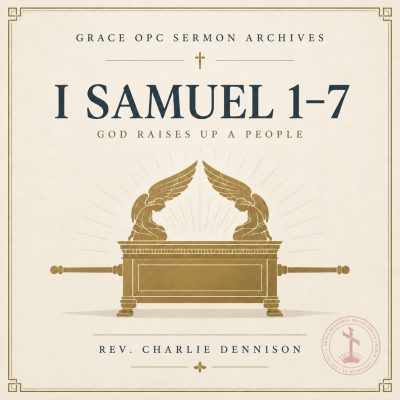
The blind man Christ heals in two stages, in Mark 8, has drawn plenty of liberal interpretation eager to explain away the strangeness of a healing that doesn’t work the first time. Read redemptive-historically instead, Christ’s second touch gives real, permanent life, not a partial fix. That permanence is bound up with an ongoing, penitent state, not a single moment of healing.
There is no pardon from God apart from real repentance, and the water Israel pours out before the Lord in verse 6 pictures exactly that kind of total surrender. Repentance forces us to reckon honestly with our own deadness, not manage it around the edges. Christ’s own perfect repentance is what makes ours effective at all.
1 Samuel 4-7 works as a compact summary of the Old Testament’s entire prophetic office, not just Samuel’s own career. Read together, these chapters present Christ himself as prophet, priest, and king all at once. Our own repentance, in the end, comes only through Christ’s repentance, enacted at his baptism.
Samuel’s return to active ministry in verse 3 sets a pattern his whole later itinerary follows, prefiguring Christ’s own continual, moving ministry. True repentance, unlike its false counterfeits, actually transforms rather than merely regrets. Christ’s kingdom, like Samuel’s ministry, is defined by that same ongoing transformation.
Israel’s double repentance directly answers its earlier double defeat, restoring what sin had cost. The victory and peace that follow are already real and not yet complete, the same tension Paul describes in Philippians 3. Samuel’s stone, Ebenezer, ‘hitherto hath the LORD helped us,’ names both what has happened and what is still to come.
Ahab and Eli both function as mixed figures, capable of real faithfulness and real failure at once, not simply villains. Samuel’s own near-total disappearance from the narrative between 4:2 and 7:2 turns out to be prophetic rather than accidental. That silence anticipates both John the Baptist’s wilderness years and Christ’s own hidden decades before his ministry began.
Acts 3:24 treats Samuel’s prophecy as foundational to everything the later prophets say, a claim worth taking seriously rather than passing over. Abraham’s own itinerary through Genesis 12-14 already displays God’s predestining hand at work, long before Samuel. A straight line runs from Samuel through John the Baptist to Christ himself.
Israel’s wilderness journey is the church’s own journey, not a distant history lesson Paul happens to reference in 1 Corinthians 10. These Old Testament stories are events, not illustrations, each one already showing Christ’s redemption at work. The Puritans understood this, and their own worship, in spirit and in truth, took its shape from exactly this conviction.
The Philistines’ own forced confession turns out to be prophetic: all creation will eventually bow to Christ the same way Dagon already has. Psalm 78 supplies the interpretive key for reading 1 Samuel 5 and 6 rightly, tying Israel’s history together as one continuous act of God. Paul’s charge to preach the whole counsel of God in Acts 20 follows that same pattern of withholding nothing.
Two parallel stories, 5:1-6:12 and 6:13-7:2, both reenact the exodus pattern in miniature, judgment followed by deliverance. Neither the forms nor the symbols involved, the ark, the cart, the golden images, ever actually reach the essence of God himself. The law works the same way: it points toward the Spirit without ever becoming it.