
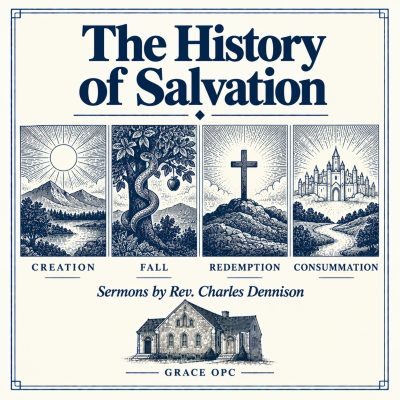
This sermon is from the Rev. Charles G. Dennison sermon archive, part of “The History of Salvation” series, and was preached at Grace Orthodox Presbyterian Church in Sewickley, PA, during a worship service on Sunday, March 4, 1990.
About this sermon
Moses divides Genesis 1-11 naturally, and this primeval history instructed Israel in two ways as it entered Canaan. God’s sovereign election stands behind it all, already moving toward Christ.
Sermon transcript
Tonight we will be reading from selected passages found in Genesis 1 through 11. Our first passage is found in chapter 1 beginning with verse 26. Chapter 1, verse 26, and we read to the end of the chapter. Then God said, let us make man in our image, according to our likeness.
Let them rule over the fish of the sea, and over the birds of the sky, and over the cattle, and over all the earth, and over every creeping thing that creeps on the earth. God created man in his own image. In the image of God, he created him. Male and female, he created them. So God blessed them.
And God said to them, Be fruitful and multiply and fill the earth and subdue it, and rule over the fish of the sea and over the birds of the sky and over every living thing that moves on the earth. Then God said, Behold, I have given you every plant yielding seed that is on the surface of all the earth, every tree which has fruit yielding seed, and it shall be food for you. To every beast of the earth, and to every bird of the sky, and to everything that moves on the earth which has life, I have given every green plant for food.”
And it was so. And God saw all that he had made, and behold, it was very good. And there was evening, and there was morning, the sixth day. Then turning over to chapter three, the beginning of verse one, Now the serpent was more crafty than any beast of the field which the Lord God had made.
He said unto the woman, Indeed has God said, You shall not eat from any tree of the garden. And the woman said to the serpent, From the fruit of the trees of the garden we may eat. But from the fruit of the tree which is in the middle of the garden, God has said, You shall not eat from it or touch it must be done. And the servant said to the woman, you surely shall not die, for God knows that in the day you eat from it, your eyes will be opened and you will be like God, with knowing good and evil. When the woman saw that the tree was good for food, and that it was a delight to the eyes, and that the tree was desirable to make one wise, she took from its fruit and ate And she gave also to her husband Whittler, and he ate. Then the eyes of both of them were opened, and they knew that they were naked, and they sewed fig leaves together and made themselves loin coverings.
And then in chapter 5, beginning with verse 21, Mandina lived sixty-five years and became the father of Methuselah. Then Enoch walked with God three hundred years after he became the father of Nephuselah, and he had other sons and daughters. So all the days of Enoch were three hundred and sixty-six years. And Enoch walked with God, and he was not, for God took him.
And on chapter six, beginning of verse five, Then the Lord saw that the wickedness of man was great on the earth, and that every intent of the thoughts of his heart was only evil continually. And the Lord was sorry that he made man on the earth, and he was grieved in his heart. And the Lord said, I will blot out man whom I have created from the face of the land, from man to animals, to creeping things, and to birds of the sky, for I am sorry that I have made him. But Noah, found grace in the eyes of the Lord. Then finally, from chapter 11, beginning with verse 1, Now the whole earth used the same language and the same words.
And it came about, as they journeyed east, that they found a plain in the land of Shinar and settled there. They said to one another, come, let us make bricks and burn them thoroughly. And they used bricks for stone, and they used tar for mortar. And they said, come, let us build for ourselves a city and a tower whose top will reach into heaven.
And let us make for ourselves a name, lest we be scattered abroad over the face of the whole earth. And the Lord came down to see the city and the tower which the sons of men had built. And the Lord said, Behold, they are one people, and they all have the same language. This is what they began to do, and now nothing in which they purpose to do will be impossible for them. Come, let us go down. And there confused their language. They may not understand one another’s speech.
So the Lord scattered them abroad from there over the face of the whole earth. They stopped building the city. Therefore, its name was called Babel. Because there, the Lord confused the language of the whole earth. And from there, the Lord scattered them abroad over the face of the whole earth.
Go with me. O Lord, it is truly no small thing that men would presume to stand on your side to address your people. So no man is to be called of himself. Rather, he is to be appointed by you. And those, then, Lord, who I appointed, may they speak with the truth, may they communicate well your purpose and intention May they declare with power that revelation of yourself which you have given to your church. We pray this on our God, through Christ our Savior. Amen.
Quickly, here are the divisions of Genesis 1-11. You have an introduction. first chapter that takes you through the third verse of the second introduction. Chapter one, verse one through chapter two, verse three, that’s the introduction. You know the content of that portion of scripture, read from it this evening, the creation of all things, the sixth and the seventh day of creation. Then in chapter two, verse four, The first main section commences, and it’s set off by the phrase there in verse four, this is the account of the heavens and the earth. This is the record concerning the heavens and the earth when they were created. And that phrase will be a kickoff for you as you move through the entirety of the book of Genesis. So chapter two, verse four, through chapter four, verse 26.
You’ll note, then, at the beginning of Chapter 5, that phrase, or something comparable to it, reappears. This is the book of the generation of Adam. Verse 1 of Chapter 5. That will take you through Chapter 9, Verse 29. And essentially, the story of Noah. So you come to Chapter 10, Verse 1. Once more, you have that phrase. Now these are the records of the generations of Shem, Ham, and Jacob, the sons of Noah.
Now that’s chapter 10, verse 1 through 11, verse 9. Then verse 10 of chapter 11. Verse 10 of chapter 11 begins a new section, which includes for you the introduction to the figure of Abraham at the end of that chapter. After the division. Chapter one one through two three. Chapter two verse four through four twenty six. Chapter five verse one through chapter nine verse twenty nine. Chapter ten verse one through chapter eleven verse nine. And then verse ten chapter eleven begins a new section. That won’t end until you get the chapter 25. I won’t deal with that right now. That’s the outcome.
Now when was Genesis chapters 1 through 11 written down in its present form? Or by whom was it written down? We believe that it was written down by Moses, the great prophet of God and the leader of the children of Israel. So it was written down in its present form 1,400 years before the birth of Christ. The time of Moses, 1,400 years before the birth of Christ. And truly, and I mean this respectfully, God only knows how many years after the creation of the world these words were written down. What we find in these chapters is written down then for the immediate benefit of that generation to which Moses belonged.
It was written down for the benefit of the Old Testament Church. Have you come to understand Israel as the Old Testament Church? It is. So this is written down for the benefit of the Old Testament Church that Israelite nation, the Jews. This nation, as you know, is descended from Abraham.
And I’ve already told you that Abraham is mentioned there at the conclusion of Genesis 11. His genealogy is introduced to you there. This one was so important to the Israelite nation, the father, if you will, of the Israelite nation. We could say that Abraham and his genealogy there in Genesis 11 is the endpoint of this section, the point to which all that has preceded has been moving. The point to which all that has preceded has been moving. He is the endpoint, if you will, of these chapters.
Israel herself then thinking about her father as being that end point to which these chapters were directed. And through Abraham, this nation, this Old Testament Church, Israel, is also introduced to a promise, to a promised inheritance, namely a plot of ground in a corner of the Mediterranean world the territory which during the time of Moses was called Canaan, the land of Canaan. Now these chapters, Genesis 1 through 11, instruct Israel then, instruct the church of the Old Testament in two ways. Think of how the Israelites would have heard these words. how these words would have impressed them. First of all, this will be a two-point sermon. First of all, these chapters help Israel, the Old Testament Church, to understand her significance.
They will help Israel understand her importance, her value. This God who has spoken to Moses, this God who has made himself known now to Israel in the Exodus, as Moses has led the children of Israel out of Egypt. This God who has made himself known to Israel at Sinai, he appears there, the ground shakes, the lightning flashes, the peals of thunder are heard, God comes down upon the mountain.
This God who has so made himself known, is the God who made the world, the God who made all things. There is no other God. This is the true God who stands against all idols, all false gods. And it is this God, who in his sovereignty, in his rule, in his power, charts and directs all of human history, all human affairs, the course of world affairs. None other than the Creator God, the great Creator God, the only God, the true God, has made himself known to Israel.
By his actions and through his revelation of himself, God makes clear that his purpose, then, centers itself in Abraham and Abraham’s seed. In Abraham and in these people who are God’s elect, his chosen, Just as then you see everything moving in Genesis 1-11, just as you see everything in those chapters moving toward Abraham, you see then history itself moving toward its center. The center of history will in fact then take into consideration this man, Abraham, and those who are descended from him.
God’s elect, God’s chosen, His people. Israel, therefore, is instructed that all human history, all human history, under the sovereign direction of the God who has made all things, converges upon is elect people. All things work together for good to them who are the call of God. All things work together for good to them who are the call of God. The elect is chosen.
Israel, therefore, in the time of Moses, looking back upon Genesis 1 through 11, is made to say, the God who is, who created the heavens and the earth, is my God. And He is bestowing on me an everlasting inheritance. Just as that God was Abraham’s God, Just as that God had promised to Abraham an inheritance, so now this Israelite, living in the time of Moses and reading these words, is convinced, that God is my God, and He is bestowing on me an inheritance. In fact, I’m about to enter the inheritance with promise to Abraham. I’m going to enter a land going with your inheritance. Now, what we have said so far is underscored by the nature of this particular inheritance, this particular inheritance in you, the land itself. We know it as the promised land, don’t we?
Geographically, this piece of real estate is situated in such a way to bring out Israel’s significance, her importance. It is a strange piece of property, to be sure. A narrow strip of land lying between expansive deserts to the east and to the south, mountains to the north and a seemingly endless sea to the west. If it bears any similarity to the land of Israel in our time, it was a particularly difficult territory. Pleasant and promising in some places, but in others a true challenge to any people.
How do you cultivate this rocky terrain? It’s almost as if the land has been sown with boulders. Yet this difficult and somewhat innocuous strip of land has been called the bridge of the world. the bridge of the world, the world’s crossroad. Did you know that three continents come together in that land? The continents of the eastern hemisphere. Can you name them? Asia, Europe, and Africa. And from ancient times, the civilizations of the world have swept back and forth through this territory, this little plot of ground.
Now you see what God has done. He has placed by His sovereignty His people strategically, and so placing them, He has set His purpose and His people and even Himself before the face of the entire world. So hearing how the true and living God who made all things by the word of His power in the space of six days has made them the center of the world, these people, These Israelites, this Old Testament Church, is established in her confidence and in her faith, and made to see her inestimable value to God, her inestimable worth to Him. God loves His people. They are the apple of his eye. They are as dear to him as his own life. And he would rather die than be without his people.
But sensing then her value, her importance, her significance, Israel is also liable to think much too much of herself. Therefore, the second thing that Israel hears when she reads Genesis 1 through 11, or hears it spoken to her, the second thing that she perceives from these chapters is her insignificance.
Yes, her significance, but then as well her insignificance. Notice the fact, neither she nor her land are specifically found in Genesis 1 through 11. They’re not there. As things begin, neither she nor the land are specifically mentioned spoken of. Emphasis, rather, falls upon the worldwide and universal considerations, not upon the very narrowly focused interests of the Jewish people and their plot of ground, which they now claim as theirs. So then, at the very outset of Revelation, Israel’s eyes are directed through constraint of revelation away from herself.
She must look away from herself. At the same time, she is seeing her importance that is qualified by a gaze that is directed elsewhere. She is being taught that God’s activities, that his actions, that his work has the most comprehensive intention worldwide, universally. While it’s almost as if by the time you get to Israel, to the nation of the Jews, you have before you but a temporary detour from God’s original design. a detour that will take you on a bit of a side trip and then you will return to the main course, the main road once more. Israel might be feeling very good about herself. She might be tempted to vanity. as she hears Genesis 1 through 11 end in the figure of Abraham and set the stage to introduce that promise of blessings to her specifically. But now, upon a second look, she is humbled by these very same chapters, as she realizes that God has wider concerns than just earth. Is not the grand blessing and maybe the greatest blessing given to Abraham this? That your seed shall be a blessing to all nations. The universal, the worldwide, the comprehensive intention of God. not just Jews, but Gentiles too. All peoples. For God so loved the world that he gave his only begotten Son.
Now in realizing in coming to grips with her insignificance, Israel, this Old Testament Church, was to be humbled. She was to be humbled as she realized that this history rehearsed for her in these chapters was a history from which she herself could not be extracted. She is crumbled by understanding that though these chapters do not speak of her explicitly and speak comprehensively and universally, yet they are chapters from which she herself cannot be extracted as if she were not included in the problems and the difficulties here described.
The conclusion, then, when you reach Genesis 12, is not that the world is bad and Israel’s good. Rather, the lesson is the world is bad, And Israel, of herself, in herself, is part of that world. So it is that Israel now is truly humbled and in a real fashion introduced to the magnitude of her insignificance because of Genesis 1 through 11. as these chapters themselves conspire to teach her a lesson in grace. God’s undeserved favor is unmerited love, for Israel has no claim on God. He will kindly deal with her and save her for the sake of the world he loves. And Israel, no less than these nations that are described, spoken of, the worldwide considerations that are laid before us in these chapters, Israel, no less than these, has reviewed before her the testimony to God’s magnificence and power in creation, and she is indicted as they are by that testimony.
Israel, no less than the world, is descended from Adam and Eve. Israel is included in them when they fall. She is not exempt. She is in view. with the rest of humanity when ruin comes to humanity and to humanity’s environment in the fall. Israel is afflicted no less than the world by original sin.
Israelites are guilty of sin, suspicion, greed, envy, the murderous heart that shows itself in our first parents and in their children. The divisions that you see in that first family, Cain rising up against Abel, are those divisions not played out within Israel herself? Do not brothers rise up with murderous intent against a brother and sell him ultimately into slavery in Egypt? Israel cannot extract herself from those chapters in order to congratulate herself upon her righteousness, her goodness, her inherent worthiness before God.
If she is going to be delivered, it’s going to have to be by grace. It’s going to have to be by God’s unmerited favor. Israel, though less than the nations, is caught in the maelstrom. The maelstrom. the downward spiral of destruction that stalks the nations as they, the perpetrators of evil, are visited by God in the flood and at Babel.
Nor does Israel any more than Enoch, of whom we have read, or Noah, lay claim to God as an inherent right When Enoch is translated, when he is taken to God, it was a confirmation of a consistent walk that evidenced the deepest humility. Enoch most certainly is not carried to God with a spirit that told him how worthy he was. Noah is not rescued in such a way so as to leave that man congratulating himself. The lessons in grace found in Genesis 1 through 11 are grounded in the inherent unworthiness of humanity comprehensively. because of that fall of Adam and Eve that involved us all.
So it is then. Israel is taught about her significance to be sure, the love of God directed toward her. But simultaneously she is taught with respect to her insignificance and how If she is to have any fruition of God at all, it will have to be by His grace. She is taught about her common lot with all humanity. If humanity is lost, she is lost with humanity. And if there is to be salvation at all, it will have to be by the power of God.
God himself intervening for the sake of those he has ordained unto everlasting life. So it is in conclusion that these chapters, Genesis 1 through 11, will teach Israel about the power of God to save, despite the hopelessness of the situation. Humanity is ruined Isn’t that what Genesis 6 tells us? Humanity’s ruined. It repented God that he had made man. It’s too late. The situation is utterly desperate and hopeless. The threats that are posed are too formidable.
But God, our God, this God, is capable of saying it despite the waters of the Red Sea, despite the armies of Barak. This God, our God, is powerful to say it despite the threat of the desert wilderness through which the Old Testament Church must travel. This God, our God, is powerful to say it despite the power of armies that outnumber the Israelites, but far better equipped than they. and better trained, mightier in every respect. And from the very foundations of Revelation, then, the people of God are trained to think along these lines. Our God, this God, will say, despite the power of the serpent, despite the power of Satan himself, He will say, for Satan is no match for Him. that the heel of the seed of a woman will be bruised, but the serpent’s head will be crushed. And this our God will save despite the threat and the appeal of civilization.
That’s the significance of Genesis 4 as you read about the development of the line of Cain and all that is there for you to consider. It’s the rise of civilization. its threat and its attractiveness, its appeal, can God save. Nonetheless, despite the wickedness and the violence that is promoted from Cain through Lamech, then into Genesis 6, to the point where there’s not a single good thought left in the heart of man at all, God can save still. And He can save despite the magnitude of man’s pride. as man builds for himself a city, a tower in the city, the top of which will reach into the heavens, so that he’ll never be threatened by any flood ever again.
This our God will save through the seed of a woman, through a new and better Adam, One whose blood speaks better than the blood of Abel. One who is more than translated like Enoch. One who is literally resurrected from the dead. Whose ark, the church, navigates through a rain of fire in the last judgment.
Whose righteous rule means the blessed unity in the spirit of the people of God. as they are brought together from every tribe, nation, and tongue, beyond babble, into a garden that’s better even than evil. And so it is for you, the New Testament Church. Everything now that you’ve read in Holy Writ, informing you of your significance and of God’s love for you. But lest you be proud and arrogant simultaneously about your insignificance and how all depends on God’s grace, His power to save you through the one He has appointed, Jesus Christ, your Lord. I know it.
The sermon text provided above is derived from the sermon audio recording making use of generative tools. It has not been manually edited. While transcription tools have a high degree of accuracy, the output may include generative textual, punctuation, and/or formatting errors.