
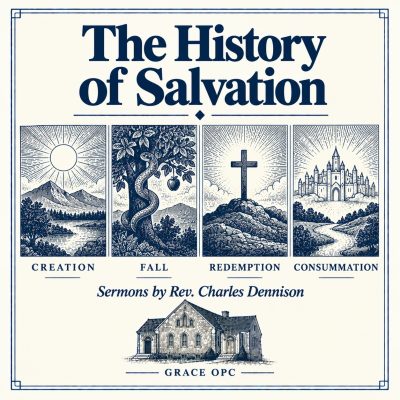
This sermon is from the Rev. Charles G. Dennison sermon archive, part of “The History of Salvation” series, and was preached at Grace Orthodox Presbyterian Church in Sewickley, PA, during a worship service on Sunday, April 8, 1990.
About this sermon
The so-called heroic figures of Judges turn out to be weak pointers to Christ rather than models to imitate, their stories compressed into the book’s own cyclical structure. The close comes with the significance of Ruth, a quiet story that completes this compact history of Israel.
Sermon transcript
Tonight we are reading some sections from the book of Judges, and also a short selection from the book of Ruth. First of all, in Judges chapter 2. Judges chapter 2. Beginning with verse 11, and reading to the end of the chapter. When the sons of Israel did evil in the sight of the Lord, and served the bail.
And they forsook the Lord, the God of their fathers, who had brought them out of the land of Egypt and followed other gods from among the gods of the peoples who were around them and bowed themselves down to them. Thus they provoke the Lord to anger. So they forsook the Lord and served bail and the Ashtar case and the angry of the Anger of the Lord burned against Israel, and he gave them into the hands of plunderers who plundered them, and he sold them into the hands of their enemies round them, so that they could no longer stand before their enemies.
Wherever they went, the hand of the Lord was against them for evil, as the Lord had spoken and as the Lord had sworn to them, so that they were severely distressed. Then the Lord raised up judges who delivered them from the hands of those who plundered them, and yet they did not listen to their judges, for they played the harlot after other gods and bowed themselves down to them. They turned aside quickly from the way in which their fathers had walked in obeying the commandments of the Lord. They did not do as their fathers. And when the Lord raised up judges for them, the Lord was with the judge and delivered them from the hand of their enemies all the days of the judge. For the Lord was moved to pity by their groanings because of those who oppressed and afflicted them. But it came about when the judge died that they would turn back and act more corruptly than their fathers in following other gods to serve them and bow down to them.
And they did not abandon their practices or their stubborn ways. So the anger of the Lord burned against Israel, and he said, Because this nation has transgressed my covenant, which I commanded their fathers, and has not listened to my voice, I also will no longer drive out before them any of the nations which Joshua left when he died, in order to test Israel by them, whether they will keep the way of the Lord to walk in it as their fathers did or not. So the Lord allowed these nations to remain. not driving them out quickly. And he did not give them into the hand of Joshua. Then turning over to chapter 17, this is Judges 17, verses 1 through 6.
Now, there was a man of the hill country of Ephraim, whose name was Micah. And he said to his mother, the eleven hundred pieces of silver which were taken from you, about which you uttered a curse in my hearing, behold, the silver is with me, I took it. And his mother said, Blessed be my son by the Lord. He then returned the eleven hundred pieces of silver to his mother, and his mother said, I wholly dedicate the silver from my hand to the Lord for my son to make a graven image, a molten image. Now therefore I will return them to you.” So when he returned the silver to his mother, his mother took 200 pieces of silver and gave them to the silversmith who made them into a graven image and a molten idol.
And they were in the house of Micah. And the man Micah at a shrine that he made an ephod and household idols and consecrated one of his sons that he might become his priest. In those days, there was no king in Israel. Every man did what was right in his own eyes.”
Then turning over to the book of Ruth, chapter 4, beginning with verse 13. So Boaz took Ruth, and she became his wife, and he went in to her, and the Lord enabled her to conceive, and she gave birth to a son. Then the women said to Naomi, Blessed is the Lord who has not left you without her Redeemer today, and may his name become famous in Israel. May he also be to you a restorer of life, and a sustainer of your old age. For your daughter-in-law, who loves you and is better to you than seven sons, has given birth to him.”
Then Naomi took the child and laid him in her lap and became his nurse. And the neighbor women gave him a name, saying, “‘A son has been born to Naomi.’ So they named him Obed.” He is the father of Jesse, the father of David. Now these are the generations of Perez. To Perez was born Hezron. And to Hezron was born Ram. And to Ram, Aminadab. And to Aminadab was born Nashon. And to Nashon, Salmon. And to Salmon was born Boaz. And to Boaz, Obed. And to Obed was born Jesse. And to Jesse, David.
Pray with me now. Our God, we do wait upon you. We look to you, the one who has given his word to your people, that they may be saved and preserved. And even now, Lord, your word goes to the ends of the earth. And we rejoice, our God, in the gathering of that harvest which you have ordained, as sons for the kingdom are brought from the east and west and north and south to sit at table with the patriarchs, and that at a table prepared by none other than the Lord Jesus Christ. We pray, our Father, that we might rejoice this salvation granted us, and may we delight in the full bounty that is provided us through our Savior. We ask this in His name. Amen.
I expect the Book of Judges is best known for some of the erstwhile heroes, if we can call them that, that appear in the pages of this book. I’m sure some names come to mind immediately. We do think of Gideon. We do think of Samson, who might not think immediately of Othniel or Ehud, but they were judges also. And of course, there is that enigmatic figure, Deborah, the prophetess of God.
So, we do have these, what we might call, heroic figures, and you note my smile. I mean that smile intentionally. These so-called heroes that come to us in the pages of the book of Judges. But I guess that along with these figures are certain statements that recur throughout this book.
The one that I have in mind is what appeared there in the 6th verse of the 17th chapter. In those days, there was no king in Israel. Every man did what was right in his own eyes. And as we hear something of the story of Micah there in the 17th chapter, we say, sure enough, seems like they did whatever they thought was right and pursued their own course.
You might note the end of the book of Judges, the very last verse, for in that 25th verse of chapter 21 you will find that the statement made in Chapter 17 verse 6 is repeated verbatim as if this were the concluding remark This is the last thought that the writer of the book of Judges would leave us with Now this statement is actually a a compressed statement, a very compact statement. There’s much in it, and it’s reflecting a great deal of the life of Israel during that time. It is a statement that calls attention to the political situation or the political arrangement pertaining to the tribes of Israel at this particular time.
Judges, this book has been written at a time when the king had appeared. The king had taken his place within the life of the nation. And now there is this reflection on a former time. A time without a king. A time without this central personage and the mechanism that was usually attended to the king, namely that successors would follow in line. So the period of the judges is particularly a time of disorder, disarray for the nation of Israel.
We could say that the writer is very positive with regard to the king and the kingdom that has come into place now in the life of these people. Very positive with respect, we would imagine, very positive with respect to the person of David and the royal line in Judah. So it is then that he looks upon the time of the king and the dawning of the kingdom, or if you will, the coming of the kingdom, as that which now establishes order, brings sense and stability to the life of the people of God. But I don’t have to inform you that the writer has more in mind than just a reflection on the political situation. For he is also calling attention to the religious climate.
The state of faith amongst these people. The tribes may well have been acting independently of one another. creating a life peculiar to their own, those who are of their own line, remembering their fathers particularly, not specifically with regard to religion, but with regard to descent. But even if the tribes are here separated and in some respect acting independently, The situation is even more chaotic than that. Not merely twelve tribes independently set and loosely hung together, but it seems as if Israel at this specific time was infected by a radical form of individualism. Now we can translate that into political terms, We can speak of it in terms of anarchy. How would you judge the acts of Micah? It is a religious act that he is involved in there, in the seventeenth chapter, but it certainly has political ramifications. Declaring independence. A personal shrine. His own private temple. His own priesthood.
So you move from the political, and what that has brought to the people, to the religious. As this is expressed in a rebellion from within the people against the law of God, so that each person seemingly becomes a law unto himself. The rebellion, then, is not merely a political rebellion for the sake of tribal autonomy or individual autonomy. It is a religious rebellion so that a people is seen to be torn apart due to their reaction against the law of God, and due to the fact that everyone now is becoming, as it were, a law unto himself, and that religiously speaking.
There are other features that we should keep in mind as we consider this phrase, this statement that is repeated in the Book of Judges. As you read the story of Micah, You might note that Micah’s mother speaks of the Lord and then turns around and hands over her money in order to make a graven image and a molten idol. Strange, you may think, but you understand what is happening in the life of these people. It is not merely, then, a matter of a people simply rebelling against God and turning their back against the name of the Lord. Oh, there’s plenty of that. And you can read the religious life of these people at this time in very absolute terms.
Yes, a rejection of God, and that’s how the writer, for the judges, would have us understand things. An absolute rejection of God and His ways. But there are indications throughout the book that point in the direction that those who were turning to the veils, turning to worship other gods, were at the same time retaining for themselves some sort of connection to the name of the Lord. In effect, what you had was a syncretistic approach to religion, a blending of paganism with the worship of Jehovah. The religion then of Israel was seemingly and hopelessly compromised.
Well, that gives you the flavor of things in this period of Israel’s history. The book itself covers the time between the conquest of the land under Joshua to the rise of the monarchy under Saul and then David. It’s a period of over 300 years that is covered here by this book. And we get an in-depth analysis of what exactly was taking place and what we might call the wheel of God’s judgment and salvation as it rolls through the book of Judges from chapter two, and that’s why we read that chapter in part this evening. There is the compact statement that we’ve already looked at, but then there is this rather extensive description of what is taking place in the life of the nation, what is happening over and over and over again, given us in the second chapter.
What we find here is that Israel is making covenants with the inhabitants, making covenants with the remaining personages, those who are holdovers in the tribes that were designated for destruction by God through Joshua. Those tribes are not completely eradicated, and we learn at the end of the chapter the reason for that. But nonetheless, some from these tribes, if not some of the tribes themselves as a whole, have survived. And what is happening is, Israel is now entering into covenants with these people.
Where is intermarriage? This then breeds an atmosphere in which Israelites then are put in a position in which they then refuse to tear down the idols, tear down the altars that have been erected to alien gods. We find Israel then abandoning God through compromise, On the one hand, it seems to be quite absolute. On the other hand, it seems to be an overlay. Yes, the name of the Lord retained, but there is this compromise that has a deadening effect.
We are told in the second chapter that another generation arose after Joshua’s generation, and the generation that knew Joshua, that did not know the Lord, nor yet the work which He had done for Israel. They forgot His work, in fact, rejecting it and choosing to go their own way.
Verse 11 tells us that Israel did evil in the sight of the Lord. They served the idols. We find Israel then turned over to the hands of the enemy. God himself acted here. He abandoned them to the enemy and subsequently raises up judges, temporary saviors, deliverers, who then rescued them as a testimony to God’s graciousness. But after their has been this deliverance through the hand of a judge, the judge dies, and the nation reverts to its sins, and their latter state is worse than the former. And thus, the wheel moves on. The people delivered then forget their judge, They forget the work that God has performed. They turn to the idol. They begin to serve them. They enter into covenants with the nations round about. They intermarry. They begin to worship foreign gods. They are distressed. They come under God’s judgment. He abandons them. He raises up another judge. And so it goes.
That’s the wheel of judgment. and deliverance that is played out again and again in the stories of the judges. Now, the outline, if you would wish for one for the book of Judges, is not what you might call an easy one. It’s as diverse as the judges themselves. You have a summary of events in the first two chapters. Then, with chapter three, you get into the lives of the judges themselves.
You have Ophniel mentioned there, Ehud as well. Chapters four and five, you have Deborah presented to you, and the fifth chapter is that marvelous song of Deborah. Chapters six through eight tell us the story of Gideon. Nine and ten, We are presented with a few judges there, 11 and 12, Jephthah, the one who offered up his daughter, you may recall.
And then, seemingly the judge who has the most time, the most ink spilled over him, Samson chapters 13 through 16. And this rather disturbing story of Micah, Chapter 17 and 18, and then the even more distressing story of the Levite’s concubine. There’s a thriller. Chapters 19 through 22 to round out the Book of Judges.
As to the meaning of the book, the significance of the book, I think that there has already been suggested enough for you to derive for yourself the significance of this book and why it has its place in Holy Scripture. God has set these nations in the inheritance for a purpose. These nations that men tend to seduce, They become an opportunity for trial, the trial of God’s people. You may think of the situation of the church. You may think of your own predicament as a Christian.
Have you not been delivered? Have you not been saved? Have you not been translated out of this present evil age and into the kingdom of God’s beloved Son? Have you not come into the inheritance that has been promised? Have you not been made to sit in the heavenly places in Christ Jesus?
And yet, sin remains a reality. Battles with the flesh continue. You are confronted on every side with situations circumstances that conspire to put you on trial with respect to your faith and your devotion to God. Will you remain faithful? So there is that parallel between the circumstance of the church presently and the circumstance of the children of Israel as they came into the land of promise. There is also this dimension. We’ve already suggested it.
But there is that sense in which we can compare the period of the judges to the entirety of the Old Testament era. As if looking at the book of Judges, we can see the history of the nation of Israel being played out before our eyes. For it’s not merely that wheel that goes around As we read through the pages of the Book of Judges, that wheel continues to go around as we read through the pages of the entirety of the Old Testament. So, you see, the Book of Judges becomes a compressed, compact treatment of the history of the nation as a whole, as if it were the Old Testament, if you will.
Here is the Old Testament. Israel never changes, does it? She seems to remain the same. And that places the book of Samuel in a very special light, doesn’t it? Because the book of Samuel tells you about the end of the period of the judges, Samuel being the last, and the dawning of a new age, the coming of the kingdom. The passage from the period of the judges into the period of the kingdom is like the passage from the Old Testament to the New.
What do we make, then, of these judges? Yes, in many respects, These judges that are raised up remind us of God’s promise. They testify to us of God’s faithfulness. They even speak to us of the coming King. These judges are like, then, the King who shall come. These judges are like the coming Messiah. who shall reign over his kingdom. But at the same time, these figures are so anticipatory of the coming king.
They are also deliberately portrayed for us as vulnerable, so unheroic, so tragically flawed. And by them, we and our spirits are compelled to cry out for someone greater still. These were temporary deliverers. We want a permanent deliverer. These were saviors with feet of clay. These were judges who were so vulnerable and, yes, weak.
Every one of them weak. Do you think Gideon a champion? The man is portrayed in the book of Judges as a fool. Not strong in faith, but weak. He has to put God to the test again and again. Prove yourself to me, Lord. He’s not held out to you as an example of great faith. He held out to you as an example of weakness, one in whom God then will perfect his power and demonstrate his might and his greatness in contrast to the man’s weakness and impotence. Samson mocked human strength. He was the strongest man that ever lived. and yet his weakness is all too evident. It’s blatant that you might see through it to that one who is greater still, the strongest and the mightiest, the Lord of Glory.
Deborah is chosen for a reason. She’s a woman. And yes, even in this feminist age, weak. Weak. And God will triumph through her, so as to demonstrate His power, the perfection of His might and strength. That’s as it is with all the judges, that you might then long for the permanent judge the great King, who is perfect in power, who is perfect in power, who triumphs for us. Well, that’s judges. What about Ruth? I don’t want to take a lot of time here, but Ruth is of the period of the judges, so you were told at the opening of that book, and you were given the story of Naomi, her sons, her daughters-in-law, and here you are introduced to that humiliation that has overtaken Israel as a people.
Naomi is a figure. She goes into exile. She experiences God’s judgments and then is restored to the land. But coming back into the land, what does she find? She finds circumstances so bad that she has to think twice about sending Ruth down to the threshing floor. What’ll happen to her there? Once she finds a place, once Ruth finds a place in the fields of Boaz, don’t go anywhere else, because you don’t know what you’ll find in someone else’s field. These are the people of God? When it comes to working out the contract, you remember the story of the working out of the contract? How it is that the laws from Leviticus have to be observed in the transferal of property.
Boaz is the one that has to explain it to everybody, because no one else can remember it. Things are in bad shape. It is a period of lawlessness, and it is a period in which only this son of Judah, Boaz, remembers the law and keeps it. It is a period in which he alone appears to be righteous and shows compassion.
And through him there is provided blessing for this Gentile. Well, if Naomi is Israel in its humiliation, Boaz is that one who exhibits within himself the pattern of the coming Christ, who keeps the law, who is righteous, who shows compassion, by whom then blessing comes to the Gentiles. It will be through his line, you know, that the Christ will come. Ruth, the book of Ruth, preaches the gospel just as the book of Judges does. And we are those who benefit. Amen. even in an army of Christ.
The sermon text provided above is derived from the sermon audio recording making use of generative tools. It has not been manually edited. While transcription tools have a high degree of accuracy, the output may include generative textual, punctuation, and/or formatting errors.