
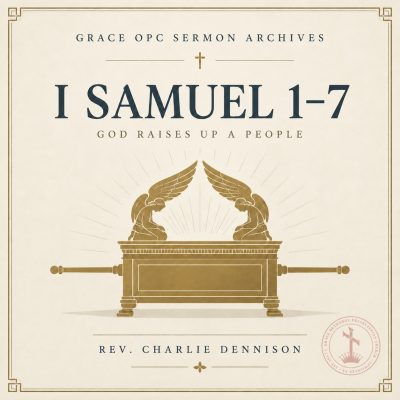
This sermon is from the Rev. Charles G. Dennison sermon archive, part of the “I Samuel 1-7” series, and was preached at Grace Orthodox Presbyterian Church in Sewickley, PA, during a worship service on Sunday, January 11, 1998.
About this sermon
Two parallel stories, 5:1-6:12 and 6:13-7:2, both reenact the exodus pattern in miniature, judgment followed by deliverance. Neither the forms nor the symbols involved, the ark, the cart, the golden images, ever actually reach the essence of God himself. The law works the same way: it points toward the Spirit without ever becoming it.
Sermon transcript
Psalm 78 is certainly a great psalm. It’s got the whole of the history of redemption packed in there for you. It’s wonderful. Our scripture reading this morning is from 1 Samuel. We’re returning to our study of 1 Samuel, and we are in chapter 6. We begin our reading at verse 13. 1 Samuel 6, verse 13. Give your attention now to the reading of God’s holy words.
And they of Beth Shemesh were reaping their wheat harvest in the valley, and they lifted up their eyes and saw the ark and rejoiced to see it. And the cart came into the field of Joshua the Beth Shemite, and stood there where there was a great stone, and they claimed the wood of the cart and offered the cattle a burnt offering unto the Lord.
And the Levites took down the ark of the Lord and the coffer that was with it, wherein the jewels of gold were, and put them on the great stone. And the men of Beth Shemesh offered burnt offerings and sacrificed sacrifices the same day unto the Lord. And when the five lords of the Philistines had seen it, they returned to Ekron the same day. And these were the golden hemorrhoids which the Philistines returned for a trespass offering unto the Lord, for Ashdod one, for Gaza one, for Ascalon one, for Gath one, for Ekron one. And the golden mice, according to the number of all the cities of the Philistines belonging to the five lords, both of fenced cities and of country villages, even unto the great stone of Abel, whereon they set down the ark of the Lord, which stone remaineth unto this day in the field of Joshua the Beth-shemite. And the Lord smote the men of Beth-shemesh, because they looked into the ark of the Lord.
Even he smote of the people fifty thousand and threescore and ten men, and the people lamented, because the Lord had smitten many of the people with a great slaughter. And the men of Beth-shemesh said, Who is able to stand before this holy Lord God? and to whom shall he go up from us?
And they sent messengers to the inhabitants of Kiriath-Jerim, saying, The Philistines have brought again the ark of the Lord. Come ye down and fetch it up to you.’ And the men of Kiriath-Jerim came and fetched up the ark of the Lord and brought it into the house of Abinadab in the hill, and sanctified Eleazar his son to keep the ark of the Lord. And it came to pass, while the ark abode in Kiriath-Jerim, that the time was long, for it was twenty years, and all of the house of Israel lamented after the Lord.
For God, we would trust that your word would be effectual. You have made it effectual in us by bringing us to yourself. Lord, our prayers go up in the interest of the effectual character of your word, its effectiveness today, that you might, by it, strengthen your people, but also through it, call many to life. Lord, we would not simply look to foreign lands, we do that of course, praying for your servants who bring that word, but we pray also for this land and those who would preach, proclaim your word presently in it. Lord, grant your people your blessing in your word, and that through servants who are determined to give themselves to your word and to bring its treasures to your people week by week. In this manner, Lord, strengthen your church, but also add to it, as you would set the gospel before those whom you are calling. Lord, we pray this, even through Christ, who is himself the living word.
Amen. The Bible is like blocks in a box. This is my Dr. Seuss message. The blocks are the thoughts. The box is the history of God’s sovereign self-disclosure, his self-revelation. The box, that is, the thoughts, fit into the box, and this box has a picture on it of how the blocks themselves are to be arranged.
That picture is the person and work of Jesus Christ. Now, keeping in mind that the thoughts presented in Scripture come in the box of God’s historical self-witness, keeping in mind that these thoughts and the box ultimately communicate Jesus Christ, and you will have a leg up on understanding better and better, more perfectly, what the Bible is saying, what it is all about. Now by this I mean that you will not simply have the facts down. and that you might even understand something of the progression of those facts. Rather, I have in mind that you will have a grasp on the proportion and symmetry of God’s Word, thereby increasingly capable of understanding any particular text in it.
1 Samuel challenges us when it comes to the blocks in the box. Much too often, to far too many Christians, the blocks here, as at other points in Scripture, in considering those Scriptures The blocks are left isolated alone, a few together gathered on the floor beside the box, but not in it. My job as a preacher, as a teacher, is to help you pick up the blocks and put them away. They’re not on the shelf. but hopefully in your heart and for the good of your soul.
One thing that you will notice about these blocks in this passage—passage that we’ve read this morning—is that they look very much like others that we’ve already seen in the story in 1 Samuel. You’ll notice, for instance, that the account we find in 1 Samuel 6, verse 13, through chapter 7, verse 2, actually bears striking similarities to what immediately precedes I have in mind the fifth chapter, the first verse, through the sixth chapter, the twelfth verse. I suggest to you then that what you have here is a parallel construction. Texts that are meant to be taken in tandem, to be read together, they are a mirror to each other. The first passage from chapter 5, verse 1 on, that passage is about the Philistines, while our passage this morning is about the Israelites. But follow now their parallel development.
In the first passage, the Philistines take possession of the Ark, that as a spoil of war. Chapter 5, verse 1. In the latter account, our text this morning, the Israelites take repossession of the Ark. They get it back. Notice further, in chapter 5, the Philistines set the ark in a sacred environment within the temple of their God. Chapter 5, verse 2. In chapter 6, in our text, the Israelites set the ark in a festal and sacred setting. Verse 14 and following. In both chapters, in both accounts, the priests Those who have been set apart within their respective societies, the priests are spoken of specifically. Chapter 5, verse 5, and then in chapter 6, verse 15, the Levites appear. Further, each story speaks about a sacred deposit set before respective symbols of deity.
In the case of the Philistines, the ark is set before the statue of Dagon, the Philistine god. In the case of the Israelites, the golden hemorrhoids are set before the restored ark, the very symbol of God’s presence. Moving along, both stories contain references to the five Philistine lords and their cities.
Moreover, in the first story, the Lord strikes, in connection with the Ark, both the religion and the people within the Philistine cities. In the second story, the Lord strikes, again in connection with the ark, both the religion and the people in the city of Beth Shemesh.
Chapter 6, verse 19. Story number 1 tells us about the Philistines’ outcry at the Lord’s judgment. Chapter 5, verses 10 and 12. while story number two tells us about the Israelites’ cry, or lament, because of the Lord’s judgment. Again, chapter 6, verse 19, and you’ll note as well, chapter 7, verse 2.
Both stories contain accounts of the demand that the Ark be removed from its immediate setting, first by the Philistines in 511, then by the Israelites in 620. Both stories describe the moves for the Ark, first among the Philistines and then among the Israelites. Both stories mention the length of time for the Ark’s sojourn. In Philistia, seven months, chapter 6, verse 1, among the Israelites at the house of Abinadab, Etiriat Gerim, twenty years.
Chapter 7, verse 2. And finally, along the more theological line, both stories contain overt references or allusions to the Old Testament exodus. In the Philistines’ story, the mention of the priests and the diviners in chapter 6 verse 2 reminds us of the magicians in Egypt, and the plagues visited upon the Philistines remind us of the plagues that have visited Egypt in the course of the Exodus experience.
While in the Israelite story, we are introduced to a man named Joshua, strategically positioned as the ark comes back into the land and the inheritance is reaffirmed, just as in the Exodus story. And you will note also that in this letter text, A man by the name of Eliezer is mentioned in chapter 7, verse 1, who serves as guardian of the ark. The name of significance, because you see, that was the name of Aaron’s son, who assumed the high priesthood upon Aaron’s death during the days of the Exodus. as we’ve moved through these parallels, you might have noticed, if you were counting as I have, that we have eleven all told.
The exact number I came up with last week in dealing with an entirely different story. The story about Jesus in the temple First of all, after his eight-day experience of circumcision, and then in his twelfth year, maybe I’m on to something here. I’m sure if I have enough time I’ll be able to come up with the allegorical significance of 11.
But kicking out the parallels now, as helpful as that may be, really does not serve us well if we do not go on and grasp the conclusions to which the text would lead us. We are helped ultimately only if we I’m encouraged to put the blocks properly back into the box.
There are any number of commentators who have drawn upon the parallels between these two texts, but it would seem that not many are capable of or bold enough to go on to present to us through their exposition the full range and intention of these passages.
What then do you make of these parallels? What do you make of these parallels? Well, immediately, the thing that strikes you, and that which you will want to keep in mind, is that the Israelites end up looking frightfully like Philistines. But in order to build toward our consideration of that rather overwhelming conclusion.
We might also pick up on that last parallel that I marked out for you there, the more theological, and treat it as something as a key for answering the question of What is this passage, or these passages, all about? That is, we might look at the parallel between 1 Samuel 5, 1 following, and chapter 6, verse 13 following, along the lines of the Exodus story. Do we see then in the capture of the Ark by the Philistines a reenactment here, this time by God Himself in and with the Ark of the Covenant, a reenactment by which He Himself descends into Egypt, there bringing upon the Philistines those plagues that lead to His exodus His release again in and with the Ark, he then experiencing an entrance into the Promised Land, and this in connection specifically with a figure named Joshua, only to see God judge Israel subsequently for its sin. as was done at Beth Shemesh and moved to a more lasting resting place under the priestly administration of another Eleazar. Now, in hearing this reading of the story, in light of the theme of the Exodus, you may well respond, well, that’s not half bad. I think I’ll go with that. Sounds pretty good to me. But you’re driven further now, you’re driven further. What would be the purpose of such correspondence, of such a match-up?
Would it be to strike Israel with this truth, to confront her with her own depravity and duplicity, her own waywardness and wickedness?
To strike at her with this truth, not only with regard to the wickedness and sinfulness of Israel, but also to confess her afresh with God’s act of condescension for her, for her sake, by which he reaffirms his commitment to his people by actually entering into a reenactment of their life, by reliving their life, such being his identification with them, his love for them. sealing this fact that it will only be by him and what he does and what he accomplishes that they will be delivered. And by this rule, might he not also renew his promises in a Joshua-like figure and in a restoration of priesthood in the house of Eliezer. It could well be, then, that the Exodus imagery that we glean from these texts serves the purpose, as you’ve noticed in the telling of the tale, of carrying us even into the next and immediate stages of Israel’s history. Those events not yet realized, being anticipated. a judgment upon Israel, and a movement through a Joshua-like figure even unto someone like unto Eliezer for the reestablishment of God’s purposes and intentions for his people. This suggests to you that here you are not merely reading history or a history that reflects upon past events such as the Exodus. But you are reading something here that has the capability of reaching out beyond itself, of going further, of touching even points that are not as yet touched in the development of the story.
I say this to you because of the significance of Joshua, that mean with regard to administration within the people, possibly a royal figure in view. But not only that, specifically because of the house of Eleazar. Did you know that the house of Eleazar, the house to which the high priesthood fell upon Aaron’s death, had been dislodged from the high priesthood by Eli’s house? Eli being from the competing house of Ithamar. When the Ark comes to Eleazar in chapter 7, verse 1, is there the anticipation of the restoration of the high priesthood to the descendants of that Eleazar, son of Aaron? a re-establishment that would take place in the days of Solomon, when Zadok would become the priest. God, therefore, is reliving the Exodus for his people, and in this means to revive sinful Israel in a new day in the land under the true priesthood. so keeping all of his promises.
But now, before you’re too satisfied with what I’ve said, before you’re too convinced that all of the blocks are back in the box and in their proper arrangement, I want to take you back to 1 Samuel chapter 4. the chapter that set the stage for chapters 5, 6 and 7.
I want you to recall what we said about Israel’s double defeat at the hands of the Philistines, recorded for you in the first eleven verses of that fourth chapter. We said these verses intend to tell us about a double devastation yet to be realized in the history of Israel. One coming for Israel at the hands, not of the Philistines, but of the Assyrians and the Babylonians. Devastation that would come when the kingdom was divided north and south, Israel and Judah. Devastation that would come and result in exile.
You see, before we get to the Exodus imagery in chapters 5 and 6, and its essential backward look, and even the limits to which it can take us as we project in the future, we are taken, catapulted into the far future in the Israel’s history. We are catapulted to the time of the exile. We are carried ahead. so that the full reach of the eschatological realization for Israel is baffling even these events and determining them. Here with the theme of the exile is the more comprehensive and satisfying route into the passage before us.
Samuel’s prophetic word that came to all Israel mentioned in 1 Samuel 4.1 comprehends the entirety of Israel’s national life. He is seemingly seen as the transitional or foundational or fundamental prophet who is anticipating now in his ministry all that is coming, all that is going to come about for Israel in her national life. And what follows in chapter 4 verse 2 through chapter 7 verse 2, in its own distinctive way, serves to place the entirety of the national life of Israel before the people, even before it transpires. Just as judgment is coming presently upon Israel and Eli’s house, at the hands of the Philistines, so it will come about at the hands of the Assyrians and the Babylonians. God will not simply go into the exodus and experience, He is telling the people He is going to go into exile. The capture and the departure of the ark is the exile of God.
And he will go into that exile, which is yet future, for and with his people. He will go into that exile before his people go into exile. And in the context of that exile, he will confound the slaves of false gods and false religions, humbling them, even humiliating them like he did the Philistines. and at restoration. He will indeed renew and fulfill the Exodus, but more. He will bring on his own people the judgments that he had brought on the nations.
It is in the interest of the coming judgment that the Lord will go into exile. for the sake of the deliverance of those who in faith will look to him. But this exile for the Lord also serves as warning for all who will not close with him, all who will not deal with him. The humiliation of the Philistines is but anticipation of the coming humiliation for Israel, and beyond that, you might say, the coming humiliation for the world. God then will bring upon his people the judgments that he brought upon the nations as those judgments are turned back upon their heads.
And this is stressed and underscored in our story this morning, in the text we’ve read this morning. When, in fact, the men of Beth Shemesh gaze into or upon or at the Ark, when they gawk at the ark. The judgment that will come upon the people of Israel, like unto that which comes upon the Philistines and upon the Assyrians and the Babylonians, is because of a religious spirit that cannot get beyond form and symbol, and because of that it never gets to God Himself. it never reaches Him. Even here, in 1 Samuel 6, There is communicated to you the true interests of the Lord when it comes to worship. Is it the ritual? Is it the form? Is it the trappings? Is it even the Ark of the Covenant?
Or is it God himself? in reference to the dependence in Israel to external form, the Lord moves toward an administration in which the leadership carries the intention of the older priesthood, even as it carries Eleazar’s name, but stripped of any of the trappings that prove to be, in the end, a distraction. that nothing is said of Abinadab’s or Eliezer’s Levitical connection. Nothing is mentioned.
Chapter 7, verse 1. The horrifying truth, therefore, is that Israel is just like the Philistines, just like the Assyrians and the Babylonians to come, and like them she will destroy herself by her religion. be it even the religion that comes from Sinai. She will destroy herself by her religion, by way of the law, which she has misunderstood, by way of the priesthood, which she has not comprehended, by way of sacrifice by way of external religious symbol like the Ark itself. She will go upon the external, she will go upon the Ark, she will gawk at the Ark and not see beyond all of the forms to God himself. Well, now, having dealt with Exodus and exile Are all the blocks picked up and put away properly? Almost. For we dare not forget the picture on the blocks. The ultimate intention is to preach Christ, to declare Christ himself.
For the ultimate showdown will not be with Dagon, a Philistine god, or any of the gods of the Assyrians and Babylonians. It will be with principalities, powers, and spiritual wickedness in heavenly places. At that time, for the accomplishment of this great consummate realization of God’s own vindication, God will come out of exile in his Son, Jesus Christ, and he will be rejected in Christ in his death by those who seek the visible and its assurances in this world, only to identify himself in Christ’s own resurrection with an administration that claims no earthly priestly pedigree. Jesus is of the house of Judah, he is not of the house of Levi. On earth, he has no right to the priesthood.
But, of course, you in this new administration do yourself no favor if you fail to see that the Church is distinct from the world and separate An entirely unique and distinct religious spirit animates and directs you, setting you apart from Philistines, Assyrians, Babylonians, and whoever else is out there. You are the Church of Jesus Christ, excluded from you, and the realization of this, however, is also the fact that there cannot be any boasting in yourself or in your religious practices, nor in any confidence with regard, in any regard, directed towards their performance. Our boasting is not in ourselves, for how will we distinguish ourselves in the end from the Philistines? How will you distinguish yourselves in the end from the Chaldeans and the Assyrians?
Certainly, boasting in ourselves and in our religious practice is not going to save us any more than it saved the Israelites, when the God behind and above the Ark Jesus Christ, in fact, the Savior of the world, returns to his Church to scrutinize her.
Having moved from the Old Testament Church to the New Testament Church, we now have the blocks in the box. And seeing all of these matters pointed to and resolved in Jesus Christ our Savior, we have them in proper order. And I trust that you are storing up all of these things, not behind some closed door in a closet, but in your heart.
O God, your grace is that we might be prepared for the judgment. And as your grace is displayed wonderfully to the Israelites to the point where you take to yourself their life, you affirm your union with them. So also, O God, for us in Jesus Christ, for in and through our Savior, you have made our life yours. But likewise, O God, We are moved on from this grace to the certainty of judgment, that we would be warned and prepared for what approaches. The Old Testament Church is a warning to us that surely, most emphatically, your judgment begins at the household of God.
Father, with the grace that you have granted to us, we ask that we would then be prepared, especially now in light of our passage, that we would not give ourselves to a formalism and the externalism of worship, but that we would move on and see that the objective of our worship is you yourself. And Father, knowing the full range of Christ’s work that we might in fact have you, may we acknowledge that you have been given to us, even as we shall see the fullness of our inheritance in the great day when Jesus comes again. Father, we pray these things in Jesus’ name. Amen.
The sermon text provided above is derived from the sermon audio recording making use of generative tools. It has not been manually edited. While transcription tools have a high degree of accuracy, the output may include generative textual, punctuation, and/or formatting errors.