
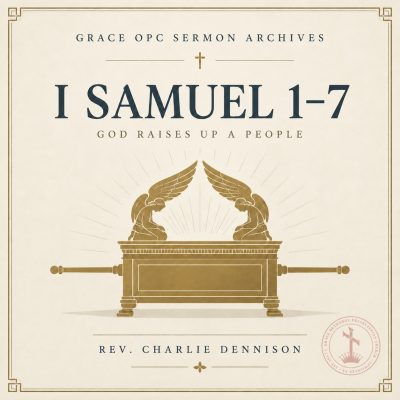
This sermon is from the Rev. Charles G. Dennison sermon archive, part of the “I Samuel 1-7” series, and was preached at Grace Orthodox Presbyterian Church in Sewickley, PA, during a worship service on Sunday, November 16, 1997.
About this sermon
Dagon’s own collapse before the captured ark is one of Scripture’s more pointed jokes, God using sarcasm and irony to humiliate the Philistines’ god. Even in captivity, the ark itself endures a kind of exile on Israel’s behalf. That endurance, not the comedy, is where God’s love actually shows itself.
Sermon transcript
This morning our scripture reading is 1 Samuel chapter 5. We will be reading 1 Samuel chapter 5 this morning. Give your attention to God’s infallible And the Philistines took the Ark of God and brought it from Ebenezer unto Ashdod. When the Philistines took the Ark of God, they brought it into the house of Dagon and set it by Dagon.
And when day of Ashdod arose early on the morrow, behold, Dagon was fallen upon his face to the earth before the Ark of the Lord. and they took Dagon and set him in his place again. And when they arose early on the morning, behold, Dagon was fallen upon his face to the ground before the Ark of the Lord.
And the head of Dagon, and both the palms of his hands were cut off upon the threshold, only the stump of Dagon was left to him. Therefore, neither the priests of Dagon, nor any that come into Dagon’s house, tread on the threshold of Dagon in Ashdod unto this day. But the hand of the Lord was heavy upon them of Ashdod, and he destroyed them and smote them with hemorrhoids. Even Ashdod and the coasts thereof.”
And when the men of Ashdod saw that it was so, they said, The ark of the God of Israel shall not abide with us, his hand is sore upon us, and upon Dagon our God. They sent therefore and gathered all the lords of the Philistines unto them, and said, What shall we do of the ark of the God of Israel? And they answered, Let the ark of the God of Israel be carried about unto Gath, and they carried the ark of the God of Israel about thither. It was so that after they had carried it about, the hand of the Lord was heavy against the city with a very great destruction, and he smote the men of the city, both small and great, and they had hemorrhoids in their secret parts. Therefore they sent the Ark of God to Ekron. that came to pass as the ark of God came to Ekron, that the Ekronites, quite I’m saying, they have brought about the ark of the God of Israel to us to slay us and our people. So they sent and gathered together all the lords of the Philistines and said, Send away the ark of the God of Israel and let it go again to its own place, that it slay us not and our people. For there was a deadly destruction throughout all the city. The hand of God was very heavy there, and the men that died not were smitten with the hemorrhoids, and the cry of the city went up to heaven.
Our Father, we ask that your word would be strong today in overthrowing strongholds of unbelief and the bastions of idolatry. May this be so, O God, throughout the world, even as your word and the gospel are proclaimed. May our zeal be for your word here and throughout the nations, and may it please you, O God, to graciously grant many salvation. Hear us, O Father, may our prayer be earnest and sincere, for Jesus’ sake Amen.
The story about the Ark of God in Philistia, beginning in 1 Samuel 5, is full of grand theology, masterful irony, and grim, although intentionally playful, humor. Now, the humor here does smack of a deliberate sarcasm. I know that many are put off by sarcasm. To them, it is the lowest form of humor. They believe being the pious folk that they are, sarcasm is inherently cruel, since it involves laughing at another or at another’s expense. Therefore, sarcasm is always wrong, it is always wicked.
According to this version of piety, Sarcasm is never, never appropriate. But I trust that it is clear to you that such piety, which expresses itself this way, actually sits in judgment of the Bible, since the scriptures are full of sarcasm. But no less does this piety that we have mentioned sit in judgment of many of the central figures that we find in the Bible, admirably commended even for and in their sarcasm. Nor should it pass note that such piety as we’ve spoken of here this morning sits in judgment of the most central figure of all in the Bible, God Himself.
It goes without saying, no one likes to be laughed at. You may even feel that You have a mission to come to the aid of all who are being laughed at, whose self-esteem is being damaged. You may even dedicate your life professionally to wiping out sarcasm harassment. I am being sarcastic. But none of this has anything to do with whether some people or some things in some situations deserve to be laughed at. If you want a quick course in the word sarcastic witch, I invite you to look at Isaiah 44, verses 9 through 20.
In this passage, God, through his servant Isaiah, mocks mercilessly, and I underscore that mercilessly, the idolater. The Lord describes the idolater as one who, maybe innocently, plants a tree, a tree of course, given an ironic twist, watered by the rain which the Lord alone can send. From this tree, the idolater takes half to fire up his stove, cook his meat, and warm himself. From the other half, the idolater makes a god. He then falls down in front of this god, this god here being called a block of wood, and prays to this block of wood, saying, Deliver me, for thou art my God.”
The bottom line is, regardless how pitiful this idolater is, regardless how tragically incapable this person is of saying, given the text in Isaiah 44, there is a lie in my right hand. the fact remains. From Heaven’s perspective, from God’s point of view, this idolater is a laughingstock. He is a ridiculous figure, a fool, who in his religious obtuseness deserves to be laughed at.
Now, I know that the habit in the Church at least in the last two centuries, has been to separate the sinner from the sin. And in this regard, we might say, laugh at the sin, not at the sinner. But the Bible makes mockery of, it laughs at, such distinctions.
We have been told by the Church and in the Church that we must follow the polite, socially correct path because our interest is to spare the feelings of the sinner. We laugh at the sin, not at the sinner, because, after all, the sin doesn’t have any feelings any more than that block of wood in Isaiah 44. But don’t you see the testimony of Isaiah 44 as proof? Don’t you see God isn’t interested in scaring us of our feelings?
He laughs at us in our sins. He mocks us in our absurd following. Despite how proud we are, we sinners have made ourselves laughable and the objects of divine sarcasm. He will even heap on us more scorn still in the judgments he brings upon us in our rebellion and our unbelief. He who sits in the heavens shall laugh, the Lord shall have them in derision.”
You read that this morning. You also sang it. So it is in 1 Samuel 5. The world here will not merely make the Philistine God, Dagon, that block of wood, laughable, he will make the Philistines themselves laughable. And by doing so, he deliberately leads up his people to laugh at the expense of these who are described. What I mean to say is, God not only makes Dagon and the Philistines laughable, he makes us laugh at them.
Shall we go through the story? The mental picture brought to mind by the descriptions of Dagon’s prostration before the God of the Ark are intended to make us laugh. Dagon, who was supposed to receive the Ark as the trophy of his triumph since his servants had vanquished the servants of Jehovah, finds himself now face down as if in worship posture before the Ark.
If that weren’t bad enough, this so-called powerful God must now be weighted—he cannot weigh himself—he must be set again in his place, only to fall again a second time, but this time decapitated and shorn of his limbs. The King James Version captures the scene wonderfully. At the end of verse 4, only the step of Dagon was left to him. Now, for no money, that’s a fairly humiliated God.
But what of the people? What of the Philistines? As with the idol, so with his worshippers. If you are going to laugh at the God, you are going to laugh at that God’s worshippers. they, beneath the mocking scorn of the God of heaven and earth, will be totally and thoroughly humiliated. These Philistines, these supposed conquerors, to whom the world belongs according to their estimations, are laid low by a plague. that cannot help but make all who hear of it ever since snicker, if not break out in a grand belly laugh. The mighty Philistines, who have just devastated Israel and captured Israel’s God, are now by hemorrhoids. There probably aren’t a lot of sermons preached on this task.
But before we’re I hope that you will understand and see the mastery of the Lord’s dealings. You will notice further now that this sarcasm in this story literally swims in a sea of And as we move from sarcasm to irony, the level of the humor rises. It becomes even sublime. Look at the ironies.
The agents of a visible man-like God who administer a double defeat to Israel in 1 Samuel 4, now witness in 1 Samuel 5 the double humbling of their God, not once but twice. The second defeat for Israel was her demise. And so Dagon’s second prostration is his utter destruction. And just as the movement for Israel in chapter 4 was toward death, capped in the death of Eli, so the movement for the Philistines in chapter 5 is toward death, sealed by the plague, the humiliating plague of Hemorrhoids.
Dagon will have left to him only his trunk or his stump, while his people will be afflicted in their trunks, even their trunks’ most socially sensitive and unspeakable spot. The thought of it is not just physically. but socially painful. It is thoroughly and completely humiliating. So much for these proud people. The visible God Dagon, who has lost his head, and cannot lift a hand to help his people. This God is the victim of the invisible, the true God. whose unseen but omnipotent hand comes down heavy upon his enemy, and note the number of times the hand of God is mentioned in the rest of the story.
Verses 6, 9, and 11. The Philistines making mention of it themselves in verse 7. And the true God He is the one who, in his eternal mind—certainly he has not lost his head—in his eternal mind, outwits the Philistines, even as he makes them, as he makes all people, finally, the servants of his sovereign purpose. And it is here that we are now forced by the sarcasms and the ironies in 1 Samuel 5 to the depths of the grand theology that finds its ground in the remarkable wisdom of God. He who has humbled Israel, chapter 4, because she had profaned his worship. now humbles the Philistines who worship false gods.
But stay with the point for a moment further. You must understand that in this enterprise of humbling the Israelites by their defeat and the Philistines by their humiliation. But by this enterprise, he who humbles both of these people does so by humbling himself. The highest reach of the story will point this out to you.
The earth’s journey is the Lord’s journey. The earth’s exile is the Lord’s exile. The Lord is giving himself over to exile itself. He will experience it. And it will be through this exile that Israel, yes, is disciplined. that Dagon worship is a devastating blow, that Dagon worshipers are laid low, and that the cry, even from these foolish Gentiles, will ascend up into heaven.” Now, the grand theology begins to overwhelm us. Do you begin with all humility to peer now into the unfathomable and inscrutable mind of God, hear at the beginning of the Old Testament story about the establishment of the kingdom of God. The very end of that kingdom is being forecast for you.
That end will be an exile for Israel as she is disciplined in the interests of her true calling. But before she enters that exile, even as she is constrained to do so under judgment, her God, the living and true God, enters into that exile and endures it Himself. This He does for her, that she might endure the exile in Him. Such is His love for her. and emerging from that exile, he has given Meryl instruction to her about her true meaning and destiny. When she herself years later returns from her captivity in Babylon, it won’t be for the sake of ground near Jerusalem or for the sacred precincts in a refurbished temple, let alone for the sake of a trumpeted self-importance and self-righteousness.
But as the Lord’s exile in 1 Samuel 5 tells us, so also for the exile of Israel to Babylon, truly in view is preparation for a consummate judgment upon Israel, a discipline accomplished in the days of Jesus Christ, one in which the Lord himself will move out from Israel into all of the nations, bringing down idols, delivering preliminary judgments among the Gentiles, so that as many as are called by him would themselves cry out to heaven and be saved in the day in which he will bring everything to a conclusion.” in its ironies, in its witticisms, but yes, in its profound theology, announces the coming of Jesus Christ and the ministry of his Church, which, like the Ark of the Covenant, bears witness to her invisible Lord who judges Israel who now, through the Church of Christ, brings down idols, effects preliminary judgments among the Gentiles, working in the hearts of all who are being saved, Gentile and Jew alike, for the sake of life’s true meaning and destiny, namely God himself in glory. that even all of God’s sarcasm, the ironic twists of his sovereign superintendent of human history, together with the grand theology of his true eternal gospel, has grabbed you.
That you have come to that place where you don’t mind being laughed at in your sin. because it means you will laugh joyously with God himself and with your Savior Jesus Christ in heaven. And even presently, yes ironically, you have begun to laugh for joy because you know that in your mission in this world and in the exile that leads from this world to the next, your Savior, like the Ark in 1 Samuel 5, has preceded you, and that he has promised his church that he will never leave her.
He has told her, Lo, I am with you always, even to the end of the world. Such is the nature of his love. And such is the nature of your confidence as you make your way in your pilgrimage. Such is the nature of your assurance and certainty as you know the cause and purpose of Christ’s church will not fail. This one who has preceded us is even remarkably with us.
Let’s pray. Father, we ask you that we would delight in you. And Father, may we not turn away from the scorn that we rightly deserve. that in facing it, O Father, may we acknowledge that we deserve to be laughed at, as do all who have turned away from the true God. We pray, Father, that we might understand that your intention is your kindness and even the salvation of those upon whom you have set salvation from all eternity. May we know the same thing. Therefore, in our humor, Lord, keep us from cruelty. And when there are opportunities to use sarcasm, may we be very, very wise, judicious, understanding the way of our God and the intentions of our God, having peered into the great mysteries, understanding, O Father, your purpose and intention for the nations, the salvation of your elect, the preservation of your Church, unto the coming of the Lord Jesus Christ.
The sermon text provided above is derived from the sermon audio recording making use of generative tools. It has not been manually edited. While transcription tools have a high degree of accuracy, the output may include generative textual, punctuation, and/or formatting errors.