
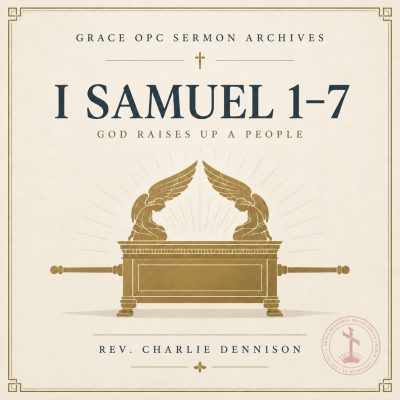
This sermon is from the Rev. Charles G. Dennison sermon archive, part of the “I Samuel 1-7” series, and was preached at Grace Orthodox Presbyterian Church in Sewickley, PA, during a worship service on Sunday, October 26, 1997.
About this sermon
Eli’s death, falling backward at the news of the ark’s capture, reads as a small commentary on the end of the world itself, the same pattern nearly every Old Testament story follows in miniature. Putting God’s will above even our own families turns out to be the real cost of faithfulness here. Christ’s own righteousness, not Eli’s failure, is what finally answers that cost.
Sermon transcript
We are beginning our Scripture reading in 1 Samuel chapter 4. We will begin reading at verse 10 in that chapter. This morning I’m going to be reading from the New American Standard Version, 1 Samuel 4, beginning at verse 10. Give your attention to God’s Word.
So the Philistines fought, and Israel was defeated. And every man fled to his tent, and the slaughter was very great. For there fell of Israel thirty thousand foot soldiers. and the Ark of God was taken and the two sons of Eli, Hophni and Phinehas, died. Now a man of Benjamin ran from the battle line and came to Shiloh the same day with his clothes torn and dust on his head.
When he came, behold, Eli was sitting on his seat by the road eagerly watching, because his heart was trembling for the Ark of God. So the man came to tell it in the city, and all the city cried out. When Eli heard the noise of the outcry, he said, What does the noise of this commotion mean? Then the man came hurriedly and told Eli. Now, Eli was ninety-eight years old, and his eyes were set so that he could not see. The man said to Eli, I am the one who came from the battle line. Indeed, I escaped from the battle line today. And he said, How did things go, my son?
Then the one who brought the news replied, Israel has fled before the Philistines, and there has also been a great slaughter among the people, and your two sons also, Hophni and Phinehas, are dead, and the ark of God has been taken.’ When he mentioned the ark of God, Eli fell off the seat backward beside the gate, and his neck was broken and he died. for he was old and heavy.
Thus he judged Israel forty years. His daughter-in-law, Phileas’s wife, was pregnant and about to give birth, and when she heard the news that the Ark of God was taken and that her father-in-law and her husband had died, she kneeled down and gave birth, for her pains came upon her. About the time of her death, the women who stood by her said to her, Do not be afraid, for you have given birth to a son. But she did not answer or pay attention. And she called the boy Ichabod, saying, The glory has departed from Israel because the ark of God was taken because of her father-in-law and her husband. And she said, The glory has departed from Israel for the ark of God. was taken.
Then turning over to the New Testament, to the gospel of Matthew, reading from Matthew 27, beginning at verse 45. From the sixth hour of darkness fell upon all the land until the ninth hour. About the ninth hour, Jesus cried out with a loud voice, saying, Eli, Eli, lama sabachthani, that is, my God, my God, why hast thou forsaken me?
And some of those who were standing there, when they heard it, began saying, this man is calling for a larger. Immediately one of them ran, and taking a sponge, he filled it with sour wine and put it on a reed and gave him a drink. But the rest of them said, Let us see whether Elijah will come and save him.
And Jesus cried out again with a loud voice and yielded up his spirit. And behold, the veil of the temple was torn in two from the top to the bottom, and the earth shook and the rocks were split. The tombs were opened, and many bodies of the saints who had fallen asleep were raised. After his resurrection, they entered the holy city and appeared to many. The centurion and those who were with him, keeping guard over Jesus, when they saw the earthquake and the things that were happening, became very frightened and said, Truly, this was the Son of God.
Father, help us in all of our opportunities, respecting your Word, to gain from that Word what you have for us. May we apply ourselves with the whole of our beings. Father, keep us from that notion that we can leave our minds at home when we come to church. Instead, Lord, may we be engaged with all of our mental facility. Lord, we pray this and keep in mind that we would be engaged also with our affections so that our love is stirred up, our love for you. and for your church. We pray these things in the name of Christ, our Savior. Amen.
The story about the death of Eli is the story about the end of the world. Now, if it is your habit to look for relevance in preaching, I would encourage you with all of my energy to look in this direction, in the direction of the end of the world. If your reply to me is that you’re not expecting the world to end any time soon, and therefore even my suggestion lacks relevance, my response to you is this. How do you know? How do you know that Jesus Christ will not return before I finish this message? How do you know that Jesus Christ will not return before the hours of this day are completed?
The Bible is clear. It has told you that since Jesus Christ first came, the ends of the ages have come upon us. That’s 1 Corinthians 10. Peter, at the foundation of the Christian Church, says this, that since Jesus Christ died and rose from the dead, and since he has sent his Spirit, we are now living in the last days. Acts 2, 17. And the Apostle John ups the ante when he says to his readers, 1 John 2, this is the last hour. And James, that most neglected of contributors to the New Testament, says that God, our judge, is even now at the door. Paul tells us in the last chapter of his letter to the Philippians, the word is at hand.
The New Testament is full of the urgency and immediacy born out of the relevance of the concerning the end of the world. The Old Testament itself prepares us for this atmosphere, this environment, this situation in which we presently live, by placing before us, through its stories and its figures, the reality of the consummation of the ages. The story about Eli’s death is about the end of the world. This story, as I have already said, is then repeated in other forms and with other figures often throughout the pages of the Old Testament. In fact, it is the very intention of this book, 1 Samuel, not only to repeat this theme of the end of the world, but to use it for its overall structure, thus placing it at the very center of its meaning.
Let me show you something. Look at verse 1 in 1 Samuel 4. What I want you to notice is the place where the Philistines camp. We can always count on Denison to pick up some obscure point. I want you to note the place where the Philistines camp. The place is called Asak. While I’m not sure the name in itself has significance, it does mean strength. And it might refer, in a theological sense, to the incomparable strength that belongs to the enemies of God’s people. And it may refer, ironically, therefore, to the lack of strength that God’s people have in themselves. The Philistines are camped at strength.
But the reason I call your attention to the name Asa It’s because you will see it again at the very end of this book at first hand. You will find it in chapter 29 verse 1. You will note that it is the site to which the Philistines again gather for the great battle that concludes this book.
In that battle, at the end of this book, you will recall both Saul the king and Jonathan his son are slain, and the Israelites are devastated. Two slain in the previous account, possibly in Phinehas, two slain in the latter account, Saul and Jonathan. The stories of Eli’s death and the story of Saul and Jonathan’s death are one.
They have the same meaning, the same intention, they press to the same conclusion. And that conclusion is to set before you the end of the world. This meaning is reinforced by the similarities of patterns we find in the two stories. I’ve already mentioned one for you, but there are others that match the story early on for Samuel with death later on at the conclusion.
Elah’s death and the Philistine triumph sets the scene for the appearance of Samuel at his coming. So Samuel and Jonathan’s death and the First King’s triumph later on sets the scene for the appearance and the ascendancy of David. And as Eli’s daughter-in-law in her death laments the loss of the Ark and memorializes that loss by naming her newborn son Ichabod, which means no glory since the glory has now departed with the Ark, so David after the latter defeat, laments the loss of Saul and Jonathan, and will memorialize them with the words, The beauty of Israel slain upon thy high places.
How are the mighty?” Let me tell you now. As the story of Eli serves the later story of Saul and Jonathan, so both of these stories serve a later story still. They force us on even more conclusively to the reality of the end of the world and to its more conclusive lament.
A lament that is found on the lips of Jesus himself. When in surveying Jerusalem, he cries out, O Jerusalem, Jerusalem, who kills the prophets and stains those sent to her? How often I would have gathered your children together, even as a hen gathers her chicks under her wings, and you would not. Behold, your house is left to you desolate. And with this picture and this lament, there comes the rendering of the temple curtain, and with it the manifest disclosure that not only is the art gone, but the glory is nowhere to be found, at least in the temple precincts. In this context, the sun is darkened. The earth quakes, the rocks split open, tombs are opened, and many saints rise.
The story about the crucifixion of Jesus Christ is definitely about the end of the world. like those of the stories about Eli and Saul and Jonathan, is meant to place us in the environment, the atmosphere, the setting of the end. But how can this be the case? You might ask. In each of these stories that I’ve listed for you this morning, in the Old Testament or in the New is about Israel.
How can stories that tell us merely about the grievous tragedies overtaking a small country in a little corner of the ancient world be telling us about the consummation and the demise of the entire planet? Haven’t we blown things out of proportion here? Well, the answer to this question goes a long way in helping us to understand the purpose of the scriptures in their entirety. You see, the end-of-the-world stories which we have noted are increasingly intense as we move through them and from one to another.
However, the pattern remains the same. They present a devastation of apocalyptic significance, if not proportions, but one that focuses upon Israel. These devastations that overtake Israel are not meant as parochial lessons about God’s judgment upon a tiny nation.
No, they are meant as sober instruction to the whole of Christ’s Church to the end of the age. Israel is the one-time Old Testament Church which prepares you for the end-time New Testament Church. Israel is the one-time Old Testament Church which prepares you for the end of time New Testament Church. That’s why you read your Old Testament. The stories about Israel’s judgment in scenes preliminary to the end are intended to tell you about the judgment that comes upon the Church when history is brought to a conclusion. The stories about Israel’s judgment in scenes preliminary to the end are intended to tell about the judgment that is coming upon the Church when history concludes.
You are not left without witness, and you are not left without warning. You have no excuse. You have been told. As Paul himself says, and we’ve quoted him earlier, when speaking about the Old Testament scriptures as a whole, these things, he says, are written for our instruction, that is, for the instruction of the Church of Jesus Christ, upon whom the ends of the ages have come. Again, 1 Corinthians 10, 11.
But if now Eli’s story, the story about his death, is meant to instruct the Church for the end of the world, what is the specific nature of that instruction? What are we supposed to gain from this? At this point we might become confused. The reason I say this is because of things that we have noticed earlier in these messages, specifically the tension in the story about Eli that appears at the end of 1 Samuel 2. If you look at the verses from verse 22 on in that chapter, on the one hand, Eli rebukes his son. On the other hand, the word comes, as it were, immediately promising judgment upon Eli, for not rebuking his sons. Eli rebukes his sons, then the word comes and promises judgment upon a man for not rebuking his sons, verses 27-36 of that second chapter.
You may remember what we said in our message on those verses. The answer to this apparent contradiction is discovered by keeping in view that Eli is more than a solitary figure, an individual person. Rather, he is a corporate figure in the life of the people of God and in the history of salvation, in whom we are to see the entirety of God’s people as a whole, in whom we see, therefore, both the positive and the negative reality belonging to those people, the Old Testament Church, anticipatory of what we will find in the New Testament Church as well. Positively, we see in him features on the one hand so glorious that they reflect Jesus Christ.
In him we see also a model Sabbath rebuking his children. even a model believer, but negatively we see in him a severe failure in that as the Lord says about him, he honors his sons above God. And because of this, despite what appears to be genuine discipline of his sons, there was in truth no such discipline at all. Eli’s serious words to his sons, it would appear, were never matched by his actions.
But if things are as we say, and Eli’s story, the story of his death, telegraphs to us, the Old Testament Church in an end-world scenario, for the sake of the New Testament Church, which now faces the end of the world, if these things are as we say, and the Church of Jesus Christ must with fear and reverence look to herself, lest she tell your spirit that treasures human affections more than love for God. Lest it tell your spirit that for the sake of human affections and the things of this fails to exact the discipline demanded for the Church as she now comes face-to-face with the end of all things. The Church cannot ignore discipline, and I will say to you that the most extreme challenge to the Church in implementing discipline is dealing with your husband, with your wife, with your children. Because for the sake of human affections, you will say, my love of God is second. It will be because of this that you bring down the judgment of God upon your heads.
When there is a child who is in need of the Church’s discipline, the parent ought to be the first at the door of the session. I think I’m becoming relevant. But you should know the instruction to the Church about living in the end times, rising out of the story concerning Eli’s death, involves more than lessons about Church discipline. of equal importance is its lessons concerning righteousness. You see, the way in which God has framed his word is deliberate. The presentation of Eli’s rebuke to his sons immediately followed by the world’s judgment upon him for not rebuking his sons. That combination of passages at the end of 1 Samuel 2 is meant to get you. It is meant to get your attention.
And it is meant to confront the New Testament Church with this truth, this truth, your righteousness, regardless of your estimations of it. even if we grant it a sincerity and a genuineness, will not hold back the end of the world. I don’t care how pious you are, you will not stand the hand of God. His judgment is going to come at His appointed time. even if I grant to you its sincerity and its genuineness, will not hold back the end of the world, much less will that righteousness provide you a reason to boast before God when the end comes.
In other words, the story about Eli confronts the New Testament Church with the inevitability of the end, as well as the absolute necessity for the vindication of God, and that out of the heart of every true believer. You hear that echoed in Eli himself. in one of his extraordinary moments. He says, after receiving the word from God concerning the judgment that is coming upon him, it is the Lord. Let him do what seems good to him. even for the Church then, that affords itself most diligently, most effectively to the matters of discipline. At the end of the world, all its righteousness will neither hold back the consummation nor provide ground for that Church to glory in itself.
I’m having second thoughts about Asa. Maybe I will make much of that name. In the end, we are brought to the place where we realize the enemy possesses an unconquerable strength against us. our ability to resist. And against this enemy, in ourselves, in our own strength, we are powerless.
This is simply another way of saying, the Church now, beloved of God, dear to Christ, in order to stand in the end, it must boast only in the Lord. and in the righteousness found in her Savior, such righteousness as resides in Christ, and appropriated not by the works of the law, but by the healing of faith. That it might be absolutely and completely. The Church, also in order to stand in the end, must not recoil from the inevitable nature of the end, but rather greet it and welcome it and embrace it with these words, come Lord Jesus, even so, quickly come. Amen.
Our God and our King You have set before us the wonders of your word, the harmony of them, the consistent thread that runs throughout, and how to a common and unified purpose you have had your word inscribed that it might be a comfort and an instruction to us.
Truly, O God, we live in the face of the end. But Lord, lest we be dismayed, we are blessed by your Son, the presence of your Spirit, the encouragement of the saints, and even the ministry of the means of grace which you have appointed. Father, we ask that we might delight in you and in your Son in light of the not having a boast in ourselves with regard to our own strength, but rather an acknowledgment that we are utterly and completely weak and depend upon you entirely. Father, you prepare for the conclusion. Even by these marvelous stories that are given to us in the Old Testament, they come to direct us, they also come to warn us. May we heal them.
The sermon text provided above is derived from the sermon audio recording making use of generative tools. It has not been manually edited. While transcription tools have a high degree of accuracy, the output may include generative textual, punctuation, and/or formatting errors.