
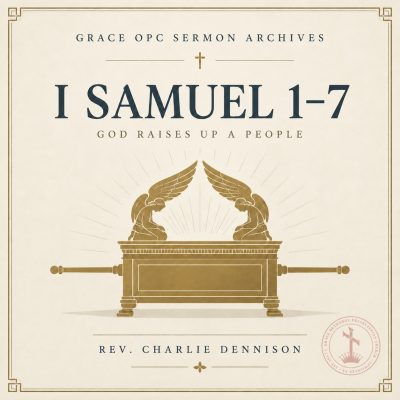
This sermon is from the Rev. Charles G. Dennison sermon archive, part of the “I Samuel 1-7” series, and was preached at Grace Orthodox Presbyterian Church in Sewickley, PA, during a worship service on Sunday, January 18, 1998.
About this sermon
The Philistines’ own forced confession turns out to be prophetic: all creation will eventually bow to Christ the same way Dagon already has. Psalm 78 supplies the interpretive key for reading 1 Samuel 5 and 6 rightly, tying Israel’s history together as one continuous act of God. Paul’s charge to preach the whole counsel of God in Acts 20 follows that same pattern of withholding nothing.
Sermon transcript
Our scripture today is in 1 Samuel 6, and we are beginning our reading at verse 13. 1 Samuel 6, verse 13. I give you attention to God’s holy, inspired word. And they of Beth-shemesh were weeping their wheat harvest in the valley, and they lifted up their eyes, and saw the ark, and rejoiced to see it.
And the cart came into the field of Joshua, Abed Shemant, and stood there, where there was a great stone, and they clad the wood of the cart, and offered the cattle a burnt offering unto the Lord. And the Levites took down the ark of the Lord, and the copper that was with it, wherein the jewels of gold were, and put them on the great stone, and the men of Beth Shemesh offered burnt offerings and sacrifices the same day unto the Lord. When the five lords of the Philistines had seen it, they returned to Ekron the same day.” And these are the golden hemorrhoids which the Philistines returned for a trespass offering unto the Lord. for Ashdod, one, for Gaza, one, for Ascalon, one, for Dath, one, for Ekron, one. And the golden mice, according to the number of all the cities of the Philistines belonging to the five lords, both of fenced cities and of country villages, even unto the great stone of Abel, whereon they set down the ark of the Lord, which stone remaineth unto this day in the field of Joshua the Beth Shemai.”
And the Lord smote the men of Beth-shemesh, because they looked into the ark of the Lord. Even he smote of the people fifty thousand and threescore and ten men. And the people lamented, because the Lord had smitten many of the people with a great slaughter.
And the men of Beth-shemesh said, Who is able to stand before this holy Lord God, and to whom shall he go up from us? and they sent messengers to the inhabitants of Kyriak-Jerim, saying, The Philistines have brought again the Ark of the Lord, come down and fetch it up to you. And the men of Kyriak-Jerim came and fetched up the Ark of the Lord and brought it into the house of Abinadab in the hill, and sanctified Eliezer his son to keep the Ark of the Lord. And it came to pass, while the Ark abode at Kyriak-Jerim, at the time was long, for it was twenty years, and all the house of Israel lamented after the Lord.” Then turning over to Psalm 78, we begin reading at verse 60.
So the Lord forsook the tabernacle of Shiloh, the tent which he placed among men, and delivered his strength into captivity and his glory into the enemy’s hands. He gave his people over also unto the sword, and was wroth with his inheritance. The fire consumed their young men, and their maidens were not given to marriage. fell by the sword, and their widows made no lamentation. Then the Lord awaked as one out of sleep, and like a mighty man that shalteth by reason of wine. And he smote his enemies in the hinder parts, and he put them to a perpetual reproach.
Moreover, he refused the tabernacle of Joseph, and chose not the tribe of Ephraim, but chose the tribe of Judah, the Mount Zion which he loved. and he built his sanctuary like high palaces, like the earth which he hath established for ever. He chose David also his servant, and took him from the sheepfolds, from following the youths great with young. He brought him to feed Jacob his people, and Israel his inheritance. So he fed them according to the integrity of his heart, and guided them by the skillfulness of his hands.”
O God, it is your word that we desire, this word that has meant life to us. And Lord, as it has been for us, we know that it is the same for your people around the world. Build your people by your word. May you be merciful, even as you call some who are estranged and others who are alien. Bring them in, restoring, reviving, converting, transforming. Lord, you filling up your assembly for the great death. Father, in this, even in this prayer, teach us to look beyond ourselves and to your interests for your kingdom and for Christ’s church to the end of the age. This we ask in Jesus’ name. Amen. How can you, a sincere believer in the Scriptures, be assured about the meaning of any one passage in the Bible? How can you, bringing matters down to cases, be assured about the meaning of 1 Samuel 6 verse 13 through chapter 7 verse 2? Now, some matters in this text will become clearer to you by considering the passage in its own light, in its own setting.
For example, what we have read this morning makes clear to us what the advice of the Philistine priests and wizards was all about, the advice that they had given to the Philistines recorded in verses 3 through 9 at the beginning of the 6th chapter. That advice meant, in light of what we see before us now, and that explicitly, that the five golden hemorrhoids and the five golden mice or rats, as some interpretations had it, made as a guilt offering to the God of Israel by these Philistines, are intended to say something about the five Philistine lords and the five Philistine cities over which they ruled.
In other words, there is a connection between the golden articles that have been formed by the Philistines and the Philistines themselves. There is a connection between them, just how close a connection becomes evident by looking at verse 4 in chapter 6 and then moving to verses 17 and 18. The point being that the offering presented by the Philistines serves as a form of confession by these Philistines to the God of Israel. that the Philistine captains, the Philistine lords and their people, have not merely been infected with hemorrhoids and rats, but that they are hemorrhoids and rats. The Bible is very blunt. Therefore, the relationship between the golden articles which the Philistines have formed and the Philistine lords and cities is repeated in verses 17 and 18 of our text this morning. The repetition of this relationship, especially after the mention of the retreat of the five Philistine lords in verse 16, serves to accent the triumph of God and the utter humiliation of his enemies, the Philistines. Such a confession run out of the Philistines, anticipates the coming confession in that day when every knee shall bow and every tongue confess.
Well then, some things in this passage become clear to us by paying close attention to the passage itself. But often in our reading of the Bible there are obscure matters, no apparent light on them being offered in the immediate context. Also there are any number of suggestions for wider meaning laid within a passage. often within what seemed to be incidental details, so easily passed over. How are you, the believer, assured about the meaning of these obscure matters, or even the wider meaning laid within the passage, even laid within incidental details?
In addressing this question, you should know the value of the heritage of which you are a part. The Westminster Confession of Faith says, the infallible rule of interpretation of Scripture is the Scripture itself. That’s something that I can appeal to outside of Scripture, not my mind. not my feelings. The infallible rule of interpretation of Scripture is the Scripture itself, and therefore, when there is a question about the true and full sense of any Scripture which is not manifold but one, it must be searched and known by other places that speak more clearly. That’s the Confession, chapter 1, paragraph 9.
Now, it has been the habit of some Reformed people, and gloriously so, when explaining the one true, full sense of any scripture, to appeal to Acts chapter 20, verse 27, wherein is recorded the Apostle Paul’s comment concerning the whole counsel of God. the true and full sense of any scripture which is not manifold but one, and appear to Acts 20.27 and Paul’s words concerning the whole counsel of God.
In summarizing his ministry, while speaking to the Ephesian elders at Miletus, Paul says, I have not shunned to declare to you the whole counsel of God. For those of you familiar with this text in Acts, or those of you even presently scanning that text in your Bibles, can’t help but notice that this statement stands yoke to other similarly phrased remarks from the Apostle Paul. The first is found in verse 20. where Paul says that he did not shrink, same verb as in verse 27, he did not shrink from declaring to these Ephesians, publicly and privately, that which was profitable for them. The second similarly phrased remark from Paul in the context is in verse 25. Here he identifies the Ephesians as those among whom he circulated. preaching the kingdom of God.”
In yoking these passages together, verse 20, 25, 27, in yoking these verses together now, are you able to pick up on the Apostle’s intention? Are you able to see that the declaration of what was profitable, in verse 20, equals the preaching of the kingdom of God, in verse 25, equals the declaration of the whole counsel of God, in verse 27.
This is the one true and fair sense of Paul’s apostolic ministry. And I would suggest to you that the scripture itself has no other singular, true, and full sense than this. At the very center of the Bible is the message about the Kingdom of God. which the Old Testament anticipates, and the New Testament realizes when God the Father offers up God the Son as sacrifice for sin, and then raises him from the dead by God the Holy Spirit for life in an eternal heavenly sanctuary into which the Church is now being gathered. Here is the exposition of the whole counsel of God. Here is the exposition of the kingdom. And if you did not catch it the first time, I will repeat it for you.
At the very center of the Bible is the message then about the Kingdom of God, or the whole Council of God, which the Old Testament anticipates and the New Testament realizes when God the Father offers up God the Son as sacrifice for sin and then raises Him from the dead by God the Holy Spirit for a life in an eternal heavenly sanctuary into which now the Church is being gathered. It is therefore the kingdom of God and its realization, historically in the event of Jesus Christ’s redemptive work, which expounds for you the whole counsel of God and provides the content and controlling interest to all so-called practical instruction.
And that is why this pulpit will never become therapeutic. And I might add, that is precisely why the Bible is not essentially therapeutic. It has at its center the declaration to you of the mighty acts of God.” So I do not come to the Bible in the first order looking for myself. I come to the Bible looking for God.
So then, in profiting properly from the meaning of any one particular passage, here is that at which we end. When we go searching for the solution to an exegetical puzzle, or the meaning of a passage’s wider range of interest, This is what we, in good Reformed and Calvinist style, keep before us. And I ask you to keep this in mind, not only when you become unsure of yourself in reading your Bible, but also when you are more than a little dazed and confused by the interpretation that you may hear of a various passage from this pulpit. Not that an appeal to the redemptive, historical, biblical, theological, properly biblical reading of the kingdom of God can ever become a blanket covering for shoddy, shallow, speculative, fanciful interpretation. But at the same time, we must not shy away from reaching into a text to gather up the gems, or stretching from our position in a text to touch the genuine horizons to which that text withdraws. to 1 Samuel 6, verse 13 through chapter 7, verse 2. If you have been with me through the course of these messages, you may have heard a number of things that left you gazed and confused.
But you are certainly aware of my approach. We need here no mere recounting of the events by which the Ark came back to Israel after it had been captured by the Philistines. We do, of course, have a recounting of those events. We always insist upon the accuracy of the history reported, but we have more than that history. as the story renders service to the kingdom of God and the overarching history of the realization of that kingdom in Jesus Christ. This passage is Christ’s sin. Can you find it?
I have told you in the course of these messages that what you are reading here, what you are hearing here, is not bare history, but prophecy. It is prophetic, and as such it anticipates the full history of Israel, the full history of the people of God, as that history leads up to the coming of the kingdom in Jesus Christ. I have suggested, furthermore, that this passage actually anticipates the yet distant exile for Israel and the subsequent restoration of the people to the land in the 6th century B.C. as they come back from Babylon. That is, the capture of the Ark by the Philistines anticipates the capture of the Jews by the And the return of the Ark anticipates the return of the Jews to the land of Palestine in the sixth century B.C. Before it happens, it is being telegraphed.
Before it happens, it is being declared. The history is being announced before it transpires. who are not convinced that we are to see in this test the history of the people of God and preparations for the coming of the Kingdom in Jesus Christ, we ask the question, Is there any corroboration of this particular interpretation anywhere else provided us in Scripture?
If, in fact, Scripture is to interpret Scripture, then, Mr. Denison, will you not prove your case by an appeal to some other passage in the Bible? Yes, I will. I’m not pulling this stuff out of the air, I’m not making it up, I know that some of you believe that. This isn’t contrivance, it is meant to excite your spirits and to open up the Word of God for you, so that you begin to see that the whole of the Bible is a Christian book from beginning to end, and that it has at its heart the Lord Jesus Christ and his Church, and you can find him on every page. That is the intention of this exercise. I strive for this with you, and in the message that goes from this Church, because I am convinced that no other approach does the Bible justice. So where is the test that corroborates your interpretation of 1 Samuel 6?
You read it. Psalm 78. Oh, it’s real good. I have in mind the verses that I’ve read, but you can read the entirety of the psalm, it’s a magnificent psalm that we don’t concentrate on enough. But I have in mind verses 60 through the conclusion, verse 72.
These verses provide an inspired commentary on first sin. and even particularly for Samuel 6. A number of things in these verses make this evident. For one thing, the psalm moves toward the establishment of David’s throne, and that’s the overall movement of the Samuel material in the Bible. You’re moving toward the establishment of David’s throne. So as with the psalm, so also with 1 Samuel, even with our text, keep in view, as verse 70 says in Psalm 78, the Lord, or he, also chose David his servant, the very point to which 1 Samuel 6 in its historical context aims.
But furthermore, verse 60, backing up. to the verse with which we began. Verse 60 mentions the site of Shiloh. Sound familiar? I hope so. For this was the site of the tabernacle and the resting place of the Ark of the Covenant prior to the defeat of the Israelites at the hand of the Philistines. The site from which the Ark went when it was captured by the Philistines.
Verse 60 speaks about God’s abandonment of Shiloh because of the sin of Eli the priest and his sons, because of the complicity of Israel itself. Rahi ran very much in view, of course, with the story that has been presented to us in 1 Samuel. But now I want you to look at verse 66, and you can thank God for the King James. You really can, and I suppose that some of you picked it up as we were reading that particular verse. Verse 66 clinches the case. It tells us that this psalm most definitely has the specifics of our story in 1 Samuel in view, in mind.
In fact, verse 66 confirms the interpretation that I have given you, that the plagues that came upon the Philistines were not mere tumors who were running treacherous sores, but hemorrhoids. You see, the actual rendering of that verse runs like this. He smote his adversaries in their back parts. The King James has in their thinderpots. Notice how the psalmist explains the Lord’s action at this point, as the verse is completed. He goes on to say, He put on them an everlasting reproach.
In other words, as humorous as this plague might have been, and what scorn was heaped upon the Philistines as a consequence of it, in the midst of that humor is meant to register the most profound and devastating humiliation. These proud Philistines before the Lord meant to look ridiculous made a shame. It is my judgment that the Philistines got the point, even if we don’t.
But I said that our story is also about the exile. That’s the point to which we have been driving here. It is about the exile and the subsequent history of Israel as a nation. How do I get the theme of the exile and restoration out of Psalm 78? Psalm 78 sees the abandonment of Shiloh, the humiliation of the Philistines, and the establishment of David’s throne against the background of the coming exile and restoration of God’s people. How do I know that?
This verse tells us that the Lord gave his strength, that is, the Ark, to captivity, there is the word. He gave his glory, the Ark, into the hand of the adversary, the Philistines. The verse is describing, therefore, the capture of the Ark. that portrays that capture in terms of a captivity. The captivity into which the Lord himself enters in connection with the ark forecasts the coming captivity into which the people of God will enter.
That captivity, which is a picture of death, promises hope and holds out expectation. Not because God’s people are worthy in themselves, not because they are worthy of deliverance, not because they are righteous. not because they have the strength to deliver themselves from death, but because God himself is gracious and has already showed them that he himself has entered into death and into captivity for them and with them, even before they experience it.
And that in itself will prove to be their benediction. To be sure, restoration means for Israel further judgment, just as our story tells us in 1 Samuel 6, just as that passage communicates to us in its depiction of the men of Beth Shemesh who defiled the ark and failed to sanctify the wall. But even here, the coming events with regard to the exile and restoration are being forecast. For these words uttered by the men and the people of Beth Shemesh have a strange ring to them and a familiarity to them.
The people say, Who is able to stand before the Lord, this holy God? These words are echoed later, after the restoration from exile, by the loss of the canonical prophets, Malachi himself, who says in his third chapter, the second verse, Who may abide the day of his coming, and who shall stand when he appears? And just as the words of the people of Beth Shemesh prepare for the appearance of David, so Malachi’s words prepare for the appearance of David’s greater son, the Lord Jesus Christ. Even Psalm 78, in its presentation of the story found in 1 Samuel, about Shiloh and the arch’s capture and restoration, prepares for the appearance of David’s greater son, one who would be given not an earthly throne, but a heavenly throne.
This is the meaning in conclusion. This is the meaning of verse 69 in Psalm 78. If you are an earthbound Jew, you will not get it. You won’t see it. It is meant for those who are born of the Spirit, whose life is elsewhere. Verse 69 envisions not a sanctuary like Shiloh mentioned in verse 60, a sanctuary which God abandoned. Rather, here is a sanctuary built by God himself.
One, according to the text, like high palaces. King James rendering. Like high mountains. The New International rendering. Like the heavens. The New English Bibles rendering. like the heavens. The mention of the earth that completes the verse sets us up.
The earth that is mentioned there appears to be established forever, but it is not. That which is in view carries you beyond the earth and its stability. But because of its appearance, because it appears to be stable and established, it provides for the Old Testament people of God that image by which they may perceive the permanence of heaven. You look to the earth and then beyond. Your eye glances off the earth and it touches heaven. You dare not beware to this world. The comments of the psalmist with regard to the establishment of the earth are meant to be taken metaphorically.
There is the appearance of prominence, and you work from that appearance of prominence to the true prominence of glory. and it is that sanctuary into which you now have been drawn. You do not belong to an assembly that is threatened by Philistines or Babylonians or anyone else. You do not belong to an assembly that is threatened by invisible powers in heavenly places, spiritual wickedness abroad. You belong to an assembly and to a sanctuary that cannot and will not be disassembled. It cannot be lost, and you have been drawn into it by the gracious work of God, who brings the captivity of Israel to a conclusion, not in a return to Jewish territory or Mediterranean real estate, or into a sanctuary in Jerusalem built by hands of men, but into the provisions of an eternal sanctuary in the kingdom of God.” And we are back to Acts 20.
I trust that this message for you confirms for you the fact that you have not been wasting your time here. And I trust that your reception of this message confirms to me that I haven’t been wasting my time on you. At the very least, I hope that it does confirm you with regard to the interpretation that I have been presenting to you of 1 Samuel 6. And also, hopefully, will help to confirm you in the general approach to the Bible that you hear from this pulpit and from this church. That whereby we interpret Scripture by Scripture in keeping with the overarching, profitable instruction concerning the Kingdom of God, which is nothing less than the whole Council of God.
Would you know it? Do you recognize it and love it? Father, we know that we having been given your word is only the beginning of the matter. But now it is applied to us and we apply ourselves to it. And Father, in that is an arduous task from which we must not shrink. So let us be up and about the business. of your word, to the benefit of our souls, and to the encouragement of your church, even as she is well instructed, and begins to know the truth of every text, and understand the single, true, and full sense of your word. We pray this, O God, that we might be the children of the faith, the children of the heritage that has been committed to us, those who are bound by Sola Scriptura, the Scriptures alone. We pray this through Christ.
The sermon text provided above is derived from the sermon audio recording making use of generative tools. It has not been manually edited. While transcription tools have a high degree of accuracy, the output may include generative textual, punctuation, and/or formatting errors.