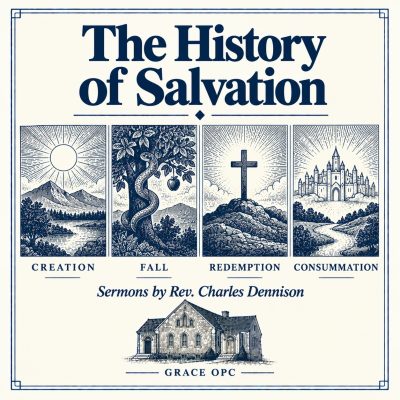
This sermon is from the Rev. Charles G. Dennison sermon archive, part of “The History of Salvation” series, and was preached at Grace Orthodox Presbyterian Church in Sewickley, PA, during a worship service on Sunday, September 23, 1990.
Tonight our scripture reading begins in John’s Gospel, the first chapter, beginning with verse one. In the beginning was the Word, and the Word was with God, and the Word was God. He was in the beginning with God. All things came into being through him, and apart from him nothing came into being that has come into being. In him was life, and the life was the light of men.
And the light shines in the darkness, and the darkness did not comprehend it. There came a man sent from God whose name was John. He came for a witness, that he might bear witness of the light, that all might believe through him. He was not the light that came that he might bear witness of the light. There was the true light, which coming into the world enlightens every man. He was in the world, and the world was made through him, and the world did not know him. He came to his own, and those who were his own did not receive him.
But as many as received him, to them he gave the right to become the children of God, even to those who believe in his name. who were born not of blood, nor of the will of the flesh, nor the will of man, but of God. And the Word became flesh and dwelt among us, and we beheld His glory, glory as of the only begotten of the Father, full of grace and truth.”
And then turning over to Matthew’s Gospel, the first chapter, Now, the birth of Jesus Christ was as follows. When his mother Mary had been betrothed to Joseph before they came together, she was found to be with child by the Holy Spirit. And Joseph, her husband, being a righteous man and not wanting to disgrace her, desired to put her away secretly. But when he had considered this, behold, an angel of the Lord appeared to him in a dream, saying, Joseph, son of David, do not be afraid to take Mary as your wife, for that which has been conceived in her is of the Holy Spirit. And she will bear a son, and you shall call his name Jesus, for it is he who will save his people from their sins.” Now, all this took place that what was spoken by the Lord through the prophet might be fulfilled, saying, Behold, the virgin shall be with child, and shall bear a son, and they shall call his name Immanuel, which translated means God with us. And Joseph arose from his sleep, and did as the angel of the Lord commanded him, and took her as his wife, and kept her a virgin until she gave birth to a son, and he called his name Jesus. Now, after Jesus was born in Bethlehem of Judea in the days of Herod the King, behold, Magi from the East arrived in Jerusalem.
I’m then turning over to Luke’s gospel, second chapter, beginning at verse 41. This is Luke 2, beginning at verse 41. And his parents used to go to Jerusalem every year at the Feast of the Passover. And when he became twelve, they went up there according to the custom of the Feast.
And as they were returning, after spending the full number of days, the boy Jesus stayed behind in Jerusalem and his parents were unaware of it. But supposed him to be in the caravan and win a day’s journey. And they began looking for him among their relatives and acquaintances. And when they did not find him, they returned to Jerusalem looking for him. And it came about that after three days they found him in the temple, sitting in the midst of the teachers, both listening to them and asking them questions. And all who heard him were amazed at his understanding and his answers. And when they saw him, they were astonished.
And his mother said to him, Son, why have you treated us this way? Behold, your father and I have been anxiously looking for you. And he said to them, Why is it that you were looking for me? Did you not know that I had to be in my father’s house? And they did not understand the statement which he had made to them. And he went down with them and came to Nazareth. And he continued in subjection to them. And his mother treasured all these things in her heart. And Jesus kept increasing in wisdom and stature and in favor with God and men.
Let’s pray again. Father, we glory in the ministry of your word to souls that are anxious and receptive. We pray, Lord, that you might bless us with your word. And also, may we see the service of your word multiply. We thank you, our God, for those called amongst your people who have a particular calling for service.
We therefore pray for the deacons of the Church of Jesus Christ and may they serve with distinction. May they give themselves selflessly for the sake of others and may the very patterns of Christ’s gift of himself be found in them. And may it please you Lord to grant them many blessings and to reward them, Lord, with kindness. And may the treasures which they lay up in heaven be those that are well regarded by you and by the hosts assembled there.
We pray for your church throughout the world that the living stones may be tended and cared for well. by these ministers, these servants that you have raised up for that very purpose. This we ask in Jesus’ name. Amen. Well, we have a lot of ground to cover tonight, but it is familiar ground for us.
When the Son of God came to earth for our salvation, the world was ready. The world had been prepared, not just because of that unity that existed due to the extensiveness of the Roman Empire. nor because of the pervasive influence of Greek culture that acted as a unifying influence throughout the entirety of that empire, nor because of the Jewish dispersion throughout much of the known world at that time. The world was ready, yes, because of those things, but because of other things as well. The world was ready in that Roman might, power, Greek sophistication and wisdom, and Jewish religious arrogance had reached that point concurrently where they provided the perfect background for the unveiling of God’s perfect, wonderful salvation.
God’s Son. would confound the power of Rome through weakness. God’s Son would confound Greek wisdom through so-called foolishness, the foolishness of God. God’s Son would confound the Jews through the religion, the perfection, of the religion of the Spirit, or the Holy Spirit. And at each of these points, the Son’s triumph is one and the same, manifest, exhibited principally in his crucifixion and then in his resurrection.
How extraordinary a figure. And the world had hardly guessed how extraordinary a figure. For in this figure we have no mere religious genius, no towering spiritual champion, not just another figure like one of those Old Testament heroes of the faith. In actual fact, as you know, he who comes is himself God. God in the flesh. John’s prologue. And here’s John 1, verses 1-18, gives us ample testimony to this fact. Here, John, the inspired writer, tells us that the Word itself has eternity.
In the beginning was the Word. The Word has eternity. that the Word accompanies God, has fellowship with God, and is capable of standing alongside of Him. In the beginning was the Word, and the Word was with God. But this Word Even though it can be spoken of as that which accompanies God capable of standing alongside of Him, this Word is itself God. In the beginning was the Word, and the Word was with God, and the Word was God.
John’s image here of the Word, calls attention to the fact that God, think of it now, think of it now, that God is eternally self-expressive. Even within himself there is communication. God is eternally self-expressive. And that expression, while originating from God, is capable of going forth from Him and standing beside Him, as it were. That expression is capable of being with Him. And that expression that comes forth from God, even though it comes forth from Him, it goes forth from Him, is nonetheless God.
The Word was in the beginning, it was with God, it was God. Indeed, then, the Word, God’s self-expression, or if you will, as he is described for you there in verse 14 of chapter 1, the only begotten of the Father. This Word became flesh in the person of Jesus Christ and tabernacled, that is, dwelt among us. And in this form, then, as he comes to us in Jesus Christ, the Son veils God’s inner being, which no man can see at any time, but he, the Son, in the veil of his own flesh, coming forth as he does from the very heart of God, the bosom of God, declares God and now makes God known. if you wish to run down to verse 18 of that first chapter in John. Powerful stuff. Incomparably so. Not just another spiritual hero, like what we find in the pages of the Old Testament. Jesus Christ, therefore, is very God of very God. Do you worship Him as such? Do you not sing praises to Him as God? Do you not address Him as God? Do you not ascribe to him the power of God. Is not this one who has come for your salvation God himself in the flesh? Yes, very God of very God. But at the same time, Fully man. Utterly distinct. Do we need convinced of that? Utterly distinct, yet sharing in our common life. Very God of very God, yet fully man.
And don’t the stories of his birth make this fact plain. a testimony of Matthew and Luke. There is no record of his birth in the Gospel of Mark. I think that you knew that. So it’s Matthew and Luke that we’re concerned with now as we consider the story of Christ’s birth. The joint testimony of these two inspired writers is this. The one who comes forth is virgin born. Think of it, virgin born.
One who does not descend by ordinary generation. One who is thoroughly, completely, utterly distinct. Not even those of the Old Testament, those extraordinarily born like Isaac and Samson and Samuel, can claim to have such a birth as this. So in this birth, Jesus is set apart as utterly unique. Yes, one who comes, God himself in the flesh. But at the same time, what else is proclaimed by these birth stories? Jesus’ birth is common with all other births. Distinct, yet common. Divine, yet human. God, yet man.
What do you judge of Mary’s pregnancy? Like any other pregnancy? Of course. Did she experience the common discomforts? Did she experience the pain as do other women? Of course. A birth common with other births. For this one who is born, is fully human.
And what of Jesus, the babe? I know the habit. Out of some traditions, and out of the romanticized Protestantism of the last century, Jesus, according to these perspectives, never whimpered, never cried. never expressed any discomfort of his own. Well, that’s a completely unrealistic picture of Jesus the babe. While he is God, yet he is man, and he is a babe like all other babes. Does Jesus the babe cry?
Why, sure. Does Jesus the babe become hungry and thus? Of course, by all means, for he is fully human. The testimony then, whether we are in John’s gospel or in Matthew or Luke, is one. The one who comes forth for us and for our salvation is divine deity, God himself, and yet man.
How we stand upon this foundation against the multiple threats that had been risen, that had been raised against it. The cults invariably deny it. That’s why John Gershner, a number of years ago, declared that liberalism was a cult. Because liberalism, in fact, denied the eternal deity of the sun. and the essential deity of Jesus Christ, God in the flesh.
Well, as to the revelation with respect to the birth of Jesus now, Luke is the one who introduces us to the first wave of that revelation from a chronological point of view. He tells us of the advent, the coming of the Messiah’s forerunner. He’s the one that offers us this information. It’s in the Gospel of Luke that we find out about the birth of John the Baptist. Chapter 1, verses 5 through 25, and then again, verses 57 through 80. It’s a very long chapter, isn’t it? You know some of the features.
John was born of a Levite home. He was the son of a priest, Zacharias his father of the tribe of Levi, Elizabeth his mother. These two had had no children. Then comes this wonderful birth of John. You remember the events surrounding John’s birth, the appearance of the angel Gabriel, the curse that falls upon Zachariah as he’s ministering in the temple because of his unbelief. Then there’s Elizabeth’s pregnancy, a marvelous thing in itself, for she in her womb was as good as dead. Then there’s the naming of the child, and finally, the restoration of Zachariah and his magnificent song. Those features, with respect to John the Baptist coming to us, so beautifully told in Luke’s Gospel. But before John was born, there was the fulfillment of that promise of the one who is greater than John, that one who would then come after him. We have that in Luke chapter 1, verses 26 through 56.
Here, once more, the angel is in view. Gabriel, the same angel, visits Nazareth in Galilee and announces to a humble maid by the name of Mary that God’s Son will be born to her. And she, unlike Zechariah, proves the embodiment of faithfulness in Israel, accepting the Lord’s will for her. She then travels to the field country of Judea, visits her cousin Elizabeth, and there breaks forth in song of praise to God for what is accomplished by him through her.
Now we turn to Matthew. We’ve heard much about Mary in Luke’s Gospel, and in Matthew we hear much about Joseph. So the emphasis falls upon Joseph in the one Gospel, and upon Mary in the other. But here in Matthew’s Gospel, then, we read about Joseph in the passage we’ve read this evening, chapter 1, verses 18 through 25. And there we hear about his attitude, for if Mary has proved to be faithful, the embodiment of faithfulness of Israel likewise chosen.
Obviously distraught over Mary’s condition, he fears for her future and her well-being. But his fears are quieted. by an angel’s visit who gives explicit instruction to him concerning Mary, and also concerning the child whom he is to name. And you remember the name. He shall call his name Jesus, for he it is who shall save his people from their sins.
Is there any verse like that verse? Matthew 1, 21. And to this verse, this consideration from the angel. Now, Matthew adds, as he continues, his own note concerning that prophecy from Isaiah 7, verse 14, that one concerning the virgin that would conceive and bring forth a child.
The name given to that child being Immanuel, which is now literally fulfilled. in the person of the Messiah, who is God with us. No little child running around the streets of Jerusalem during the days that He has. No, the literal fulfillment of the manual. God with us. Now Matthew doesn’t give us many details of the birth, We are told that Jesus is born in Bethlehem there at the opening up of the second chapter of Matthew. Actually, we have to turn again to Luke for the details of Jesus’ birth. You remember the trip by Mary and Joseph from Nazareth to Bethlehem?
That because of the edict of Augustus? Was he really ruling the world? Is the true ruler Augustus, or is it God? Is he directing affairs from on high? Well, they make their way to Bethlehem, as you know. There is the birth there in the stable. The child is placed in a manger. You know what a manger is, don’t we? A trough for feeding cattle.
Humble beginnings for the one who is God, but also man. The humility of this birth is accented by what follows, the arrival of shepherds, humble shepherds from the hillside to worship Him. Thus the poor inauspicious beginnings of our Savior in this world forecast what lies ahead for Him. Humiliation. Poverty. The son of man has nowhere to lay his head. His identification with God’s righteous poor. He makes himself poor so that we might become rich. Well, if there is this concentration in Luke upon poverty and humility, in turning to Matthew once again, we find a concentration upon glory.
Magi. Kings from the east arrived in Jerusalem, seeking out the child for the purpose of worshipping him, for they had seen his star in the heavens.” Matthew 2, verses 1-12. Their service, the service of these Gentiles, the service of these Gentile rulers, who now have come from the ends of the earth, as if they had come from the ends of the earth.
Their service contrasts Herod’s scheming and his butchery, recorded for you in the latter part of that second chapter in Matthew. Jesus is whisked away to Egypt, Joseph having been warned in a dream, And then there follows the slaughter in Bethlehem, the slaughtering of the males in Bethlehem, and the whisking away of Jesus to Egypt signal a new exodus out of Egypt, I have called my son. And in this new exodus, Judea itself will prove to be just as much Egypt as Egypt herself. But before that departure into Egypt, enter Luke once more with material of his own. Luke chapter 2, verses 21 through 38.
Here we see Jesus’ parents and Jesus himself Submissive to the law, Jesus on the eighth day, circumcised, then brought to the temple according to the purification rites of Israel. While he is there, he becomes the center of attention to two figures that are also frequenting the temple precincts.
One Simeon, the other Anna, who recognize him now as the Lord’s Christ, Let now my servant depart in peace, for I have seen the salvation of the Lord.” Sunnian, also being a prophet, proclaims what lies ahead for Jesus, but also for his mother. Sufferings are in the future. But through him, through this one, many in Israel will fall, but also rise.
Jesus was a wonderful child, we are told by Luke. Moving on then from that 38th verse, verses 39 and 40 in Luke 2, but one who in the temple when he was 12 acknowledges his true calling, verses 41 through 52, which we’ve read this evening. He is a devoted son to Mary and Joseph. He will fulfill and honor the commandments But true devotion is to his Father above, and he will serve his Father for the sake of the true temple, the house of God, into which we, God’s people, are brought.
Along with that theme, then, of poverty and humility that we see repeatedly in the story of Jesus’ birth in Luke’s gospel, there will be an emphasis upon the temple, an emphasis that we don’t find, for instance, in Matthew’s gospel. As a matter of fact, Luke’s gospel begins with a scene in the temple, Zacharias, and ends with a scene in the temple, with the disciples themselves in the temple, praying and worshiping there. All of this to the end that the temple itself will be transformed. The true temple appear, nothing else than the house of God into which we are brought.
And that through the death and resurrection of Jesus Christ, this one who is born, is Lamb of God. He is final offering and sacrifice, not for the sake of shedding his blood upon an altar in the temple in Jerusalem, but for the sake of bringing his blood into the heavenly temple and the sanctifying of things there. so that we might have access to the ultimate temple of God, the house that is eternal, not made with hands. That, through Christ’s death, but also His resurrection. We, united to Him, are being built up into a holy temple through the Spirit of our God. And we are performing service, service like unto the service He performs, for we are in Him. Amen.
The sermon text provided above is derived from the sermon audio recording making use of generative tools. It has not been manually edited. While transcription tools have a high degree of accuracy, the output may include generative textual, punctuation, and/or formatting errors.