The sermon text provided below is derived from the sermon audio recording making use of generative tools. It has not been manually edited. While transcription tools have a high degree of accuracy, the output may include generative textual, punctuation, and/or formatting errors.
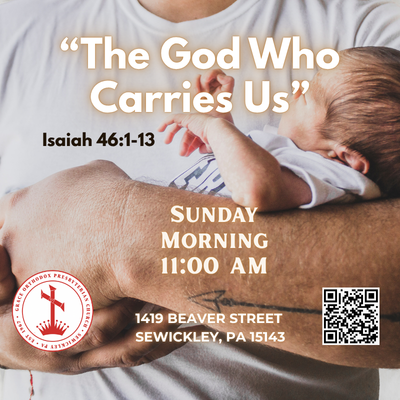
The title of my sermon this morning is The God Who Carries Us. Children, there are five key words I would like you to listen for today: irony, idolatry, power, salvation, and stubborn. Friends, today we often hear complaints about the loss of civil discourse in our society. These complaints come from academics, journalists, and various public speakers. This concern is significant when you consider the reality of our time. We live in a period of deep division.
In our divided times, basic politeness, common courtesy, and the ability to engage in calm, respectful dialogue with those who hold different views seem to be increasingly rare in our culture. At the same time, modes of communication such as harsh sarcasm, bitter and aggressive criticism, and hostile hostility have become so common that the use of words to harm others has lost its power to shock. I am old enough to remember a time when the way people, even Christians, spoke to one another—especially online—would have been considered shocking thirty or forty years ago. But that behavior is now commonplace.
Now, I suspect that a major contributing factor to this loss of civil discourse is the conversational culture created by social media. On many websites, people can go to the comments section and make harsh personal attacks on strangers using a computer keyboard or phone. These attacks often occur in secrecy, with individuals hiding their identity behind a vague username that provides near-total anonymity. Well, pastor, are you here to give us a sermon against technology? No. I am not opposed to technology, and I am certainly not against the responsible use of social media. It can be a positive tool when used properly. Of course, I recognize that there is a place for sharper forms of communication, such as irony and sarcasm.
In fact, as we will see in just a few moments, God himself, in his word, sometimes uses these sharp forms of communication to make his point, to confront his people with their sin, so that they may turn back to him in repentance, and to warn the wicked of their sinful ways. However, having said that, let us remember, brothers and sisters, before we begin our text for today, that as followers of Jesus Christ, we should always maintain a tone of gentleness and respect in our communication, even toward those who do not believe. This is especially important when we are sharing the gospel of our Lord and Savior, Jesus Christ. I would remind us of what the Apostle Peter wrote to persecuted Christians. In 1 Peter 3, verses 14 through 17, he says, that even if you suffer for righteousness’ sake, you will be blessed.
Have no fear of them, nor be troubled. But in your hearts, honor Christ the Lord as holy. Always be prepared to make a defense to anyone who asks you for a reason for the hope that is in you. Now, how are we to do that? He says, yet do it with what? Not with harsh criticism or mockery, no. Do it with gentleness and respect, having a clear conscience, so that when you are slandered, those who speak evil of your good conduct in Christ may be put to shame. For it is better to suffer for doing good, if that should be God’s will, than for doing evil.
But dear friends, having reminded us of our Christian duty to pursue holy speech in our communication with others, our passage for this Lord’s Day morning does in fact give us an example of the legitimate use of irony. After all, our passage for this Lord’s Day morning is filled with a tone of irony, as the Holy Spirit, through the prophet Isaiah, uses clear and forceful language to expose the foolishness of idolatry, the emptiness of idol worship, the spiritual blindness of idolaters, and also to call God’s people back into a relationship and loyalty toward their incomparable God. If you have read through the book of the prophet Isaiah, you will remember or recognize that, especially in this latter section of Isaiah, Isaiah often engages in what might be called an anti-idolatry argument, where he uses strong language to confront the foolishness and emptiness of idolatry. And our passage for this Lord’s Day morning represents a climax in Isaiah’s anti-idolatry or anti-polytheistic argument. In this argument, Isaiah draws a sharp contrast between, on the one hand, powerless, helpless idols, such as the idols of Israel’s oppressors, the Babylonians, on the one hand, idols which must themselves be carried.
And on the other hand, there is the one true and living God of Israel, the God who carries us, his redeemed people. As we turn our attention to our text for today, we first learn here about the powerlessness of idolatry. The powerlessness of idolatry. Let us look at the first two verses. Isaiah begins this chapter as follows.
He says, “Bell bows down, Nebo stoops, their idols are on beasts and livestock. These things you carry are borne as burdens on weary beasts. They stoop, they bow down together. They cannot save the burden, but themselves go into captivity.” Now, if you are a careful Bible reader, what kinds of questions should enter your mind as you read this passage? First, you should ask yourself, who is Bel? Who is Nebo?
What is Isaiah referring to by these two names? The name Bel was equivalent to the Canaanite deity Baal. Here, Bel probably refers to Marduk. Marduk was sometimes called Bel Marduk. Bel Marduk was the patron god of the great empire of Babylon in the ancient world.
What about Nebo? Or sometimes Nebo is referred to as Nabu. Nebo, or Nabu, was the son of Marduk. He was the chief deity of Borsippa, which was located south of Babylon. Nabu was believed to be the god of learning, the god of writing, and therefore he was a favorite god among the intellectual classes in Babylon. In the religious life of Babylon, the images of both Bel and Nebo, or Nabu, were commonly honored by being transported in religious processions.
They were exalted and carried about in religious processions so that they might be honored. Is that what is happening in our passage for today? No. In this passage, the chief gods of the great Babylonian empire are depicted not as being raised up and carried about in religious processions. No, they are depicted as being bowed down in utter humiliation and dishonor. As they are transported, not in celebratory religious processions, but instead carried away by weary beasts of burden into captivity.
And as they are taken into captivity, they will go into oblivion. How many worshipers of Baal and Nebo do you know today? Where is the religion of ancient Babylon today? I am sure that if you do an online search, there might be some cults that acknowledge ancient Babylonian deities, some neo-pagan groups that recognize these gods, but the worship of Bel and Nebo is no longer practiced. They have gone into captivity; they have gone into historical oblivion.
All of this implies, beloved, the Lord’s hand of judgment. The Lord’s hand of judgment would fall upon the Babylonian empire and its so-called gods. In the ancient Near East, it was believed that as it went with the gods of the nation, so it would go with the nation itself. And as these gods were carried away on beasts of burden into captivity, so the people of Babylon would themselves go into captivity. Consider this: the Babylonians, as Isaiah the prophet declared through the spirit of prophecy, predicted that one day Judah would go into Babylonian captivity. Babylon was used as an instrument of God’s judgment against His faithless, covenant-breaking people, and they were taken by the Babylonians into captivity. Jerusalem and its temple were destroyed, and the people were taken into Babylonian exile. But the nation that God had used to take His faithless people into exile would itself one day be judged by God and would be taken into captivity.
And so we have the irony of it all. Again, Isaiah had prophesied that the Babylonians would one day conquer Judah and take God’s faithless people into exile. They would one day be conquered by another king, a great king, King Cyrus, whom we learned about on the last Lord’s Day. That King Cyrus would conquer them, and they would themselves be taken into captivity.
Again, look at verse two, as the deities of the great empire of Babylon are depicted as being bowed down in utter humiliation and defeat. It says, “They stoop, they bow down together; they cannot save the burden.” These gods cannot save the burden of their images, which are being carried upon weary beasts of burden, while themselves go into captivity.
Now let us consider the significance of Babylon. It was a major power in the ancient Near East. It was a force to be reckoned with, but the Lord ultimately defeated Babylon. Yet as we compare Scripture with Scripture, we learn that Babylon in Scripture came to represent not only the ancient empire of Babylon, but also more generally the fallen world system of humanity as it is organized in rebellion against God. Therefore, Bel and Nebo represent not only ancient Babylonian religion, but also the religion of fallen humanity.
We see this, for example, in the book of Revelation. Revelation 18, verses one to three, also mentions Babylon. Here the Apostle John, under the Spirit’s inspiration, mentions Babylon, even though Babylon had been destroyed centuries before. Yet the name Babylon came to represent something broader. It says in Revelation 18, one to three: “After this I saw another angel coming down from heaven, having great authority, and the earth was made bright with his glory, and he came out with a mighty voice.”
Fallen, fallen is Babylon the Great. She has become a dwelling place for demons, a haunt for every unclean spirit, a haunt for every unclean bird, and a haunt for every unclean and detestable beast. Notice the emphasis on unclean. Consider the significance of ceremonial uncleanness under the old covenant. This represented separation from God and God’s holiness.
Thus, this Babylon represents humanity in its unclean, fallen state, in rebellion against God. Verse three says: “For all nations have drunk the wine of the passion of her sexual immorality, and the kings of the earth have committed immorality with her, and the merchants of the earth have grown rich from the power of her luxurious living.” Because Babylon came to represent, in a broader sense, fallen humanity’s religion and rebellion against God, I believe it is legitimate to infer from our passage today that the Babylonian gods Bel and Nebo symbolize the religion of fallen humanity. These so-called gods not only burden the beasts that carry them, but they are powerless to carry the weight of their own images, let alone the burdens of their worshipers.
Now let us move to verse six. Speaking of those who worshiped Bel and Nebo and similar idols, the text says: “Those who lavish gold from the purse and weigh out silver in the scales hire a goldsmith, and he makes it into a god.” Then they fall down and worship. Here, friends, we see the irony and vanity of idolatry. The worshipers of idols—consider this—they are bowing down to what? They are bowing down before the work of their own hands. Even though they adorn this work with precious metals such as gold and silver, it remains the work of their own hands. They have paid a goldsmith to create these gods, and then they bow down before the products of their own labor. What foolishness, what utter folly, what complete vanity.
Isaiah gives a similar anti-idolatry argument a few chapters earlier, in chapter 44, verses 9 through 20. Although I did not preach through that passage, I would like to read it now, because it is clear and straightforward. Let us return to Isaiah 44 and read verses 9 through 20. As I read, I want you to notice the tone of sarcasm as the Lord confronts the foolishness and emptiness of idolatry. Isaiah 44, beginning at verse nine.
All who fashion idols are nothing, and the things they delight in do not profit. Their witnesses neither see nor know, so that they may be put to shame. Who fashions a god or casts an idol that is profitable for nothing? Behold, all his companions shall be put to shame, and the craftsmen are only human.
Let them all assemble, let them stand forth. They shall be terrified, they shall be put to shame together. You can see here, can you not, that the Lord strongly opposes idolatry? God is offended by the worship of false gods. He alone deserves our worship. The passage continues in verse 12: the ironsmith takes a cutting tool and works it over the coals. Here the text describes the process of making idols. The ironsmith takes a cutting tool and works it over the coals.
He fashions it with hammers and works it with his strong arm. He becomes hungry and his strength fails. He drinks no water and is faint. Thus, he engages in hard and laborious work to produce this idol. Verse 13: the carpenter stretches a line. He marks it out with a pencil. He shapes it with planes and marks it with a compass. He shapes it into the form of a man, with the appearance of a human being, to dwell in a house. He cuts down cedars, or he chooses a cypress tree, or an oak, and lets it grow strong among the trees of the forest. He plants a cedar, and the rain nourishes it.
Then it becomes fuel for a man. He takes part of it, and here is the irony: he takes part of it and warms himself. He kindles a fire and bakes bread. Also, he makes a god and worships it. He makes an idol and falls down before it. Half of it he burns in the fire. Over the half he eats meat. He roasts it and is satisfied. Also, he warms himself and says, “Aha, I am warm. I have seen the fire.”
And the rest of it he makes into a god, his idol, and falls down to it and worships it. He prays to it and says, “Deliver me, for you are my God.” And here, Isaiah confronts the utter spiritual blindness of those given over to idolatry. He says, “They know not, nor do they discern, for He has shut their eyes so that they cannot see, and their hearts so that they cannot understand.”
No one considers, nor is there knowledge or discernment to say, “Half of it I burned in the fire, I also baked bread on its coals, I roasted meat and have eaten, and shall I make the rest of it an abomination? Shall I fall down before a block of wood?” He feeds on ashes. A deluded heart has led him astray, and he cannot deliver himself or say, “Is there not a lie in my right hand?”
Beloved, again, we see the vanity and irony of idolatry. But then verse seven of our passage, after this idol is built, what must be done with it? Can it move of itself, of its own volition? No, it says in verse seven, they lift it to their shoulders, they carry it. They set it in its place and it stands there. It cannot move from its place.
If one cries to it, it does not answer or save him from his trouble. Like their images, which must be secured in place and made immovable, the so-called gods of these images are supposed to represent, those gods are actually powerless to act, powerless to save. Why? Because of the simple fact that they do not really exist. They are utter vanity.
Now again, this is very plain and simple Bible truth to those of us who know Christ and believe God’s word. But this was truth that needed to be declared even among the professed people of God in Isaiah’s day. What are some of the things that we can learn from our passage for today? First of all, friends, just as man-made idols must be carried by their makers because they are powerless, so man-made religion is powerless to save.
Religion is not a good thing when we speak of man-made religion. In fact, religion of this kind is positively harmful. It is, in fact, damnable. Man-made religion can save no one. It can only confirm unrepentant sinners in their sin. In fact, all man-made religions only end up burdening those who choose to follow them, just as Bell and Nebo burdened the poor beasts that had to carry them off into captivity. Why then do so many choose false religion? Because the human heart is dark and proud. Man-made religion caters to the pride of fallen man.
It tells fallen man that he can do something to achieve his own salvation. He can achieve whatever the goal of the religion is—nirvana, or salvation, or paradise—by his own efforts, or at least in part by his own efforts. But the true and living God says in His word: “No, we cannot save ourselves. It is all of God, all of grace. It comes from the divine initiative alone.” That is what the gospel means. That is why the gospel is good news. It is good news because we cannot save ourselves. The good news is that what we cannot do, Christ has done for all who trust in Him. To reject the Gospel of Jesus Christ in favor of man-made religion is to reject true spiritual liberty for a burdensome bondage and spiritual slavery.
While the Apostle Paul in Galatians chapter five was not confronting technical idolatry, he was confronting the Judaizing heresy, which was a false gospel. This false gospel pointed people to their own keeping of the law rather than to Christ. And insofar as people were pointed to themselves, the Judaizing heresy was in fact idolatrous. But what does Paul say in Galatians five?
He says, “For freedom, Christ has set us free.” Christ frees you, brother or sister, from the guilt, the penalty, and the power of sin. He has already freed you. You are forgiven, as I mentioned earlier in the service. The sin that was against you has been nailed to the cross. It has been buried in His tomb. It has been cast into a sea of forgetfulness. You are free in Christ. Paul says, “For freedom, Christ has set us free.”
Therefore, stand firm and do not submit again to a yoke of slavery. Do not submit to man-made religion, to works righteousness, or to idolatry in any of its forms, whether crude or sophisticated. Let us not reject the gospel, because in rejecting the gospel, we reject liberty and choose enslavement. Another thing we learn from our passage for today is that all idolatry and man-made religion ultimately represents the worship of the self. For to worship an image fashioned by the imagination and hands of man is ultimately to worship man.
Isaiah gives us some detail about those who fashion these idols in verses six and seven. They lavish gold from the purse, they weigh out silver in the scales. There is great planning that goes into it. There is skilled artistic work by the goldsmith that goes into it. It is fashioned by the imagination, art, and labor of man.
And so ultimately, it is about man, not about the true and living God. Now we live in a day when there is much secularism. Secularism pervades our society today. And sometimes it is called secular humanism, where man has made himself the measure. Man and man’s reason are exalted as the highest authority.
But there is also religious idolatry. Religious idolatry is ultimately godless humanism disguised as religion. All idolatry is ultimately the worship of self. While false gods are incapable of acting, incapable of carrying their worshipers, incapable of saving, the true and living God, the God of Abraham, Isaac, and Jacob, the blessed triune God revealed in the scriptures and confessed by us Christians, is the God who acts.
He is omnipotent, all-powerful. He is able to accomplish all His holy will, and He is powerful to deliver, powerful to save. Because He is the true and living and omnipotent God, He does not need to be carried by us, His worshipers. No, brothers and sisters, He is the God who carries us.
This brings me to my next point, as we consider the power of the living God. We have considered the powerlessness, the impotence of idolatry and of idols. Now let us consider what we learn here about the power of the living God. Look at verses three and four. God confronts His people.
He says, “Listen to me, O house of Jacob, all the remnant of the house of Israel.” When God says, “Listen,” it is time to pay attention, time to hear, not merely with the ears, but to hear God’s word so that we may trust and obey it. “Listen to me, O house of Jacob, all the remnant of the house of Israel, who have been born by me from before your birth.”
See, God is saying, you do not need to carry me. You have been born by me from your birth, carried from the womb, carried from the womb. This is one of the most comforting verses, to me at least, in the book of Isaiah, verse 4. The Lord says, “I will carry and will save.” If God says, “I will,” He means it. He will, because He is able to do it.
Here again, Isaiah clearly shows the sharp contrast between the Babylonian gods, which had to be carried, and the true and living God of Israel, who has carried His people from before their birth. Notice, by the way, the maternal imagery used here.
Certainly, God is our loving and gracious Father in heaven. The Trinity includes God the Father. We do not have the right to change such designations. God is our Father in heaven. Yet our Heavenly Father is not only a God who protects and provides for us; He is also a God who has a maternal love for us. He is a Father in heaven who nurtures, carries, and comforts us. What comfort there is in this truth.
Then the Lord says in verse five, “To whom will you liken me, and make me equal?” The people of God had wandered away from the Lord. They had turned after and worshiped the gods of the nations, such as Bel and Nebo, and many of them fell into the worship of these gods. But the Lord asks them, “To whom will you compare me? To whom will you liken me and make me equal?”
You cannot make a likeness of me. This is one reason why, in the second commandment, God says, “You shall not make for yourself a carved image, or any likeness of anything that is in heaven above, or that is in the earth beneath, or that is in the water under the earth.” Any image that humans make of God does not reflect the infinite glory and majesty of God, no matter how artistically elaborate the artwork may be. God cannot be compared to any created thing, especially not to dead, lifeless, powerless, non-existent idols, for He is the incomparable one.
Then, skipping down to verse eight, as God continues to confront His people, He says, “Remember this and stand firm. Recall it to mind, you transgressors.” God calls His people, “you transgressors.” You see, God’s people had repeatedly broken His covenant by worshiping the idols of the nations.
So here God confronts them honestly and forthrightly with their sin. However, at the same time, He does not confront them to crush them. His motivation in confronting them and in using this biting irony throughout this chapter is not to crush or destroy His people, but to restore them. He is motivated by love when He confronts them. Here, God confronts them with their sin.
At the same time, He graciously summons them to remember their God and His grace to them in the past. Then He says in verse nine, “Remember the former things of old.” What is He talking about there, the former things of old? Well, Isaiah does not say directly, but such things would include God’s gracious call to Abraham and God’s deliverance of His enslaved people, Israel, when they were slaves in Egypt under Pharaoh. These are the former things that they are to recall, that they are to think upon, so that their faith might be renewed.
And brothers and sisters, this is why we come together, Lord’s Day after Lord’s Day, because we are so forgetful. This is why Jesus gives us the Lord’s Supper, where He says, “Do this in remembrance of Me.” We need to call to mind what the Lord has done for us in the past. The Lord who has acted for the salvation of His people in the past is the God who is still with us in the present.
Here God asserts in this passage His sole unique godhood, and by implication, we have a dogmatic denial of polytheism and idolatry in all of its varied forms, whether we are speaking of its ancient crude forms or more sophisticated secular forms. God says, “Remember the former things of old, verse nine, for I am God and there is no other.” Is that plain enough?
He says I am the one, there is no other God. I am God and there is no other. I am God and there is none like me. Declaring the end from the beginning. The proof that He is the only true God is found in predictive prophecy. He declares the end from the beginning, for He has planned the end from the beginning. He is the sovereign God. And from ancient times, He speaks of things not yet done, saying, “My counsel shall stand, and I will accomplish all My purpose.” He calls a bird of prey from the east—that is a reference to Cyrus, the king of Persia, the man of My counsel from a far country. I have spoken, and I will bring it to pass. I have purposed, and I will do it.
God can say this because He is the living God. He is not like the idols. He is the living, sovereign, omnipotent God. But the idolaters have denied this God. What is it that motivates such idolatry? Briefly, we are reminded of what the Apostle Paul writes about idolatry in Romans chapter one. I will read a few verses here: Romans 1, 18 to 25.
For the wrath of God is revealed from heaven against all ungodliness and unrighteousness of men, who by their unrighteousness suppress the truth. For what can be known about God is plain to them, because God has shown it to them. For His invisible attributes, namely His eternal power and divine nature, have been clearly perceived ever since the creation of the world in the things that have been made. So they are without excuse. General revelation, God’s revelation in creation and conscience, makes it abundantly clear that the true and living God is, and everyone knows it in their heart of hearts—even the most vocal atheist who claims, “No, there is no God.” They know in their heart of hearts, because they were created in the image of God.
But what is the dynamic of idolatry that Paul describes? He says in verse 21, although they knew God, they did not honor him as God or give thanks to him, but they became futile in their thinking and their foolish hearts were darkened. Claiming to be wise, they became fools and did what? They exchanged the glory of the immortal God for images resembling mortal man and birds and animals and creeping things. Therefore God gave them up in the lust of their hearts to impurity and so forth. And he says, they exchanged the truth about God for a lie and worshiped and served the creature rather than the creator, who is blessed forever.
Amen. Let not the people of God fall into that kind of error. But verse 11 is particularly comforting, because again, Isaiah, through the spirit of prophecy, predicts a time when the people of God will go into Babylonian captivity. But in this passage, he comforts the people of God, both in his day and in the days of the exile. There will be a change. God will bring deliverance because God will call a bird of prey from the east, the man of my counsel from a far country.
He says, I have spoken, I will bring it to pass. I have purposed, I will do it. I will deliver. I am not going to leave you alone and abandon you entirely in your Babylonian exile. I am arranging for your return. And he will use Cyrus, the king of Persia, who would conquer the Babylonians and pave the way for the Jewish exiles to return to the promised land.
We learn in this passage, especially in verse 10, where he says, my counsel shall stand and I will accomplish all my purpose. God’s sovereign counsel shall stand. I am reminded again of what Paul said in Ephesians 1, verse 11, where he is talking about predestination. But Paul says this.
He says, in Him—that is, in Christ—we, the believers, in Christ, have obtained an inheritance, having been predestined according to the purpose of Him who works all things according to the counsel of His will. He is able to work all things according to the counsel of His will because He is the living God, the all-powerful God, and we can trust in Him. Here are a few takeaways from this point.
First, God is the incomparable one who carries His people. In union with our Lord and Savior, Jesus Christ, our gracious God and heavenly Father, carries us. Therefore, dear listener, do not look to the false gods of man-made religion, philosophy, or ideology to carry you, for they cannot carry anything. They are dead, they are vain, they are lifeless. Instead, look in faith to the true and living God, revealed in His Son, the Lord Jesus Christ, who died for sinners and rose from the dead, so that all who trust in Him may not perish, but have everlasting life. Unlike the powerless deities of paganism, the true God is all-powerful, and therefore He is able to carry out all of His holy will. Let us, brothers and sisters, therefore, trust in Him. But what about the people of God?
They are confronted in this passage by God as transgressors. Their hearts are stubborn. Their necks are stiff. This brings me briefly to my final point. We see in the closing verses of this chapter that salvation has been brought near to those with stubborn hearts. Salvation is brought near to those with stubborn hearts. The Lord says, “Listen to Me, you who have stubborn hearts.” Again, He is still addressing His people. They have hardened their hearts against the Lord. They are stubborn. They are set in their ways. They have dug in their heels.
But he says, listen to me, you stubborn in heart, you who are far from righteousness. And in this passage, righteousness is a synonym for salvation. You are far from righteousness. You are far from salvation. Listen to me, the Lord says. They cannot bring salvation near to themselves. They cannot attain salvation by their own efforts because they are far from righteousness, far from salvation. But the Lord says, I bring near my righteousness. It is not far off. And my salvation will not delay. I will put salvation in Zion for Israel, my glory.
Here we find hope for the stubborn heart. My friends, the all-powerful sovereign God is able to soften even the most stubborn-hearted. And that should give you and me hope as you think about family or friends or loved ones or neighbors or coworkers in your life who do not know the Lord and who may be stubborn and resistant in their unbelief. That very stubborn one may be one of God’s elect. And God is able to soften that one’s heart.
Remember what he did with the apostle Paul? Saul, the great persecutor of the church, the Lord was able to soften and humble his heart, turning his heart of stone into a heart of flesh. Our sovereign God is able to do the same. He has done that with us. In our stubbornness, he softened our hearts and drew us with the cords of love unto himself.
Let us trust that he will do that with others as we pray for the lost in our lives. Let us not lose hope for them. And let us always put our trust in the sovereign God. Let us pray that God would show his sovereign grace by bringing his salvation near, even to the hard-hearted. Amen, let’s pray.
We thank you and praise you that you are the true and living God. You are not like the gods of the nations that must be carried and that burden their followers. You are the God who carries us, the God who relieves our burdens. Lord Jesus, you are the Savior who says, “Take my yoke upon you and learn from me, for I am gentle and lowly in heart, and you will find rest for your souls.” Grant, Lord, that we on this Lord’s Day would not only enjoy physical rest from our daily activities, but would find our spiritual rest in Christ our Lord, for it is in his name that we pray. God’s people said, amen. Let us close our time of worship by rising and singing together number 485, “Like a River Glorious.”