The sermon text provided below is derived from the sermon audio recording making use of generative tools. It has not been manually edited. While transcription tools have a high degree of accuracy, the output may include generative textual, punctuation, and/or formatting errors.
God’s Word, as we continue our consideration of the book of the prophet Isaiah. This morning we are in Isaiah 44. My sermon text is Isaiah 44, verses 1 through 8. You will find that on page 718 in your pew Bible. Isaiah 44, verses 1 through 8. I will begin reading at verse 25 in the previous chapter, chapter 43, verse 25.
Hear the word of God. I am he who blots out your transgressions for my own sake, and I will not remember your sins. Put me in remembrance. Let us argue together. Set forth your case, that you may be proved right. Your first father sinned, and your mediators transgressed against me.
Therefore, I will profane the princes of the sanctuary and deliver Jacob to utter destruction and Israel to reviling. But now hear, O Jacob, my servant, Israel, whom I have chosen. Thus says the Lord, who made you, who formed you from the womb, and will help you. Fear not, O Jacob, my servant, Jeshurun, whom I have chosen.
For I will pour water on the thirsty land and streams on the dry ground. I will pour my Spirit upon your offspring and my blessing on your descendants. They shall spring up among the grass like willows by flowing streams. This one will say, I am the Lord’s. Another will call on the name of Jacob, and another will write on his hand, the Lord’s, and name himself by the name of Israel. Thus says the Lord, the King of Israel and his Redeemer, the Lord of hosts. I am the first and I am the last. Besides me, there is no God who is like me.
Let him proclaim it. Let him declare and set it before me, since I appointed an ancient people. Let them declare what is to come and what will happen. Fear not, nor be afraid. Have I not told you from of old and declared it? And you are my witnesses. Is there a God besides me? There is no rock, I know not any.
The grass withers and the flower fades, but the word of our God endures forever. Let us pray for the Lord to bless the preaching of His word. Heavenly Father, Your word is powerful. We pray that by Your Spirit, the power of Your word would impact us this morning. We pray that the seed of Your word would find a lodging place in our souls and bear much spiritual fruit in our hearts and lives. And we ask that You would set a guard over my lips, that I, Your unworthy servant, may only declare that which is faithful and true to Your word this morning. For Your glory and for our edification, we pray this in Jesus’ name. And all of God’s people said.
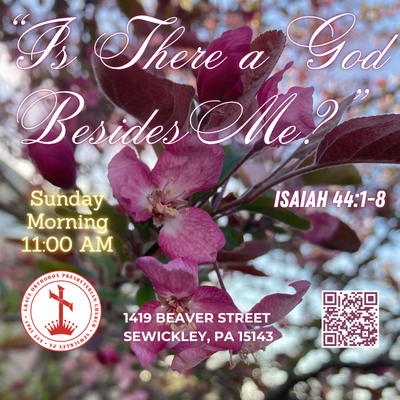
Amen. Amen. Please be seated. The title of my sermon this morning is, “Is There a God Besides Me?” Children, there are three words I want you to listen for this morning. One is a long word: monotheism, which means belief in one God. Then there is blessing, and there is uniqueness. Hear, O Israel, the Lord our God, the Lord is one. These words, known as the Shema, are recorded in Deuteronomy 6, verse 4, and were spoken by the prophet Moses to the Israelites as they were preparing to enter and conquer the promised land.
In these words of the Shema, the Holy Spirit reminds us, as God’s people, of the most basic and foundational truth of our biblical faith: the truth that there is only one true and living God. In other words, the truth of monotheism. Our Westminster Shorter Catechism summarizes this fundamental Bible truth in question and answer number five.
If you are following along in our adult morning instruction class, we just covered this this morning. Those of you who attended the class should know it by heart. The question is: Are there more gods than one? And the Bible-based answer to that question is: There is but one only, the living and true God. So it is indeed basic truth.
But one of the things we have been learning in our study of the book of the prophet Isaiah is that many of the Jewish people in Isaiah’s time, many of Isaiah’s contemporaries, forgot this truth again and again. Like many of these Jewish people in Isaiah’s time, like many of their ancestors, they often forgot this basic truth of divine revelation.
The truth that their God, the God of Abraham, Isaac, and Israel, was the one and only God. Therefore, the implication was that they must worship and serve him alone. Although God had clearly revealed himself in Israel’s history as the one true and living God, and although he had shown the so-called gods of the Gentile nations to be lifeless idols, and although he had instructed his people repeatedly through his law to avoid idolatry and to worship him exclusively, still, in spite of all this, many of the Israelites had compromised with the paganism of their Gentile neighbors. They had compromised by worshiping other so-called gods in addition to worshiping Yahweh, the God of Israel.
As a result of their consistent impenitence and unbelief in going after other gods, the Lord, through his prophets such as the prophet Isaiah, threatened to bring down the curses of the covenant upon his faithless people. The covenant curse would eventually result in the people being driven out of God’s land, the promised land where God dwelt, and being sent away into exile in the pagan land of Babylon.
In fact, Isaiah predicts this historical judgment of Babylonian exile at the end of chapter 43, which I read last week. Just a few moments ago. Chapter 43, verse 28 says, “Therefore, I will profane the princes of the sanctuary.” This refers to the ruling priestly class who oversaw the life of the temple in Jerusalem. He says, “I will profane the princes, the leaders of the sanctuary.”
And how would God do that? Certainly, by the destruction of the temple in Jerusalem. They would have no work then. They would be sent into exile. He says, I will profane the princes of the sanctuary and deliver Jacob to utter destruction and Israel to reviling. So God was going to bring this severe historical judgment upon His faithless, idolatrous people.
However, what is remarkable about this section of Isaiah is that, despite the fact that many among the professed people of God in Isaiah’s time had forgotten the foundation of their faith as expressed in the Shema, and therefore had deserved the curses of the covenant, we learn, beloved, we learn in our passage for this Lord’s Day morning, that the Lord’s ultimate purposes for His people were not purposes of curse, not purposes of judgment and wrath and chastisement, but rather purposes of spiritual blessing, spiritual renewal, and spiritual fruitfulness.
How wonderfully the grace of God toward His sinful people is revealed in this passage of God’s holy word. The reason why Yahweh is able to carry out His gracious purpose is because He is the God of the Shema. He is the one true and living God. He is the one described by Isaiah in verse six of our passage for today as the King of Israel and His Redeemer, the Lord of hosts.
Therefore, let His humbled, repentant, and chastened people not be afraid. For He is God, and there is no other, as it says in verse eight: Fear not, nor be afraid. Have I not told you from of old and declared it? You are My witnesses. Is there a God besides Me? There is no rock, I know, not any.
He is firm in His sovereign purposes of grace, and He is able to carry out those purposes. Why? Because He is the God of the Shema, the one true and living God. Now this brings us to our passage for today. Let us first consider, brothers and sisters, what we learn here about God’s purpose of ultimate blessing for His people. God’s purpose of ultimate blessing for His people is clearly revealed in verse one, where He says: “But now, hear, O Jacob, My servant, Israel, whom I have chosen.”
Thus says the Lord, who made you, who formed you from the womb, and will help you. There is almost a motherly imagery here. The Lord has made them and formed them in the womb. He says, “I will help you.” He says, “Fear not, O Jacob, My servant. Jeshurun, which means upright one, whom I have chosen.”
As I mentioned, ultimate blessing—this ultimate blessing and renewal—will follow historical judgments. In the flow of redemptive history, the judgment of the Babylonian exile would come first. And God, through the prophet Isaiah, is preparing His people for the inevitable Babylonian exile.
This might tempt the faithful among His people to think: If we are going into exile, has God forgotten us as His people? Has He forgotten to be gracious to us? Is He done with us forever? The answer, of course, is no. See, there is a contrast here between the first four verses of our passage for today and the end of chapter 43, where in verse 28 it says: “Therefore I will profane the princes of the sanctuary and deliver Jacob to utter destruction and Israel to reviling.”
That is a judgment statement. But that judgment statement is immediately followed by this tremendously comforting and encouraging passage in verses one to four. Verse 28, the end of chapter 43, once again prophetically anticipates the Babylonian exile. Judgment and chastisement would come, but that would not be God’s final word to His wayward people.
This reminds me of the language that David uses, for example, in a different context. David uses this kind of imagery in Psalm 30, verses four and five, where he says, “Sing praises to the Lord, O you his saints, and give thanks to his holy name, for his anger is but for a moment.” David had experienced the chastening anger of the Lord in his own life when he had fallen into sin. But David could testify, “His anger is but for a moment, and his favor is for a lifetime. Weeping may tarry for the night, but joy comes in the morning.”
Now how does this chapter begin? It begins with two marvelous words: “but now, but now.” Let us compare this to the beginning of chapter 43. We see this kind of back and forth movement in Isaiah between pronouncements of judgment followed by reassurances of grace. We see that same dynamic at the end of chapter 42 and into chapter 43. Chapter 43, verse 1. What are the words we learn first? What do we hear first?
It says, “But now, but now, thus says the Lord, he who created you, O Jacob, he who formed you, O Israel, fear not, for I have redeemed you, I have called you by name, you are mine.” This sounds familiar, does it not? Because again, the beginning of chapter 44, the Lord says, “But now, hear, O Jacob, Israel whom I have chosen, thus says the Lord who made you, who formed you.” He goes on to say, “Fear not, I have chosen you.” God had declared a word of judgment at the end of chapter 43, but now he proclaims a word of grace. The gospel of Jesus Christ is God’s “but now.”
See, the law condemns us. The law shows us that we are lawbreakers, that we do not love the Lord our God with all of our heart, soul, mind, and strength. We do not love our neighbor as we love ourselves. We have broken his law, and the wages of sin is death. The law condemns us. The law humbles us.
But thank God, the law does not have the last word. In Jesus Christ, God speaks to us, His people. He has declared a word of judgment in the law, but now He proclaims a word of grace in the gospel. And what does God say? He says, “Hear.” Oftentimes, if you are a parent, you know the need to remind your children to listen. “Listen to me. Won’t you listen to me? I told you, didn’t I?” You want your children to pay attention, to hear what you are saying.
Our Heavenly Father is the same way. But when God says, “Hear,” He does not mean only to hear with your ears, to receive information. You see, friends, biblical hearing is not merely listening with the ear. It involves a wholehearted engagement of the heart. Hearing, in other words, with a heart of faith, a heart of trust in the Lord, a heart that is intent on responding to what is heard with obedience, trust-filled obedience. Now, how does the Lord address His people here in the opening of this chapter?
He says, “O Jacob, now remember Jacob. He was once a deceiver, yes. The name Jacob means ‘supplanter’ or ‘deceiver.’ But He says, ‘Jacob, My servant, Israel whom I have chosen.’ And yet later on, in verse two, Jacob is called Jeshurun, which means ‘upright one.’ The one who was once a deceiver, a supplanter, would become the upright one.
Why? Not because of his own worthiness or works, but by the transforming, sanctifying grace of God. But in any case, He addresses His people as My servant, My chosen. Again, after the solemn words of divine judgment that had been proclaimed in the previous context, these words that Yahweh uses to address His people in this passage would be deeply reassuring, deeply comforting to them. And then what does He say in verse two? Thus says the Lord, who did what?
Who made you, who formed you from the womb and will help you. On the last Lord’s Day, I pointed out that Isaiah often uses this kind of creational language to describe God’s formation, his special providential formation of the covenant nation, his people. He says, I have created you. This is like making a new creation. By using this language of creation, Yahweh points to his sovereign providential formation of his people.
He says to them, fear not, fear not. This exhortation to avoid anxiety and to replace anxiety with faith bookends this section. We see this exhortation here in verse two: Fear not, O Jacob, my servant, Jeshurim, whom I have chosen. And then we see it again in verse eight: Fear not, be not afraid, and so forth. So God is trying to convey a message, is He not? Do not be afraid, I am with you. Despite the coming Babylonian exile, let the faithful among his people not fear, for God will not abandon either his promises or his people.
He is indeed the rock of our salvation—the name that He calls Himself at the end of this passage in verse eight. There is no rock; I know of no other. Why does God call Himself a rock? Because He is the ultimate source of our stability and security, and we build our lives upon Jesus Christ, our Lord, who is the rock of our salvation. We build our lives not on the sands, the shifting sands of human opinion or human ideology, but on the solid rock foundation of the Lord Jesus Christ and His gospel truth. God is the rock of our salvation, our foundational source of stability and security, and thus we can take refuge in Him.
And so we see that the blessings would follow the historical judgment. But what are these blessings that are spoken of? Well, Isaiah becomes a little more specific in verses three and four. It says this in verse three: “For I will pour water on the thirsty land and streams on the dry ground.” What a picture. You may have seen a desert. If you have never been to a desert, it is very dry. Here, He gives a picture of thirsty land—land that desperately needs refreshing rain.
And the Lord says, “I will pour water on the thirsty land and streams on the dry ground.” This imagery is intended to depict spiritual blessing and spiritual refreshment. He says, “I will pour My Spirit upon your offspring, and My blessing upon your descendants. They shall spring up among the grass like willows by flowing streams.”
Not only will the Lord bring refreshment, He will bring spiritual fruitfulness. But what is this referring to? When will the Lord do this? This will happen after the exile. I believe that Isaiah here is referring to the Messianic New Covenant age, as he so often does, especially in this latter section of his prophecy.
Friends, the Messianic New Covenant age is the age of the Holy Spirit. We are in the age of the Holy Spirit. This age was secured by the finished work of Christ in His atoning death and His bodily resurrection and ascension. This age of the Spirit was inaugurated by the outpouring of the Holy Spirit on the day of Pentecost, when the Holy Spirit was poured out upon the church.
The day of Pentecost was a unique redemptive historical event. We are not to expect the same kind of events that occurred at Pentecost to continue, because that was a unique historical event. I say this, even though our Pentecostal friends might disagree, but this is how it is presented in the Scriptures. Therefore, we have the Holy Spirit living in new covenant fullness after Pentecost.
We are in the age of the Spirit. This is what the Messianic age is. The age of the Spirit will, of course, produce abundant spiritual fruit. How? First, by bringing in new converts, even from among the Gentiles. This is referred to or alluded to in verse five: “This one will say, I am the Lord’s. Another will call on the name of Jacob, and another will write on his hand, the Lord’s, and name himself by the name of Israel.”
It will also be evident by producing the fruit of the Holy Spirit in the lives of God’s people. You know the fruit of the Spirit: love, joy, peace, patience, kindness, faithfulness, gentleness, and self-control.
Isaiah is not the only one who anticipates the age of the Spirit in the Messianic era in which we live. We have a classical prediction of this new covenant age in Joel chapter two, verses 28 and 29. If you would like to turn there, these should be familiar words because they are quoted by the Apostle Peter on the day of Pentecost. Joel chapter two, verses 28 and 29.
The Lord, through Joel, says this: Afterward, I will pour out my Spirit on all flesh. Your sons and your daughters shall prophesy, your old men shall dream dreams, and your young men shall see visions. Even on male and female servants I will pour out my Spirit in those days, and they shall prophesy. Wherever you are on the social scale, the Lord will pour out His Spirit upon you. The Spirit is not limited to the elite among God’s people. It is also poured out upon male and female servants.
We see this fulfilled on the day of Pentecost, when the Spirit was poured out on the church, with tongues of fire and speaking in tongues, and all that occurred. The people responded by asking, “What shall we do, brothers?” Again, I would remind you of what we learn in Acts 2, verses 36 to 39. As Peter concludes his sermon, having explained the passage from Joel and preached the gospel to the people, he says: “Therefore let all the house of Israel know with certainty that God has made this Jesus, whom you crucified, both Lord and Christ.” When they heard this, they were deeply moved and said to Peter and the other apostles, “Brothers, what shall we do?” Peter replied, “Repent and be baptized, every one of you, in the name of Jesus Christ for the forgiveness of your sins. You will receive the gift of the Holy Spirit, for the promise is for you and for your children and for all who are far off—those whom the Lord our God calls to Himself.”
This universal spread of the gospel is anticipated in our passage for today, and it is described as being like streams in the desert. A few points of application I wish to make from what we have considered so far. We have discussed how, as Isaiah foresees it prophetically here, this new covenant age is the age of the Holy Spirit. What does this mean? What are the implications of this?
Well, one of the implications is that God Himself takes the initiative in our salvation. Who takes the first step? Does God take the first step toward you, or do you take the first step toward God? According to the Bible, God is the one who takes the initiative. He chooses us, not because we choose Him, but because He first chose us. We love Him because He first loved us. And we move toward Him because, in grace, He has first moved toward us.
Without the work of the Spirit, we, brothers and sisters, would still be in a spiritual wasteland. We would still be in a land, a thirsty land, as Isaiah describes it in verse three. Spiritually speaking, we would be characterized by dry ground. But now that the Spirit, through the Word, has come to us, and now that the gospel has come to us, we have been made alive in Christ and have come to Him.
Another truth that we learn from this passage is that true conversion produces both spiritual refreshment and spiritual fruit. Verse three speaks of the refreshment of the age of the Spirit—the messianic new covenant age. I will pour water on the thirsty land and streams on the dry ground. I will pour My Spirit upon your offspring, My blessing on your descendants. After the exile, the spiritual barrenness of the exile, there will be spiritual renewal. There will be spiritual refreshment.
But not only that, there will be spiritual fruit. As verse four says, they shall spring up among the grass like willows by flowing streams. Have you, dear listener, found your spiritual refreshment in Christ and His gospel? And do you bear the fruit of the Spirit in your life? Christ is the only source of such spiritual blessing. Come to Him and rest in Him today for your salvation. But how is all of this made possible? It is made possible because of who God is.
And that leads me to my next point as we move to the next section of this chapter, verses six through eight. We learn here of the absolute uniqueness of Yahweh, the one true God. After predicting these glorious new covenant blessings, the blessings of the Holy Spirit in their fullness under the new covenant, we read these words: Thus says the Lord, the King of Israel and his Redeemer, the Lord of hosts, I am the first and I am the last. Besides me there is no God.
Who is like me? Let him proclaim it. Let him declare and set it before me, since I appointed an ancient people. Let them declare what is to come and what will happen. Fear not. Nor be afraid. Have I not told you from of old and declared it? You are my witnesses. Is there a God besides me? There is no rock, I know not any.
The blessings of the Lord, which we read about in the first five verses of this chapter, flow from the being of the Lord, which we read about in this section of our passage. In other words, what God does for us in our salvation flows out of who God is in the majestic mystery of His glorious triune being. These verses, of course, set the stage for Isaiah’s stinging denunciation of idolatry, which we will consider later on the next Lord’s Day, in verses nine through twenty. But let us, in the meantime, consider some of the details of these verses as we go again to verse six.
Notice the titles of the Lord. He is described here as the King of Israel. He is the King, the Sovereign One. He is also Redeemer. He is Savior, and He is the Lord of hosts. These titles are meant to reassure, to fortify, and to strengthen us as God’s people. Brothers and sisters in Christ, let us remember just who our God is. Who is your God? Who is my God? He is the King of Israel. He is our Redeemer. He is the Lord of hosts. And what does Lord of hosts mean?
Now, when the scriptures use the title Lord of hosts, they sometimes refer to the heavenly hosts—the sun, the moon, and the stars. At other times, this term refers to military language, such as the hosts of the Lord, the heavenly armies of the Lord, or even the Israelites as the army of the Lord. In some instances, the description of God as Lord of hosts emphasizes the Lord as the captain of our salvation, the divine warrior who conquers all of His enemies and ours. According to Dr. E. J. Young, in this particular context, when Isaiah uses the title Lord of hosts, the word “hosts” includes all things within the sphere of creation, and Yahweh is the Lord of all.
Whatever exists in heaven and on earth, He is its creator and its ruler, and to Him all things must give service. Thus, God’s omnipotence, eternity, and unity are proclaimed. This unity, this omnipotence, and this eternity are also implied in the Lord’s name.
He says, “I am, I am. I am the first and I am the last. Besides me, there is no God.” What does He mean when He says, “I am the first and I am the last”? First of all, this means that God is self-existent. By definition, He is the uncreated creator, the self-existent one.
This makes Him very different from us, and very different from the so-called gods of the ancient pagan pantheon. He is not merely the first or the greatest or the supreme God among a group of deities, as many of Israel’s neighbors imagined the divine realm. No, He alone is God. Again, as Israel declared, “The Lord our God, the Lord is one,” and therefore He is worthy of our exclusive devotion. Then, in verse seven, the Lord turns His attention to the pagan gods and challenges them.
He says, “Who is like me? Let him proclaim it.” There is a kind of irony here, a biting irony. Let those lifeless gods proclaim. Let them speak, as I am speaking. Let them declare and set it before me, since I appointed an ancient people. Let them declare what is to come and what will happen. Again, Yahweh challenges the so-called gods to demonstrate their reality. Let them declare the future. In other words, let them engage in predictive prophecy, as Yahweh is able to do.
Of course, they are unable to do this, because they do not actually exist. This verse implies that God is able to engage in predictive prophecy. As we will see, the Lord demonstrates this ability by predicting the rise of King Cyrus long before Cyrus appears in human history. This is just one of many proofs that God alone is God. Then, to conclude this passage, the Lord says, “Have I not told you from of old and declared it? I am not telling you anything new,” he says. “I have already told you. You can trust me. You can rely upon me. And you are my witnesses.”
What are they witnesses of? That he alone is God. Again, is there a God besides me? There is no rock, I know not any. This passage comes full circle with another call to renounce fear and to place faith in the one true God. Consider this, friends. The all-knowing, the omniscient God declares that he knows of no other deities. He says, “I am it. I know everything. I do not know of any other God. There is no other God besides me.” If the all-knowing God says that he is the only God, then that settles the question of how many gods there are, does it not?
You say, “Okay, pastor, this is so basic.” Yes, but there are people who actually believe in multiple gods. Your Mormon neighbor, for example, is a kind and respectful person, but they are, in fact, polytheists. They say, “Oh yes, we believe in Jesus Christ,” but their understanding of Jesus is not the same as ours. According to their belief, their God was once a man like us, a man who achieved godhood and was able to create his own universe. In that view, there are many gods. But how could the Mormon God exist and be identified with the God of the Bible? Because the God of the Bible says, “I am the only God. Is there a God besides me? There is no rock, I know not any.” The Mormon God could not honestly say that.
So again, these are truths we need to keep in mind. This is a valuable passage of Scripture to reference when speaking with Mormon friends or neighbors, or with others who believe in multiple gods. And again, I am sure they have ways of responding to this.
But perhaps a more urgent matter we should remember as we conclude our time in the Word today is this: Nowadays, one of the most common arguments atheists use in debates with believers in God is to say something like this: “Listen, you Christians, you theists—you do not believe in all the gods that exist.”
You do not believe in Zeus, you do not believe in Thor, you do not believe in Horus or Shiva, and so on. We atheists, we simply believe in one less god than you do, right? That sounds clever, does it not? It may momentarily unsettle you and cause you to reflect. Sometimes they go on to say: since there are so many gods, and since many religious believers claim their gods are true, how can Christians be so arrogant and closed-minded as to claim that your God is the only true one? This is an argument, an assertion that can have an emotional impact. It is designed to unsettle you, to make you doubt.
But while this is a clever argument and a clever assertion, beloved, the problem with this kind of reasoning is that it ignores the absolute uniqueness of the biblical God—the God of Abraham, Isaac, and Jacob, the blessed Father, Son, and Holy Spirit whom we worship. You see, friends, all the so-called gods and goddesses of the ancient Near East—those that Isaiah’s contemporaries would have known—were limited, morally flawed, and often tied to specific tribes or nations. Gods and goddesses such as Baal, Ashtaroth, Dagon, Chemosh, and others were limited beings. They were confined to creation. They were like powerful but limited creatures, subject to the natural order, just as human beings are. But that is not the kind of God we believe in.
Yahweh, the God of the Bible, is not a limited, tribal, or nationalistic deity, nor is He a contingent being. Yahweh is not in any way comparable to so-called deities such as Thor, Zeus, Baal, Bel, Nebo, Chemosh, or others. No, friends, He is the infinite, transcendent God. He is transcendent over time, over space, and over matter. In fact, God is the creator of time, space, and matter. He is not limited by them.
To compare the sovereign, self-existent triune God of the Bible to the so-called gods of ancient paganism is to demonstrate a gross and inexcusable ignorance of what the Bible reveals and of what Christians confess about the one true and living God. And by the way, this is one of the reasons why skeptics sometimes ask, if God created everything, who created God? When a child asks this question, it can be insightful. But when a mature adult asks it, having no reason to be ignorant, it is a foolish question, because God, by definition, is the self-existent one.
We are not arguing for a God who has a beginning. We believe in the God who reveals Himself as the uncreated Creator, the one who, by definition, is self-existent. Therefore, the answer, children, to the question, “Who created God?” is no one. God has always been, because He is the uncreated Creator. Again, as Yahweh asks in verse eight, “Is there a God besides me?” His answer is clear: “There is no rock. I know not any.”
Only a fool would ignore God’s testimony to Himself. But friends, the fear of the Lord is the beginning of wisdom. As Solomon tells us in Proverbs 1:7, “The fear of the Lord is the beginning of knowledge.” Fools despise wisdom and instruction. Do not be a fool. Take God at His word. Trust Him and make Him your rock and your refuge.
Amen. Let us pray. Heavenly Father, we thank you that you are God, that you are sovereign over all things. We pray, Lord, that you would deepen our love for you and help us to stand in awe of you, for you are great and mighty. We stand in awe of your grace toward us through the Lord Jesus Christ, the God-man, the Word made flesh, our Savior. We pray, Lord, that you would give us the grace to be faithful witnesses as we proclaim you as the true and living God. In Jesus’ name we pray, and all of God’s people said, Amen. Let us close our time of worship this morning by rising, and we will sing hymn number 220, “Give Praise to God.”