
The sermon text provided below is derived from the sermon audio recording making use of generative tools. It has not been manually edited. While transcription tools have a high degree of accuracy, the output may include generative textual, punctuation, and/or formatting errors.
Well, friends, as we prepare for the preaching of God’s Word, please remain standing. I’d invite you to turn to our sermon text for this evening. Tonight we consider Isaiah chapter 52, verses 1 through 12. Isaiah 52, verses 1 through 12. You’ll find that beginning on page 728 in your Pew Bible. But I’d like to begin reading little bit back in chapter 51 verse 17, so I’ll read chapter 51 verse 17 through chapter 52 verse 12. Dear friends, this is the Word of God. Hear it with reverence and awe. Wake yourself, wake yourself. Stand up, O Jerusalem, you who have drunk from the hand of the Lord the cup of His wrath, who have drunk to the dregs the bowl, the cup of staggering.
There is none to guide her among all the sons she has born. There is none to take her by the hand among all the sons she has brought up. These two things have happened to you. Who will console you? Devastation and destruction, famine and sword, who will comfort you? Your sons have fainted. They lie at the head of every street like an antelope in a net.
They are full of the wrath of the Lord, the rebuke of your God. Therefore hear this, you who are afflicted, who are drunk, but not with wine. Thus says your Lord, the Lord, your God, who pleads the cause of his people. Behold, I have taken from your hand the cup of staggering, the bowl of my wrath you shall drink no more, and I will put it into the hand of your tormentors who have said to you, bow down that we may pass over, and you have made your back like the ground and like the street for them to pass over.
Awake, awake, put on your strength, O Zion. Put on your beautiful garments, O Jerusalem, the holy city. For there shall no more come into you the uncircumcised and the unclean. Shake yourself from the dust and arise. Be seated, O Jerusalem. Loose the bonds from your neck, O captive daughter of Zion.
For thus says the Lord, You were sold for nothing, and you shall be redeemed without money. For thus says the Lord God, My people went down at the first into Egypt to sojourn there, and the Assyrian oppressed them for nothing. Now therefore, what have I here, declares the Lord, seeing that My people are taken away for nothing? “‘Their rulers wail,’ declares the Lord, “‘and continually all the day my name is despised. “‘Therefore my people shall know my name. “‘Therefore in that day they shall know “‘that it is I who speak, here I am.
“‘How beautiful upon the mountains are the feet of him “‘who brings good news, who publishes peace, “‘who brings good news of happiness, “‘who publishes salvation, “‘who says to Zion, your God reigns.'” The voice of your watchmen, they lift up their voice.
Together they sing for joy. For eye to eye they see the return of the Lord to Zion. Break forth together into singing, you waste places of Jerusalem. For the Lord has comforted his people. He has redeemed Jerusalem. The Lord has bared his holy arm before the eyes of all the nations. And all the ends of the earth shall see the salvation of our God. Depart, depart. Go out from there. Touch no unclean thing. Go out from the midst of her. Purify yourselves, you who bear the vessels of the Lord. For you shall not go out in haste, and you shall not go in flight. For the Lord will go before you, and the God of Israel will be your rear guard.
The grass withers and the flower fades, but the word of our God endures forever. Shall we pray for the Lord to bless the preaching of his word? Our Lord and Father in heaven, we would pray that by your spirit you would illuminate us, our minds, and open our hearts to behold wondrous things from your word.
We thank you for this passage of holy scripture. We thank you, Lord, for raising up Isaiah and shaping him and forming him into a true prophet of yours, Lord. And we thank you for communicating your word through him to us. And we pray that by your spirit, you would help us to hear this word, to receive it into our hearts. And by your spirit, may your word find a lodging place in our souls and bear much spiritual fruit in our lives. We ask that you would bless me and be gracious to me, Lord, as I bring your word.
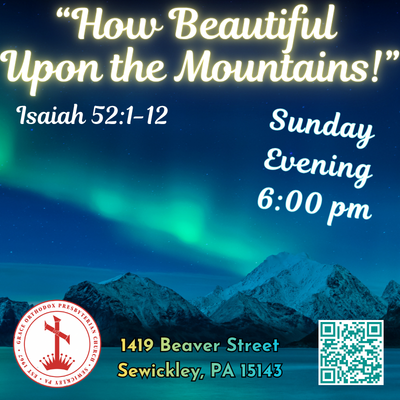
Pray that you would set a guard over my lips and that I might speak only that which brings glory to your name and is faithful to your word. We pray all of these things, heavenly Father, through Christ our Lord and all of God’s people said. Amen. You may be seated. The title of my sermon this evening is How Beautiful Upon the Mountains. And the children can be listening for these three key words, the words hope, joy, and home.
Well, dear friends, when the Second World War finally ended, there were great waves of celebration both in Europe and in the United States. As one online resource describes it, people around the world celebrated the end of World War II with spontaneous massive street parties, ticker tape parades, and emotional gatherings of thanksgiving. Celebrations unfolded in two major waves. There was VE Day, May 8th, 1945, marking the end of war in Europe. And then there was V-J Day, August 14th, 1945, marking the final surrender of Japan.
Well friends, even though we live almost 80 years after these events, we can imagine how the announcement of the ending of World War II must have resulted in just an overwhelming sense of relief and rejoicing among populations that had endured such a long, brutal war, a war that had cost so many lives and had brought such widespread destruction to so many nations. How welcome must have been the good news of the war’s ending to the multitudes of war-weary souls who had had to endure it. Well, dear ones, as joyful as the good news of the ending of World War II in 1945 must have been to the peoples of Europe and the United States at that particular time in history, in our passage for this Lord’s Day evening, the prophet Isaiah anticipates an even greater joy, and he predicts the announcement of the greatest good news there ever could be. And that is the good news of ultimate peace, happiness, indeed, salvation.
As it says in verse seven of our passage for tonight, how beautiful upon the mountains are the feet of him who brings good news, who publishes peace, who brings good news of happiness, who publishes salvation, who says to Zion, your God reigns. this proclamation of the ultimate good news would bring great joy to the nations of mankind.
Now we need to remember the setting and context of our passage for this evening. We find it obviously in the latter section of the book of the prophet Isaiah. And it’s important to understand that this particular passage in Isaiah is a transitional passage. And by the Spirit’s inspiration, it’s a passage that prepares the readers for the climax of the servant of the Lord theme that we find so prominently in this particular section of Isaiah’s prophecy. And it’s also a perfect setting for or preparation for the climax of the messianic theme that is found more generally throughout the book of the prophet Isaiah. Now the language and the imagery, if you were paying attention when I read this passage, the language and the imagery that Isaiah uses in this passage, this language and imagery are not merely intended to communicate the Lord’s message to his covenant people, though certainly it does that.
But it is designed to do so in a manner that makes a maximum emotional and personal impact. Portions of Holy Scripture, such as this one that we consider this Lord’s Day evening, not only underscore the fact that God’s Word is truth in the sense of accurate doctrinal truth. Yes, it is that, and it’s very important. But God’s Word is also beautiful. God’s Word is powerful. It is emotionally impactful. And certain sections, many sections are even aesthetically delightful.
By the spirit of prophecy, Isaiah had not only predicted and warned about the Babylonian exile of the covenant nation for its idolatry and faithlessness in breaking God’s covenant, but Isaiah had also predicted the ultimate restoration and spiritual renewal of God’s wayward people, a restoration and renewal that would bring ultimate comfort to the chastened, humbled, exiled people of God. And that is, again, the major theme of this latter section of Isaiah. If you turn back to the beginning of this latter section of Isaiah in chapter 40, verses 1 and 2, what are the first two words that are stated in that passage? If you go back to Isaiah 40, 1 and 2, it says this. Comfort, comfort my people, says your God. Speak tenderly to Jerusalem and cry to her that her warfare is ended, that her iniquity is pardoned, that she has received from the Lord’s hand double for all her sins. Comfort, comfort my people.
Now a sign of this restoration and renewal that would bring such comfort and that sign of such restoration and renewal would occur with Israel’s national renewal when the people would return to the promised land from their Babylonian exile. That’s the immediate historical event that is on Isaiah’s prophetic horizon. And yet, friends, The Israelites, not only would they return from exile and eventually rebuild the city and the temple in Jerusalem, but Israel’s national renewal in the post-exilic community points to something beyond itself. It points to the ultimate spiritual and eschatological renewal, the spiritual renewal of eternal salvation that God’s people would experience in the age of the Messiah, the era of the Lord Jesus Christ, the promised Messiah. and the suffering servant of Yahweh, whom we will be reading about more fully in the coming weeks.
The announcement of this good news of restoration and salvation by heralds sent forth to proclaim the good news would not only bring joy to the redeemed among the Israelites, but the result would be, as verse 10 tells us, that all the ends of the earth shall see the salvation of our God. Again, to read verses 9 and 10. It says, and all the ends of the earth shall see the salvation of our God.
So brothers and sisters in Christ, tonight as we approach this glorious passage of God’s word, we see that in this passage, God’s people are awakened to the hope of renewal. This is the first point in your sermon outline if you’re following along. The people of God are awakened to the hope of renewal. Verse one begins, with the word awake. And it repeats it for emphasis.
Awake, awake, put on your strength, O Zion. Put on your beautiful garments, O Jerusalem, the holy city. Awake, awake, the people of God. God, by the spirit of prophecy, calls his people to awaken. It’s interesting that this can be compared to chapter 51, verse 9. In that particular passage, Isaiah, representing the people of God, cries out to God to awake. He says, awake, awake, put on strength, O arm of the Lord, awake as in the days of old, the generations of long ago, and so forth. Well there, God was petitioned to awaken to action for his people. But here, God himself calls his people to awaken.
He’s calling out to his exiled people. He’s saying, awake, hope is on its way. And he goes and says to them, put on your strength, O Zion. They had been weakened by the chastisement and judgment of the exile, but now, Isaiah, in the spirit of prophecy, foresees a day when the exiled people of God will be awakened from their exile. They will be brought back to a strengthened position, and they’re called to put on their strength.
Put on your strength, O Zion, and then, to kind of clarify and deepen what he’s saying there, put on your beautiful garments, O Jerusalem, the holy city. The term Zion, Jerusalem, the holy city, came to be classifications or words that indicated the people of God, the covenant people of God. And therefore, it would include us in the Church of Jesus Christ today in terms of its application. Now, what are the beautiful garments that we are to put on, O Zion of God?
Well some scholars believe that this refers to priestly garments. The people will be called back from exile and they’re called once again to be a holy people so they are to symbolically at least put on these priestly garments. Others think that this is a figurative reference to royal wedding garments. So what is it? Is it priestly garments, wedding garments?
Well, probably, you know, there’s arguments that could be made for either interpretation, but it seems to me that the latter makes more sense within the context of this passage, namely that he’s calling the people of God to put on the royal garments, wedding garments. Because after all, God calls Jerusalem to be seated in verse two. And if he’s talking about being seated on a throne as the Lord’s bride, his queen, then that would make sense that the beautiful garments we put on are to be the garments as the Bride of the Lord. We are the Bride of Christ after all.
And then it makes this wonderful promise at the end of verse 1. He says, Now in this context Isaiah probably has in mind especially foreign invaders such as the Babylonians. The people of God throughout their history had had problems with foreign invaders, Gentile invaders who would come in and conquer them or at least influence them away from the Lord and into idolatry. But he’s saying, no, there will come a time when there shall no more come into you the uncircumcised and the unclean. But as one commentator reminds us, the exclusion of the uncircumcised and the defiled should not be read as the product of a harsh nationalism, but as a reminder that the alien had so often entered Jerusalem either to conquer or to pollute its worship or both. And so then it goes on to say in verse two, shake yourself from the dust and arise, be seated, O Jerusalem, loose the bonds of your neck, O captive daughter of Zion. When God’s people were taken into exile in Babylon, they were humbled to the dust. They were brought down to the dust. They were put into bondage. They were enslaved.
But now God is saying, I’m going to free you. So shake off the dust and arise. The Babylonian exile had indeed chastened God’s people, humbled them to the dust, but the Lord would graciously raise them up that they might take their seat as his royal bride. It reminds me of that line from that wonderful hymn, The Church is One Foundation. It says, from heaven he came and sought her to be his holy bride. With his own blood he bought her and for her life. he died. And it’s interesting, the Lord says to his people, shake off the dust. I’m raising you up from the dust, in essence, is what he’s saying here.
This contrasts with what the Lord predicted back in chapter 47, verse 1, where God would humiliate Babylon by causing the virgin daughter of Babylon to take her seat, not on a throne, but in the dust and on the ground. Back in chapter 47, verse 1, it says, come down and sit in the dust, oh, virgin daughter of Babylon. Sit on the ground without a throne, O daughter of the Chaldeans, for you shall no more be called tender and delicate.”
So you see God is going to reverse, God is going to give a great reversal. Those who had been exalted, the Babylonians, would be humbled to the dust. Those whom the Lord in mercy actually had chastened and humbled would be raised up and once again seated on the royal throne.
And then it goes on to say in verse 3, Yahweh handed his faithful people over to Babylon as a punishment. So Babylon paid nothing for God’s people, and therefore the Lord owed nothing to Babylon for the redemption of his people. That’s the thrust of what verse three is saying here. The Babylonian exile was a chastisement from the Lord, but their redemption was a free and sovereign gift of grace.
It certainly wasn’t because they deserved it. They had been a stiff-necked and hard-hearted people. And then it goes on to say this in verses four and five. For thus says the Lord God, my people went down at the first into Egypt. He’s reminding them of their history of oppression. They had gone down into Egypt. The Lord had rescued them from Egypt, of course, to sojourn there. And the Assyrian oppressed them for nothing.
Now therefore, what have I here, declares the Lord, seeing that my people are taken away for nothing? What am I going to do about this? This is if the Lord is. musing within himself, speaking to himself, saying, what am I going to do about this? Their rulers wail, declares the Lord, and continually, all the day, my name is despised. Therefore, my people shall know my name. Therefore, in that day, they shall know that it is I who speak. Here I am.
The captivity of God’s people in Babylon would give occasion for the Lord’s name to be blasphemed among His enemies and the enemies of His people. After all, if you were a citizen of ancient Babylon, what would the conquest of Judah and Jerusalem, what would that mean to you? in the ancient pagan worldview that would mean that, well, Yahweh the God of Israel has been defeated. If His people have been defeated, that means their God has been defeated by our gods. Our gods are more powerful. And again, that would cause blasphemy against Yahweh the Lord.
But God says, My name has been blasphemed among the Gentiles because of Israel’s faithlessness. It’s interesting that the Apostle Paul quotes from verse 5 in Romans 2, 24. If you turn to Romans 2, verse 24, where Paul is speaking of how the Gentiles blasphemed the Lord because of the Jews’ unbelief and faithlessness. It says this in verse 24.
Let me back up and begin reading. in verse 17, but if you call yourself a Jew and rely on the law and boast in God and know His will and approve what is excellent because you are instructed from the law, and if you are sure that you yourself are a guide to the blind, a light to those who are in darkness, an instructor of the foolish, a teacher of children, having in the law the embodiment of knowledge and truth, then you who teach others, do you not teach yourself? While you preach against stealing, do you steal? You who say that one must not commit adultery, do you commit adultery? You who abhor idols, do you rob temples?
You who boast in the law dishonor God by breaking the law, for as it is written, again, this is where he’s quoting from verse five of our passage, the name of God is blasphemed among the Gentiles because of you. And that is a great, horrible thing, that God’s name is blasphemed among the Gentiles, but God is not gonna allow things to stay that way.
For he goes on to say in verse six, therefore my people shall know my name, therefore in that day they shall know that it is I who speak, here I am. E.J. Young writes of this verse, he says, because God’s name is so continually blasphemed among the heathen, his own people will know his name. And that means, friends, one day God’s name will be known and acknowledged among his people in truth. And that will reassure the people of what God says at the end of verse six. And what does he say? He says, here I am. Once more, God’s gracious presence would dwell with his people.
When God sent his people into exile, his presence, his gracious presence departed from Jerusalem and from the temple. The Lord, in a sense, abandoned his people. Not ultimately, of course, but there was a sense in which the Lord had departed. The people were separated from their God because they were separated from his land and his temple.
But again, they weren’t ultimately separated because God was going to restore them. And once again, he would say to his people, here I am. I have come to dwell in your midst. God would once again be Emmanuel to his people. Even though God had predicted the Babylonian captivity of his sinful people, that was not the end of the story, praise be to God. His exiled people would be awakened to the hope of renewal. And as I stated before, what this means for us today, living as we do in this new covenant era, what this means for us today is that Israel’s national renewal in the post-exilic community points to the ultimate spiritual renewal provided to sinners in our Lord and Savior, Jesus Christ.
Through the Gospel, God calls us sinners to awaken from our exile in sin and to put on your beautiful garments, which means ultimately to put on the Lord Jesus Christ. Have you put on your beautiful garments? Have you put on the righteousness of Christ by faith? Have you put on the Lord Jesus Christ?
I’m reminded of what the Apostle Paul writes in Galatians 3, 25 to 29. You’re welcome to turn there if you’d like. Galatians 3, 25 to 29. As he’s writing to a group of Gentile Christians, mostly Gentile Christians, he says this. I’m in Ephesians, no wonder I can’t find it. All right.
Galatians 3, beginning at verse 25, it says, But now that faith has come, we are no longer under a guardian, for in Christ Jesus you are all sons of God through faith. For as many of you as were baptized into Christ have done what? Have put on Christ. There is neither Jew nor Greek, there is neither slave nor free, there is no male and female, for you are all one in Christ Jesus. And if you are Christ’s, then you are Abraham’s offspring, heirs according to promise.
And again, as Paul says in Romans 13, verse 14, but put on the Lord Jesus Christ and make no provision for the flesh to gratify its desires. I believe that’s the verse that the Lord used to convert Saint Augustine. Put on the Lord Jesus Christ. Put on your beautiful garments. What are our beautiful garments? the Lord Jesus Christ and his righteousness, which we receive by faith and faith alone. Dear listener, have you put on the beautiful garments of Christ by trusting him and him alone for your salvation?
So we see the promise of hope renewed. But next we see God’s people are summoned to the joy of their salvation in verses seven through 10. This good news of renewal and salvation is to be published abroad and disseminated not only among the believing remnant of Israel, but as we’re told in verse 10, among the eyes, before the eyes of all the nations. Once again, Isaiah by the spirit of prophecy foresees a time when even the Gentile nations afar off will hear and benefit from the good news of God’s salvation through the promised Messiah. Again, as it says in verse seven, how beautiful upon the mountains are the feet of him who brings good news.
Now, what’s this referring to? Well, in ancient times, when armies went out to battle, the folks at home wanted to know what was going on. They didn’t have access to, you know, instant access to what was going on in distant lands. And so, in ancient times, messengers were often sent out from the scene of battle to bring news of the battle’s outcome to the king and to the people back home, whether that be good news of victory or the bad news of defeat.
But here, In verse seven, here the messenger brings good news, good news of victory, which Isaiah describes here as peace, good news of happiness and salvation. And this is a message that underscores the blessed truth that God’s downcast people so desperately needed to hear, especially in their exile. And that message is at the end of verse seven.
The message is, your God reigns. Yes, you were defeated and taken off into exile. And yes, the Babylonians would interpret that as meaning, well, our gods are more powerful than the God of Israel. But God reminds His people, your God reigns, not Baal, not the gods, not Chemosh, not the gods of Babylon. No, your God reigns. And the exile did not take away His reign. The Apostle Paul applies this passage to gospel preachers, as we read earlier in the service. If you go back to Romans 10 and look at verses 14 and 15, notice how Paul lifts this language and applies it to gospel preachers.
He says in chapter 10, 14 and 15, how then will they call on him in whom they have not believed? And how are they to believe in him of whom they have never heard? And how are they to hear without someone preaching? And how are they to preach unless they are sent? This is talking about called, ordained, sent out evangelists, gospel preachers. We have one in our own congregation whom we sent out this summer to the Boardwalk Chapel in Wildwood, New Jersey. How are they to preach unless they are sent? As it is written, how beautiful are the feet of those who preach the good news. How beautiful indeed are the feet of those who bring the good news of the gospel of Jesus Christ. And what is the result of these messengers that bring the good news?
Well then, verse 8, it says, The voice of your watchmen, they lift up their voice, together they sing for joy, for eye to eye they see. That means they see it clearly The return of the Lord to Zion, or as some versions indicate, the return of the Lord’s people to Zion. This is the return of the great king. Once again, the message will go forth. The watchmen of the city are pictured as seeing the heralds of good news clearly, and their response is an outburst of joy and rejoicing.
And then it says in verse nine, break forth into singing. You waste places of Jerusalem for the Lord has comforted his people. He has redeemed Jerusalem. The redeemed of the Lord are called upon to rejoice in our faithful covenant God who has comforted and redeemed his people.
And then verse 10, the Lord has bared his holy arm before the eyes of all the nations. The Lord’s arm represents his power, his power at work. He has bared his holy arm, he’s getting ready to act. In other words, he’s bared his holy arm. God’s arm, again, represents his power.
Through the gospel, God displays his power unto salvation to all of the nations. of mankind. Again, all of this anticipates the Gentile ingathering that was to take place in this Messianic New Covenant age. And we see this prophecy being fulfilled as the Gospel goes forth, as sinners throughout the world are called to faith in Christ, as churches are planted among all the nations of humanity. Again, The Lord bears his holy arm before the eyes of all the nations, and all the ends of the earth shall see the salvation of our God. Brothers and sisters in Christ, the good news of our salvation in Jesus Christ ought to fill us with the joy of the Lord, just like it fills the watchman, as the message of the announcers, the heralds, fills the watchman in the city with joy in verse eight. The gospel should fill us with joy. Let us rejoice in the Lord always, and let us also seek opportunities to share the joy of the Lord with others.
But this powerful passage ends with a call to depart, which is actually a call home. Let’s consider finally that God’s people are called home from a far country. God’s people are called home from a far country. The Spirit through Isaiah says this in verse 11, depart, depart, go out from there, touch no unclean thing, go out from the midst of her, purify yourselves, you who bear the vessels of the Lord. Now in the historical context that is foreseen here by the spirit of prophecy, This would appear to represent the call of God’s people in their exile to depart at the proper time, to depart from the pagan land of Babylon, that unclean pagan land, that unholy land, to depart from the land and indeed to touch no unclean thing and to bear the vessels of the Lord. When the people went back, Cyrus had allowed them to take the vessels from the temple back with them to Jerusalem. But since Babylon in Scripture came to represent the pagan world in rebellion against God in general, this ultimately has a spiritual reference in that it calls us as God’s people to depart from our sins in repentance and to return in faith to a right relationship with God.
We see that reflected in many passages, but just a couple of passages in the New Testament. 2 Corinthians 6, 14 through 18, this ought to be a familiar passage to many of us. In that passage, 2 Corinthians 6, verses 14 through 18, it says this. Paul writes, I will make my dwelling among them and walk among them, and I will be their God and they shall be my people. Therefore, go out from their midst and be separate from them, says the Lord, and touch no unclean thing, then I will welcome you, and I will be a father to you, and you shall be sons and daughters to me, says the Lord Almighty.”
Believers are called to not be unequally yoked, to come out from the sinful patterns of this fallen world. And we see this call also in the book of Revelation, Revelation 18, verses 4 and 5, where clearly Babylon is being used in a figurative sense there to symbolize the kingdom of Satan, the fallen world system set in opposition to God. And it says this in Revelation 18, 4 and 5, Then I heard another voice from heaven saying, come out of her, my people, come out of Babylon, my people, lest you take part in her sins, lest you share in her plagues, for her sins are heaped high as heaven, and God has remembered her iniquities.” So we are called out from this sinful, fallen world.
We are called to follow Christ. as holy pilgrims on our way to the ultimate promised land. We are being called home, heavenward to glory. But in terms of this call to the exiled people, there will be a difference between that call and the call of the Israelites out of Egypt.
For verse 12, it says, for you shall not go out in haste, and you shall not go in flight, for the Lord will go before you, and the God of Israel will be your rear guard. You shall not go out in haste. When the people of Israel left Egypt, when the Lord, through Moses, took them out of Egypt, did they go at a leisurely pace? No, they went in haste. They went in haste.
Let’s turn to Exodus 12, verse 33. Exodus 12, 33 says this. The Egyptians were urgent with the people to send them out of the land in haste. For they said, we shall all be dead. You see the contrast there? When it came to the Israelites going out of Egypt, they were compelled to go out in haste. But our passage for today, for this evening, verse 12 says, you shall not go out in haste. See the contrast there.
Consider also verse 39 of this chapter. Verse 39, it says, and they baked unleavened cakes of dough that they had brought out of Egypt, for it was not leavened because they were thrust out of Egypt and could not wait, nor had they prepared any provisions for themselves. In this second exodus predicted by Isaiah here, God’s people would go out from Babylon, as one commentator puts it, not as panicky fugitives but in confidence. And the implication is we, as we make our pilgrimage out of this present evil age to glory, We are not doing so as overwhelmed fugitives. We are doing so in confidence because we walk with the Lord. And we are promised here. It says, the Lord will go before you. The God of Israel will be your rear guard.
Again, this appears to be an allusion to the way that God led the Israelites out of Egypt and through the wilderness, escorting them in a pillar of cloud by day and a pillar of fire by night. Again, Going back to Exodus chapter 13, verses 21 and 22, Exodus 13, 21 and 22, it says this.
And the Lord went before them by day in a pillar of cloud and to lead them along the way, and by night in a pillar of fire to give them light that they might travel by day and by night. The pillar of cloud by day and the pillar of fire by night did not depart before the people. And that pillar of cloud by day and fire by night was what the theologians call a theophany. It was a visible supernatural sign of God’s special presence with His people. He was accompanying His people. He was walking with them. He was protecting them. And that protection especially comes out in the crossing of the Red Sea in chapter 14, verses 19 and 20.
It says, Then the angel of God, who was going before the host of Israel, moved and went behind them. And the pillar of cloud moved from before them and stood behind them, coming between the host of Egypt and the host of Israel. And there was a cloud in the darkness, and it lit up the night, without one coming near the other all night.
So that’s what Isaiah appears to have in mind as he writes these words here in verse 12. He says, the Lord will go before you. The God of Israel will be your rear guard. And think about it, think about it. What that means is that the Lord journeys with us. He goes with us, he accompanies us in our journey of faith, and he protects us by his grace.
Beloved, this passage reminds us that we have been called to renounce this world of sin and to follow the Lord Jesus Christ in faith. The life of Christian discipleship is a pilgrimage. It is a journey of faith. We are strangers and exiles in this present Babylon, this present evil age. But in the gospel, God calls us to depart. He calls us to make our pilgrim journey of faith. And in calling us to make this pilgrim journey of faith, let us remember that in Christ, our gracious heavenly father is calling us not just to leave something, but he’s calling us home, home from a far country.
Our pilgrimage in this present wilderness is ultimately a journey home to our heavenly homeland. a gradual departure from our exile east of Eden to the heavenly garden temple in Christ, where we will dwell with him forever in the new heavens and the new earth where in righteousness dwells. That’s where we are headed, brothers and sisters. As we make this pilgrimage, this journey, this departure, let’s make it together. Let us journey together in love, in faith, in fellowship as brothers and sisters in Christ, walking alongside each other as the Lord walks alongside of us. And let us keep our eyes fixed on the one who has called us home, namely the Lord Jesus Christ, the one who is the author and the finisher of our faith.
And all of God’s people said, amen. Let’s pray. Lord and Father in heaven, We thank you, Lord God, for the glad tidings of great joy. We thank you for the privilege of hearing this good news, and we pray that we would be a good news people, that our feet would be beautiful as your people as we seek to spread the good news of Jesus, as we seek to publish peace, bring good news of happiness, publish salvation, saying to Zion, your God reigns. Lord, we pray that these truths would make an impact upon our souls and redirect us, Lord, in our pilgrimage. Help us know each day that we are journeying to glory, to our heavenly homeland. For, Lord, you have called us home, and we are making our journey there. In Jesus’ name we pray and all of God’s people said, amen. Let’s close our time of worship this evening by rising and we’ll Ozai on haste, your mission high fulfilling.