The sermon text provided below is derived from the sermon audio recording making use of generative tools. It has not been manually edited. While transcription tools have a high degree of accuracy, the output may include generative textual, punctuation, and/or formatting errors.
Well, friends, please remain standing for the reading of God’s word. We return this Lord’s Day evening to our consideration of Isaiah, and tonight we are in Isaiah 45. My sermon text this evening is Isaiah 45, verses one through seven, and you will find that beginning on page 719 in your pew Bible. I would like to begin reading in the previous section of the last chapter, so we will begin at chapter 44, verse 21, and I will read through chapter 45, verse seven. But again, our focus this evening will be on the first seven verses of chapter 45. So, friends, this is the Word of God. Let us hear it with reverence and awe, beginning at chapter 44, verse 21.
Remember these things, O Jacob, and Israel, for you are my servant. I formed you. You are my servant, O Israel. You will not be forgotten by me. I have blotted out your transgressions like a cloud and your sins like mist. Return to me, for I have redeemed you. Sing, O heavens, for the Lord has done it. Shout, O depths of the earth. Break forth into singing, O mountains, O forest and every tree in it. For the Lord has redeemed Jacob and will be glorified in Israel. Thus says the Lord, your Redeemer, who formed you from the womb.
I am the Lord who made all things, who alone stretched out the heavens, who spread out the earth by myself, who frustrates the signs of liars and makes fools of diviners, who turns wise men back and makes their knowledge foolish, who confirms the word of his servant and fulfills the counsel of his messengers, who says of Jerusalem, she shall be inhabited, and of the cities of Judah, they shall be built, and I will raise up their ruins. Who says to the deep, be dry, I will dry up your rivers. Who says of Cyrus, he is my shepherd, and he shall fulfill all my purpose.
Saying to Jerusalem, she shall be built, and to the temple, your foundation shall be laid. Thus says the Lord to his anointed, to Cyrus, whose right hand I have grasped to subdue nations before him, and to loose the belts of kings, to open doors before him, so that gates may not be closed. I will go before you and level the high places. I will break in pieces the doors of bronze and cut through the bars of iron.
I will give you the treasures of darkness and the wealth hidden in secret places, so that you may know that it is I, the Lord, the God of Israel, who call you by your name. For the sake of my servant Jacob and Israel, my chosen, I call you by your name. I name you, though you do not know me.
I am the Lord, and there is no other. Besides me, there is no God. I equip you, though you do not know me, so that people may know from the rising of the sun and from the west that there is none besides me. I am the Lord, and there is no other. I form light and create darkness. I make well-being and create calamity. I am the Lord, who does all these things.
Friends, the grass withers and the flower fades, but the word of our God endures forever. Let us pray for the Lord to bless the proclamation of His word this evening. Our gracious Lord and Father in heaven, we thank You that You have redeemed Your people in Christ, and we thank You that You have given us this treasure of Your word. We pray, O Lord, that as we consider this portion of Your God-breathed scriptures, Your Spirit, the Spirit who breathed out the Word of God, would indeed breathe new life into our hearts and cause Your Word to find a dwelling place in our souls. And we ask, Lord, that You would open our minds and our hearts, illuminate us by Your Spirit, that we might understand what the Spirit is speaking to us in this portion of Your Word. May we learn and be edified, may we be challenged, and may we be transformed by the renewing of our minds through Your word and by Your Spirit. Lord, grant me, Your unworthy servant, the grace to declare Your word this evening with clarity and power, and we pray that Jesus would be exalted in the proclamation of Your word tonight. In His name we pray, and all of God’s people said.
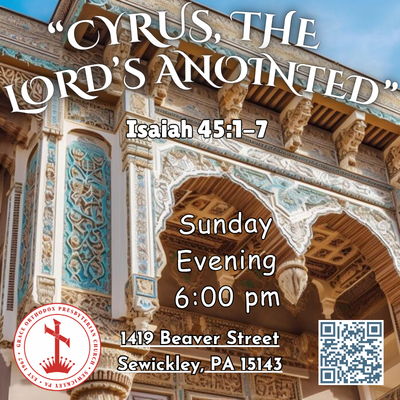
Amen. Congregation, you may be seated. The title of my sermon this evening is Cyrus, the Lord’s Anointed, and I encourage the children to listen for three key words in my sermon tonight: anointed, promises, and uniqueness. Anointed, promises, and uniqueness.
One of the amazing things about our God is that He is omniscient. Omniscient means all-knowing. God knows everything, and He knows it completely. He knows the end from the beginning. He knows the past, the present, and the future because He is the eternal God. In fact, He is above and beyond time. He is a great and awesome God.
And there are many evidences of the Lord’s omniscience throughout the scriptures. Friends, our passage for this Lord’s Day evening is one such passage. This passage tonight is a powerful testimony to God’s omniscience. I say this because the passage contains one of the clearest examples of a highly specific predictive prophecy—a prophecy concerning the Persian king Cyrus.
Cyrus, the king whom God would sovereignly raise up to conquer Babylon and thus pave the way for the Jewish exiles in Babylon to return to the promised land and to rebuild the temple in Jerusalem. Therefore, Cyrus would serve an incredibly important and significant role in the course of redemptive history in the lives of God’s people.
When we consider the timeline, the Jewish exiles in Babylon were there for about seventy years. When we consider Isaiah, he served as a prophet of God for a period of over forty years, from at least 740 BC through 701 BC, and beyond that into the late 600s BC. His prophetic ministry spanned the reigns of at least four kings in Judah. If we go back to Isaiah chapter one, verse one, Isaiah tells us when the vision came to him: “The vision of Isaiah, the son of Amos, which he saw concerning Judah and Jerusalem in the days of Uzziah, Jotham, Ahaz, and Hezekiah, kings of Judah.” Thus, he had a very lengthy prophetic ministry in the southern kingdom.
But on the other hand, when did King Cyrus, the subject of our passage for this evening, reign? It is important to understand that Cyrus was likely a dynastic name. Isaiah would have been aware of a Cyrus from his own time, namely Cyrus I, the Persian king of the Achaemenid dynasty, who was a contemporary of both Isaiah the prophet and Ashurbanipal of Assyria. However, this is not the Cyrus mentioned in our passage for this Lord’s Day evening. The Cyrus referred to in Isaiah chapter 45 was enthroned as king of Persia in 559 BC, more than 150 years after Isaiah began his prophetic ministry. Cyrus the Great conquered Babylon in 539 BC.
This conquest made it possible for various exiles in Babylon, including the Jewish exiles, to return to their native lands and to rebuild the temples of their deities, which the Babylonians had destroyed during their conquests. Therefore, Cyrus’s decree permitting the Jewish exiles to return to Jerusalem and authorizing them to rebuild the Jerusalem temple is recorded in the book of Ezra.
If we go to Ezra chapter one, verses one through four, we find the following. After 2 Chronicles in the Old Testament, Ezra begins his book with these words: In the first year of Cyrus, king of Persia, that the word of the Lord by the mouth of Jeremiah might be fulfilled. The Lord stirred up the spirit of Cyrus, king of Persia, so that he made a proclamation throughout all his kingdom and also put it in writing. This is Cyrus’s proclamation.
Thus says Cyrus, king of Persia: The Lord, the God of heaven, has given me all the kingdoms of the earth, and he has charged me to build him a house at Jerusalem, which is in Judah. Whoever is among you of all his people, may his God be with him, and let him go up to Jerusalem, which is in Judah, and rebuild the house of the Lord, the God of Israel. He is the God who is in Jerusalem. Let each survivor in whatever place he sojourns be assisted by the men of his place with silver and gold, with goods and with beasts, besides freewill offerings for the house of God that is in Jerusalem. Consider this: it is amazing, is it not?
Now the point here, beloved, is that our passage for this evening appears to contain, as I mentioned, a very clear, predictive prophecy that mentions this King Cyrus by name. And it does so almost two centuries before Cyrus is even born, before he even enters into the scene of human history. In fact, this predictive prophecy about King Cyrus is so abundantly clear that it has caused skepticism among some. What do they do with a passage like this?
Well, this passage is so clear that it has led skeptical and higher critical scholars of the Bible—those who reject the supernatural events described in the Bible, including the miracle of predictive prophecy—to theorize that this later section of Isaiah was not written by the original Isaiah, the prophet who wrote the first 39 chapters, but was instead written by an anonymous later prophet. This prophet is believed to have lived during the time of King Cyrus and to have modeled his own prophecies after the writings of Isaiah. Scholars often refer to this supposed author as Second Isaiah, or, using more formal scholarly language, Deutero-Isaiah. However, there are many strong reasons to reject this so-called Second Isaiah theory. There are no compelling scholarly reasons to doubt that Isaiah was the actual human author of both the earlier and later sections of the book. Furthermore, critical theories such as the Second Isaiah theory are often, though not always, rooted in an anti-supernatural bias—specifically, a rejection of the miracles recorded in the Bible. Therefore, the point remains that Isaiah chapter 45 is a powerful testimony to the supernatural divine origin of this predictive prophecy concerning King Cyrus. And thus it stands as one of the most compelling evidences for the truth that Scripture is indeed the very word of God, breathed out by the Holy Spirit.
But having recognized the divine authority and origin of this passage of God’s Word, and having recognized that this passage contains predictive prophecy, what do we actually learn from this passage? What are the lessons that we are meant to learn as the people of God from this passage? In order to explore these lessons, we first need to consider the significance of Cyrus as Yahweh’s anointed.
King Cyrus is described in verse one of our passage as the Lord’s anointed. It says, “Thus says the Lord, thus says the Lord.” The word Lord is in all capital letters, indicating that this is Yahweh, the covenant name for God, Yahweh, the God of Israel, the true and living God. He says, “Thus says the Lord to his anointed.” The Lord is depicted as speaking to one described as his anointed, and then he identifies that anointed as Cyrus, saying, “whose right hand I have grasped, to subdue nations before him, and to loose the belts of kings, to open doors before him, that gates may not be closed.”
Cyrus is introduced in the immediately preceding context. That is why I began reading at the end of chapter 44. Cyrus is not introduced at the beginning of chapter 45. He is actually introduced in chapter 44, verse 28. Let me begin reading again, from verse 24 of chapter 44.
Thus says the Lord, your Redeemer, who formed you from the womb. I am the Lord who made all things, who alone stretched out the heavens, who spread out the earth by myself, who frustrates the signs of liars and makes fools of diviners. He turns wise men back and makes their knowledge foolish, who confirms the word of his servant, and fulfills the counsel of his messengers, who says of Jerusalem, she shall be inhabited.
Remember, the Lord had predicted that there would be exile and that there would be judgment against the faithless people of God. But this passage looks beyond that judgment to a time when God would restore His people. Once again, Jerusalem would be inhabited. Verse 26: “And of the cities of Judah, they shall be built, and I will raise up their ruins.” He says to the deep, “Be dry,” and I will dry up your rivers. This likely refers to the miracle of the Exodus, when God parted the Red Sea. Then in verse 28: “Who says of Cyrus, ‘He is my shepherd, and he shall fulfill all my purpose.'” That is very significant, by the way.
In our passage for tonight, he is called the Lord’s anointed, but at the end of chapter 44, he is called the Lord’s shepherd. What is the significance of someone being described as a shepherd? In the ancient Near East, kings and royalty were often described as shepherds. They were the shepherds of their people. The Lord is our shepherd, as it says in Psalm 23. This is not a sentimental psalm. For many people today, Psalm 23 is beloved, but it is actually a royal psalm. When one says, “The Lord is my shepherd,” it means the Lord is my king. I am His sheep, under His authority and under His control.
This is what is said of Cyrus, the Persian king, a pagan. The Lord would use him as His shepherd to fulfill His purpose. What is that purpose? “I will say of Jerusalem, ‘She shall be built,’ and of the temple, ‘Your foundation shall be laid.'” But how will Cyrus, this pagan king, be equipped to fulfill the Lord’s purpose through him and to shepherd God’s people? The answer comes in our passage for tonight. “Thus says the Lord to His anointed.” Here again, at the beginning of chapter 45, he is called Yahweh’s anointed. What is the significance of this term when applied to Cyrus, this pagan king of Persia?
Well, the term anointed, as it is used in the Old Testament, is often used in a general sense and can mean different things depending on the individual who is anointed. However, in every case, it points to the impartation of the Spirit of the Lord, so that the anointed one is empowered and enabled by God’s Spirit to accomplish a specific task. Under the Old Covenant administration, for example, priests and kings were anointed with oil as a sign that the Spirit would empower them to fulfill their roles as prophets, priests, and kings. But here, this particular king, though he is a pagan, is anointed by the Spirit to accomplish a specific task.
Now, you might be wondering, does the term Messiah mean anointed one? Is the Lord here calling Cyrus, a pagan king, his Messiah? The term Messiah does mean anointed one, and the various Old Testament anointed ones anticipate and point forward to the ultimate anointed one, the promised Messiah, our Lord and Savior, Jesus Christ. For Christ was anointed and endowed with the Spirit of God above measure, with respect to his humanity, to accomplish the role that the Father had sent him to accomplish—namely, to save his people from their sins as the God-man and as the Lord’s anointed.
And Cyrus, even though a pagan king, pointed forward to Christ in this specific sense: he was a king anointed by the Spirit to fulfill a particular function. Christ is the greater king, the righteous king, the one who would accomplish God’s purposes to save his people from their sins.
So again, in what sense—specifically, the sense in which Cyrus was God’s anointed—how do we understand this? Dr. E.J. Young, I think, explains it well. He says that the reference to Cyrus as the Lord’s anointed does not necessarily imply that Cyrus became a true worshiper of the God of Israel. Rather, the term suggests that there was a specific task he was to accomplish, and for this task, he had been anointed by the sovereign God of Israel, who imparted His Spirit to equip him for its performance. In this sense, Cyrus is a type of the messianic servant of the Lord, upon whom the Spirit came in greater measure, so that he might be equipped for a task infinitely greater than that of Cyrus—namely, to set His people free from the spiritual bondage of sin and guilt.
And notice what the Lord says and promises to Cyrus here. He says of Cyrus, “Whose right hand I have grasped.” The image of Yahweh the Lord grasping King Cyrus’s right hand. The right hand symbolizes authority and power. Though Cyrus is a pagan king, he is nonetheless under the control and direction of the God of Israel. This is what the imagery points to. Why does the Lord grasp Cyrus’s arm? To subdue nations before him and to loosen the belts of kings, to open doors before him so that gates may not be closed. Indeed, it was ultimately by the Lord’s blessing, and not by Cyrus’s own military prowess, genius, or royal resources, that Cyrus was enabled to accomplish so much in terms of military victories, conquests, and the establishment of his kingdom. What do we learn, brothers and sisters? Cyrus was indeed a mighty king.
He was an anointed one, raised up by Almighty God and empowered by God’s Spirit to conquer Babylon and thus to deliver God’s people from their Babylonian exile, so that they could return to their homeland, the promised land, and so that they could rebuild the temple in Jerusalem. All of this would pave the way ultimately for the coming of the ultimate anointed one, Jesus of Nazareth, the Lord’s Messiah. In redemptive history, Cyrus points, as I said, to a greater king, to God’s ultimate anointed one, the Lord Jesus Christ. And Christ came not just to conquer a political adversary and deliver us from political exile. No, Christ, our King, our anointed one, came that He might conquer sin and death and Satan, so that we, His people, might be delivered from our exile of sin and return to our true homeland. And what is our true homeland? The new heavens and the new earth, where righteousness dwells.
Dear listener, dear exiled sinner, look to King Jesus as your anointed one, as your Savior. So we see that the Lord identifies Cyrus as His anointed. But notice next the Lord’s promises to Cyrus in verses two through four. The Lord says this to Cyrus: I will go before you and level the exalted places. I will break in pieces the doors of bronze and cut through the bars of iron. It goes on to say: I will give you the treasures of darkness and the riches of secret places, so that you may know that it is I, the Lord, the God of Israel, who call you by your name. For the sake of My servant Jacob and Israel, My chosen, I call you by name. I name you, though you do not know Me.
In verses two and three, the language and imagery used in these verses indicate that the Lord will providentially remove serious obstacles in the way of Cyrus. These obstacles are symbolized by doors of bronze and bars of iron. The Lord will enable Cyrus to break through the doors of bronze and the bars of iron. This will allow him to gain victory. Not only will the Lord enable Cyrus to gain victory, but Cyrus and his kingdom will also be enriched in the process. As it says in verse three, I will give you the treasures of darkness and the hidden riches. Riches will come to the Lord’s anointed Cyrus as he is used as an instrument in God’s hands to accomplish His sovereign purposes. Ultimately, what is the goal here? What is the Lord’s intention for Cyrus?
It says in verse three that you may know that it is I, the Lord, the God of Israel, who call you by your name. Furthermore, in verse four, He says, I name you, though you do not know me. Though you are a pagan, an idol-worshiping pagan, I will use you to display My reality and My glory, so that you may know Me. Yahweh, the God of Israel, is free to use whomever He chooses, whether that individual is a believer or an unbeliever, whether that individual is a worshiper of God or a pagan polytheist.
God is sovereign and is able to use leaders and rulers such as Cyrus to accomplish His sovereign purposes for the benefit of His people. As the Lord tells Cyrus in verse four, for the sake of My servant Jacob and Israel, My chosen, I call you by name. I am not doing this for you, Cyrus, ultimately. I am doing this for My own glory, for God’s glory, but also for the benefit of My chosen people, My servant Jacob, Israel, My chosen one.
Now, this predictive prophecy is such that it should have led Cyrus to consider the God of Israel to be the one true and living God. That is, in fact, true. Did Cyrus know about this prophecy, written by the prophet Isaiah several centuries before Cyrus came to power? According to the Jewish historian Josephus, Cyrus did read this prophecy. As Josephus states in his Antiquities, Cyrus had actually read the prophecy of Isaiah. Even if this detail is incorrect, we know from the book of Ezra that Cyrus was at least aware of the God of Israel, aware of the people of the Jews, and aware that God’s temple was to be located in Jerusalem.
Cyrus appeared to be, in his own way, a fair-minded ruler. He was a ruler who took interest in the religious beliefs and practices of his captive subjects. He followed a policy of tolerance. He demonstrated a high degree of religious tolerance for his time.
It was not only the Jews whom he allowed to return to their homeland and rebuild their temples. This was his general policy toward the various peoples who had been captured and conquered by the Babylonians. He permitted them to return to their homelands and rebuild the temples of their own gods, and he did the same for the Jews.
However, we are reading this passage from a New Testament perspective. We are reading it and thinking, did Cyrus become a believer in the true God? Did he come to true faith? Ultimately, we cannot know this with certainty. While we may certainly hope that Cyrus came to a true and saving knowledge of the living God in the end, the historical records we have suggest that he remained a pagan polytheist in his basic religious outlook. There are records of him attributing his successes to his god Marduk. Nevertheless, whatever the state of Cyrus’ soul may have been, God sovereignly chose to use him to accomplish His sovereign purposes of judgment against the Babylonians and of grace toward His humbled, exiled people. This is something that believers should reflect on, and it should cause us to stand in awe of our awesome God. Consider the irony in all of God’s dealings here through Cyrus.
The irony is this: on one hand, we have Cyrus, a powerful worldly king, a significant figure in the international affairs of the ancient Near East. He was a strong man, a brilliant man, and a great military strategist. On the other hand, we have God’s humbled, conquered, and exiled people living in Babylon. This contrast raises many questions for us to ponder.
Questions such as, why would God do it this way? Why would the one and only God, the almighty creator of the universe, the Lord over all the nations, sovereignly overrule history to benefit this tiny, weak, sinful nation of Israel? And why would God use a pagan, polytheistic king to rescue his people from their Babylonian exile, revealing Cyrus’ name centuries before he was even born? And why would he use this pagan king to pave the way for the Jewish exiles to return from their exile and authorize them to rebuild the Lord’s temple in Jerusalem? Why would God do it this way? Why would the Lord so order and direct such a major figure in history as King Cyrus to benefit his small remnant of returning exiles? Do you have an answer to that question? I do not.
God does what he chooses to do according to his wise providence. In answer to such questions, we need to humble ourselves before the awesomeness of our God, the God whose infinite wisdom is unsearchable, inscrutable. And we need to recognize that the Lord’s ways are not our ways. His thoughts are not our thoughts. I am reminded of what Isaiah writes later in his book, in Isaiah 55, verses eight and nine. These may be familiar verses to you, but we need to take them to heart. The Lord says, “For my thoughts are not your thoughts. Neither are your ways my ways, declares the Lord. For as the heavens are higher than the earth, so are my ways higher than your ways and my thoughts than your thoughts.”
I am reminded of what Paul wrote in that passage from 1 Corinthians that was read earlier in the service. As Paul, by the Spirit’s inspiration, reminds the Corinthians that not many of you were among the wise or the noble by worldly standards when you were called into the kingdom. Remember, the so-called foolishness of God is wiser than the so-called wisdom of men. The so-called weakness of God is more powerful than the so-called power of men.
The Lord has His wise and holy purposes, and we can trust that He knows what He is doing. Again, as Paul writes in Romans 11:33–36, after spending the first eleven chapters of the book of Romans reflecting upon and expounding the glories of the gospel, He concludes this doctrinal section by saying, “Oh, the depth of the riches and wisdom and knowledge of God! How unsearchable are His judgments and how inscrutable His ways! For who has known the mind of the Lord? Or who has been His counselor? Or who has given a gift to Him that He might be repaid? For from Him and through Him and to Him are all things. To Him be glory forever. Amen.”
So let us humble ourselves. Let us not sit in judgment over the Lord and His ways, and say, “Lord, why did You not do it this way? Would it not have been better if You had done it this way?” God knows what He is doing. We can trust Him. Let us praise Him that He will move heaven and earth, and He will use the leaders and influential people of our day to ultimately benefit His people. For Christ, our resurrected and reigning Savior, rules over all things ultimately for the sake of His elect church, small and sinful though we are. So let us stand in awe of the Lord and His providential wisdom. Let us humble ourselves under the mighty hand of God.
This is truly what the Lord through Isaiah counsels Cyrus to do in this closing section of our passage, verses five through seven, where the Lord asserts His exclusive uniqueness. This is my final point. We notice here that the Lord asserts His exclusive uniqueness. The Lord says He identifies Himself to Cyrus and to all who are like Cyrus. He says, “I am the Lord, and there is no other. Besides Me, there is no God—neither Marduk, nor Baal, nor Ashtoreth. The Lord says, ‘I equip you. Not Marduk, not Baal. I, the Lord, equip you, Cyrus. Though you do not know Me, I am the one who equips you.'”
And why does the Lord do this? So that people may know, from the rising of the sun and from the west, that there is none besides me. I am the Lord, and there is no other. Pastor, this is becoming repetitive. Yes, Isaiah is repeating himself for emphasis. The Lord says, I am the only one. Do you understand? But ultimately, this is stated here for Cyrus.
Because God’s intention is that all peoples may know that he and he alone is God. And that is one of our responsibilities as the Church of Jesus Christ: to bear witness to the truth that there is only one God, the blessed triune God revealed in the scriptures. And there is only one mediator between God and humanity, only one Savior. His name is Jesus. He alone is the Lord and Savior of his people. God’s intention is that all peoples would come to this knowledge, would come to know this gospel.
Then God concludes this section we are considering tonight by asserting his sovereignty over all. It says in verse 7, “I form light and create darkness. I make well-being and create calamity. I am the Lord who does all these things.” In other words, God is sovereign over all.
He is sovereign in judgment, and he is sovereign in mercy. And by the way, this passage does not mean that the Lord is the author of sin. We must read passages like this in light of the rest of the scriptures, and the scriptures make it very clear: God is neither the author nor the approver of sin. Though God has permitted, sovereignly permitted, sin and evil in this present age for his own wise and holy purposes, he is still sovereign over all. He is not the author of sin, and we can trust him. He alone is God.
Let us give to Him our ultimate allegiance and loyalty, and let us trust in Him that He is working out His sovereign purposes for His glory and for our ultimate good. Amen. Let us pray. Heavenly Father, we thank You and praise You, Lord, that You are sovereign. We thank You that You are sovereign over history, even over history outside of the church. You are sovereign over all the nations and You rule the hearts of kings, such as King Cyrus. We ask, Heavenly Father, that we may take great comfort in these truths.
And we may know that You cause all things to work together for our ultimate good and for Your ultimate glory. We pray these things in Jesus’ name, and all of God’s people said, Amen. Let us close our time in the Word by rising and singing together hymn 336, “O Sacred Head Now Wounded,” as we prepare for the celebration of the Lord’s Supper. Let us sing together hymn 336.