
About this sermon
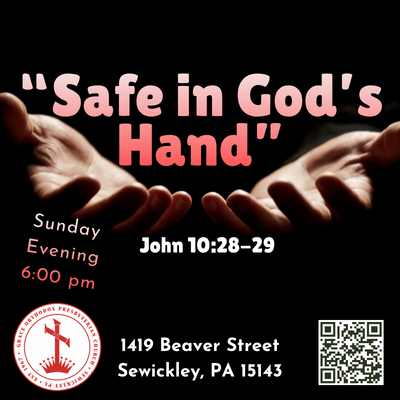
Many people feel less safe than they once did, but those who belong to Christ are secure in God’s hand. Their security rests on God’s purpose: the Father gave his sheep to the Son before the foundation of the world, and the Son gives them eternal life in time. It rests on God’s power, because no one can snatch them from the hand of the Son or of the Father, who are one. It rests on God’s preservation, because God works in believers to will and to work, so they persevere to the end.
Sermon transcript
Well, good evening. If you would, open your Bibles with me to John chapter 10. As you are doing so, I will say it is truly good to be here this evening. It is good to be back here this evening. I know I have met many of you in the past. It has been a little while since I have been here. It has been three or perhaps five years. I believe the last time I preached was the Sunday just before your pastor began his ministry. He was actually present at that time. He had moved here and was ready to begin. So it is good to see you. I think there are many connections we have made simply through speaking with one another. There are some I remember, and there are others whom I am thankful to have met for the first time. There are also those I look forward to meeting after the service.
This evening, in John chapter 10, we will focus on a brief section of the chapter. We will examine two verses closely, and we will also consider the broader context. We will reflect on the doctrine of the perseverance of the saints. We were already prompted to consider this doctrine in the confession.
As we begin, I will read the passage, and I will expand the reading slightly. Please listen to the word of our living and true God—the inspired, inerrant, infallible word of our God. John chapter 10, beginning in verse 22.
At that time, the feast of dedication was taking place in Jerusalem. It was winter, and Jesus was walking in the temple, in the colonnade of Solomon. The Jews gathered around him and said to him, “How long will you keep us in suspense? If you are the Christ, tell us plainly.” Jesus answered them, “I told you, and you do not believe. The works that I do in my Father’s name bear witness about me. But you do not believe because you are not among my sheep.”
My sheep hear my voice, and I know them, and they follow me. I give them eternal life, and they will never perish; no one will snatch them out of my hand. My Father, who has given them to me, is greater than all, and no one is able to snatch them out of the Father’s hand. I and the Father are one.
Please pray with me for God’s blessing on the preaching and hearing of His Word. Our Father in heaven, we come before You and ask You, God, that You would work in our hearts this evening. Work in us so that we may be attentive to Your word, and that You, by Your Spirit, would take that word and press it upon our hearts. May we come to know You better and be more fully conformed to the image of our Lord Jesus Christ, our Savior and King. We pray in His name. Amen.
I am wondering this evening how you feel. Do you have a general sense of safety and security? Or are you perhaps prone to worry, anxiety, despair, or even depression? Statistics show that people generally feel less secure and less safe than they did in the past. Various reasons are cited, such as crime and political instability—these are examples of things people mention when explaining why they feel less secure than they once did. But I want to take this idea and apply it for a moment to your salvation, to your eternal life.
Do you feel secure? Do you feel safe in your soul, in the hand of God? Brothers and sisters, that is our focus this evening. As we look at these few verses, I want us to be encouraged. If you are in the Lord Jesus Christ, if you believe in Him, if you trust in Him, if you have turned from your sins and are His son or His daughter, then you can feel safe in His hands. You have security. So this evening I want to encourage you to be confident, and in that confidence to rest in the strong hand of our God. Be confident and rest in the strong hand of God.
We have good reason to be confident in God’s security. And this evening, as we consider this passage, I want us to consider together three reasons that arise from this passage for why we can be confident in God’s security. Let me first state these three reasons, and then let us walk through them together. The first is this.
We are secure because of God’s purpose. Secondly, we are secure because of God’s power. And thirdly, we are secure because of God’s preservation. Therefore, we have security because of God’s purpose, His power, and His preservation. Let us begin by considering how we are secure because of God’s purpose.
As we look at the text, one important truth that should stand out is that God has a purpose. God is not merely the God of the present moment. God is the God of the past, the present, and the future. Our eternal salvation, from beginning to end, is due to the purpose of God. Salvation is God’s work from beginning to end.
You may ask, where do we see this in our text? Let us examine a few passages that point us in this direction. First, verse 29 states that the Father has given the sheep, the elect, His people to His Son. We are a gift of love from the Father to the Son, and this occurred before the foundation of the world. Furthermore, it is not only from the foundation of the world that this is true.
God is also at work in you at this time. For example, verse 27 says that we hear the voice of the Son of God, we hear the gospel, and we believe. We continue to hear His voice and follow Him as He leads us. We come to know Him. He gives eternal life to His people in time. Verse 28.
And so here we have a salvation that began with the foundation of the world and takes place in time. The focus of this passage is primarily that He holds us in His hand now, in time, and into eternity. God has a purpose, and salvation is His work from beginning to end.
Jesus Christ, as the author of Hebrews tells us, is the author and perfecter of faith. If we had more time this evening, I would ask you to turn with me to Ephesians 1. There we would read how God has predestined us from the foundation of the world. In that passage, Paul speaks of redemption in Jesus Christ, the gift of the Holy Spirit, and the Spirit as a deposit guaranteeing what is to come. Throughout this passage, the purpose of God is clearly stated. We are secure because of God’s purpose.
We read Romans chapter 8. I will refer back to it several times. Remember the well-known verse that many of you may have memorized: those who are called according to His purpose. God works all things together for good for those called according to His purpose.
If you have children, or if you are a parent, you will understand this. If you do not have children, you will still understand, because you once were a child or have had a parent. If you do not have a child, you were once a child. Or perhaps you are still a child in some way. Children, especially young children, often do not fully understand the purposes of their parents.
And of course, that makes sense. There is growth. There is development. There is maturity that takes place. And that young one must trust the parent. That the parent has their good in mind. That the parent is making the right decision. That the parent is leading them. And when they say, “Hold my hand,” crossing the road, or whatever the situation may be, the child trusts the parent. Because the child does not fully understand everything, but they know that the parent has their best interests in mind. They know that the parent cares. They know that the parent has an understanding that they do not have. And in many ways, we are like those children, are we not? And perhaps the distance between us and God is infinitely greater than the distance between a child and a parent.
But do we understand the purposes of God? No, but we know that God has a purpose. And we know the God of purpose, that God is good, that God is loving, that God is all-knowing, all-wise, all-powerful, and that God cares for us according to His purpose. As we consider the purpose of God, the other thing I want you to see is that eternal life is the purpose of God.
Jesus mentions eternal life in this passage. And when we say the words “eternal life,” sometimes we become accustomed to saying them without truly reflecting on their meaning, thinking simply that it means going to heaven. But if you consider eternal life, it is a gift from God. And it is a gift from God that, by definition, is eternal.
One commentator said it quite tersely: “You cannot have eternal life that is not eternal.” Think about that. And ask yourself: Am I secure in the hand of God? Will God hold on to me? If you have eternal life, you always have eternal life, because eternal life is by definition eternal.
You go back to John chapter 5, and Jesus says, “Those who have eternal life will not come into judgment, because they have passed from death to life.” If you have eternal life, you will not come into judgment. You have been declared not guilty. John chapter 3, of course, verse 16, that well-known passage, says, “For God so loved the world that He gave His only begotten Son, that whoever believes in Him should not perish but have everlasting life.” And here He uses the same words. Look again at verse 28: “I give them eternal life, and they will never perish.” This is actually a very strong construction. In the Greek, it is two negative adverbs in a row. It is “ou me.” And what this means is no, you will never, ever perish. It is an emphatic statement declaring an absolute impossibility. Verse 29 tells us that we are the Father’s gift to the Son. It says there, “The Father has given them to the Son,” and this is a perfect tense, meaning He did something in the past that has ongoing effects now, even into the present. God has given His people to the Son, and this is a foundation for security. This is a foundation for us to feel safe and secure. If you will just reflect with me for a moment on John chapter 6, there Jesus uses the same language in verses 37 through 40 about the Father giving us to the Son. And here there are some repercussions of what this means. There are some extensions of what comes as a result of this. Verse 37 says, “All that the Father gives Me will come to Me, and whoever comes to Me, I will never cast out.” For I have come down from heaven, not to do My own will, but the will of Him who sent Me. And this is the will of Him who sent Me, that I should lose nothing of all that He has given Me, but raise it up on the last day. For this is the will of My Father, that everyone who looks on the Son and believes in Him should have eternal life, and I will raise him up on the last day.” Everyone who is given from the Father to the Son will come to the Son, and the Son will lose none.
But raise Him up on the last day. So, brothers and sisters, to understand the unconditional election of God and the gracious redemption of God is comforting. Trust in the purpose of God. You may not understand all the details or how everything works, but we can trust in God and know that His purpose is a wonderful source of security for us. Secondly, we are secure because of God’s power, His purpose, and His power.
Do you feel weak? Do you feel weak? Perhaps you do. Maybe once you were young and thought you were invincible, but now you feel more weak and frail. You have a sense of your humanity. Yes, you are weak. All of us are. But know this: the good news is that you do not depend on yourself. You do not depend on your own strength, the power, or the faithfulness of God. That is the ultimate reason why any believer, including you, is secure in salvation. God, as we said, has the purpose to save. And you know what? God is faithful. And God is powerful to accomplish His own purpose. God will do it, and God can do it.
R.C. Sproul said this: “If it were left to us, we would all fall away from the faith. But He keeps us secure.” Our security is not because we hold tightly to Him, but because He holds tightly to us. The preservation of the saint is the work of the triune God. And he is right. This is not because of our own strength. If you are trusting in your strength, in your power, or in your grip, then of course you have reason for insecurity, because you cannot do it. But God is powerful, and God will do it.
And notice what Sproul said. He said, this is the work of the triune God. You get a glimpse of this in this passage. Let us consider that for a moment. First, consider the fact that Christians are kept and protected by God, the Father. You see this in verse twenty-nine. Verse twenty-nine says, “No one is able to snatch us out of the Father’s hand.” Think about that.
The Father holds you securely. No one has the power. No one has the ability. No one can open His hand and remove you from it. Consider an infant, a newborn. When the mother picks up the newborn and holds her, the infant is powerless. The infant has no strength, no power, no ability to rise and leave the mother’s hand. In a similar way, we are like that infant in the grip of a good God who holds us with kindness.
Notice the conjunction in verse twenty-nine, the word “and.” “My Father, who has given them to me, is greater than all, and no one is able to snatch them out of the Father’s hand.” These two clauses are connected. No one is able to snatch them, to take us out of the Father’s hand. Why? Because the Father is greater than all. No one can force open His hand. No one.
I have heard various arguments, and I have had conversations with people, including some that were illogical, about why salvation can be lost, why one could escape the hand of God. I once spoke face to face with a man who said, “No one can take you out of God’s hand except yourself.” This idea is illogical and contradicts the teaching of the Lord Jesus Christ. Why does He say that we cannot be taken out of God’s hand, nor can we take ourselves out of it? Because no one is stronger than God. God is greater than all. And you know what?
If you could take yourself out of the hand of God, then you would be greater than God. And if the next believer could take herself out of God’s hand, then she would be greater than God. And if every believer could take themselves out of the hands of God, then every believer would be greater than God. But Jesus Christ said, and we believe, and we know, by common knowledge even, that God is greater than all. And what a wonderful comfort it is to know that.
Who would want to be greater than God? John Calvin said, the salvation of the elect is no less certain than the power of God is invincible. See that? We know God has invincible power. God is omnipresent. And he says, the salvation of the elect is no less certain than that knowledge. If God is all powerful, then you are secure. Christians are kept and protected by God, the Father. Secondly, we are kept and protected by Jesus Christ, the Son of God.
And here we see that in verse 28, Jesus himself says, “I give them eternal life, and they will never perish. No one will snatch them out of my hand.” Notice the parallelism there between the Father and the Son. Of course, He says in verse 30, “I and the Father are one.” And again, there are conjunctions here in verse 29. Here we have two of them. He says, “I give them eternal life, and they will never perish, and no one will snatch them out of my hand.” And again, these three things go together.
To be given eternal life is to never perish, is to be held in the hand of Jesus Christ always. To perish is to be snatched out of His hand. Those who will not perish, therefore, will always be in the hand of Jesus Christ. Believers cannot lose their salvation. If you go to Jude, verses 24 and 25, there it says, “God is able to keep us and to hold us and to persevere us.”
Let me briefly take you to a couple of passages. First Thessalonians, chapter 5. Now, you must know that Jude said, God is able. Wait, that is from First Timothy. Let me correct that. It is First Thessalonians. I was looking at the passage and thought it was in the wrong place on the page. Have you ever done that? You read your Bible and you know where something is on the page, but it is not there. I knew it was not supposed to be there.
First Thessalonians, chapter 5, verse 23. Now may the God of peace himself sanctify you completely, and may your whole spirit and soul and body be kept blameless at the coming of the Lord Jesus Christ. He who calls you is faithful. He will surely do it. This is a powerful truth. Jude says He is able. And Paul says here that He is faithful. He will surely do it.
Philippians 1:6 says that the God who saved you is faithful and He will complete what He began in you. Christians are kept by God the Father and by Jesus Christ. Christians are also kept and protected by the Holy Spirit.
This is part of the reason I had us read Romans chapter 8. I already mentioned verse 28 about God’s purpose. Then, of course, we saw the chain of redemption in verses 29 and 30, from the beginning to the end. I should have mentioned this when I was speaking about God’s purpose, from beginning to end. But you also see in verses 26 and 27, just before that, where it says the Holy Spirit intercedes for us according to the will of God. This shows the work of the Trinity. I wish we had more time to return to Romans 8 and walk through verses 31 to 39, which state that nothing can separate us from the love of God.
Nothing. So you may feel weak. And you should. But He is strong. I can remember years ago we went to the beach, and my two older sons, who are now eighteen and almost nineteen, and my sixteen-year-old son, who is already taller than me, were small at the time. I can remember that trip to the beach, especially my older son.
And I would take him out into the water, during low tide. I would hold his hands, and he would face away from me. I would hold his hands, and the waves would come and push against him, moving him back and forth. I would hold him, and I would lift him. He had so much fun. But he knew that if he went out there alone, he would be overwhelmed by the water.
Yet he knew that when I was holding his hands, he was safe, because I was strong enough to hold him. Brothers and sisters, we are secure because of God’s power. He holds us. You will never perish. You will never be snatched out of His hand. No one is able to do so.
Therefore, you should have confidence, not in yourselves, but in God. We are secure because of God’s purpose. We are secure because of God’s power. Thirdly, and finally, we should consider that we are secure because of God’s preservation. God’s preservation. You may ultimately think, yes, I understand. I believe that God has a purpose. I believe that God has power. But I am also doing something. God calls me to believe in Him. God calls me to trust Him. God calls me to obey Him.
It is God who works in the believer to bring about perseverance. We call this the perseverance of the saints. Are we not to persevere? The believer willingly obeys. The believer takes responsibility for perseverance. So I want us to consider this for a moment. What about this perseverance? What does it mean? What does it look like? We read about it in the confession. We have said it. So a few thoughts as we consider preservation and perseverance. First, those who are not true believers do not persevere. You know this. You may already be thinking about it, asking yourself: What about the person who was excommunicated? What about the one who denied Christ and walked away from the faith and has not returned? What about that?
Well, this doctrine does not mean that those who accept Christ can live any way they want and have no fear of hell. It does not mean that all you need to do is pray a prayer or sign a card or say a certain thing, and suddenly you are in and saved, and then you can do whatever you want. This is why the term “eternal security” sometimes receives criticism, and we prefer the expression “the preservation of the saints” or “the perseverance of the saints.”
But if you look at the context, you see, for example, that just one verse earlier, in verse 26, Jesus says to the Pharisees, “You do not believe because you are not among my sheep.” They are not his people, and this is evident in the fact that they do not believe. And then they live and pursue an ungodly life. You see this clearly if you read through passages such as John 6 through 10.
In chapter 6, a large group of disciples turns away. A disciple is a learner, a follower, right? They were following him and learning from him. But they turn back and walk away, saying, “This is a hard teaching. Who can hear it?”
Then Jesus looks at Peter and the other eleven and asks, “What about you?” Peter replies, “Lord, to whom shall we go? You have the words of eternal life.”
Thus, there is a clear contrast between those who turn away and those who say, “Where can we go?” And in chapter 8, verse 30, it says that many believed in him. But did they truly believe? Because in verse 31, Jesus looks at those same people and says, “If you truly believe, you will abide in my word. You will remain in me and persevere.” This is a good time to be reminded of that confession. I think it was 17-1.
It says this: Those whom God has accepted in His beloved, who have been effectually called and sanctified by His Spirit, cannot totally or finally fall away from the state of grace, but shall certainly persevere to the end and be eternally saved. True believers will persevere in faith and will not reject God.
Now, this does not mean that a Christian will never fail. This perseverance does not imply perfection. It does not mean that we will live a perfect life without ever stumbling. But what it means is that we will not fall and never get up. We may backslide; we may grieve the Spirit, as the Bible says, but not permanently, not completely, not finally. You may ask, why cannot a believer persist in a lifestyle of sin? I wish we had a whole session to study this thoroughly. I brought this up. When we read the articles here, something was said that caught my attention.
It says, in Article 2, the perseverance of the saints depends not upon their own free will, but upon the immutability of the decrees of election. We have covered that. It flows from the free and unchangeable love of God the Father. Yes, upon the efficacy and merit and intercession of Jesus Christ. That is correct. He accomplished our redemption. The abiding of the Spirit. There is the whole Trinity. And here it is: the seed of God within them. The nature of the covenant of grace from which arises also the certainty and infallibility thereof. So you have the seed of God in us.
I have this in my notes: First John chapter three, verse nine. And there John says, why cannot you continue in a lifestyle of sin if you are truly a believer? Why is it that you cannot persist in a lifestyle of sin? He says, because God’s seed abides in you. And if God’s seed abides in you, then He who is in you is greater than he who is in the world.
So we persevere, but this is where I want to bring it together. Why do we persevere? We said that the seed of God abides in us, and I think that begins to make the connection for us. We persevere because God preserves. We persevere because God preserves.
Consider the coin. Here we have two sides of the coin. On one side is perseverance. This is the side that we see, live, and experience. We are persevering. We are placing ourselves under the means of grace. We are loving the Lord. We are fellowshipping with the saints. We are striving to grow in the grace and knowledge of the Lord Jesus Christ. But what lies beneath this perseverance, what energizes and empowers it? It is the fact that God is preserving us. Let me give you a few passages. Jeremiah, we will go briefly to the Old Testament. Jeremiah, chapter 32, verse 40. God says, “I will make with them an everlasting covenant that I will not turn away from doing good to them. And I will put the fear of me in their hearts that they may not turn from me.” See that? Why is it that they do not turn from Him? Why is it that you do not turn from Him? Because He has put the fear of Him in your heart so that you will not do so.
Ezekiel, chapter 36. This is Ezekiel’s version of the same promise. Ezekiel 36, verses 26 and 27. God says, “I will give you a new heart, and a new spirit I will put within you. I will remove the heart of stone from your flesh and give you a heart of flesh. I will put my Spirit within you and cause you to walk in my statutes, and be careful to obey my rules.” God says, “I will give you my Spirit. I will cause you to obey and to walk.” And Jesus says in our passage, “My sheep hear my voice, and they follow me.”
They walk with me. One more New Testament passage: Philippians chapter two. Love this passage. Philippians chapter two, verses 12 and 13. A well-known passage. A great passage that brings both of these ideas together. Also, Philippians chapter two, verses 12 and 13, Paul writes this:
Therefore, my beloved, as you have always obeyed, so now, not only in my presence, but much more in my absence, work out your own salvation with fear and trembling. For it is God who works in you, both to will and to work for his good pleasure. See that. It is God who is at work in you. And because God is at work in you, he is stimulating you to love and good deeds, to will and to do according to his good pleasure.
And he says, therefore, go and work out your salvation with fear and trembling. He does not say work into your salvation with fear and trembling. He says, go work it out. Go do your part. Why? Because God is at work in you. There is this two-sided reality. So perseverance may seem like an impossible task, that is, until you understand preservation.
True security is found in knowing that we are secure in Him. We are secure because of His purpose. From beginning to end, our salvation rests upon His purpose. We are secure because of His power. The whole Trinity holds us in His hand. We are secure because of His preservation. He preserves us, and He causes us to persevere.
What great reason we have for confidence. And this confidence leads us to rest, giving us the ability to rest in Him. We can rest in our salvation. We can rest even in our daily lives. Instead of living in worry and panic and anxiety and fear, we can rest, knowing that He has a hold on us. Be confident. Rest in the strong hand of our God. Let’s pray.
Our God and Father, we thank you for the great security we have, not in our own strength, but in you. Thank you, God, for your great purpose, which we cannot fully understand, for your wonderful power that holds us, keeps us, and preserves us. We thank you for preserving us, God. We do not deserve it, but we are thankful for the Lord Jesus Christ, who secured our salvation. All who are given to him will come to him and will never be cast out, and all will be raised on the last day. We look forward to that, and we are encouraged by it in the name of Jesus Christ, our Lord. Amen.
If you would open to Psalm 121, I will say a few introductory words. Psalm 121 is one of many psalms we can consider when thinking about the power of God, the preservation of God, and the security we have in God. When you read Psalm 121, the psalmist begins by saying, “I lift my eyes to the hills. From where will my help come?” Some commentators believe the psalmist is looking toward the hills, where bandits were known to hide. There is reason to fear, to be afraid, and to doubt one’s safety and security.
Where will my help come from? Who will help me? Then the psalmist says, “My help comes from the Lord, who made heaven and earth—the one who made the heavens and the earth.” As we sing this psalm together, I want you to notice that throughout the psalm, we are reminded of the God who is our keeper. I may not have used the word “keeper” during the sermon, but it is a synonym for all that we have been discussing. In verse three, it says, “He will not let your foot slip. Your keeper will not sleep. He does not slumber.” He will keep Israel at your right hand. The Lord, your keeper, is your constant shade. Again and again, we are reminded of how God keeps us. In verse seven, it says, “He keeps your life secure.” Praise God. Let us stand and sing this psalm together. Psalm 121.
The sermon text provided above is derived from the sermon audio recording making use of generative tools. It has not been manually edited. While transcription tools have a high degree of accuracy, the output may include generative textual, punctuation, and/or formatting errors.