
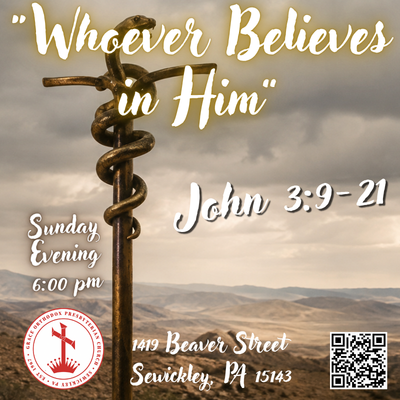
About this sermon
Nicodemus asks how a man can be born again, and Jesus answers with heavenly things. As Moses lifted up the bronze serpent so that dying Israelites could look and live, so the Son of Man must be lifted up, that whoever believes in him may have eternal life. “For God so loved the world, that he gave his only Son.” God did not send his Son to condemn the world but to save it. Believers struggling with sin can rest in this: Christ came to free them from sin’s bondage and make them alive.
Sermon transcript
Remain standing for the reading of God’s Word. This evening’s passage comes from the Gospel of John. We will be reading from John chapter 3, verses 1 through 21. We will read these verses to provide context, but the focus of our passage this evening, and the focus of our exhortation this evening, is from verses 9 through 18. You can find this passage on page 1055 of the Pew Bible. John chapter 3, verses 1 through 21.
Hear now the word of the Lord. Now there was a man of the Pharisees named Nicodemus, a ruler of the Jews. This man came to Jesus by night and said to him, “Rabbi, we know that you are a teacher come from God, for no one can do these signs that you do unless God is with him.”
Jesus answered him, “Truly, truly, I say to you, unless one is born again, he cannot see the kingdom of God.” Nicodemus said to him, “How can a man be born when he is old? Can he enter a second time into his mother’s womb and be born?” Jesus answered, “Truly, truly, I say to you, unless one is born of water and the Spirit, he cannot enter the kingdom of God. That which is born of the flesh is flesh, and that which is born of the Spirit is spirit. Do not marvel that I said to you, ‘You must be born again.’ The wind blows where it wishes, and you hear its sound, but you do not know where it comes from or where it goes. So it is with everyone who is born of the Spirit.”
Nicodemus said to him, “How can these things be?” Jesus answered him, “Are you the teacher of Israel, and yet you do not understand these things? Truly, truly, I say to you, we speak of what we know and bear witness to what we have seen, but you do not receive our testimony. If I have told you earthly things and you do not believe, how can you believe if I tell you heavenly things?”
No one has ascended into heaven except He who descended from heaven, the Son of Man. As Moses lifted up the serpent in the wilderness, so must the Son of Man be lifted up, that whoever believes in Him may have eternal life. For God so loved the world that He gave His only Son, that whoever believes in Him should not perish but have eternal life. For God did not send His Son into the world to condemn the world, but in order that the world might be saved through Him. Whoever believes in Him is not condemned, but whoever does not believe is condemned already, because he has not believed in the name of the only Son of God.
And this is the judgment: the light has come into the world, and people have loved the darkness rather than the light, because their works were evil. For everyone who does wicked things hates the light and does not come to the light, lest their works should be exposed. But whoever does what is true comes to the light, so that it may be clearly seen that their works have been carried out in God.
Let us pray. Heavenly Father, we thank You for Your word, and we thank You, O Lord, for the gospel. O Lord, the gospel is so simply and yet so beautifully given to us in this passage. O Lord, we have heard this same gospel in this same passage over and over. We know it by heart, and yet, O Lord, as we read this beautiful passage once again this evening, we pray that the Spirit would work in our hearts to learn new things, that these things that we have heard over and over again would be impressed upon us once again, and that You would quicken our hearts, that You would revive our hearts, that You would shake our hearts so that we would be gripped by these wonderful, beautiful truths that You have so graciously given to us in Your word. We pray all of this in Your Son’s name. Amen. Please be seated.
A thoughtful young believer recently asked me: If belief in God only occurs when God has first changed a person’s heart, why does God not change everyone’s heart so that everyone is saved? This is a common question that arises in the minds of both believers and unbelievers. If God can change people’s hearts so that they will believe, why not regenerate the hearts of all unbelievers so that all may believe? This question is especially relevant to our passage this evening. The passage we examined earlier in the first part of the conversation between Jesus and Nicodemus teaches that regeneration precedes faith. In other words, God must change an unbeliever’s heart before that person can believe. Verse 16 in our passage for this evening states: “For God so loved the world that he gave his only begotten Son, that whoever believes in him shall not perish, but have eternal life.” Thus, on the one hand, the Scriptures teach that belief is only possible when God first acts in the unbeliever’s heart.
Yet on the other hand, the Scriptures also call all unbelievers to repent. The Gospel call to faith and repentance is freely offered to all, to all Jews and all Gentiles alike. Although our passage this morning does not answer this difficult question fully, it does address one aspect of it: even though God, in his infinite merciful plan of salvation, has chosen only some to be saved, he still calls all men and all women to repentance and faith in him. However, this call to repentance and faith is not a mere formality. It is not insincere.
A famous pastor from Scotland in the 1800s once wrote regarding the free offer of the gospel. We preach a free and worldwide gospel. We proclaim a free and worldwide invitation to sinners. We present to every sinner a gracious welcome to Christ without any preliminary qualifications whatsoever. We do not require any person to wait until he has confirmed his own election or can provide evidence of regeneration or sufficient repentance or deep conviction.
We tell every person, as he is, to go to the Savior at this moment, assured that he will not be cast out or sent away. The call of the gospel to turn away from sin and to hate it, to put it to death, and to turn to our Creator who has sent his only Son, Jesus Christ, to die on the cross for our sins, is a genuine plea to all who would listen to cling to Jesus as the only truth and the only way to eternal life.
In our passage this evening, in this interaction between Nicodemus and Jesus, our passage reminds us that Jesus reminded this learned scholar of the free offer of the gospel. It reminds us that this free offer has always been made by God, beginning in the Old Testament and continuing into the New Testament. It begins in the Old Testament with shadows and types, and then leads to the fulfillment of that type in the New Testament. And in our passage, after reminding us of these truths, it ends with a guarantee of results for all mankind. More simply, Jesus gives us the type from the Old Testament, the fulfillment in the New Testament, and the guarantee for all mankind. Let us now turn to the type of Christ found in the Old Testament. The type of Christ found in the Old Testament from verses nine through fifteen.
At the core of the problem for the great teacher of the Pharisees was not that he did not know his scriptures. In fact, Nicodemus most likely knew more about the Old Testament scriptures and what they contained than 99 percent of Christians alive today. The problem was not a matter of knowledge of the scriptures.
As Jesus himself says in verse 10, “Are you not the teacher of Israel, and yet you do not understand these things?” The leading teacher of the Jews had knowledge of even the most detailed aspects of the law and the prophets. And yet he had failed to understand what they pointed to. When Jesus proclaimed that a man needed to be born of water and the Spirit in verse five, he was not proclaiming a new doctrine. He was proclaiming a doctrine drawn from passages such as Ezekiel chapter 36. The great teacher of Israel had failed to understand the Old Testament scriptures which he knew so well. And he was puzzled by what Jesus was saying. This reminds us once again that knowing the scriptures, even knowing them well, is not enough to be saved.
My systematic theology professor in seminary was close friends with a well-known liberal theologian from Europe. He told us that this theologian had memorized large portions of the New Testament in Greek. This man knew more about the New Testament than most conservative scholars. This is remarkable. He knew entire books of the Bible in Greek.
But at the same time, this theologian did not believe any of it was the revealed word of God. None of it was authoritative or binding upon him or his conscience. For him, it was merely an academic exercise to gain more knowledge. Yet all that knowledge in this man’s mind did nothing but condemn him further and make his judgment even more certain. It is crucial for Nicodemus and for us not only to know the scriptures, but to understand them rightly and believe in them.
Jesus continues in verses 12 through 14. Let us read them again. If I have told you earthly things and you do not believe, how can you believe if I tell you heavenly things? No one has ascended into heaven except he who descended from heaven, the Son of Man. And as Moses lifted up the serpent in the wilderness, so must the Son of Man be lifted up, that whoever believes in him may have eternal life. As we read these verses, let us remember what Jesus is responding to in verse 9.
Jesus had clearly laid out what was required to enter the kingdom of God. It was not being Jewish. It was not keeping the law just enough to assuage the wrath of God. It was not by outwardly keeping the law. It was not by memorizing all of the scriptures. The only way, according to Jesus, to enter the kingdom of God is by the Holy Spirit removing your heart of stone and replacing it with a heart of flesh. The only way, according to Jesus, that a man or woman can enter the kingdom of God is for the Spirit to give them new life, for them to be born again.
Jesus even refers to the Old Testament scriptures that Nicodemus knew so well. But Nicodemus in verse nine responds, and he shows that he has no idea what Jesus is saying. It says, Nicodemus said to him, “How can these things be?” So Jesus responds in verse 12.
I have already told you in terms that man can understand. Explaining the mechanics of how things actually work is not going to help you understand the spiritual reality that takes place at new birth. This is what he means when he says, “How will you believe if I tell you heavenly things?”
We do not fully understand how a man is regenerated. The scriptures do not fully explain the precise mechanics of the Holy Spirit working and changing our hearts. That is a mystery that has not been revealed to us. But what has been revealed and what we must believe is that the Holy Spirit indeed gives us new life.
And so Jesus answers, Nicodemus: if you cannot understand what has already been revealed—truths regarding man’s salvation—then explaining further the more complex heavenly realities behind it will not help. But Jesus does not leave Nicodemus with this difficult statement. He explains why, despite the lack of understanding, Nicodemus is to trust in him.
Jesus says in verse 13, “No one has ascended into heaven but he who descended from heaven, the Son of Man.” This may be one of the most difficult passages in the Gospel of John to understand. Some liberal theologians use this passage to argue that John is reinterpreting events in Jesus’s ministry to fit his theological agenda. They claim that Jesus uses the past tense here, saying, “No one has ascended,” which is past tense.
Therefore, they argue, this portion must have been added by the gospel writer, because Jesus clearly has not yet ascended into heaven. They conclude that this must be a mistake by the author. In other words, they understand Jesus to be referring to himself in the first part of verse 13. Jesus would then be saying, “No one has gone up into heaven but me, who has descended from heaven.”
However, there are several problems with this interpretation. The first is that it assumes John was careless. The second is that it assumes John lacked knowledge of the Old Testament scriptures. For there are several examples in the Old Testament of men—mainly Enoch and Elijah—who were taken up into heaven without experiencing physical death. So what exactly is Jesus saying here? Well, remember that Jesus is establishing his authority by which he is teaching.
Jesus is not saying that no one has ever physically gone up into heaven, because we know that Elijah and Enoch did so. He is saying that no one has gone to heaven to the Father’s side and returned. All people who die and go to heaven remain there and do not come back. No one has been at the Father’s presence and then returned to reveal gospel truths to humanity. But there is one who has come from the Father’s right hand to reveal the Father to humanity, and that is the Son of Man. Therefore, no one has ascended into heaven and returned, but there is one who has come from the Father’s right hand to reveal Him to us, and that is Jesus, the Son of Man.
And this is why Nicodemus, even if he does not fully understand what Jesus is saying, must trust Him, because He has come to reveal the Father to us. The Son of Man did not come merely to reveal the will of the Father. He came to accomplish a specific purpose, and that is to redeem the people whom the Father gave Him.
Jesus then continues to remind Nicodemus of the scriptures that he already knows, in verses 14 through 15, which we have just read. Jesus is the fulfillment of the Old Testament scriptures. Remember what Jesus says to the two disciples on the road to Emmaus. He said to them, “How foolish you are, and how slow to believe all that the prophets have spoken! Did not the Messiah have to suffer these things and then enter into His glory?” And beginning with Moses and all the prophets, Jesus explained to them what was said in all the scriptures concerning Himself. That is according to Jesus.
All the scriptures, all the Old Testament scriptures, point to the coming Messiah. The entire narrative of redemptive history in the Old Testament points to Jesus. And Jesus in our passage this evening gives us just one example among many of a type of Christ that points to Him. He recalls for us the story that we read in Numbers chapter 21.
In Numbers chapter 21, the Israelites, as they often did, forgot the covenant promises of God. They forgot all that He had done for them in bringing them up out of Egypt and in sustaining them during their journey through the wilderness. The Israelites began to complain about the food that had been provided to them. Instead of humbly turning to the Lord and asking for food and water, they complained against God.
Numbers 21:5, which we read, records their response to God. It says, “The people spoke to God and to Moses, ‘Why have you brought us up out of Egypt to die in the wilderness? For there is no food and no water, and we loathe this miserable bread.’” As a result, God sent serpents among the people, and many were bitten and died.
Under this judgment, the people quickly came to Moses and begged him to intercede on their behalf before God so that they might be saved from certain death. Then God told Moses to make a bronze serpent and set it on a pole, so that anyone who looked at it would be healed from the deadly bite.
Now, if you are Nicodemus, hearing this story from Jesus once again, being reminded of this story from the Old Testament, several questions should arise. For example, why was it necessary for a bronze serpent to be erected? God had already given the people detailed instructions on how they were to atone for their sins. The sacrificial system had been established many years before for God’s people. But for some reason, simply looking at the bronze serpent brought them forgiveness and salvation from death. The obvious answer to this question is that neither the sacrificial system nor the bronze serpent brought true salvation to God’s people. Both pointed to the future reality of the coming Messiah. When the people of God sinned gravely against Him, they were told to look to the serpent hanging on a pole and trust that God would save them from certain death. In the same way, Jesus says that the Son of Man will be lifted up so that whoever believes in Him will have eternal life. This brings us then to the fulfillment of the Old Testament type. The fulfillment of the Old Testament type in verses 16 through 17. Let’s read that again, verses 16 through 17.
For God so loved the world that he gave his only Son, that whoever believes in him should not perish but have eternal life. For God did not send his Son into the world to condemn the world, but in order that the world may be saved through him. These words are widely considered to be the most famous and most repeated Bible verses from the Scriptures. Yet no matter how many times we hear these words, they are refreshingly comforting to us once again.
The fact that we can read these words, and that these words are true, is a humbling reality for us. These are the greatest truths that anyone could ever read or hear, contained in these two verses. Nothing in this verse makes sense from a human perspective. Every clause of these verses is a wondrous mystery that could be studied throughout history.
Starting with the first clause, “For God so loved the world.” What a wondrous reality this is—that God would love men and women despite their sin and rebellion. Since Adam and Eve believed a lie and chose that lie over God, they loved that lie. Since that time, humanity has rebelled against God every minute of every day. Humanity has rejected God. Humanity has hated God. Humanity has turned away from God. Humanity has put God aside.
Yet God loved the world. As a side note, this does not mean, “For God so loved the world. He loved him so much.” It means that God loved the world in this way: He sent His only Son. He loved it in this way, that whoever believes in Him would have eternal life. Another question that must be answered is, what is the world? Did God love the birds and the bees? And is that why He sent His Son?
No, it clearly refers to humanity. The world is in contrast to only the Jews. It is important that we understand this, because in verse 14, the type was given only to the Jews. But in the fulfillment of that type in the New Testament, in verses 16 and 17, this gospel truth is no longer for the Jews alone, but for all humanity—men from every part of the world, not just the kingdom of Israel.
So then, God has loved the world in this way: He gave His only begotten Son, that whoever believes in Him, whether Gentile or Jew, may have eternal life. Once again, we must stop and be in awe of these words—the eternal Son of God, the eternal God, the God who does not need our praise or glory, who has no need for us to be whole. That God gave us His only begotten Son.
When atheists read the story of Abraham and Isaac, they are often horrified by it. They often cite it as a reason to disbelieve the scriptures. Because they rightly, on some level, cannot understand the idea of a father willingly sacrificing his son. Why would a loving father send his own son to die? But the whole story of Abraham and Isaac is once again misunderstood if it is not seen in the broader context of redemptive history.
This story teaches us that God will provide an atoning sacrifice on behalf of humanity, so that Isaac in his time and we in our time would not have to pay the punishment for our sins. It also offers us a vivid image, a glimpse into the reality of what the father is experiencing when he sends his son for us. The gospel of Jesus Christ is truly good news for those who believe in Him. We often tell unbelievers that the gospel is good news, but we must first understand the bad news before we can hear the good news. We go on to explain that the bad news is that we have sinned against a holy God and are condemned to eternal death, and so on. But that is not the only part of the gospel that is bad news.
In order for the gospel to be true, in order for you and for me to be saved, in order for us to have a chance to be made right with God, the second person of the blessed Trinity, the eternal Son of God, was given by the Father and became a man. He suffered blasphemy, abuse, hardship, and hunger, and ultimately he suffered the wrath of God on the cross. In order for you and for me to be saved and to have eternal life, the eternal Son of God was killed by the very people whom he had created. The cost for you and for me to be in the presence of God, even this evening, to worship him and to be with his people, is the only begotten Son of God. That is the cost for you and for me. It can be difficult to understand how Jesus could pay the eternal debt for millions of people. How could Jesus pay? How could one man pay for that on the cross?
The reason he could is because of who he was. Jesus, the eternal Son of God, is more valuable than all sinners combined. Do you understand the cost, the great cost that was paid for you? He is everything to the heavenly Father. And yet he willingly came to this earth, and the Father, out of love for you and for me, chose to purchase a people for himself and sent his Son to die on the cross for us.
What a wondrous mystery this is. What a love this is that he has shown to us. And John continues, that whoever believes in him should not perish, but have eternal life. This is the great gospel call to all people to repent. There is no one exempt from this call. No matter what you have done in this life, no matter the sin, no matter the hatred you have shown to others or to God, you must heed this call.
There is no other way to be made right with God. You cannot absolve yourself of your sins. You cannot clean yourself up before you come to God. You cannot do enough good works to outweigh the bad. The only hope you have in this life is to cling to Jesus and to put your faith in him. And if you do, Jesus promises that you will have eternal life. And there are some who struggle with this reality. Another common objection to the gospel is how someone like Hitler could be in heaven if he were to repent.
But the nice Mormon man down the street or the nice Mormon woman down the street will not. Surely such a thing is unjust. And at first this seems like a strong argument against Christianity. But the problem with this statement is that it does not recognize two things. It does not recognize the sinfulness of that nice Mormon man or woman down the street. And more importantly, it does not recognize the greatness and the glory of the man who was hanging on that tree 2000 years ago. Do you know who that was?
It was the eternal Son of God who hung on that tree. And no matter your sin, past or present, know that God’s salvation is greater. And he has prepared a path to eternal life for you. So put your faith in him. And John goes on in verse 17, with more glorious words of hope for us. He writes in verse 17, For God did not send his Son into the world to condemn the world, but in order that the world might be saved through him. What a wonderful assurance this is to us. The Father sent the Son into the world to save us.
Jesus has not come to condemn us in our sin, but to call us away from our sin into eternal life. I want us to remember these words when we are struggling with sin. Jesus has not come to condemn you in your sin. He has come to save you from that sin, to break the chains that easily ensnare us, and to free us from the bondage in which we were living. He has come to make us alive in Christ Jesus, so that we can live in righteousness and in truth. But notice that John here is speaking of Christ’s first coming. The first time that Jesus came, He came not in judgment, but to save. But Jesus is coming back. And this time, it will be to judge the world.
This brings us then, lastly and briefly, to the guarantee in verse 18, the guarantee for all mankind in verse 18. Verse 18 writes: “Whoever believes in Him is not condemned, but whoever does not believe is condemned already, because he has not believed in the name of the only Son of God.” In verse 18, we are given two promises. One joyous promise for those who believe in the name of Jesus. And the second, a terrifying warning for those who reject Christ. John writes, for those who believe, their salvation is sure. As Paul writes in Romans chapter eight, “There is therefore no condemnation to those who are in Christ Jesus, who walk not after the flesh, but after the Spirit.”
The penalty was paid for us on the cross by the eternal Son of God, who is wholly sufficient to save you from your sins. There is no more need for sacrifices or good works to justify us. Christ’s active and passive obedience have made us right before our Father in heaven.
But if you do not heed the gospel call of Jesus Christ, John says that you will perish in your sins. Your judgment is already secure because you have not looked to the one, Christ Jesus. The judgment for those who do not believe is eternal, just as the reward is for the believer. But instead of eternal life in Christ Jesus, it is eternity spent under the wrath and curse of God. So turn away from your sins if you do not know him, and turn to the one who hung on a tree so that you can have life in him.
These gospel truths are the same gospel truths that have been given to humanity from the very beginning. God gave the same gospel in seed form to Adam and Eve. And throughout the whole Old Testament, little by little, God revealed to humanity more and more about His plan of salvation. But all along, God had offered humanity a way to eternal salvation, which was to believe in the Messiah who was to come, who would crush the head of the serpent, who would bring an end to sin and death. And that gospel, as it became more and more unfolded, became more and more clear, bringing hope to many in the Old Testament.
And for us, it is the same hope, that we find in Jesus Christ. Brothers and sisters, this is indeed one of the most hopeful passages in the New Testament, but it is also one of the most solemn passages in the scriptures. There are many in our world whom we pass by on a daily basis who do not know the name of Christ and who do not believe in Him. If they die in their sins, there is no more hope for them. But believer, you have that hope within you. You know the one, you know Jesus Christ, who freely offers the gospel to all. We have a chance to bring this gospel to a dying world. So I encourage you to bring the gospel in your daily lives to these people.
And lastly, as we live our lives, this gospel is not just for unbelievers, but also for believers. Although we are saved, we still struggle with sin. The gospel is a continual reminder that we are not slaves to sin, but have been made alive in Christ. Therefore, let us remind ourselves daily of this wonderful gospel, of this simple yet beautiful gospel, and let us share it with a world in need.
Let us pray. Heavenly Father, we thank you for who you are. We thank you that you are not like us. O Lord, if we were in control, we would have destroyed the world long ago. Yet you, O Lord, our gracious God, are merciful and patient. You are a God who loves us despite our sin. We thank you that you are our God, that you have chosen, in your infinite mercy and grace, to send your Son, Jesus Christ, to die on the cross for our sins, so that his righteousness might be made ours and so that our debt might be paid by him.
We thank you for the reminder of this glorious gospel that we have received tonight through your word. We pray, O Lord, that as we leave this place this evening, the gospel of Jesus Christ would remain continually in our minds, that we would be continually reminded of this amazing truth that affects every part of our lives. It is indeed the greatest encouragement we have. We pray, O Lord, that we would not hide this light, but that we would shine it before all. We would boldly proclaim this glorious truth, this glorious gospel, to everyone we meet. And we pray, O Lord, that you would use us mightily to bring your sheep into the fold. We pray all this in your Son’s name, amen. Let us continue our worship by standing and singing hymn 449, hymn 449.
The sermon text provided above is derived from the sermon audio recording making use of generative tools. It has not been manually edited. While transcription tools have a high degree of accuracy, the output may include generative textual, punctuation, and/or formatting errors.