
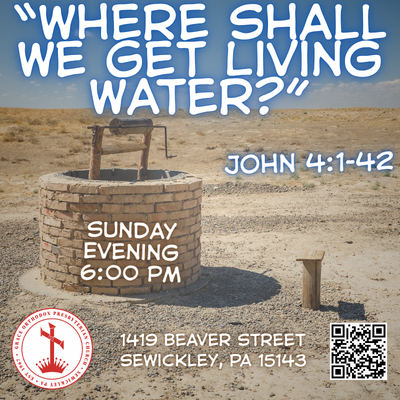
About this sermon
At Jacob’s well Jesus offers the Samaritan woman living water: whoever drinks the water he gives will never thirst again, for it becomes a spring welling up to eternal life. That water is the Holy Spirit, who never leaves believers without his sustaining work, though they still suffer and doubt. Christ is also the access to the Father. The hour has come when true worshipers worship in spirit and truth, not on Gerizim or in Jerusalem, as God extends his promise to the nations.
Sermon transcript
Remain standing as we read the word. This evening’s Bible passage is from John chapter 4, verses 1 through 42. We will be reading all 42 verses, but the focus of this evening’s exhortation will be from verses 1 through 27. John chapter 4, verses 1 through 42. Hear now the word of the Lord.
Now when Jesus learned that the Pharisees had heard that Jesus was making and baptizing more disciples than John, although Jesus himself did not baptize but only his disciples, he left Judea and departed again for Galilee, and he had to pass through Samaria.
So he came to a town of Samaria called Sychar, near the field that Jacob had given to his son Joseph. Jacob’s well was there, so Jesus, wearied as he was from his journey, was sitting beside the well. It was about the sixth hour. A woman from Samaria came to draw water, and Jesus said to her, “Give me a drink,” for his disciples had gone away into the city to buy food. The Samaritan woman said to him, “How is it that you, a Jew, ask for a drink from me, a woman of Samaria? For Jews had no dealings with the Samaritans.” Jesus answered her, “If you knew the gift of God and who it is that is saying to you, ‘Give me a drink,’ you would have asked him, and he would have given you living water.” The woman said to him, “Sir, you have nothing to draw water with, and the well is deep. Where do you get this living water? Are you greater than our father Jacob, who gave us the well and drank from it himself, and as did his sons and his livestock?” And Jesus said to her, “Everyone who drinks of this water will be thirsty again, but whoever drinks of the water that I will give him will never be thirsty again. The water that I will give him will become in him a spring of water welling up into eternal life.” And the woman said to him, “Sir, give me this water, so that I will not be thirsty or have to come here to draw water.”
And Jesus said to her, “Go call your husband and come here.” The woman answered him, “I have no husband.” Jesus said to her, “You are right in saying, ‘I have no husband.’ For you have had five husbands, and the one you now have is not your husband. What you have said is true.” The woman said to him, “Sir, I perceive that you are a prophet.”
“Our fathers worshiped on this mountain, but you say that in Jerusalem is the place where people ought to worship.” Jesus said to her, “Woman, believe me, the hour is coming when neither on this mountain nor in Jerusalem will you worship the Father. You worship what you do not know. We worship what we do know, for salvation is from the Jews. But the hour is coming, and is now here, when the true worshipers will worship the Father in spirit and in truth. For the Father is seeking such people to worship him. God is spirit, and those who worship him must worship in spirit and truth.”
The woman said to him, “I know that Messiah is coming, he who is called Christ. When he comes, he will tell us all things.” And Jesus said to her, “I who speak to you am he.”
Just then his disciples came back, and they marveled that he was talking with a woman. But no one said, “Who do you seek?” or “What do you seek?” or “Why are you talking with her?” So the woman left her water jar and went away into the town, and said to the people, “Come see a man who told me all that I ever did. Can this be the Christ?”
They went out of the town and were coming to him. Meanwhile, the disciples were urging him, saying, “Rabbi, eat.” But he said to them, “I have food to eat that you do not know about.” So the disciples said to one another, “Has anyone brought him something to eat?” Jesus said to them, “My food is to do the will of him who sent me and to accomplish his work.”
Do you not say that there are yet four months until the harvest? Look, I tell you, lift up your eyes and see that the fields are white for harvest. Already the one who reaps is receiving wages and gathering fruit for eternal life, so that the sower and the reaper may rejoice together. For here the saying holds true: one sows and another reaps. I sent you to reap that for which you do not labor. Others have labored, and you have entered into their labor.
Many Samaritans from the town believed in him because of the woman’s testimony. He told me all that I ever did. So when the Samaritans came to him, they asked him to stay with them. And he stayed there two days. And many more believed because of his word. They said to the woman, “It is no longer because of what you said that we believe, for we have heard for ourselves. And we know now that this is indeed the Savior of the world.”
Let us pray for God’s blessing upon the Word exposited. Heavenly Father, what a privilege it is to be able to hear your Word proclaimed. We pray, O Lord, that you would, through your Holy Spirit, work in each one of us. That the gospel of Jesus Christ would go forth into our hearts, that your word would remain there, that it would grip us, that we would see the glories of Jesus Christ and his mercy and his grace toward us. We pray, O Lord, that we would be encouraged, that we would be brought up, that we would be caused to draw closer to you and to one another. We pray all of this in your Son’s name. Amen. You may be seated.
Well, I am sure many of you have seen or at least heard of the news from Nepal and Tibet. If you have seen any of the videos that have come out of those regions, they are some of the most frightening images that one could ever see. There is one video in particular that you may have seen. A flood is approaching, and there is a building that is four or five stories tall. The flood comes and completely covers this building. The building is entirely consumed by the water.
Reports now indicate that at least hundreds, and possibly thousands, have died, and thousands remain missing. Something similar occurred in 2011 in Japan, when a tsunami caused by an earthquake struck the northeastern shores of the country. On that single day, nearly 20,000 people died from the combined effects of the earthquake and the wave, with the vast majority killed by the wave. The wave was so large that, at some points, it reached a height of 130 feet—equivalent to 13 basketball hoops stacked on top of one another. This was an immense force.
It is understandable that those who experienced this tragedy often avoid the ocean, even decades later. For many, the ocean represents the force that took their loved ones and caused lasting nightmares. The wave tore apart families, destroyed homes and businesses, ruined marriages, and destabilized entire towns for years.
On the other hand, there are places in the United States and around the world where water is regarded as a precious resource that must not be wasted. On this earth, there are regions where water is so scarce that conflicts have been fought and people have died to gain access to it.
The idea of a source of water that would satisfy their thirst forever would likely be the most desirable thing to these people. The scriptures, like the examples I have given, also speak of water as both a blessing and a curse. When the Israelites wandered in the wilderness, they desperately needed water.
Their situation was so dire that they complained about God bringing them out of the land of Egypt. In their minds, at that time, it would have been better to remain in Egypt, enduring slavery, sometimes being beaten or even killed, because at least in Egypt they had access to water. The Israelites did not humbly request water from God. Instead, they complained to Moses and verbally attacked God.
But God, being gracious, provided water through a rock, which Paul identifies in 1 Corinthians 10 as being Christ himself. Thus, Christ was the living water for His people in the Old Testament. There are many other examples where water is portrayed as a blessing from God, quenching thirst and enabling crops to bear fruit, providing both nutritional nourishment and relief to parched mouths. Therefore, for God’s people, those who are under His blessing, water is seen as a blessing.
At the same time, water also represents judgment for sinners who have rejected the gospel call. Most notably, we can recall the great flood in Genesis, when the waters covered the entire earth and every man, woman, and child not in the ark perished because they had rejected the gospel call of Noah. Later, in the Exodus account, God used the waters of the Red Sea to destroy the enemies of Egypt who were pursuing the Israelites. Further, in the prophetic literature, numerous examples show God’s judgment likened to water or a flood coming upon His enemies.
Thus, for the people of God, for those of us who trust in Him, God provides water as a blessing to quench our thirst and strengthen us in our walk with Him. But to those who reject God, water becomes a terrifying instrument of judgment, used to vanquish the enemies of God’s people.
And in our passage this evening, Jesus reminds us that the provision he has given us is not a momentary provision, nor is it merely a physical provision of water, but rather a spiritual and eternal water that he has given us. In the Old Testament, God provided manna and water from a rock for his people, which gave them temporary relief. But in his Son, Jesus Christ, he has given us water that leads to eternal life. He has done so that we may be spared from God’s judgment and brought into eternal communion and worship of our Creator.
In our passage this evening, we will consider first the access we gain to living water through Christ. That is, Christ is our access to living water, and second, Christ is our access to the Father. First, Christ is our access to living water, and second, Christ is our access to the Father. Christ is our access to living water can be found in verses 7 through 15. Let us read those verses again: A woman from Samaria came to draw water, and Jesus said to her, “Give me a drink.” For his disciples had gone away into the city to buy food.
The Samaritan woman said to him, “How is it that you, a Jew, ask for a drink from me, a woman of Samaria? For Jews had no dealings with Samaritans.” Jesus answered her, “If you knew the gift of God and who it is that is saying to you, ‘Give me a drink,’ you would have asked him, and he would have given you living water.”
And the woman said to him, Sir, you have nothing with which to draw water, and the well is deep. Where do you get this living water? Are you greater than our father Jacob, who gave us the well and drank from it himself, as did his sons and his livestock? Jesus said to her, everyone who drinks of this water will be thirsty again, but whoever drinks of the water that I will give him will never be thirsty again. The water that I will give him will become in him a spring of water welling up to eternal life. And the woman said to him, Sir, give me this water, so that I will not be thirsty or have to come here to draw water.
As we consider our passage this evening, it is important for us to briefly examine the historical context in which this passage takes place. When we first read this story, if we were to read it for the first time in our modern context, it may seem surprising. Especially when we read the words of the woman in verse 9, where she says, “How is it that you, a Jew, ask for a drink from me, a woman of Samaria?”
In our day and age, the idea of one person from one ethnic group refusing to interact or commune with another person solely on the basis of ethnicity is considered morally unacceptable. This is true, except for a small group that has recently begun promoting such views in certain reform circles. Aside from that group, this idea is universally regarded as unacceptable.
But in the time of the scriptures, separating along ethnic lines was common and expected. After all, the Jews were primarily, with the exception of some Gentiles who were incorporated into their community, an ethnically homogeneous religious group. It was common for the Jews to regard other ethnic groups with disdain. The Samaritans, in particular, were deeply opposed to the Jews. Their division was not only ethnic but also religious.
The Samaritans, as many of you may know, had their roots in the northern kingdom of Israel. When the Assyrians conquered Israel, they took most of the Israelites into exile, but left some behind. When the Assyrians brought in other foreigners to settle the land, the remaining Israelites intermarried with those foreigners. When the Jews who had been in exile returned, they resented those who had stayed behind and viewed them with suspicion because they had intermarried with non-Israelites.
As a result, the Jews separated themselves from the Samaritans, and the two groups grew further apart. Eventually, although the Samaritans accepted the five books of Moses as scripture, they built their own temple on their own land. This further deepened the division between Jews and Samaritans. By the time Jesus came, the division was so great that the idea of a Jewish man sharing a drink with a Samaritan woman would have been completely unacceptable to both groups. The Jews considered the Samaritans to be defiled by foreign blood and compromised in the most important matter—worship of the one true God.
Returning to our text this evening, we see that Jesus was traveling from Judea to Galilee when he stopped at a well to get water. The well he stopped at was none other than the well of Jacob. Jacob, of course, was one of the patriarchs of Israel and held common significance for both the Jews and the Samaritans. Both Jesus and the woman had roots that went back thousands of years to this common ancestor. It was at this well that they shared a connection, and Jesus said to the woman, “Give me a drink.” The woman, deeply influenced by her historical context, responded with surprise.
And she says, “How is it that you, a Jew, would ask me, a woman of Samaria, for water?” The Gospel writer, John, then explains why she said this. He states that the Jews had no dealings with Samaritans. As we discussed earlier, the Jews avoided the Samaritans and regarded them with disdain. Therefore, for Jesus to not only speak with this woman but also to drink from her jar, to commune with her, and to discuss serious matters with her—especially with a woman considered defiled by Jewish standards—was utterly unacceptable for a Jewish man.
Hence, in verse 27, we see the disciples’ reaction: they were amazed that he was speaking with this woman. Then Jesus responds to the woman. He says, “If you knew the gift of God and who it is that is saying this to you, you would have asked him, and he would have given you living water.”
Once again, Jesus does not respond directly to what the woman said. Instead, he responds in a way that causes her to ask further questions. While the woman is considering the cultural divide between Jesus and herself, Jesus focuses on the deeper divide—the true divide—that exists in the human heart, which is far from God. Jesus wants her to understand that there is something deeper and more serious at stake than this ethnic division, and that she has not yet come to know the one true God. And just as the woman in chapter 3, Nicodemus, understood Jesus literally rather than spiritually as he meant it, so she now responds, “Where and how are you going to get this water? Are you greater than our father Jacob? Even he, the greatest among us, had to dig a well and use tools to draw water. How can you produce water without such tools?”
Once again, Jesus answers her question indirectly. Jesus said to her, “Everyone who drinks of this water will be thirsty again, but whoever drinks of the water that I will give him will never be thirsty again. The water that I will give him will become in him a spring of water welling up to eternal life.” He did not say this directly to her, but He made it clear in His reply that He was speaking of spiritual matters, not physical water.
The water that God provided to Jacob, and the water that God gave to the Israelites in the wilderness, were both temporary solutions to a physical need. The Israelites were suffering under intense heat. They were parched, and they could feel their strength gradually fading as they went without water. At their most desperate moment, God provided them with water, which to them, I am sure, tasted like the best water they had ever tasted. But after several hours, this water no longer satisfied their thirst. Their thirst returned.
They would again seek water, because this desire is only briefly fulfilled. People must continually take in physical nourishment throughout their lives in order to perform basic bodily functions. But Jesus says He can give water that never runs dry—a water that, when drunk, brings eternal satisfaction. Indeed, according to Jesus, when this water is received, it becomes a spring of water within the believer, leading to eternal life. Clearly, He is speaking of spiritual matters, and He is referring to the Holy Spirit, the third person of the Trinity.
Now, Jesus is not saying that believers will never suffer. He is not saying that they will never have doubts. He is not saying that they will never need to be renewed or encouraged by the word. He is saying that once the gift of the Holy Spirit is given, believers will never be left without the sustaining work of the Holy Spirit in their lives.
There will never be a time in your life, believer, when you are left without the water that produces new life in you. Calvin, in his commentary, explains it this way: For he, that is Jesus, does not say that from the very first day we drink so as to be fully satisfied, but only means that the Holy Spirit is a continually flowing fountain, and that therefore there is no danger that those who have been renewed by spiritual grace will be dried up. Therefore, although we thirst throughout our whole life, it is certain that we have not received the Holy Spirit for only one day or for only a short period, but as an everlasting fountain, which will never fail us. And thus believers thirst and keenly thirst throughout their whole life, yet they have an abundance of quickening moisture. However small the measure of grace they have received, it gives them perpetual vigor so that they are never entirely dry. So for the believer, this eternal water, the water that gives eternal life, will never run out.
But for the unbeliever, on the other hand, whether they acknowledge it or not, the unbeliever is constantly walking around searching for something to quench the deep gap that exists in his nature between what he was created for and how he is living.
And sinful man attempts to fill this void with many things. They fill it with money, with fame, with alcohol, with sex, with drugs, with pursuing a good career, with status, and many other things. Some unbelievers have recognized the futility of chasing after these things. And they try to find purpose and meaning in things that are good and have been given to us by God, such as family, children, and other responsibilities.
Jordan Peterson is a notable example of this. You may have heard of him. He is a well-known psychologist from Canada who has written many books and delivered numerous lectures. He teaches at length about finding meaning and purpose by taking on greater and greater responsibilities. Yet even if you were to follow this man’s advice completely, you would still find yourself longing for something more.
Because God created us. The one true God, the God of Abraham, Isaac, and Jacob, created you for something more. He created us, and what is truly astonishing is that He made man and entered into a covenant with him. He made man to be in relationship with Him, to live in intimate communion with His Creator. While earthly relationships are necessary and vital, if we do not have a relationship with our Creator, we will always be searching for something to quench our thirst and to give us peace.
But if we know the Lord, if Christ has granted us the gift of the Holy Spirit, then the eternal God, the one who created you, now dwells within you. He strengthens you, He convicts you of sin, He sanctifies you, He comforts you, He builds you up through the Word, and He will keep you until the end. As Jesus says, He will lead you to eternal life. As Paul writes in Ephesians chapter one, in Him you also, when you heard the word of truth, the gospel of salvation, and believed in Him, were sealed with the promise of the Holy Spirit, who is the guarantee, the guarantee, of our inheritance until we acquire possession of it to the praise of His glory. Physical water may give us momentary sustenance, but the eternal water, the eternal Holy Spirit that gives us water unto eternal life, which Jesus Christ has offered to us, gives us eternal sustenance. And by the gift of the Holy Spirit in our lives, we are also granted access to the Father. This brings us then to Christ, our access to the Father. Christ, our access to the Father, as described in verses 16 through 26. Let us read that passage once again, verses 16 through 26.
Jesus said to her, “Go call your husband and come here.” The woman answered Him, “I have no husband.” Jesus said to her, “You are right in saying I have no husband, for you have had five husbands, and the one you now have is not your husband. What you have said is true.” And the woman said to Him, “Sir, I perceive that you are a prophet.”
You worship what you do not know. We worship what we know. For salvation is from the Jews. But the hour is coming, and is now here, when true worshipers will worship the Father in spirit and in truth. For the Father is seeking such people to worship him. God is spirit, and those who worship him must worship in spirit and in truth. And the woman said to him, I know that the Messiah is coming, he who is called the Christ. When he comes, he will tell us all things.
And Jesus said to her, I who speak to you am He. Once again, in verse 15, the woman shows that she still has not understood the meaning of Jesus’ words. She again asks, Can I have this water, this water that gives eternal life? And so Jesus takes a different approach to help her understand the significance of his words and the authority by which he speaks.
Jesus knew that this woman had been unfaithful. She had not only had more than one husband, but five husbands. The man she was currently living with was not one of her husbands. He asked her to bring her husband, knowing that she was living with a man who was not her husband. And so she responded, I have no husband.
And here Jesus is revealing her life before her. The most intimate, the most private, the greatest secret in her life, the most damaging to her—this is what he brings to light. And we see that her attitude immediately changes when she realizes that this man before her knows everything about her life. Therefore, she says, He must be a prophet. In this story, Jesus is gradually revealing more of who he is to this woman. But the woman still does not fully understand who he is. So the woman then recognizes that he is sent from God.
And she takes the opportunity to ask him a central question that divided the two peoples. She asks him, in which place are we to worship God? In other words, who is correct? Are the Jews correct in Jerusalem, or are the Samaritans correct? It seems that her question is genuine.
Jesus knows that she still has not understood what he is teaching. The people whom Jesus encounters throughout this Gospel have consistently tried to understand his words in physical terms. We saw this with the Jews at the Temple. We saw it with Nicodemus, and now we see it this evening with the woman.
Jesus is not speaking of physical realities. The worship of the Old Testament, the Temple structure, and the sacrificial system all pointed to a spiritual reality—the reality that would come when God sent his Son, Jesus Christ, to fulfill all these things. Then God’s people would worship him by spirit and with truth, not in a specific location, not in a specific building, not in a specific nation, but by the power of the Holy Spirit and in accordance with the truth of the Scriptures.
As an aside, some commentators suggest that here Jesus is minimizing the distinction between the Jews and the Samaritans. I submit to you that Jesus was not saying that their distinction was unimportant.
He says in verse 22, “You worship what you do not know; we worship what we do know, for salvation is from the Jews.” Here Jesus fully affirms the Jewish understanding of the matter. The Samaritans, although they sought to worship the God of Abraham, Isaac, and Jacob, had indeed strayed from the people of God. They were outside the covenant community and were worshiping contrary to God’s Word. Therefore, Jesus affirms that how we worship matters, and we must do so in accordance with God’s will. But Jesus’ overall point here is that there will come a day—and indeed that day has come—when the location of worship will no longer matter.
As we were reminded in this morning’s sermon, God promised Adam, all the way back in Genesis chapter 12, verse 3, that God would bless all the nations through the seed, through his seed. God’s plan of redemption from the very beginning was to extend the call of the Gospel beyond the nation of Israel. And it was through Jesus Christ and the inauguration of the New Covenant that this promise to Adam would now be fulfilled. Jesus continues in verses 23–24: “But the hour is coming, and is now here, when the true worshipers will worship the Father in spirit and in truth, for the Father is seeking such people to worship Him. God is spirit, and those who worship Him must worship in spirit and in truth.”
Christ has now come, and He has inaugurated the new covenant, and there is no longer a limit to the nation of Israel. This is now open to every man and every woman from every tribe, nation, and tongue. And Jesus says that this time is now here. The time has come for the worship of God to be no longer tied to the physical location of Jerusalem and to be brought to every nation, to every tongue, and to every tribe. The worship of God would no longer be defined by the Temple of Jerusalem, but would now be identified by those who are led by the Holy Spirit and worship Him according to the Scriptures.
Because Jesus says, “God is Spirit, and those who worship Him must worship Him in spirit and in truth.” Therefore, the nature of worship for us is primarily spiritual. It is not to be conducted with physical objects, as is done by Roman Catholics or Eastern Orthodox Christians. Christ has indeed given us two sacraments—baptism and the Lord’s Supper—but these are the only two physical signs He has provided for worship. Now, God dwells in us. God dwells with us. There is no longer a need for the physical types of the Old Testament, which only pointed to the greater reality that is Christ. And now, since the perfect revelation of Jesus Christ has come, the types of the Old Testament must pass away.
Jesus says this reality is happening now. In other words, it is occurring at this very moment. As we see, the people of Samaria come to believe in Jesus and worship Him. The Gospel is now, even at this moment, coming not only to the Jews but also to the Gentiles. Therefore, the chief marker of those who worship the one true God is not their ethnicity, nor is it the place where they worship. It is those who are indwelt by the Holy Spirit, who receive the living water, the gift of Jesus Christ to us. Those who worship the one true God in spirit and in truth are the true church.
There is much more that could be said about Jesus’ words here, and much more that would be helpful to study. But as we come to the end of our time this evening, let us be reminded of the truths that Jesus proclaimed.
There is only one thing that satisfies the human soul, and that is a relationship with His Creator. It is communion with our God. It is our reliance on Him. It is His dwelling with us. But because of our rebellion against Him and our sin, that relationship is fundamentally broken. Thus, we live our lives constantly searching, constantly in need of something we do not have. We are constantly parched, seeking the water that can heal us.
But Jesus Christ has come to this earth to reconcile us to God and to dwell with humanity. He has come so that our sins may be removed as far from us as the east is from the west. And that same man, Jesus Christ, has given us a gift. He has given you and me a gift that is the Holy Spirit. The Holy Spirit regenerates us. The Holy Spirit sustains us. The Holy Spirit purifies us. The Holy Spirit convicts us of our sins. The Holy Spirit comforts us in times of need and grief. And most importantly, the Holy Spirit keeps us until the end. Most wonderfully.
It is by the Holy Spirit that we are united to Christ, so that we can come before the Father even this evening. We come before the Father by the Holy Spirit and worship Him in spirit and in truth. So if you do not know this peace, if you do not have this living water, if you do not know the Father in heaven, turn to Him even this evening and find peace and life. If you have already come to Christ, be encouraged that even now this living water springs forth within you. Even when you do not feel it, the Spirit is sanctifying you, the Spirit is comforting you, the Spirit is building you up, the Spirit is encouraging you, and the Spirit is keeping you until that blessed day when we will see our Savior.
Let us pray. Heavenly Father, we thank You that You have not left us alone, that You have given us the Holy Spirit. Oh Lord, this life that we live is difficult. There are many challenges, many discouragements, much grief, much pain. Now, Lord, You have not left us alone. You have sent Your Holy Spirit to dwell in us.
Through Your Word, we may be encouraged, we may be built up, we may find comfort, we may be convicted, and we thank You, O Lord, for the work of the Holy Spirit. We pray, O Lord, that even this week as we go from here, You would work mightily in each one of us, draw us closer to You, sanctify us, turn us away from sin, and turn us to You. We pray all this in Your Son’s name. Amen. Please stand as we continue our worship with hymn 272, hymn 272, I Heard the Voice of Jesus Say.
The sermon text provided above is derived from the sermon audio recording making use of generative tools. It has not been manually edited. While transcription tools have a high degree of accuracy, the output may include generative textual, punctuation, and/or formatting errors.