
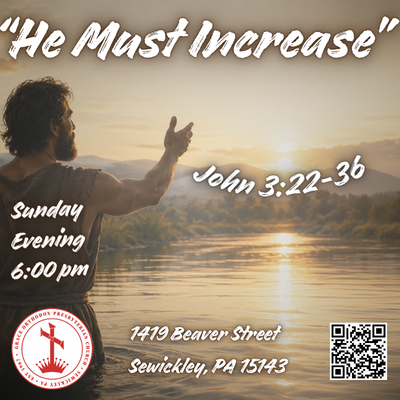
About this sermon
When John’s disciples worry that everyone is going to Jesus, John answers that he is not the Christ but the friend of the bridegroom, who rejoices at the bridegroom’s voice: “He must increase, but I must decrease.” Scripture calls God the husband of his people, and Christ is that bridegroom. He comes from above, speaks the words of God, and has all things from the Father; whoever believes in the Son has eternal life. Ministers are never the main characters in the story of redemption; Christ is.
Sermon transcript
This evening’s passage is from the Gospel of John, chapter 3, verses 22 through 36. You can find this in the Pew Bible on page 1055. Hear now the word of the Lord. After this, Jesus and his disciples went into the Judean countryside, and he remained there with them, baptizing.
John also was baptizing at Aenon near Salem, because water was plentiful there. People were coming and being baptized, for John had not yet been put into prison. Now a discussion arose between some of John’s disciples and a Jew concerning purification. They came to John and said to him, “Rabbi, the one who was with you across the Jordan, to whom you bore witness—look, he is baptizing, and all are going to him.”
John answered, “A person cannot receive even one thing unless it is given to him from above. You yourselves bear witness that I said, ‘I am not the Christ, but I have been sent before him.’”
“The one who has the bride is the bridegroom. The friend of the bridegroom, who stands and hears him, rejoices greatly at the bridegroom’s voice. Therefore, this joy of mine is now complete. He must increase, but I must decrease.”
“He who comes from above is above all. He who is of the earth belongs to the earth and speaks in an earthly way. He who comes from heaven is above all.
“He bears witness, yet no one receives his testimony. Whoever receives his testimony sets his seal to this, that God is true. For he whom God has sent speaks the words of God, for God gives the Spirit without measure. The Father loves the Son and has given all things into his hand. Whoever believes in the Son has eternal life. Whoever does not believe in the Son shall not see life, but the wrath of God remains on him.”
Let us pray. Heavenly Father, we thank you, Lord, for your word. We thank you that you have preserved your word over thousands of years, so that this day we could come to it, hear it read, and hear this glorious truth from it. We pray, O Lord, that through your Spirit you would strengthen each one of us, work in each one of our hearts, and open our hearts to receive your word and these truths. We pray that through your Spirit you would cause each one of us to be encouraged in Christ, to see Christ, to see his glory, and to grow more deeply in love with him. We pray, O Lord, that we would love one another more through your word. We pray all this in your Son’s name. Amen. You may be seated.
As we continue further into the book of John, I think it can be easy for us to become distracted by the details of the book and lose sight of its major themes and the path the gospel writer is guiding us to follow. And as we lose sight of the broader message and the purpose of this gospel, it becomes easy for us to overlook the importance and the weight of each passage we consider.
Just by way of reminder, John writes in the twentieth chapter the reason for writing his gospel. He writes in chapter 20: “These have been written so that you may believe that Jesus is the Christ, the Son of God, and that by believing you may have life in his name.” Because of this narrow focus that John has in the purpose of his gospel, at times it can feel as though certain passages are repetitive or that we have heard this same emphasis repeatedly. But as we go on, I want us to bear in mind several things about the Gospel of John. First, John intentionally and carefully crafted each aspect of the Gospel that we read. Remember that in his time, it was not inexpensive to hire a scribe or to record these words. It was not like he had access to a computer or to printing at a cost of just one cent per page. It was a difficult and expensive task.
We also can consider John’s statement in chapter 20. He writes that Jesus performed many other signs that were not written in the gospel. This means that John selected only a few of the signs that Jesus performed in order to fulfill the task and purpose for which he wrote the gospel. Therefore, each passage that we read, each section that we come across, plays a unique role in accomplishing John’s stated purpose. If I am not able to bring out that uniqueness, that is on me, not on the text. Having said that, as we begin our text for this evening, I want us to remember once again these three reasons for which John wrote.
First, that you may believe that Jesus is the Christ, meaning that Jesus is the Messiah, the Savior of God’s people, as prophesied in the Old Testament—the seed of the woman who would crush the head of the serpent, the suffering servant in Isaiah, and the rod of Jesse, the one who would end the enmity between God and sinners. This is why John includes so many references to the Old Testament and devotes significant time to John the Baptist and his testimony regarding the Messiah.
Second, that you would believe that Jesus is the Son of God. In the Gospel of John, this belief is of great importance because it establishes the authority by which Jesus taught. Jesus was not a mere wise man or a good teacher. He came down from heaven and testified to that which he knew firsthand about the Father in heaven. Therefore, we can trust what Jesus says about God, because He has absolute authority. Or as John puts it in verse 31, He is above all.
Lastly, that in believing in Jesus’ name you may have eternal life in Him. Through the witness of John and his gospel, the reader is invited to believe in the name of Jesus Christ and to have eternal life. These three themes appear repeatedly throughout the gospel. John emphasizes these three themes, especially in our passage this evening. He does so by highlighting a unique aspect of these themes. In our passage this evening, he records for us the further witness of John the Baptist. In chapter 1, as you may remember, we saw the first part of John’s witness regarding the Messiah. That witness emphasized John’s role in preparing Israel for the coming Messiah. We considered the distinguishing aspects and features of the ministry of John and the ministry of Jesus.
But in our passage this evening, John the Baptist reminds his disciples of the central purpose of his own ministry. John the Baptist did not come to be glorified. He did not come to bring glory to himself. Instead, he came to glorify the one who is the central figure in the history of redemption. Our passage this evening teaches us that as we proclaim the good news, as we bring the good news to a dying world, we are to remain in the background and to place Christ at the forefront, so that the bridegroom may be seen by many, and through Him, many may find eternal life.
And we will do so. We will consider this by first considering the role of the best man, and secondly, the glory of the bridegroom. Let us now turn to the role of the best man in verses 25 through 30. Let us read that passage again, verses 25 through 30.
Now a discussion arose between some of John’s disciples and a Jew over purification. They came to John and said to him, “Rabbi, the one who is with you across the Jordan, to whom you bore witness—look, he is baptizing, and all are going to him.” John answered, “A person cannot receive even one thing unless it is given to him from heaven. You yourselves bear me witness that I said, I am not the Christ, but I have been sent before him. The one who has the bride is the bridegroom. The friend of the bridegroom, who stands and hears him, rejoices greatly at the bridegroom’s voice. Therefore, this joy of mine is now complete. He must increase, but I must decrease.”
When we considered and read John’s witness in chapter 1, we examined in depth the role he played as a bridge between the Old and the New Testaments and between the Old and New Covenants. He is, in many ways, an Old Testament prophet who prepared the people of Israel for the coming Messiah. He baptized in the manner of the Old Testament purification rituals, yet he foretold of the one who would bring a greater baptism. In many ways, his preaching was still in types and shadows because the reality that was Christ had not yet appeared. But when the Messiah did come, when he did appear, John was the one who identified him as the Lamb of God who would take away the sins of the world.
And so John successfully bridges the gap between the types and shadows of the Old Testament and helps to inaugurate the new covenant. But in order for that new covenant to be inaugurated, the old must come to an end. John the Baptist’s ministry must come to an end so that Christ’s ministry can move forward. In the past dispensation, as the author of Hebrews puts it, God spoke to his people by the prophets, but in these last days, he has spoken to us by his Son, who reveals the Father in greater measure. Or as John, in our passage, calls him, the Bridegroom.
In our passage this evening, we see that John’s disciples did not grasp this reality. They did not realize that the testimony John had given regarding Jesus made him the main character of God’s story and not John. Our passage begins with a discussion between John’s disciples and a Jew over purification. The exact nature of this dispute is not given to us in the scriptures, but whatever it was, they came to John the Baptist to resolve it. The disciples say to John, “Rabbi, he who is with you across the Jordan, to whom you bore witness, look, he is baptizing, and all are going to him.” Whatever this dispute or discussion was appears to have been related to Jesus’ baptism. Perhaps the Jewish man was confused as to why there were two different groups baptizing in two different areas and how they were related, but whatever it was, it was somehow related to baptism and Jesus. John’s disciples came to John and asked him a question.
They make a statement that betrays their misunderstanding. It shows that they have misunderstood John’s testimony. They say, “Look at that man over there, the one about whom you bore witness. He is now doing baptisms, and everyone is going to him instead of to you.” In this, they show that they had indeed not understood John’s testimony.
But they also show that they had indeed heard John’s testimony. They say, as you testify, the man that you testified about. They had heard what John had said about Jesus and his baptism, that his baptism was greater. They had heard him say that Jesus was the very Lamb of God who takes away the sins of the world.
And yet, what are they concerned about? They are concerned that the crowds are leaving John and are going to Jesus. They are worried that the man who they had been following, that they had devoted their lives to, John the Baptist, was losing prominence and that people would no longer come to him for guidance and for baptism. These disciples mistakenly believed that their teacher was the main character of a story that God was writing.
And so they disregarded the true testimony of their teacher and were now complaining that the crowds had gone to Jesus. But John the Baptist understands his role. He understood the testimony that he gave. He recognized what he previously confessed about Jesus. And so he responds in this way to his own disciples.
A person cannot receive even one thing unless it is given to him from heaven. You yourselves bear me witness that I said, I am not the Christ, but I have been sent before him. Now, the first part of this sentence is a little bit difficult to understand at first. What does it mean when he says a person cannot receive even one thing unless it is given to him from heaven? Well, if you read different commentators, there are several different interpretations as to what it means. But what makes the most sense is that John is confessing his own limitations.
In other words, John is saying to his disciples, the ministry that I have, the baptism that I give is not from me. None of this is about me. This ministry was given to me from heaven. And so if God has brought this ministry to an end and exalted another, praise be to God. The authority for his ministry and the glory due for it was never mine to begin with.
And one passage that supports this reading, besides the immediate context, is Matthew chapter 21. Please turn there with me to Matthew chapter 21, verses 23 through 27. When he entered the temple, the chief priests and the elders of the people came up to him as he was teaching and said, “By what authority are you doing these things? And who gave you this authority?” Jesus answered them, “I also will ask you one question. If you tell me the answer, then I also will tell you by what authority I do these things. The baptism of John—was it from heaven or from man?”
They discussed it among themselves, saying, “If we say from heaven, he will ask us why we did not believe in him. But if we say from man, we are afraid of the crowd, for they all hold that John was a prophet.” And so they answered Jesus, “We do not know.” And he said to them, “Neither will I tell you by what authority I do these things.” Here Jesus is putting the chief priests and elders in a difficult position so that whatever they answer, they would either be opposed by the crowd or they would have to admit that they had rejected a prophet sent from God.
What is important for our passage from Jesus’s words is that Jesus is saying that John’s ministry and his baptism are from heaven. Jesus is teaching that John’s baptism was not from human authority. It was not based on his own authority. It came from heaven. It was based on the authority of God.
And so here, in Matthew, Jesus is echoing John’s own teaching regarding himself to his disciples in verse 27 of our passage. Going back to our passage this evening, John the Baptist continues: “You yourselves bear witness that I said, I am not the Christ, but I have been sent before him.” Here, John is rebuking his disciples. He is saying, you already know who he is.
He is the very Messiah for whom our nations and our beloved people have been waiting for hundreds and thousands of years. All of our religion and all of our faith rest on this one man. It is he who will bring peace. It is he who will bring peace between God and humanity. It is he who will take away the sins of the world, not me. I have come only to prepare the people of God for his coming.
This reminds me of what Paul says to the church in Galatia in Galatians 1:6: I am astonished that you are so quickly deserting him who called you in the grace of Christ and are turning to a different gospel. John the Baptist is saying to his disciples: Have you already forgotten what you yourselves know and have heard? I am not the Christ. I have been sent ahead of him to proclaim the man who will bring salvation to humanity. And that man is Christ.
This leads us then to the glory of the bridegroom, the glory of the bridegroom. After reminding them of his own role in redemptive history, John the Baptist then turns to teach them about the glory of the bridegroom in verses 29 through 30. Let us read that again from verses 29 through 30: The one who has the bride is the bridegroom. The friend of the bridegroom, who stands and hears him, rejoices greatly at the bridegroom’s voice. Therefore, this joy of mine is now complete. He must increase, but I must decrease.
This analogy that John uses, comparing the Lord to the bridegroom of his people, is not one that John the Baptist originated. Many passages in the Old Testament describe the relationship between God and his people as a marriage union. The Old Testament refers to this relationship as a marriage union in passages such as Isaiah, Ezekiel, and Jeremiah, among others. Most clearly, we find this analogy in Hosea. In Hosea chapter two, let us turn there for a moment. Hosea chapter two, verses 16 through 20. Verse 16: “And in that day, declares the Lord, you will call me my husband, and no longer will you call me my bale. For I will remove the names of the bales from your mouth, and they shall be remembered by name no more.”
And I will make for them a covenant on that day with the beasts of the field, the birds of the heavens, and the creatures of the ground. And I will abolish the bow, the sword, and war from the land. And I will make you lie down in safety, and I will betroth you to me forever. I will betroth you to me in righteousness and in justice, in steadfast love and in mercy. I will betroth you to me in faithfulness, and you shall know the Lord.
Through the prophet Hosea, God promises Israel that there will come a day when the people of God will repent and return to the Lord. On that day, God declares, they will once again be able to call the Lord their husband, and the union between the Lord and his people will be an eternal union. The marriage union between the Lord and his people will be established forever.
Fast forward to our gospel. In John 3, verse 29, John the Baptist identifies Jesus as the bridegroom. Jesus is the central figure of the story of redemption, for He is the groom of the wedding. He is the head of the household of the people of God. So if the people of Israel, as His disciples realized, left John the Baptist and went to their Bridegroom, what is the issue with that? That is exactly what was supposed to happen. The Bride of Christ, that is, the people of God, were indeed meant to welcome their Bridegroom.
Now sadly, as we know, many of them—many of the people of Israel—did not remain with Jesus but ended up rejecting Him. As we read in the first chapter of John, the light came to His own, and His own rejected Him. But John continues, “The friend of the bridegroom, who stands and hears him, rejoices greatly at the bridegroom’s voice. Therefore, this joy of mine is now complete.” Once again, John understands his role in the marriage between Christ and His people. He is not the focal point of the wedding ceremony. His role, according to him, is that of the best man.
To magnify the Bridegroom, to bring attention to the Bridegroom, and to rejoice in the marriage of the Bridegroom to His bride. This is indeed true. Have you ever been to a wedding? Often, the people who are most joyful, besides the bride and the groom, are those who stand beside them. The best man and the maid of honor are deeply joyful because their closest friends are committing to one another and beginning a union that is unique and beautiful. But in this case, the union between Christ and His bride is an eternal union. It will have no end, and it will be in truth and in righteousness, as Hosea says. And this is why John says his joy is complete.
This is why he says he must decrease so that Christ may increase, because John’s role has now been fulfilled. He has indeed preached the gospel of the coming Messiah, he has identified the Messiah for the people of God, and he has now passed on the responsibility to the main character of the story, who is Jesus Christ. John, as the representative of the Old Covenant and as the last of the Old Covenant prophets, must decrease so that the ministry of Jesus may increase and move forward. Here once again in our passage we have John the Apostle drawing our attention to the surpassing greatness of the Son of God over the Old Covenant revelation. If you remember, over the past few weeks in chapter 2, verses 1 through 11, we saw the new wine which Jesus provided, which surpassed the old. The new wine of the covenant that he would provide to his people.
At the end of chapter 2, we saw Jesus driving out the animals from the temple and we saw his proclamation to the Jews that he was the true temple. He was the reality of what the old covenant temple pointed to. The true temple is the body of Christ, in whom the fullness of God dwells, and through whom we have access to the throne room of God.
And in the first half of chapter 3, we saw that Jesus demonstrated to Nicodemus the superiority of the Son of Man over Old Testament types and shadows. We saw that the bronze serpent granted temporary salvation from the poison of a snake bite. But when people looked to the Son of Man, who would also be lifted up on a tree, they would have salvation that is not temporary, but eternal. And lastly, in our passage, John the Baptist confesses the superiority of Christ’s revelation over his own.
And this is the central message of the first few chapters of the Gospel of John, that Christ is greater than what came before. He is the greater fulfillment of the Old Testament. He is the greater provider. He is the greater sacrifice, the greater temple, and the greater revelation of the Father, because He has indeed come from the right hand of the Father to this earth. And John the Apostle goes on to give commentary on John the Baptist’s words in verses 31 through 36. This is what John the Apostle says, writes: He who comes from above is above all. He who is of the earth belongs to the earth and speaks in earthly ways. He who comes from heaven is above all.
He bears witness to what he has seen and heard, yet no one receives his testimony. Whoever receives his testimony sets his seal to this, that God is true. For he whom God has sent utters the words of God. For he gives the Spirit without measure. The Father loves the Son and has given all things into His hand. Whoever believes in the Son has eternal life. Whoever does not obey the Son shall not see life, but the wrath of God remains on him.
These words of John the Apostle further emphasize the words of John the Baptist. Jesus is the only one, as we have seen throughout the Gospel of John, who has come from heaven, who has come from the Father’s side, and He has come to reveal the Father to us. He is above all, because all things, as John writes, have been given to Him by the Father.
And this is the glory of the Bridegroom. He is the very Son of God incarnate. He has come to this earth to save a people for Himself. And we, the church, made up of both Jew and Gentile, are privileged to be able to call Christ, the second person of the Trinity, our Bridegroom.
Well, John’s role in redemptive history was certainly unique and will never be replicated. The truths that he confesses here are not unique. Pastors and evangelists in our day are called to proclaim the gospel of Jesus and the scriptures, but they are not the main characters of the story. Despite how many pastors in our culture and in our churches act in public, they are not the main characters of God’s story of redemption.
One of the greatest sins that afflicts pastors of any age, and especially in our age, is the sin of pride. Just because people come on Sunday and hear them preach, they sometimes begin to think that they are what people come to hear. Just because someone bought their books, or worse yet, read some of their blogs, they begin to think that they are what people are eager to learn from and eager to hear about. But the truth is, as John the Baptist said, we should be standing in awe of the Bridegroom. It is ironic that a pastor would have pride.
It is his whole job to be reading and explicating the scriptures, which teach that we are all sinners in need of grace. The whole job of the pastor is to point away from himself as a needy man who falls short of the glory of God, and to point to Christ, who is the only hope for our salvation. And yet sin remains in this life, so pastors and missionaries and evangelists must be vigilant in preaching Christ.
As Christ says in chapter 5 of John, “How can you believe, when you receive glory from one another and do not seek the glory that comes from the only God?” Would pastors seek the glory of men and not God? They do not seek to obey Him. It is a road that leads to destruction. But it’s not just pastors or evangelists.
We must all stand in awe of the Bridegroom. We must all confess, as John did, that we have a role to play in the plan of redemption. God has called you, as a man or woman, as a child in the Bride of Christ, to be a part of that Bride. And He has given you gifts to serve the people of God.
But you are not to be proud or to be deceived into thinking that the good you do brings glory to yourself. We are not to serve others for our own benefit, but to serve others for their good and for the glory of God. The goal of evangelism, the goal of service to others, and the goal of the Christian is not personal glory. It is not for the masses to come to us, but to bring glory to God and to bring the masses to Jesus.
Our goal is to be faithful in the role that Christ has called us to, to be faithful in the small tasks that have been entrusted to us, and in doing so we bring glory to God. We should all be content to hear the voice of the Bridegroom and find joy in Him, so that when God calls us away from our role in the Bride of Christ, we too can say with John that our joy is complete. If you think that you have little to offer the Bride of Christ, remember what John says in verses 33 through 34:
“Whoever receives his testimony sets his seal to this, that God is true. For he whom God has sent utters the words of God, for he gives the Spirit without measure.” God gives the Spirit without measure. God has given each one of you gifts to serve the church. He has given you His Spirit to use those gifts abundantly. Do not remain on the sidelines watching others serve. Find out what your gifts are. Develop your gifts and use them.
The work that He has called the bride to do is heavy. It is vital work. It is work that concerns life and death. It deals with eternity, as John says: “Whoever believes in the Son has eternal life. Whoever does not obey the Son shall not see life, but the wrath of God remains on him.” This work that we have been called to do is a matter of life and death.
So join the work. Give glory to God. Listen to the voice of the Bridegroom. Trust that God will give you His Spirit to strengthen you to do all that He has called you to do. Let us pray. Heavenly Father, we thank You, O Lord, for raising up faithful men and women, faithful men and women who do not desire glory for themselves but desire glory only for You. Lord, it is easy for us to sit idly by and watch others serve, but O Lord, You have called each one of us, even the least of us, to do great things. You have given each one of us gifts to serve the church. O Lord, even the smallest of us, You have called to love one another.
O Lord, You have not left us alone. You have given us the Holy Spirit to strengthen us so that we can fulfill what You have called us to do faithfully. And O Lord, we pray that we would be faithful in doing so: faithful in obeying Your word, faithful in loving You, faithful in our worship, faithful in our daily callings, faithful in loving our families, faithful in loving our children and our spouses, faithful in loving our friends, our enemies, and our fellow believers. Lord, we pray that we would be faithful in loving You. And we pray all this in Your Son’s name. Amen. Please stand as we sing our closing hymn, Hymn 417. Hymn 417, “Jesus shall reign where’er the sun.”
The sermon text provided above is derived from the sermon audio recording making use of generative tools. It has not been manually edited. While transcription tools have a high degree of accuracy, the output may include generative textual, punctuation, and/or formatting errors.