
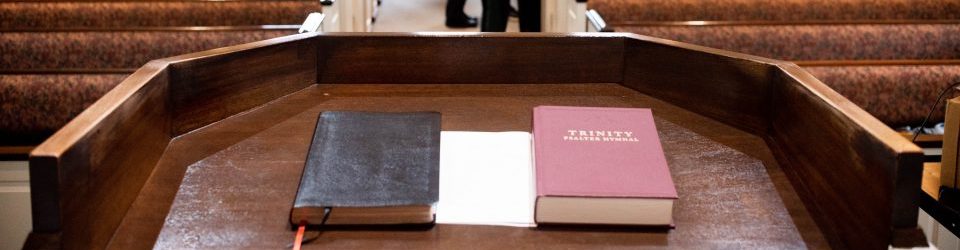

This sermon is from the Rev. Charles G. Dennison sermon archive, part of the “Philemon” series, and was preached at Grace Orthodox Presbyterian Church in Sewickley, PA, during a worship service on Sunday, February 7, 1999.
We are reading this morning from Philemon. We are beginning at verse 1. This is God’s word, give your attention to it, Philemon 1. Paul, a prisoner of Christ Jesus, and Timothy, our brother to Philemon, our beloved brother and to Ephia, our sister, and to Archippus, our fellow soldier, and to the church in your house, grace to you and peace from God our Father and the Lord Jesus Christ. I thank my God always, making mention of you in my prayers, because I hear of your love and of the faith which you have toward the Lord Jesus and toward all the saints, and I pray that the fellowship of your faith may become effective through the knowledge of every good thing which is in you for Christ’s sake. At the same time, also prepare me a lodging, for I hope that through your prayers I will be given to you. Epaphras, my fellow prisoner in Christ Jesus, greets you as does Mark, Aristarchus, Demas, Luke, my fellow workers, the grace of the Lord Jesus Christ be with your spirit.
The immediate matter before us is Paul’s prayer as found in Philemon. That prayer, its appropriate introduction and its content, appears in verses four through six. We have already spent a great deal of time against the background of these verses, five messages in fact, studying Paul’s attitude toward prayer and his attitude in prayer. Paul’s attitude toward prayer, as we have observed, finds its anchor nowhere else but in Jesus Christ himself. So that Paul approaches prayer with the deepest awareness of his union with Christ. Just as the risen Christ offers prayer for the elect at all times at his Father’s right hand in heaven, So Paul, being united to Christ by faith, offers prayer to the saints at all times here on earth. Paul lives in and from his Savior. Thus he prays always. We, who like Paul, live in and from our Savior, do the same thing. Or at least we should.
Giving heed to the example of Paul, but also to his admonition, you might remember what he told the Thessalonians, pray without ceasing. Here, then, is Paul’s attitude toward prayer. But as to his attitude in prayer, we have discovered Paul overflowing with thanksgiving to God, specifically with thanksgiving to God for fellow believers. that is for other people who, because of Jesus Christ, are beloved by the Apostles. We have noted that this is actually a unique feature to Paul’s prayers. Not found explicitly in the Old Testament prayers, or even in Jesus’ prayers as they are recorded for us in the Gospels. The unique aspect being Paul’s profuse thanksgiving for other people. But rather than this being an innovation by the Apostle, we discover that this dimension to his prayers is actually an expression of the farthest reach of the covenant, as Paul in his prayers grasps hold not only of the risen Christ in glory, but of that blessed fellowship that shall exist between God’s people, one to another, in heaven. Paul always gives thanks, he says, for Philemon now.
And I dare say Philemon gives thanks for Paul, because the day of Christ is coming in which each will be, according to 2 Corinthians 1.14, each other’s ghost and lord. And that, in the eternal mutual bond, they are privileged to know through Christ in God. Paul gives thanks to God for Philemon because Paul presently sees heaven and already experiences its reality wherein the perfect fulfillment of the covenantal bond between believers He will give thanks to God for Philemon forever. And our assumption is that Philemon will be doing nothing less on Paul’s behalf.
And as far as you and I are concerned, I will be doing the same thing for you. And I trust that you will be doing the same thing for me. This is grand stuff. I think you will agree. But having now reinforced our grasp of these points, we are ready to move from verse 4, on which we have been concentrating, that I hear at Twitter. Does that mean you’re ready to move on?
From verse 4 into verses 5 and 6, and into the more immediate motivation for Paul in prayer, and into the specific content of that prayer. What do we find in these latter verses? In order to help us with this question, it now becomes necessary to say something about the order that is the structure of this letter. I bring this issue up now because it will have a bearing upon our interpretation of the immediate motivation of Paul in prayer and the content to his prayer.
Let me begin by either introducing you to or reminding you about one of the frequently used features in Bible literature. What I have in mind is the chiasm. That is C-H-I-A-S-M, the chiasm. Often in the Bible we run into what is called parallelism. We find a parallelism again and again in the Psalms. There is a famous parallelism from the Psalms. The earth is the Lord’s and the fullness thereof, the world and they that dwell therein. Do you know where to find that? Of course. Psalm 24, verse 1.
From this verse you can easily see what a parallelism is. Parallelism is a device in which successive lines are balanced by stating similar things but with different words, thus filling out the thought and extending or deepening the images suggested by the statements. Another blatant parallelism, this one from Psalm 114. When Israel went out of Egypt, the house of Jacob there from a people of strange language. You can hear the parallelism again. Psalm 33, the psalm we read this morning in our responsive reading.
It is full of parallelisms. For example, verse 9, For he spake, and it was done, he commanded, and it stood fast. Parallel statements, balanced. But the second statement filling out, expanding, or deepening the thought of the first. But the Bible also uses a variation and a complication to the simple parallelism.
And this is what is called a chiasm. A chiasm is an inverted parallelism. in which the successive elements of one statement are balanced by the inversion or reversal of those elements in a second statement. I’ll repeat that. A pieism is an inverted parallelism in which the successive elements of one statement are balanced by the inversion or reversal of those elements in a second statement. Let me give you an example from a very familiar text.
I have in mind Romans 10, verses 9 and 10. Romans 10, verses 9 and 10. Verse 9 reads, If you confess with your mouth the Lord Jesus, and shall believe in your heart that God has raised him from the dead, you shall be saved. You will notice the order in this verse.
First, the mouth is mentioned for confession, and then secondly, the heart for belief. But now I want you to look at verse 10, where the order is reversed. For with the heart, man believes unto righteousness, and with the mouth, confession is made unto salvation. In verse 9, first the mouth is mentioned and then the heart. In verse 10, first the heart and then the mouth. Mouth, heart, heart, mouth. If we were to assign the letter A to the word mouth and the letter B to the word heart, we would end up with the pattern of an inverted or reversed Parallelism. A, B, B, A. Mouth, heart, heart, mouth.
And if we were to diagram this chiasm, it would look to us like the uprights and the crossbar of a bread house. With the A’s at the top of the uprights, opposite each other, and the B’s at either end of the crossbar again opposite each other. Do you want the choreography? A, B, B, A. A, B, B, A. You see? We could really get into this thing. I feel like I’m trying out for cheerleader. But of course, chiasm can become quite involved and quite difficult in the Bible.
For instance, it has been suggested that Mark chapter 3 verses 21 through 35, among many other examples we might cite, This passage moves from the attempt of those close to Jesus to restrain him because they believe he is utterly mad, verse 21, to Jesus at the end of this passage identifying those who are truly close to him, verses 31-35.
So you have the beginning and the end bound together with this common thought, the A’s again in our chiasm structure. In between these two caps of the uprights, we have running down the one upright, the double accusation from the scribes in verse 22, Jesus cast out demons by the Prince of Demons, for instance, followed by the crossbar, verses 23-26, with Jesus’ response to the double accusation from the scribes, albeit now in reverse order, running up the opposite upright in verses 27-29. And thus we have the pattern worked out for us, to be sure a bit more complicated, that a ties in nonetheless A, B, C, D, D crossbar, C, D, A. But now you’re all sitting there thinking, of what use?
Of what possible use? is the chiasm, and why in the world are you taking up my time with all of this literary stuff? On the most elementary level, as in the Romans 10 passage, the chiasm provides a structure that lends deliberately to Paul’s statement a sense of wholeness, a sense of completion.
His thought ends where it began, namely with the mouth and its confession. But interestingly, interestingly, It also possesses an internal order with its parallel statements that emphasize the heart. You begin and you end with the mouth making confession, and in between there is this crossbar that bears the weight of the upright. And all of the weight falls upon the heart.
I don’t think that there is a more powerful chiasm in scripture. One as instructive as this. In the more complicated chiasm of Mark 3, we have the drama of Jesus’ encounter with various parties, addressing the question specifically about who Jesus’ true friends are. While through the course of this drama, in chiasm form, a series of items stand opposite each other, by which the hearer and the reader might understand the nature of the struggle over Jesus more completely, with the weight of the chiasm resting firmly upon the powerful analysis of Satan and his kingdom by Jesus in verses 23-26. Again, strong The kālas of Zen is a means by which a passage expresses its internal integrity, its completeness, its wholeness, all the while providing a means for comparing and contrasting the elements in the passage for the purpose of our viewing a better grasp on the passage’s meaning. And not just an avenue into the human author’s mind, but an avenue into the mind of God himself, who is finally the author of the Word.
Why is this passage important? What is this passage trying to tell us? How can we know? Does the Lord himself providentially place elements in order and in sequence and in relationship to help us understand better? Indeed he does. Now to Philemon. My posture is deliberate. Paul’s letter to Philemon in its entirety is a triumph. All of this has been worth it, because now we’re going to see how this comes to bear upon Philemon as a whole. In recognizing that Philemon is a chiasm, we are able to better grasp the individual parts of the letter, as well as this letter’s central concern, its central burden. To this end, I want you to see the amazing symmetry to the official. The first thing I want you to do is to compare the beginning of Philemon with its conclusion. the beginning of Philemon with its conclusion.
Count the names, excluding the name of Christ and God the Father, count the names in verses 1-3. Then count the names in verses 23-25. You will find that there are five names in the two sets of verses. but you will also find the repetition of certain words and phrases, such as the word prisoner and the phrase fellow worker. Furthermore, you will find the name Christ Jesus in the literal translation of the Greek, Christ Jesus in verses 1 and 23. You will also find The recurrence of the word grace and the title name of our Savior, the Lord Jesus Christ, in verses 3 and 25.
It seems obvious. The opening and the closing of Philemon are a matched pair. They match up in many regards. We don’t have time this morning to go through the entire letter, matching up in detail its various parts. However, leaving those details for our upcoming messages, you won’t want to miss them. Let me at least this morning provide you with the outline, in order that you might know where In fact, you might have a preview for those upcoming messages, and a means to appreciate them better. Here, then, is the chiasmic structure of Philemon.
Verses 1 through 3, as we have seen, match verses 23 through 25, the conclusion. that pertains specifically to Paul’s prayer match verse 22. Verses 7 and 8 match verses 20 and 21. Verses 9 through 11 match verses 18 and 19. Verse 12 matches verse 17. Verse 13 matches verses 15 and 16, leaving by itself Verse 14, standing alone as the crossbar, bearing the weight. The 14th verse being then the center of the epistle, the very heart of what Paul intends to communicate.
And that verse reads this way, that without your consent, Philemon, I did not want to do anything, so that your goodness would not be in effect by compulsion, but by your own free will. We haven’t reached the point in our messages where we can speak with appropriate appreciation about this beautiful and deeply spiritual verse.
But we are at the point where, in our next message at least, we can begin to speak about Paul’s immediate motivation and the content to his prayer in verses 4-6, and that in light of, yes, Philemon’s prayer mentioned in verse 22. Do you see it? Paul’s prayer, verses 4-6, matches up with Philemon’s prayer in verse 22. And these prayers, I can assure you, will mutually open up each other. even as an exposition of them will open up the hearts of both Paul and Philemon. So transparent will their hearts be made to be through the investigation of their respective prayers, that in your prayers you will be able to see nothing less than the gospel clearly at work in each one of them.
You want practical theology? I don’t. You might. But if you want practical theology, boy does Paul have for you some practical theology, but it’s not the kind that any seminary involves itself in, sadly and tragically. In fact, by looking intently at Paul and Philemon’s prayers you will be able to see the eternal and heavenly character of that love which they bear to one another. And you will be able to see no one less than your Savior Jesus Christ imprinted upon their piety. And you will be enabled, in the final analysis, to gaze into the face of God. I don’t know about you, but I can’t wait for these next messages.
Our Father, again, as we have said before, we stand with the disciples, asking Jesus that he might teach us to pray. But now, O God, we are recognizing that the spirit of the risen Christ is at work in the Apostle Paul, and that we are being given lessons in him and from him, because he lives in and from his Savior. Father, we pray that you would train us well, that you instruct us faithfully in the nature of prayer and in its content. Father, draw us on so that this magnificent expression of love in prayer would find its expression in us, even as we are committed to pray for one another, as Paul and Philemon were committed to pray for each other. Help us, Lord, for we look to you in Christ’s name, knowing that his prayers are effectual for us, and that they are perfect and are our hope. We pray these things truly through Him.
The sermon text provided above is derived from the sermon audio recording making use of generative tools. It has not been manually edited. While transcription tools have a high degree of accuracy, the output may include generative textual, punctuation, and/or formatting errors.