
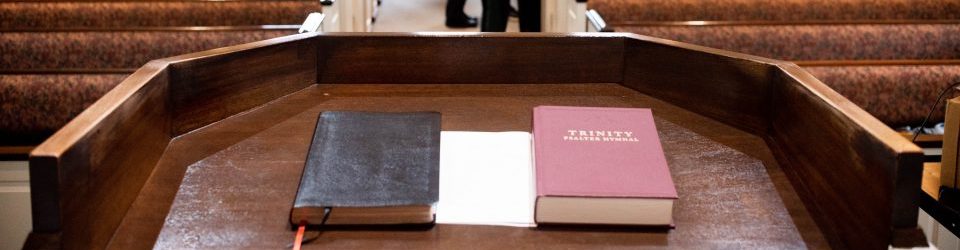

This sermon is from the Rev. Charles G. Dennison sermon archive, part of the “Philemon” series, and was preached at Grace Orthodox Presbyterian Church in Sewickley, PA, during a worship service on Sunday, February 14, 1999.
we have settled a few things about Paul’s prayers. And hopefully, by way of extension, we have settled a few things about our own prayers. First, and I hope you’re not tired of hearing it, Paul prays, as he says, always. And that because he is bound to Jesus Christ, who himself prays always, who even now lives at his Father’s right hand in glory to make perpetual intercession for us.
Romans 8.34. But secondly, Paul, in his prayers, always gives thanks, seemingly, and that profusely, for others. For others such as Philemon. And he does this because he knows that he will be always giving thanks for these others and for Philemon in heaven.
In both of these matters, then, Paul testifies to a living connection, a living connection to the realities, and particularly in the case of his prayers for others, the future realities For Paul, then, prayer is truly spiritual. That is with a capital S, so that you might understand it to be an enterprise of the Holy Spirit, belonging to the realm of the Spirit in glory. in his prayers is engaged in a truly spiritual enterprise in which he perfectly participates in the very heavenly life of his Savior, while also participating in the future life of glory. Is this motivation enough for you in your own prayers, to be participating in the very life of Christ, to be participating in the future glories of heaven? Why, one might think that we would rush to prayer. that we couldn’t be kept from it.
Nor are these matters, as Paul presents them, in any sense an abstraction. Heaven forbid, or a mere theological construction. Much less are they an expression of that type of piety given to fits of rhetorical embellishment and exaggeration. as if Paul, in speaking about his prayers and the fact that he prays always, was actually engaged in setting forth a statement essentially untrue. He knowing it was untrue, but also realizing that it was religiously justified and useful because of the noble ends in view. I tell them I pray always. After all, Paul, by his little religious lie, might then get some people to pray just a little bit for a few, thus justifying his claim that he prays always for the many. Untrue though that may be, thus promoting an admirable goal.
This is not Paul’s method. This is not his practice. Rather, in reporting on his prayers, Paul is self-consciously controlled by the glorified Christ to whom he in prayer is united, just as he is self-consciously controlled by the eternity, the always aspect of heaven. of which he presently partakes, and to which he will eventually be brought in the full redemption of his own body in the day of the resurrection. In other words, when Paul tells us he prays always and that he prays for others, he actually does. He’s not making it up. He’s not telling a lie. He’s telling the truth, and we need to follow him.
But where exactly does Paul lead us in this? We have spoken about Paul’s motivation in prayer at the loftiest level, at the level of his union with Christ. We have spoken about Paul’s motivation in prayer and about the exalted context of his admirable thanksgiving for others in the context of eternity. But what now about the actual content to Paul’s prayers? What is the content of his petitions? What does he pray for, and are we able to follow him here?
Now, this happens to be not only a very interesting question, but a very complicated question in Paul’s case, and I say this for two reasons. For one thing, although many commentators and many a preacher have made grand efforts by and large, the substance of Paul’s recorded prayers, as that substance appears to us from epistle to epistle, remains impenetrable to us. To most of us, the substance seems to come across as a keeping up of religious language. Word upon word, pious phrase upon pious phrase, in what, to be perfectly honest and frank, seems to be odd and irregular combinations. When taken as a whole, Paz’s prayers leave us with the overall effect of a smoked beer. But a turn to the experts in expounding the prayers doesn’t seem to help us, for if Paul is opaque, the experts are opaque, and that at great length.
We may well throw up our hands at Paul’s summaries of his own prayers. We may throw up our hands at Paul’s summary of his prayer for Philemon. where he says in verse 6 of Philemon, that the communication of thy faith may become effectual by the acknowledging of every good thing which is in you in Jesus Christ. What does he mean? What is he talking about?
But when a respected Bible scholar goes on for three or four pages about this same verse, And at the end of the matter, you neither understand Paul nor the scholar, you’re doubly frustrated. And if we, in our own piety, have come to Paul’s prayers with the idea that those prayers would be a help to us in formulating our own, then the problem has made all the more pressing for us. How can we follow Paul as to the content of prayer when we don’t know what he’s talking about? But the other reason why this matter of the content of Paul’s prayer is so perplexing is because of the very broad consideration Paul himself puts in our path in another context.
He tells us in Romans 8.26, for we do not know what we should pray for as we ought. We do not know what we should pray for as we ought. And in hearing this, we are tempted to say in light of this text, not only don’t we know what Paul’s talking about in his prayers, Paul himself doesn’t know what he’s talking about, and tells us so. So let’s go on our merry way, throwing out religious words, pious vocabulary, spiritual phrase upon spiritual phrase that is utterly and completely impenetrable, unintelligible, and vacuous.
Just like Paul. But is it actually the case that Paul doesn’t know what he’s talking about in his prayers? Despite the problems we may be having here, I’m sure that you will agree, at the end of the day, Paul’s prayers are meant to be accessible to us. And both we and Paul are to know what we are praying for when we engage in this sublime spiritual activity.
But this being the case, why then all the troubles? Why all the difficulties? Why is it that as we give ourselves to reading one of Paul’s letters, we not only hurriedly pass over the salutation and greeting, we also pass over rather quickly the prayer?
In our effort to clear things up, let’s begin with the mystery of Romans 8.26.
What does Paul mean when he says, We do not know what to pray for as we ought? What does Paul mean when he says, We do not know what to pray for as we ought? What Paul has in mind is the struggle we have keeping in view the proper goal. The goal which in prayer can only be pursued in a way that adds particular content to the prayer itself. The manner of prayer extending itself into the content of prayer. Paul has in mind the struggle we have keeping in view the proper goal to our lives, for our existence, the goal which in prayer can only be pursued in a way that adds even here particular content to the prayer itself.
Now, in penetrating the mystery of Romans 8.26, it is difficult to miss in the verses surrounding this one text the repeated pattern at work. It may be helpful for you to have the text in front of you.
In verse 22, for instance, Paul tells us that the whole of creation groans and travails as a woman in childbirth. But why does the creation groan and travail? And what would be the deliverance comparable to the childbirth in which the creation itself would be delivered? For verse 19 tells us that the goal of the groanings and the travail is the revelation of the sons of God, by which is meant the coming resurrection of all God’s children on the last day.
That’s what’s in view. That is what the groaning and the travail of the creation is all about. the coming resurrection of all God’s children on the last day. Verse 21 then speaks about this great event as the glorious freedom of the children of God. That day in which it will be realized, the glorious freedom of the children of God.
If we were to speak of the creation’s groanings and travail as the creation’s prayer, that’s the point. If you are to speak of the creation’s groanings and travail as the creation’s prayer, the content of that prayer is directed toward the grand day of the last day and the entrance into glory of all of Christ’s redeemed people. That is what the creation prays for.
But it is not without reason that this last day is understood to be the end of the world, the conclusion of the world, the termination of the world. You see, in its prayer, so-called the creation, then is expending itself, is exhausting itself for the sake of God’s purpose in saving His elect and granting to them the resurrection on the last day. Coming into view in this personification of creation, you know what personification is. The attributing of the features and attributes of a person to an inanimate object. or something that is other than personal, in this personification of the creation, coming into view is not simply the image of an expectant mother awaiting the birth of her child, but the image of Christ himself, who sacrifices himself for the salvation of his people.
The creation is expending itself, exhausting itself, in the interests of the resurrection of the children of God. It is giving itself away to its own termination, to its own end and destruction, in the interest of the resurrection of the children of God. It is giving itself over to death in the interest of the life of the children of God. Doesn’t that sound like Christ to you?
Prayer then, on the background of this portrayal of creation, focuses no less upon the grand goal of the coming day, but at the same time it focuses upon a plea rising from the soul of that one at prayer, that he or she sacrificed themselves, even as the creation does, in the interests of God’s marvelous plan. The creation is giving itself away in its prayer. of giving yourself away in your prayer.
And what we have suggested here, what we have intimated, is confirmed by the exposition of the rest of the pattern laid out for us in the following verses here in Romans 8. Twice more we will hear about burning. Father Paul’s lead, twice more, in the text you will hear about groanings. In verse 23, we ourselves are presented with respect to our groanings. The text says, even we ourselves groan within ourselves. In view are our prayers now, and what content do these prayers have?
Verse 23 tells us, our adoption as sons, that is the redemption or the resurrection of our bodies. That is what is in view. But isn’t this the self-same content to prayer? as it flows out of the great goal of the resurrection that we have already observed in the case regarding the creation. It is indeed.
And what is our groaning in prayer but the rigorous subordination of ourselves internally in all of our personal desires for the sake of the coming glorious day of God, even to the point in our prayers that we demand ourselves take up our cross and follow Christ. you want to learn about the content of prayer, you want to be taken to school on the matter of the content of prayer, you are to look to the cross. If we are looking to Christ with respect to that aspect of our prayer, And we are constrained to pray always. We are looking to Christ also now with regard to the content of prayer and what that content looks like. It looks like the cross.
Specifically, as we now, like the creation, give ourselves away in the interest of God’s own purpose and intention, and that to which he is drawing all things, ourselves included. But now the pattern is filled out, you will notice, with the person of the Holy Spirit.
For as the creation groans and we groan within ourselves, we are told that the Holy Spirit also groans and that with groanings that cannot be uttered,” verse 26 at the conclusion. These groans, as the groans of the creation, as our own groans, are prayers. These groans of the Holy Spirit are the prayers, the intercession of the Holy Spirit. And when we consider these prayers of the Holy Spirit, we find nothing different from what we have already observed in the previous cases.
In verse 27, moving one verse further, verse 27 reveals the content now of the Spirit’s prayers, rising, as in the other cases, from the goal in view. And at the end of that 27th verse, the goal is represented to us, albeit differently in different words.
It is called the will of God. And what’s the will of God? Well, we know that it actually pertains to the color of shoes I’m to wear this morning, and it pertains to, you know, those remedial matters that pass by the windows of our soul repeatedly, interminably, day after day, You know, should I buy the brown suit or should I buy the blue suit? Oh, I think I ought to take here in the dressing room a moment to pray to the Lord and ask Him what His will might be. I don’t think so.
That will of God in view at the end of the 27th verse is nothing less than the movement of the entirety of creation, the movement of all of the sons of God, the compilation of all, the amassing of all of the energies and powers of this world order toward the great day of the resurrection, the end.
Here is the goal to which even the spirit in his prayers subordinates himself as servant-like, Christ-like. giving himself over to the will of God in an absolute sense. And while the Spirit has no internal struggle within himself for the accomplishment of this goal, he is well aware of the struggle in us, because we do not know what to pray for as we are. That is, we do not do well because of our sin. at keeping the grand goal in view in the content of our prayer. Nor do we allow, again, because of our sin, that goal to dominate our prayers from beginning to end. Much less are we always prepared in our prayers to express that loss of self that denial of self, that sacrifice of our own interests for the sake of God’s consummate purpose.
Thy will be done on earth as it is in heaven. Thy kingdom come. Hallowed be thy name in the great day. when all things shall reach their consummate stage. But even though we do not know how or what to pray for as we ought, praise God, we have the Spirit, who in his prayers enters into our plight, Christlike, but also welcomes us into the sufficiency of his own intercessions. a sufficiency, I might add, that leads us on into the full, competent intercession of Jesus Christ at the right hand of God, spoken of in verse 34.
Does Paul know what he’s talking about in his prayers? By all means. Although we struggle in our prayers, are we to know what we’re talking about in our prayers? And despite the apparent difficulty, to Paul’s prayers as found in his letters, even here in Philemon, are they finally, at the end, penetrable and translucent by all means.
Surely we shall find Paul’s prayers intelligible, and that in keeping with the pattern of prayer observed in Romans 8. even in keeping with the content and sufficiency of the prayers of both the Holy Spirit and the Ascended Christ. So when we turn to Philemon 4-6, it will be our task to expound those verses in light of what we have found in Romans 8. And in that exposition, there will be laid in front of you the grand content of the prayers of the people of God. Because that grand content is nothing less than the content of the prayers of the Holy Spirit and the glorified Christ. Stay tuned.
Oh God, we realize the struggle in prayer, not only because of our own experience, but because of the testimony that is given to us in your word. how the disciples come to Jesus and ask him that he might teach them how to pray, they themselves perplexed, they having difficulty.
Lord, it is true that we have had our own difficulties. And when we have looked for help, maybe even looked for help in Paul and in the prayers that he summarizes for us in his epistles, It seems that our perplexity only deepens, and we’re unsure of what direction we should go, or what should be the exact content of those prayers that we should be uttering. To the end of the resolution of this difficulty, O God, help us. For we would have our prayers, yes, conformed even to those of the Apostle, but more than Lord, we would have our prayers conformed to the prayers of Jesus Christ who makes intercession at your right hand. May it be our spirit’s intention to submit ourselves to that content and to the revelation that you have made with regard to yourself, even as it pertains to the matter of our prayers. Help us, O God. that, Lord, truly, we would have before our eyes at all times the end to which we press, namely, the great resurrection. We pray these things in Jesus’ name. Amen.
The sermon text provided above is derived from the sermon audio recording making use of generative tools. It has not been manually edited. While transcription tools have a high degree of accuracy, the output may include generative textual, punctuation, and/or formatting errors.