
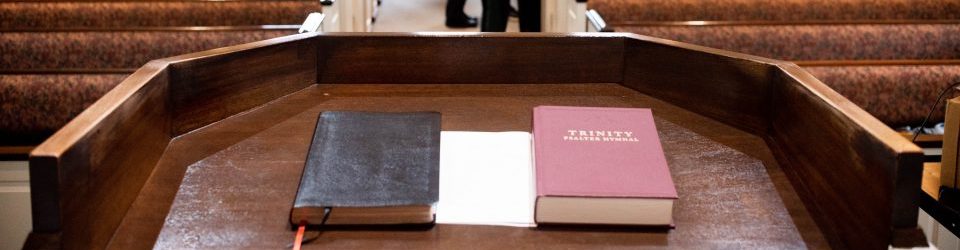

This sermon is from the Rev. Charles G. Dennison sermon archive, part of the “Philippians” series, and was preached at Grace Orthodox Presbyterian Church in Sewickley, PA, during a worship service on Sunday, April 12, 1992.
We are reading from Philippians chapter 3 this morning, beginning with verse 1. We will be looking at especially verses 4 through 6 in our message this morning. Through the Word of God. To write the same things to you, to me indeed, is not grievous, but for you it is safe. Beware of dogs, beware of evil workers, beware of the concision.
For we are the circumcision which worship God in the spirit and rejoice in Christ Jesus and have no confidence in the flesh. Though I might also have confidence in the flesh, If any other man thinketh that he hath whereof he might trust in the flesh, I more, circumcised the eighth day, of the stock of Israel, of the tribe of Benjamin, and Hebrew of the Hebrews, as touching the law of Pharisee, concerning zeal, persecuting the church, touching the righteousness which is in the law, blameless.
What things were gained to me, those I counted lost for Christ, lay doubtless, and I count all things but lost for the excellency of the knowledge of Christ Jesus my Lord, for whom I have suffered the loss of all things, and who count them but done that I may win Christ and be found in him, not having mine own righteousness which is of the law, but that which is through the faith of Christ.” the righteousness which is of God by faith, that I may know him, and the power of his resurrection, and the fellowship of his sufferings, being made confirmable unto his death. If by any means I might attain unto the resurrection of the dead, not as though I had already attained, if it were already perfect, that I follow after that if that I may apprehend that for which also I am apprehended of Christ Jesus. Brethren, I count not myself to have apprehended, but this one thing I do, forgiving those things which are behind and reaching forth unto those things which are before, I press toward the mark for the prize of the high calling of God in Christ Jesus.
Let us therefore, as many as be perfect, be thus minded, and if in anything ye be otherwise minded, God shall reveal even this unto you. Nevertheless, whereto we have already attained, let us walk by the same rule, let us mind the same thing. Brethren, be followers together of me, and mark them which walk. and mark them which walk so as ye have us for an example.
What obstacles remain yet for us, Lord, in our understanding of your word? It may be, Lord, that those blocks which we have set in place woefully those that would in fact block our understanding. We also know, our God, that there is that ruthlessness of life which carries us away as we would shield our sin. But Father, draw us back to your word, that we might look intently into it and there behold the provision for our sin and the mercy that is given us in your forgiveness.
We thank you, our God, for the grace of the gospel, the death of Christ our Savior, that death by which we have been cleansed and set right before you. We glory in our Savior, we exalt in his name. and who are ready, Father, to hear what you would say to us. For his sake.
Amen. in earnest to Philippians 3, and in coming back to this text, we are coming back to a familiar place in order to take up this discussion with an old friend. As we return to Philippians 3 and concentrate on it again, As we look specifically at verses four through six this morning, we are reminded of things that we have met previously in Paul’s dealings with the Philippian church.
We are reminded of Paul’s literary ability, his literary skill and brilliance. the way in which he is able to put things so well for us, to draw us on, and also to draw us into his discussion. At the same time, we are reminded of Paul’s masterful wit, his very clever twists of phrases and ideas that are able to confront his audience with the truth about themselves. And very importantly, of course, we are confronted by the Apostle’s tremendous doctrinal insight, his spiritual excellence, as he would set before us the purpose and plan of God and convince us afresh of Christ’s excellence. First of all, with regard to Paul’s literary skill, as that comes to the surface in verses four through six. These verses are beautifully crafted. The fourth verse rises out of the third naturally, easily.
Paul, at the conclusion of that third verse, about how these Philippian Christians, with himself, glory in Christ Jesus and put absolutely no confidence in the flesh, trust not one bit in the flesh. Then, in verse Paul carries over this theme of boasting and confidence specifically with respect to himself as he sets himself now before these Philippians as an example. Paul introduces himself then here into the discussion at verse 4, because he would set himself before these Philippians apparently as one with the greatest confidence possible in the flesh. He states, in effect, whatever qualifications anyone else might have for boasting in their flesh, for boasting in their accomplishments, my qualifications are greater and even more valid.
Then he goes on to list his credentials in verses 5 and 6, presenting them almost in resume fashion. I know that some of you have been busy, maybe recently, maybe in times past, with constructing resumes. Well, here is a wonderfully compact resume given you by the Apostle Paul. It comes in wonderful resume-clipped style. low excess words, compact, it’s almost as if he’s worked on it for a while, to get it down to this compressed form. The first four categories he gives to us here in this resume he’s presenting, the first four categories set before us is pedigree. Now think of this pedigree, if you will.
As to circumcision, he’s an eighth-dayer. Sets him apart, you know the Old Testament law. After birth, male child circumcised on the eighth day. This was part of religious obligation and duty set upon the Jewish people. And Paul fits the bill. He is an eighth-dayer with regard to circumcision.
If you’re going to boast in your flesh, even in the marks that are on your flesh, well, here you are. I can boast as well as anyone else. With respect to the nation, I am an Israelite, but even more, you see, even more in setting out his credentials, Paul is making a racial statement, an ethnic statement.
He is an Israelite. He is of a pure race. He is of that special race. He is of that favored race. As far as his family is concerned, that is tribally, he’s able to trace his lineage. He has the family tree all well worked out. He is of the tribe of Benjamin. He has the papers to prove it. How’s he doing?
This man is a Hebrew of the Hebrews. He’s Hebrew stock from purebred Hebrews. No half-breed, not infected by Gentile blood, not infected by Samaritan blood, not infected by Hellenistic blood, by the Greeks. He’s a fine Jewish boy with Jewish parents. This fellow’s family connections are impeccable. But you might be thinking, how is Paul able to boast in these things?
After all, he didn’t have anything to do with them, did he? In these things that he’s listed so far, he was wholly passive. Isn’t that true? Did he circumcise himself? No, he didn’t circumcise himself. Did he have anything to do with the fact that he was born into the Jewish race? No, he didn’t have anything to do with that. What about his family, the tribe of Benjamin? No, he didn’t have anything to do with that. How about being a Hebrew from Hebrew line, pure? No, he didn’t have anything to do with that.
Paul isn’t able to take credit for any of these things, but yet, it is precisely because he is passive with regard to these things that his boast actually increases. Well, how is that possible? You see, Paul in his religious estimation of things is convinced of God’s providence and his sovereignty. It’s no accident that he has the lineage, the family that he does. God has obviously specially favored him with these family ties of which he can boast. Paul is special. But not only is he special by God’s providence, by God’s sovereignty, by root of his fortuitous As he goes on to say, he’s special because he improved on these natural endowments.
A lot of boys out there with the advantages I had, but they just went up to improving on them as much as I did. I never missed a step. No one got ahead of me. I was always at the head of the class. I would not allow myself to be inferior to any. So Claude then improves upon his natural advantages. He makes choices. And by all of those choices he improves his standing and his boast. After all, isn’t that what life’s all about? He who can boast best? He whose pride is insurmountable? Like a mountain in itself? Isn’t that what it’s all about? Putting yourself in a position where you’re above the criticism of others? So by his choices, he improves upon his standard. He joins the strictest sect of establishment Judaism. He joins the Pharisees. Now, that wasn’t an obnoxious group.
In Paul’s estimation, it was the highest station to which one could ever aspire, to become a Pharisee, that was to become a separated one, one who delighted in God’s law, in God’s law with respect to holiness and purity, to stand apart from uncleanness and impurity. Give oneself no rest when it comes to the law and the particulars that are extracted from that law. To be rigorous, infinitely rigorous, with regard to oneself.
In Pharisee, pursuing righteousness and thinking that while you are pursuing righteousness, pursuing holiness, pursuing godliness, that you are all actually paving the way for God’s entrance into the world with his final administration of the kingdom through his Messiah. If the Messiah were to come, He would have congratulated me first for my righteousness, because it was actually my righteousness above anyone else’s that prepared the way for his coming. And then proving his worth, he sets about this Pharisee, Paul, to defend Judaism against all enemies, he tells us, as to zeal in persecutor of the Church. So precisely here, against this enemy of Judaism, the Church, the Church of Jesus Christ, the Church made up of these followers, these followers of that heretical and false Messiah, Jesus of Nazareth.
And finally, as his crowning touch, in terms of his performance, his decisions, his choices, he has absolutely no doubts whatsoever. He says, as to the righteousness, the end of verse 6, the righteousness which is in the law, found to be blameless. Now, Paul isn’t here saying that he is sinless. What he’s saying is that he knew how to take care of sin under the old administration and did it scrupulously. He went to the temple, he offered sacrifices, he pled with God for forgiveness. So now, Paul here isn’t claiming sinlessness. He can’t, however, allow himself no excuse with respect to sin, and pursued with sincere deliberation and scrupulous integrity the prescriptions of God’s law down to the letter. And before the law, with its provision of forgiveness in sacrifice, Paul is found in his own estimation to be blameless. No one could fault him.
Well, here, in the space of these two brief verses, you have the Apostle’s resume. He has surveyed for you his life, that life before he became a Christian, and he is setting himself forward here as the cream of the Jewish crop. with fine artistic ability.
Maybe we would wish we had such ability when we were making up our resumes. With fine literary skill, he builds his case for personal excellence, commending himself on the basis of these works of the flesh. This flurry of mounting phrases carries us along the path of Paul’s apparent superiority. But what do we do with these words? I hope you’ve noticed that as I’ve been going through this I’ve been smiling a lot. My wife tells me it’s a grimace that I try to convince myself that it’s a smile.
Taken in one sense, don’t these words, even if Paul is merely reflecting upon his past Jewish experience, don’t these words sound somewhat elegant? Does Paul really think that he was the cream of the Jewish crop? That he was the best Jew that ever lived? Don’t these words betray a bit of pomposity? In suggesting that he has grounds to boast with regard to that former life with respect to those privileges and the performance observed in him.
It does sound, does it not, as if Paul with all seriousness is saying of all the Jews in my time I was the greatest. Now you all have to admit it, don’t you? I just told you, didn’t I? I am the greatest. And would it be the height of condescending insolence to say then, in effect, as it seems Paul is doing, if I, the greatest, gave up everything to follow Christ. What’s the matter with you lesser blokes, who are hardly as fine as myself?
Now, you should all be prepared for this. especially if you’ve been wandering around in evangelical circles for a number of years. I grew up in those circles. I know how it went. The convert would come to town, the convert turned evangelist. And what would he do? He would tell you how great he was. Or how great he used to be. And don’t you wish you were that great? And if you were just like me, you could be that great. Doesn’t it wear you out?
Those kind of people always attract a crowd. Maybe that’s the reason that there isn’t a scowled crowd here today. That many people find the message that is preached from this pulpit uninteresting. All those converts then, turned evangelists, were ones who seemed to glory in the descriptions of their pre-regeneration days, making sure you know just how lucky Jesus is to have them on his team. But it’s a truly false intention to use a sort of backdoor arrogance.
A boasting about his ability that sets him above others. A boasting about his ability that allows him to boast about his boasting. Do you see how ridiculous it’s getting? If I’m laughing up here, you’re supposed to be laughing. It is becoming comical. And that’s exactly what Paul intends.
The thing that we must remember is that Paul is not just a fine writer. but he is possessed with a very sharp and fine and clever wit. There is a biting, and I don’t hesitate to say it, I have said it before, there is a biting and even sarcastic twist of Paul’s words. Is it somehow impious to be sarcastic? Is that a mark of a lack of piety? Not according to the Apostle Paul. He was a master. Remember what he says at the end of verse 2 in Philippians 3? Remember how we dealt with that?
He’s describing these dogs. these evil workers who think of themselves quite the contrary, of course, but he comes to the last phrase. He calls them the mutilators. They think of themselves as the circumcisers. Paul calls them the mutilators. He’s being funny. There are other passages where Paul is equally sarcastic. I’m convinced that that’s why we can’t read 1 Corinthians 13 properly. Every time I hear that passage read in public forum, it’s done with Samoan tones. Paul is having one good time at the expense of those who think too much of themselves. have a sarcastic twist to them. For certainly, and you have to admit, Paul knows that there are others, maybe even some, in the company of those troublemakers that are threatening the Philippian church who would brag about their pedigree and their performance.
They would bring out all of the particular items with which they would make up their But isn’t that precisely the nature of bragging or boasting? Isn’t that the very nature of the flesh and the way in which the flesh behaves? Isn’t the way of it always this, that you must vie for and claim the very best spot? You must always insist on your own superiority?
So there’s a bit of tongue-in-cheek here on the apostle’s part, as he playfully enters into the spirit of the thing. His true intent is to expose the utter folly of the vain show in the flesh. That vain show is always reduced in the end to a contest. Who can make the greatest claim? And then subsequently, who is awarded with a following of those who are most impressed with that sort of thing?
Now, you haven’t misunderstood the apostle if you see him here as being a bit ridiculous. He intends by way of this boast to make fun of boasters. So then Paul is the fine writer. And Paul is the penetrating witch. But above all, Paul is the consummate theologian and doctor of the soul. In speaking this way to enemies that threaten the Philippian assembly, he is speaking to the Philippian assembly itself. And confirming these Christians with the liability to their soul.
Not just that somebody will come in and begin to insist that they practice circumcision and some other Old Testament rites, but that there would be in them a spirit born of the flesh that cultivates a boast in the flesh, a confidence in the flesh, over against that exaltation in Christ, and that glorying in Him and in Him exclusively.
You may well be asking, if my life is not given to boasting, then to what can it be given? If I cannot live my life being proud of myself and insisting upon my own superiority, then what’s left to life? Why go on living? After all, that’s what life is all about. The doctor of the soul has just removed the excuse of the flesh. And the boasting, the pride, the arrogance that is born of the flesh.
What will be the nature of your dust? I’m white. I’m white. I’m black. I come from the heights. I come from across the tracks and I’m proud of it. I’m good. I’m very good. I’m good with women. I’m good with money. I’m good with religion. I’m really a genius when it comes to the things of religion. I’m a superstar. I’m an athlete. I’m a student. I’m the best there ever was. Laugh at yourself.
And the foolishness of such arrogance exposed now so narrowly. because of the appearance of Jesus Christ who robs all everyone of their boast in the flesh and provides us with the only solid boast the boast that is found in him and nowhere else Do you remember what the Apostle Paul says in Galatians 6.14? Here is Paul speaking, this time without his wry wit, without his clever sarcastic twists.
Here he is, in all of his genuineness and sincerity, may it be. that I never should boast except in the cross of our Lord Jesus Christ through which the world was crucified to me and I to the world. Here is one robbed of his boast in the flesh who says I still have every reason, even the best reasons to live in the service of my God. to the glory of my Savior. Amen.
Speak to us, our Father, in your Word and by your servant the Apostle, that we too may be addressed and robbed of our boast in the flesh, even to the point where we see just how ridiculous that boast is. And Father, train us well with regard to the only boast that remains, the boast that is found in Christ, the confidence that is discovered with Him. May we be pleased, our Father. to live with such confidence as you give us, for service in your name, that we might glorify you in our love for Christ. We ask it through Christ.
The sermon text provided above is derived from the sermon audio recording making use of generative tools. It has not been manually edited. While transcription tools have a high degree of accuracy, the output may include generative textual, punctuation, and/or formatting errors.