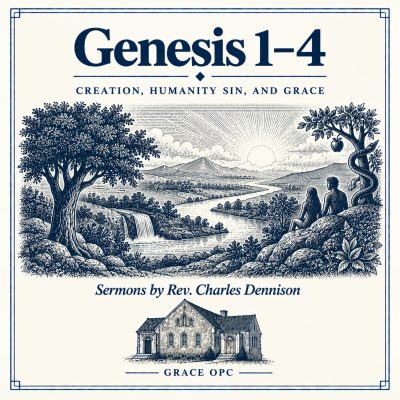
This sermon is from the Rev. Charles G. Dennison sermon archive, part of the “Genesis 1-4” series, and was preached at Grace Orthodox Presbyterian Church in Sewickley, PA, during a worship service on Sunday, January 19, 1992.
We begin our scripture reading tonight in the prophecy of Jeremiah. This is Jeremiah, chapter 10, beginning at verse one. Hear the word which the Lord speaks to you, O house of Israel. Thus says the Lord, do not learn the way of the nations. Do not be terrified by the signs of the heavens, although the nations are terrified by them.
For the customs of the peoples are delusion, because it is wood cut from the forest. the work of the hands of a craftsman with a cutting tool. They decorate it with silver and with gold, they fasten it with nails and with hammers so that it will not totter. Like a scarecrow in a cucumber field are they, and they cannot speak. They must be carried because they cannot walk. Do not fear them. For they can do no harm, nor can they do any good.
There is none like Thee, O Lord. Thou art great, and great is Thy name in might. Who would not fear Thee, O King of the nations? Indeed, it is Thy due. For among all the wise men of the nations, and in all their kingdoms, there is none like Thee. that they are altogether stupid and foolish.
In their discipline of delusion, their idol is wood. Beaten silver is brought from Tarshish, and gold from Ufaz. The work of a craftsman and of the hands of a goldsmith. Violet and purple are their clothing. They are all the work of skilled men, but the lore is the true God.
He is the living God and the everlasting King. At His wrath the earth quakes, and the nations cannot endure His indignation. Thus you shall say to them, The gods that did not make the heavens and the earth shall perish from the earth and from under the heavens. It is He who made the earth by His power, who established the world by His wisdom, and by His understanding, He has stretched out the heavens. When He utters His voice, there is a tumult of waters in the heavens, and He causes the clouds to ascend from the ends of the earth. He makes lightning for the rain. He brings out the wind from the storehouses. Every man is stupid, devoid of knowledge. Every goldsmith is put to shame by his idols, for his molten images are deceitful, and there is no breath in them. They are worthless, a work of mockery. In the time of their punishment they will perish. The portion of Jacob is not like these, for the maker of all is he, and Israel is the tribe of his inheritance. The Lord of hosts is his name.”
And reading from Genesis chapter 1, they’re reading verse 14 through the 19th verse. Then God said, let there be light in the expanse of the heavens to separate the day from the night and let them be for signs and for seasons and for days and years. Let them be for lights in the expanse of the heavens to give light on the earth. And it was so. And God made the two great lights, the greater light to govern the day and the lesser light to govern the night. He made the stars also. God placed them in the expanse of the heavens to give light on the earth and to govern the day and the night and to separate the light from the darkness, and God saw that it was good. And there was evening, and there was morning, a fourth day.
Now, as we look at the account of the fourth day, of creation, Genesis 1, 14 through 19. We want to honor the three principles that we have laid out previously. We want to take those principles and apply them to the account of what God does on this fourth day. First of all, In appreciating what is transpiring here, we must be impressed with the formfulness structure that has been established for us from the opening of this first chapter in Genesis. Now remember that structure.
With the fourth day, we are entering into the second set of days. That second set of days will be days four through six. And this second set of days relates to the first set of days, days one through three. So if you have a piece of paper, just draw a line down the middle. Put days 1, 2, and 3 on one side and days 4, 5, and 6 on the other. Draw lines back and forth and see the parallels that exist between those days.
Now as you do, there is a structure that will present itself for you. That structure has to do with these terms form and fullness. We can speak of it in other terms. We can call what is described here for us as, in the first set of days, kingdoms or domains. In the second set of days, rulers, governors, those who have dominion. Therefore, as we look at day one, We saw the creation of a form, or a kingdom, or a domain.
And we can call that form, that kingdom, that domain, the form, kingdom, and domain of day and night. Day and night. I want you to look at verse 5. And God called the light day, and the darkness he called night. So here, the form, or the kingdom, can be called day and night. But now I want you to look at day four, verses 14 through 19. And here you see the creation of the lights. It’s plural here, you will note. It’s plural. In the first day, God created the light. He said, let there be light, singular. Now we have the creation of the light, plural, in the fourth day. There is the greater light, we are told, and there is the lesser light. And the greater light will govern, rule, have dominion over the day, and the lesser light will rule, have dominion over the night. You see how it’s working itself out?
This all in order to resolve what was presented to us in verse two of chapter one. For in that second verse, we were faced with the formlessness and the emptiness and the darkness that enshrouded the creation. Remember how it reads. and the earth was formless and void, and darkness was over the surface of the deep, and the Spirit of God was moving over the surface of the waters.” So God now is resolving the formlessness, the emptiness, the darkness that are spoken of in that second verse of the first chapter.
And he does so in the process, with the process, of creating forms, that is, Domains kingdoms and then filling them The formlessness the emptiness the darkness mentioned in verse two are Beginning then their final stage of resolution as we move into the fourth day The fullness that is spoken of here a fullness that has to do with the light of The fullness comes as a guarantee against regression.
There’s no going back. But they also, but it also, that is the fullness, these lives also come as a sign of completion. A guarantee against regression and a sign of completion. The description of God setting the respective lights in verse 16 to rule and govern the day and night provides content to the whole notion of fullness and sets the lights as sentinels to the creation’s progress and signs of God’s achievement.
They still so testify. The sun is still above you. The moon is full this very night. In the clearness of the night, you will see the stars as a testimony to the certainty that is established even from the beginning with regard to God, His power, and His faithfulness. if you but have eyes to see.
You see, the creation itself is not mute. It speaks if you can but hear the language. Well then, our first point God resolving the formlessness, the void, and the darkness, creating kingdoms that he will then fill with those who will govern those kingdoms. And the lights now will govern the day and the night.
But secondly, we must be impressed, and this very importantly, We must be impressed with the testimony that these verses give to the invisible world that stands behind what appears. It is not alone you which does appear. There is more to reality than meets the eye. Secondly, then, we must be impressed with the testimony that these verses give to the invisible world that stands behind what appears.
Within the fabric of creation itself, We have testimony to this very structure as we move from day one to day four. We hear in day one of the creation of light. God said, let there be light. But we have already observed that this light, which is spoken of in relationship to the first day, must be distinguished now from the light that is spoken of in day four.
This means, then, that the light of the first day is hidden from us. Such a light is before us. It predates us. It predates man. It is veiled even within the structure of the creation. You do not see it, even though it is there. Then day four comes, and that prior light, the light that was created on the first day, whatever that light is, gives way, we could say, to the obtrusive, obvious light set by God in the heavens. we move from light to light, or from what even in its light appeared to be darkness to the light that blazes and dazzles, to the light that fills our day, to the light even that illumines our night. There is a movement in the narrative as you move from day one to day four. from light to light, from unseen light to light that does appear. Here, then, is testimony to the fact that behind the things that do appear are things that don’t appear, that aren’t obvious to us at all. In grabbing hold of those things that do not appear, We then are enabled to understand the things we see.
Behind light, there is light. Beyond the light of the sun and the moon and the stars, there is other light and even greater light. But we must also remember the light that belongs to this creation, be it the light of the first day, verses 1 through 5, or the latter light of day 4, verses 14 through 19. The light of this creation must itself give way to the light that is found only and solely in God Himself, a light known in His dwelling place above, where He shines forth in all of His splendor. There is a true light that lightens every man, that shines forth from beyond this creation.
And therefore, once more, We are compelled to look beyond this world order in which we live. We are compelled to look beyond the world order in which we find ourselves. The creation order we live in is but a provisional temporary tabernacle formed after the pattern of a sanctuary above. The whole creation order is a tabernacle for the sun. Testimony of that is given us in Psalm 19, verse 4. The whole created order is a tabernacle for the sun, built after the form of the eternal tabernacle in which God himself is the sun, the light.
Our second point, then, beyond the things which do appear are those things which do not. And even what is being spoken of here with regard to the fourth day of creation is witness to that truth. Our third point is the utter impotence of the creation, apart from the direct work and the design of God.
It is plain to us once more in the account of the fourth day. We have learned that the creation is deliberately fashioned by God so that it lacks any inner potentiality. That is, it cannot generate within itself a resolution to its own difficulties. It cannot generate, for instance, a resolution to its formlessness, its emptiness, or the darkness that enshrouds it.
And this comes out once more for us in the account of the fourth day, loud and clear. Even though there is light in the creation, the light of the first day. That light, as important as it is, lacks all power to establish or orchestrate the coming to light, the coming to light of that light which belongs to the bodies which God creates on the fourth day. The light of the first day cannot create the bodies, then, that give light that are spoken of on the fourth day. The light of the first day does not create the sun, it doesn’t create the moon, it doesn’t create the stars.
God himself is responsible for them. He made also the stars. God must act. He is seen as specifically active. making the heavenly bodies of one. How marvelously instructive this is. To an ancient race of people. It teaches them that they need not fear the stars. And the heavenly bodies that are above them. It teaches them that these heavenly bodies are not divine, they are not gods and goddesses, that they are not the originators of creation, that they are not creators themselves. Neither are they animated with self-possessed supernatural power or the ability to control the destinies of man. How tragic the slavery of ancient cultures and civilizations due to their religious superstitions. Moses warns the people of Israel in Deuteronomy 419 to flee from devotion to such things.
Why would you worship the sun? Why would you worship the moon? were the stars. Why would you think that your destiny was controlled by any of these creative things? Have I not made them all? Says the Lord. Job speaks of it as that from which he in his integrity has kept it. He speaks of that devotion which is evidenced in the peoples that live around him, a devotion to superstitious religious concoctions, a devotion to heavenly bodies, a fear of them. a worship of them. He speaks of all of this as that from which he, in his integrity, has kept himself.
Job thirty-one, verses twenty-six and twenty-seven. Josiah, Judah’s last great king, purged Jerusalem, you may recall, and the temple of all the vestiges of sun worship in his great reform, 2 Kings 23, verse 11 and following. And Jeremiah says, do not learn the way of the nations, and do not be terrified by the signs of the heavens, for the customs of the people are delusion. Jeremiah 10, verse 2.
These heavenly bodies are far from being gods. According to the Word of God, these heavenly bodies are ministers of God to the world and to mankind, performing service for their Creator, lending to the creation patterns of order by which the temporal differentiation is made for the regulating of day and night, as well as the regulating of seasons for man. for his years. And thus it is in Job, chapter 38, verse 7, the morning stars belong to a grand choir subordinate to God. The moon is made for seasons. The sun knows its appointed course because of God, to whom the sun and moon owe their existence.
Psalm 104, verse 19, so thoroughly does God intend His people to see the impotence of the creation and the subordination of the heavenly bodies, that he delays the creation of these heavenly bodies to the fourth day. And in the divinely inspired account that we have of their creation, you will notice that the sun and moon The king and queen of paganism in time are not as much as named. We hear about the greater light, we hear about the lesser light, but the sun and moon are not specifically named, and that by design.
They are anonymous. So whether it’s ancient paganism or modern paganism, Whether it’s ancient stargazers or modern stargazers. Whether it’s those who in ancient cultures worshipped heavenly bodies, or those who presently in their foolishness consult horoscopes. Whether it’s those in ancient cultures who bowed down before what they considered to be astral powers, or those in our present time who have given in to new age nonsense.
We must remember, God made the heavens and all their hosts. Amen. Let’s pray together. Our Father, we do thank you for the testimony of your word. marvelous witness to your power and greatness that we see about us. May we not be led astray. There were ancient idolatry. There are modern idolatry. And Lord, deliver us from them. We ask Lord, that we would be kept from an inordinate love of the things of this creation, a love which in many has developed into false worship. Instead, our God, we pray that our love may be for you and that we might be found to be servants in this creation unto the day in which you will bring us to yourself in the new creation, the new heavens and the new earth. A day when there will be no more need for the sun or the moon or the stars, for you and the Lamb are the light in the city of God.
The sermon text provided above is derived from the sermon audio recording making use of generative tools. It has not been manually edited. While transcription tools have a high degree of accuracy, the output may include generative textual, punctuation, and/or formatting errors.