The sermon text provided below is derived from the sermon audio recording making use of generative tools. It has not been manually edited. While transcription tools have a high degree of accuracy, the output may include generative textual, punctuation, and/or formatting errors.
So please remain standing for the reading of God’s Word. This morning, we consider a passage from 1 John, chapter 2, verses 28 to 29, on page 1211 in your pew Bibles. If you wish to hear Isaiah, I will be preaching from Isaiah this evening. But this morning, especially in celebration of the Lord’s Supper today, I thought it would be appropriate to consider this important passage from 1 John. I will read through chapter 3, verse 3, but we will begin reading at verse 28 in chapter 2. So friends, this is the word of God. Please hear it with reverence and awe.
And now, little children, abide in Him, so that when He appears we may have confidence and not shrink from Him in shame at His coming. If you know that He is righteous, you may be sure that everyone who practices righteousness has been born of Him. See what kind of love the Father has given to us, that we should be called children of God. And so we are. The reason why the world does not know us is that it did not know Him. Beloved, we are God’s children now. And what we will be has not yet appeared, but we know that when He appears, we shall be like Him because we shall see Him as He is. And everyone who thus hopes in Him purifies himself as He is pure.
The grass withers and the flower fades, but the word of our God endures forever. Let us pray for the Lord to bless the preaching of His word. Oh, great and glorious and awesome God, heavenly Father, we pray that our hearts may be open and receptive to that which Your Spirit is speaking to us in this portion of Your God-breathed word. We thank You and praise You, God, for the Scriptures. They are indeed a lamp unto our feet and a light unto our path. And we ask, Lord, for the illumination of Your Spirit as we consider this portion of Your word. We ask that You would once again set a guard over my lips, that I might speak only that which is faithful to Your word, edifying to Your people, and most important of all, glorifying to Your holy name. We ask all these things, heavenly Father, through Christ our Lord. And all of God’s people said: Amen.
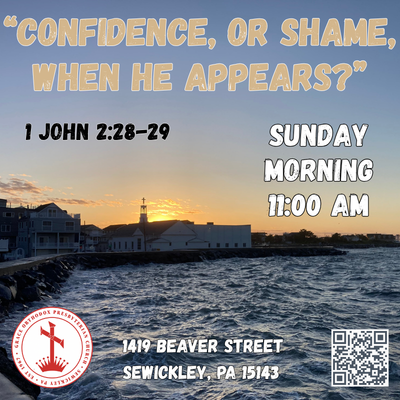
Amen. You may be seated. The title of my sermon this morning is Confidence or Shame When He Appears? I would encourage the children to listen carefully to this sermon this morning. By the way, there are sermons available for you to take notes if you wish. The key words for my sermon today are abide, confidence, shame, and righteousness. Dear ones, the word of God teaches us very clearly that there will indeed be a final day of judgment, a day that will come when our Lord Jesus Christ returns in glory at His future glorious second coming. Now, before he rediscovered the biblical gospel truth of justification by faith in Christ alone apart from works, the great Protestant reformer Martin Luther dreaded the day of judgment. Luther spent countless hours torturing himself with harsh penances and lengthy visits to the confessional.
Why did he do this? He did this because he was not confident of his standing before the infinitely holy and righteous creator of the universe. He knew God was holy. He knew that he was sinful. But he did not, before his pre-conversion time, understand the amazing grace of God given to sinners in the Lord Jesus Christ.
And you know, Luther was not alone in this lack of confidence in the face of the future Judgment Day. This lack of confidence, this fear and uncertainty in the face of the future Judgment Day, was quite common among Luther’s fellow Roman Catholic contemporaries. In fact, it was one of the driving forces behind the high demand among the people for the sale of indulgences, a practice that was contrary to Scripture and greatly enriched the Vatican while taking advantage of the tender consciences of the faithful. But how different things are today, especially when we compare the general mindset of our secular contemporaries, on the one hand, with Luther’s more religious contemporaries, on the other hand.
In general, today very few people fear God. Who today fears or even has significant concerns about the prospect of a Judgment Day? In fact, I would suspect, brothers and sisters, that many people today, even many who would call themselves Christians, deny the reality of a final Judgment Day. And in denying the final Judgment Day, they deny the reality of ultimate responsibility and ultimate accountability to God.
For many of our secular contemporaries, God, if He exists, is viewed as being all love and no justice, all grace and no wrath. He is seen as a therapeutic figure whose purpose is to comfort and affirm, regardless of one’s actions. This view portrays God as one who would never wish to cause pain, but only to make people feel good about themselves. Why should such a God be feared? And why would such a God hold a judgment day, unless perhaps to give everyone a participation trophy?
However, friends, if our passage for today teaches us anything, it teaches us that there will indeed be a final judgment day. John’s words in our passage assume that such a final judgment will take place, and this judgment will occur, as stated in verse 28, when He appears—when Christ appears. What is He referring to? The appearance of Christ. In other words, when Jesus returns at His parousia, His future glorious second coming at the end of this age. Our passage also implies that on the final day of judgment, the day of our Lord’s glorious return, there will be two groups of people. There will be those who have confidence before His divine majesty, and there will be those who shrink from Him in shame.
John is not writing these words to terrify his original readers. In fact, John is seeking to encourage the Christians to whom he is writing. He is seeking to strengthen them against false teachers who were trying to undermine their confidence in the biblical Jesus. Because this is the case, we can assume that the main purpose of this passage is not to cause believers to doubt their salvation. That is not John’s purpose.
He is not seeking to minister doubt, but He is seeking to minister faith, to encourage these believers to continue abiding in, clinging to, and trusting in the Lord Jesus Christ. The Spirit, through this passage of Scripture, is encouraging us, brothers and sisters, to strengthen our confidence in the Lord Jesus Christ as we look forward to the sure and certain hope of our Lord’s glorious appearing. Therefore, as we turn our attention to our passage for this morning, we notice first of all that only those who abide in Christ will have confidence at His appearing. Only those who abide in Christ will have confidence at His appearing.
Let me read verse 28 again. He says, “And now, little children, abide in him.” The word “now” indicates that he is continuing his thought from the previous context. Notice the tenderness, the pastoral tenderness with which he addresses his readers. He has a fatherly love for them, and he desires to encourage them. What does he say? He says, “Abide in him.” In other words, abide in Christ. What does he mean by abiding in Christ? This is one of John’s key teachings. To abide in Christ is to rest in Christ, to trust in Christ—not merely to believe intellectually, as important as that is, but to trust Him personally as your own Savior from sin.
This is not a one-time decision. It is not simply, “I walked forward, I responded to an altar call.” By the way, there is nothing in the Bible about altar calls or sinner’s prayers. These practices did not exist before about 150 years ago. And some Christians today, if you cannot remember the time when you walked down the aisle or prayed a sinner’s prayer, they doubt your salvation. But consider this: no one prayed sinner’s prayers or walked in response to altar calls before about 1850. Does that mean there were no Christians before those revivalistic methods arose? Of course not. The Bible never says you are saved by making a decision for Christ.
You are saved by faith, by trusting in Christ, believing that in Christ you have a merciful and forgiving God. It is about His grace, not about your decision. Of course, if you trust Him, you will decide for Him. You will entrust your soul to Him. And that is what abiding in Christ means. But it is not just a one-time event. It is an everyday, continuous practice. That is why it is called abiding in Christ. You do not simply believe in Christ once and that settles it. You continue to trust. You continue to rely on Him, rest in Him, call out to Him, long for Him, and remain in Him. And if you do, by the grace of God, you will have confidence when He returns in glory.
Now, it is important to understand that this passage in 1 John is transitional. Verse 28 repeats what was said in verse 27, and verse 29 anticipates what John will say next about practicing righteousness. In verse 27, John wrote: “But the anointing that you receive from Him abides in you, and you have no need that anyone should teach you, for as His anointing teaches you about everything, and it is true and is no lie, just as it has taught you, abide in Him.” Then in verse 28, it says: “And now, little children, abide in Him.” He is repeating himself for emphasis. This highlights the importance of personal faith in Christ. He says, “Abide in Him,” why? So that when He appears, we may have confidence and not shrink from Him in shame at His coming. So that when He appears, we may have what? Confidence.
What does the term confidence denote? It is actually a very strong term in the Greek. One of the commentators I studied while preparing this sermon pointed out that the word is so strong that the English word confidence does not fully convey its meaning, although it is the best word available in our language. Bible commentator Lenski says that the Greek word here indicates the undismayed confidence of faith, the feeling of freedom and joy in the presence of another person, especially a judge. This speaks of a bold confidence.
When Jesus returns, those who abide in Him will have a bold confidence and will not be uncertain, saying, “I wonder if I am in or not.” No. What is the basis for such confidence? Is it our own religious performance? Do those who abide in Christ have confidence because they are such good people, because they are such perfect Christians?
No. No. The ground and basis for our confidence were not directly addressed by John in this particular passage. When we compare Scripture with Scripture, we see that the ground and basis for our confidence in the face of the approaching Judgment Day is not our own works, not our own worthiness, and not even our own faithfulness in using the means of grace, though that is important. The ground and basis for our confidence is outside of ourselves. It is the merit and sacrifice of the Lord Jesus Christ.
John spoke of this earlier in chapter two, in the well-known words of 1 John 2:1–2, where John writes: “My little children, I am writing these things to you so that you may not sin. But if anyone does sin, we have what? We have an advocate with the Father, Jesus Christ, the righteous. He is the propitiation for our sins, and not only for ours, but also for the sins of the whole world.”
Jesus Christ, the sinless Son of God, has obtained and earned a perfect righteousness for those who abide in Him. If you are in Christ, His blood has cleansed you from all your sins, and His righteousness has clothed you. Then what have you to fear when you stand before the Father on the Day of Judgment? You stand in Christ. When the Father sees you, He sees you in Christ. He sees Christ. He sees the perfect merit and sacrifice of His Son.
This is why, for example, the Apostle Paul speaks of this confidence. If we go to Romans 5, and I will read verses 6 through 11, it says: “For while we were still weak, at the right time Christ died for the ungodly. For one will scarcely die for a righteous person, though perhaps for a good person one would dare even to die. But God shows His love for us in that while we were sinners, Christ died for us.” Consider this: while we were rebellious sinners, resisting our Creator and committing rebellion against Him through disobedience and breaking of the covenant, even then God demonstrated His love by sending His Son, Jesus, to die for our sins.
The passage continues in verse 9: “Since, therefore, we have now been justified by His blood, much more shall we be saved by Him from the wrath of God.” If you are now right with God, justified by His grace through faith in Christ, and if you are now in the grace of God, this verse promises that you shall be saved. This refers to ultimate eschatological salvation. No one who is now justified will ever be lost in the future, because God does not revoke His justifying verdict. Since we have been justified by His blood, much more shall we be saved by Him from the wrath of God. This is what gives us confidence for the day of judgment.
He goes on to say, for if while we were enemies we were reconciled to God by the death of His Son, much more now that we are reconciled shall we be saved by His life. Not only did Jesus die for us that we might be declared righteous before God, but He also continues to intercede for us. And He keeps us. We do not keep ourselves ultimately. He keeps us, in the palm of His hand.
More than that, verse 11, we also rejoice in God through our Lord Jesus Christ, through whom we have now received reconciliation. So the basis of our confidence is not in ourselves, but in Christ and Christ alone, in His perfect merit and the infinite value of His sacrifice for our sins. But how do we receive the benefits of our Lord’s merit and sacrifice? How do we receive this confident standing? We receive it by God’s justifying verdict, received by faith, by abiding in Christ alone apart from works.
Now, the Apostle John in our passage for today is not dealing specifically with the doctrine of justification as such, but that doctrine is, that truth is in the background of everything he says here. As Dr. Kistemacher writes, believers do not turn in shame from Christ, for they know their sins have been forgiven. They are free from shame. If you are a Christian, if you are in Christ, you will experience no shame on Judgment Day, because Jesus took that shame from you.
He bore that shame on the cross. And you say, well, what if I have a backsliding? What if I fail? What if I stumble? We all stumble in many ways. That is not an excuse to stumble, but it means that when Jesus saved you, He knew about all the future sins you would commit. But they have all been nailed to the cross. They have all been buried in His tomb. They have been cast into a sea of forgetfulness.
And that is why we can be confident as we trust in him and his perfect merit and sacrifice for us. Dear listener, if you are trusting, resting in Christ as he has offered to you in the gospel, you are free from shame. No matter how you may feel, you are free from shame. And you need not fear that you will shrink away at our Lord’s appearing. Do you abide in him? Do you trust in him? Do you believe that his merit and sacrifice are sufficient to avail for you on judgment day?
But we also learn here, and there is an implied warning here as well, that those who do not abide in Christ will shrink away in shame at his appearing. As it says in verse 28 again, “Little children, abide in him, so that when he appears we may have confidence, and not be ashamed before him at his coming.” Or as Lenski translates it, to be shamed away from him.
Now there are many people today who are very confident that they are good in the eyes of others, but they have no basis for that confidence. There are many who think, “I am a good person. I am a good person. I am better than others.” They compare themselves to other people. But God does not judge us by comparing our behavior relative to other people. We can always think of people who are more morally depraved than we are, and we can think of people who are morally better than us on a relative scale.
But God judges us by the standard of his holy character as revealed in his perfect law. And so, if you would stand before the infinitely perfect and righteous God, you need a perfect righteousness, and you do not have it, and neither do I. That is why those who are trusting in themselves, in their works, in their religiosity, in their charity, or perhaps in their ideology, those who trust in anything other than Christ as their confidence, on that day when Jesus returns, will realize that their faith was misplaced. They will shrink away in shame as they see the glorious Lord revealed in his luminous glory.
Our confession of faith in chapter 18, section one, which is the section on assurance of grace and salvation, says this about those who would shrink away: Although hypocrites and other unregenerate men may vainly deceive themselves with false hopes and carnal presumptions of being in the favor of God in a state of salvation, which hope of theirs shall perish, yet such, but here is where the hope comes in, yet those who truly believe in the Lord Jesus, love him in sincerity, and endeavor to walk in all good conscience before him, may in this life be certainly assured that they are in the state of grace and may rejoice in the hope of the glory of God, which hope shall never make them ashamed.
I remember hearing a story once about a Christian gentleman who happened to be on a plane flight, and he happened to sit next to, I believe it was a Roman Catholic bishop or archbishop. He got into a conversation with this well-known cleric and asked him, “You know, are you assured that you will go to heaven when you die?” The archbishop smiled slightly and said, “No one can know that.” That is so sad, isn’t it?
Because John says you can know, turn to 1 John 5, verse 13. This is one of the purpose statements that John lays before us in his epistle. As he is nearing the end of his epistle, he reaffirms his purpose for writing to these believers who were being threatened by false teaching and were at risk of being destabilized in their faith. He tells them one of the reasons why he writes to them. He says, “I write these things to you who believe in the name of the Son of God.” So who is he writing to? He is writing to Christians—those who believe in the name, the person, of the Lord Jesus Christ, the Son of God. I write these things to you, why?
That you may know that you have eternal life. And I believe this is translated the same way in many of the Roman Catholic versions as well. You can know that you have eternal life.
You can have confidence now, if you are trusting Christ for your salvation with true repentant faith, that you have eternal life. And certainly, if you know that you have eternal life now, you will have confidence before him when he returns. But how does this impact our lives?
Does this confidence lead us toward an arrogant attitude, or toward the sin of presumption? There are some Christian denominations, even professedly Christian ones, that teach that if you think you can know that you are going to heaven, that is the sin of presumption. But it would be the sin of presumption only if you are trusting in your own works or in your own ability to remain in the faith by your own strength.
But if your confidence is in Christ, in His perfect satisfaction, and in His atonement and merit, and if that is where your trust is, then is Christ insufficient to keep you? That is essentially what you are saying. If you deny that you can have confidence in Christ, does that not reflect poorly on your Savior? That He is a perfect Savior, that He is able, and that He who began a good work in you is able to carry it through to the day of completion. Well then, why not just go on sinning? If everything is already set, why not continue in sin? John addresses this in verse 29.
He says, “If you know that He is righteous, you may be sure that everyone who practices righteousness has been born of God.” This brings me to my final point, beloved. Those who are born of God and abide in Christ are characterized by the practice of righteousness, by practicing righteousness.
We are not saved by our good works, but we are saved for a life of good works. We are reminded of this in other passages of Scripture. For example, the well-known passage in Ephesians chapter two, verses eight through ten: “For by grace you have been saved through faith, and this is not your own doing; it is the gift of God, not a result of works, so that no one may boast. Faith alone, salvation by grace alone through faith alone.” But then we must continue to read on to verse ten.
For we are His workmanship, created in Christ Jesus for good works, which God prepared beforehand that we should walk in them. We are not saved by good works, but we are saved for good works. And as Paul says elsewhere, I like how he states this in Galatians 5, verse 6: “For in Christ Jesus neither circumcision nor uncircumcision counts for anything, but only faith working through love.” He goes on to describe the fruit of that faith in verse 16 and following.
But I say, walk by the Spirit, and you will not gratify the desires of the flesh. For the desires of the flesh are against the Spirit, and the desires of the Spirit are against the flesh, for these are opposed to each other, to keep you from doing the things that you want to do. But if you are led by the Spirit, you are not under the law.
Now the works of the flesh are evident: sexual immorality, impurity, sensuality, idolatry, sorcery, enmity, strife, jealousy, fits of anger, rivalries, dissensions, divisions, envy, drunkenness, orgies, and things like these. The list could go on and on.
And he says, I warn you, as I warned you before, that those who do such things will not inherit the kingdom of God. Those who are unrepentant in pursuing the works of the flesh shall not inherit the kingdom of God, but the fruit of the Spirit—not the fruit of your attempts to bear this fruit, but the fruit of the Spirit at work in your life. The fruit of the Spirit is love, joy, peace, patience, kindness, goodness, faithfulness, gentleness, self-control. Against such things there is no law. And those who belong to Christ Jesus have done what? They have crucified the flesh with its passions and desires. Those who are born of God and abide in Christ are characterized by the practice of righteousness.
This reminds us that God himself is righteous. He defines righteousness by his own character. Righteousness is one of his communicable attributes, as theologians describe it. But what does the practice of righteousness involve in John’s vocabulary? In the context of 1 John, practicing righteousness first includes believing in the biblical Jesus and loving fellow Christians.
He is not speaking of a Pharisaical, works-based righteousness—a so-called righteousness that arises from a legalistic, self-justifying spirit. That would be a mindset in which one thinks, “I will do good works to earn God’s favor.” If this is the attitude behind good works, one may perform actions that appear good outwardly, but they are done for sinful motives. This is not practicing righteousness; it is practicing self-righteousness. Nor is Paul referring to mere civic righteousness—external actions that even unbelievers can perform. Instead, he speaks of true righteousness that comes from the new birth, from being born again and abiding in Christ.
Dear ones, once again, Judgment Day is indeed approaching. It will occur when the Lord Jesus Christ appears in visible glory at his future second coming. If Jesus were to return today, would you have confidence before him, or would you shrink away from him in shame? Dear listener, if you are abiding in Christ and trusting in him alone for salvation from sin, then you can be assured that you will have confidence when your Lord appears. But if you are not abiding in him by faith, then you will shrink from him in shame. Do not remain in that condition. Cry out to God for mercy. Repent. Trust in Christ for salvation as it is freely offered in the gospel. Then you will be able to have confidence before him when he returns in glory, and you will not need to worry about shrinking away from him in shame.
Praise God that we who are in Christ are clothed in His righteousness, and when He appears, we will appear with Him in glory. This is our hope and this is our joy. Judgment day is coming. We can be confident in Him, brothers and sisters. Let us walk together in this confidence as we look forward to our Lord’s return in glory. Amen. Let us pray. Our great God and heavenly Father, we thank You for the confidence You give us in the gospel of Jesus Christ. We thank You that our salvation is grounded not in our own works or worthiness or merit, but in the merit and sacrifice of Christ and Christ alone. By Your Spirit, Lord, may these truths find a lodging place in our souls, and may they awaken love, joy, and peace. We pray these things in Jesus’ name. And all of God’s people said, amen. Let us respond to what we have heard by rising, and we will sing together number 517, “I Know Whom I Have Believed.” 517.