
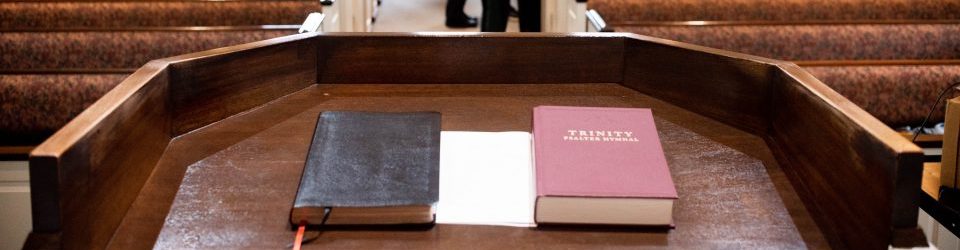

This sermon is from the Rev. Charles G. Dennison sermon archive, part of the “Philippians” series, and was preached at Grace Orthodox Presbyterian Church in Sewickley, PA, during a worship service on Sunday, April 19, 1992.
This morning our scripture reading begins in the book of Genesis, chapter 25. This is Genesis, chapter 25. We begin reading at verse 27. Listen to the word of God. And the boys grew, and Esau was a cunning hunter, a man of the field. And Jacob was a plain man, dwelling in tents. And Isaac loved Esau because he did eat of his venison. But Rebekah loved Jacob. And Jacob sought cottage, and Esau came from the field. and was faint. And Esau said to Jacob, Feed me, I pray thee, with that same red potage, for I am faint.
Therefore was his name called Edom. And Jacob said, Tell me this day thy birthright. And Esau said, Behold, I am at the point to die. And what profit shall this birthright do to me?” And Jacob said, “…swear to me this day.” And he swore unto him, and he sold his birthright unto Jacob. Then Jacob gave Esau bread and pottage of lentils, and he did eat and drink and rose up and went his way. Thus Esau despised his birthright.
Then turning to Philippians chapter 3, beginning with verse 3. So we are the circumcision, which worship God in the spirit and rejoice in Christ Jesus, and have no confidence in the flesh, though I might also have confidence in the flesh. If any other man thinketh that he hath whereof he might trust in the flesh, I more. Circumcised the eighth day of the stock of Israel, of the tribe of Benjamin, and he ruled the Hebrews as touching the law, Pharisee, concerning thee, or persecuting the church, touching the righteousness which is in the law, blameless.
But what things were gained to me, those I counted lost for Christ.” And I count all things but loss for the excellency of the knowledge of Christ Jesus my Lord, for whom I have suffered the loss of all things, and do count them but dumb that I may win Christ and be found in him, not having mine own righteousness which is of the law, but that which is through the faith of Christ, the righteousness which is of God by faith, that I may know him. and the power of his resurrection, and the fellowship of his sufferings, being made conformable unto his death, if by any means I might attain unto the resurrection of the dead. Not as though I had already attained, either were already perfect. But I follow after, if that I may apprehend that for which also I am apprehended of Christ Brethren, I count not myself to have apprehended, but this one thing I do, forgetting those things which are behind and reaching forth unto those things which are before, I press toward the mark for the prize of the high calling of God in Christ Jesus.
Your word, Lord, is means of grace to us whereby you would communicate with us that regular refreshment and encouragement and that continual correction and even reprimand where necessary. Father may your word be so wonderfully helpful to us and Lord may it be helpful for your elect in the world as they would be gathered even today in order to praise your name from this day onward and forever. Hear us for the sake of Christ the living word. Amen.
Now I’m sure that Jacob and Esau played out that scene so many, many, many centuries ago without the slightest thought about that scene’s eternal significance. Now I think that you realize that the events on that day spoken of here in the book of Genesis revealed things about each one of those boys. Things at the very center of each of their personalities. Speaking about even the secrets of eternity.
Esau was quite the man. He was a hunter, quite gifted, very powerful. And he had been hunting this particular day. But now he drags himself home, famished it seems, only to come upon his brother, Jacob, who seems to have built his own diner on the edge of the field. Some have suggested that this was the first delicatessen. The stew with cimerek smelled mighty good. And Esau, the first born, salivates.
He wasn’t a man to hold back when it came to his desires. He was rather impetuous, in fact. He was a man of action, after all. So he says to Jacob, give me some stew. Now, Jacob was not known for ever giving something for nothing. And Jacob says, all right, I’ll give you some stew if you give me your birthright. Interestingly, Esau doesn’t say it. my birthright for a bit of stew?
Obviously, Esau is taking this as something of a game among brothers. He’s having a good time. Kids for cats, you know. A little exchange on the edge of the field. All of this with the tents of his father and you, presumably. A few more steps and he can be eating with his dad, right? What’s a birthright to me? I’m about to die from hunger!”
So in effect, so says the scripture, Esau sells to Jacob his birthright. In addition to the game quality of his exchange, the fun and games that Esau and Jacob are having. There is also a thought in Esau’s mind, even if I say I sell my birthright, what can this wimp do? After all, I’m stronger than he is. After all, I’m my father’s firstborn. After all, I’m my father’s favorite. What can Jacob actually do? I can enter into this game without any fear whatsoever of losing my birthright.
As to the significance of these events, however, the Spirit of God makes this judgment Thus Esau hated his birthright. This is nothing to play with, Esau. This is nothing to joke about, Esau. Thus Esau hated his birthright. and seemingly the inheritance to which that birthright entitles him.
At the same time, we have Jacob presented here for us, and he comes across, does he not, as the opportunist? Oh yes, he may enter into the spirit of the game with Esau, but In all seriousness, this is no game for Jacob. He is the opportunist, he is in fact a devilish conman. But simultaneously he is one who thinks that that birthright and the inheritance to which that birthright gives him the right, these things are the most important things in all the world. The implication is, despite the con, despite the conniving, despite the sneaky deceit, Despite the wickedness that is in the heart of Jacob, Jacob at root level loves the inheritance. Esau hates it.
In fact, nothing in the world is as precious to Jacob as that inheritance. As the story of Jacob works itself out in the remaining chapters of Genesis, it will take him all of his life to even begin to realize what the nature of the inheritance is. It will take him all of his life to realize that that inheritance is given as a gift, it is not secured by conniving deceit. Still, even though that’s true, and even though we see these negative features in Jacob, Jacob is admirable to this extent. His heart is set upon the inheritance above all else. Jesus will take up the matter of this admirable quality that appeared in Jacob, and he will latch that admirable quality onto the appearance of the kingdom of heaven.
Matthew 11, verse 12, is a very, very difficult verse. It is truly a tough nut to crack. In the King James it reads like this, and from the days of John the Baptist until now, the kingdom of heaven suffereth violence and violent men take it by force. Now I think that it is admitted by most everyone today that that is not a very good translation of the Greek.
Even here, in this somewhat opaque translation, two things are communicated clearly for us. First of all, the kingdom of heaven is not something that is viewed by Jesus as future or distant, rather it is viewed as a present reality. First of all, that much is clear.
The kingdom of heaven is viewed as something that is present and operating. Secondly, despite the opaque nature of the translation given us in the King James, it is clear to us that those who are drawn to this kingdom are energetically grabbing hold of it. This verse then communicates the energy and determination with which the kingdom of heaven is being seized. And in light of this, maybe a better translation of this verse would be, and from the days of John the Baptist until now, the kingdom of heaven forcefully shows itself. Forcefully shows itself. and determined men see it.”
Now this whole idea and notion, this reality which Jesus is commenting on here in Matthew 11, will receive further exposition when Jesus speaks to his disciples in parables. Matthew 13, beginning at verse 44. Here is the famous parable about the treasure hidden in a field which a certain man discovers. And in order to secure the field in which that treasure is hidden, this man goes and he sells everything. everything he has, that he might have the treasure.
Jesus is saying the kingdom of heaven is like that treasure. So determined men cast aside restraint. They even seem to cast aside all sense and seize hold of that kingdom because of its incomparable worth, even though it means the loss of everything else. I must have the kingdom. And Jesus goes on.
He tells us next in that thirteenth chapter, verses forty-five and forty-six, that the kingdom of heaven is compared to a merchant in quest of fine pearls. But when he finds the one pearl of matchless value, the pearl of great price, he liquidates his holdings so that he might hold in his hand this possession. of inestimable worth.
It is this mercantile language, this language of commerce that Paul employs in Philippians 3. This language about buying and selling. Reminiscent of Esau selling Jacob buying the birthright. Reminiscent of the man selling all he had to buy the field with the treasure. Reminiscent of that language used with regard to the merchant who buys the pearl of great price.
All this overlaid with language that breathes, as it were, the most intense, maybe even violent determination. I must have it!” So Paul then fills out his 1040, his Schedule C, in Philippians 3 verses 7 and 8. He speaks about gain, that is, he speaks about profit. The language used has in view monetary profit and gain.
He also speaks about loss. He speaks about suffering loss, and in view is bankruptcy. over against gain is bankruptcy. And from the reading of things on the surface, it seems as if Paul has lost all of his senses. He is deliberately choosing bankruptcy. And forfeiting whatever was gained to him. so great is that which he gains through his bankruptcy.
The apostle then becomes one in whom the story of Jacob is finally explained. He becomes one in whom the parables of Jesus take on flesh and bone. no longer just parables, no longer just stories, but real life. Here is someone living them out. We are not dealing then with make-believe.
Here is one in the Apostle Paul for whom the kingdom of heaven has forcefully shown itself in the risen Christ. and who has, with the greatest and fiercest determination, seized hold of it, even though this has meant the loss of everything else for him. Now, in reckoning his loss, the apostle has been playing a game of his own, having a bit of fun in games himself, at the expense of those that threaten the freedom and vitality of the Philippians. The apostle has been having a bit of fun at the expense of those who brag in what they consider their worth. And for the sake of bragging rights in a contest with braggers, Paul has portrayed himself as the greatest Jew of his time.
There was no one like me. That’s what verses 4 through 6 are all about. We have to take them somewhat tongue-in-cheek, you see. But now he goes on. His tone moves from the ridiculous of verses 4 through 6 to the sublime of verses 7 through And in those verses, verses 7 through 11, truly we have presented for us one of the most succinct and powerful presentations of Paul’s gospel.
One conveyed in the most intimate and moving terms, Paul is saying, even if I were the greatest Jew of my time, whatever things in fact may have been profit to me, from such a status, I forfeit them all, I give them up. I go even further. Not just whatever benefits from Judaism may have accrued to me, be they even the most superlative, but whatever in all the world may have accrued to me, I forfeit it all. And may it be known to you that no one takes these things from me with me putting up a fight in an effort to keep them for myself. It is I, Paul, who reckons the loss, who willingly forfeits everything.”
Here is the religious soul struck by the grace of God. the religious soul at its very best. Not in fact what we read in verses 4-6 that boast in the flesh, but what we read in verses 7-11 that boast in Christ. In this late and final epoch of God’s dealings with this world, in this epoch of the administration of the gospel, there falls away the duplicitous craftiness of a Jacob to gain first place in his family for the sake of an inheritance that would be given him from his father Isaac at the expense of his brother Esau. it falls away, fields with treasures buried in them, pearls of infinite worldly value and even such things as make for a kingdom be it even the kingdom of heaven and that one that remains in whom all these things find their meaning so that they, even they are eclipsed by his surpassing excellence. That one who remains is Jesus himself. The inheritance to which your birthright in the kingdom entitles you. the inheritance of incomparable value. Jesus himself. Your reward.
Ever since then all that the religion of Judaism can offer, over against all that this world can offer, is this one for whom all those things are intended. Over against all of this is set Jesus Christ alone, the All in All. says Paul, who is himself my inheritance, my treasure, my priceless pearl, my kingdom. I have willingly forfeited everything.
And what a bond now exists between that apostle and his Savior. What he finds coming to expression in himself is because of what came to expression in his Christ. He finds that his willingness to surrender everything, even if he had everything, his willingness to surrender everything, to give everything up for Christ, rises in him because Christ who truly had everything, gave up everything for him. How he loves him.
Don’t you love him too? Aren’t you giving up everything for Him as well? Father, set well in our hearts and souls your word that going from this place we will not forget. And Father, grant us strength that in living for you we may understand that there is nothing that compares in value to Christ our Savior. We are determined, O Lord, to give up everything for him. Amen.
The sermon text provided above is derived from the sermon audio recording making use of generative tools. It has not been manually edited. While transcription tools have a high degree of accuracy, the output may include generative textual, punctuation, and/or formatting errors.