
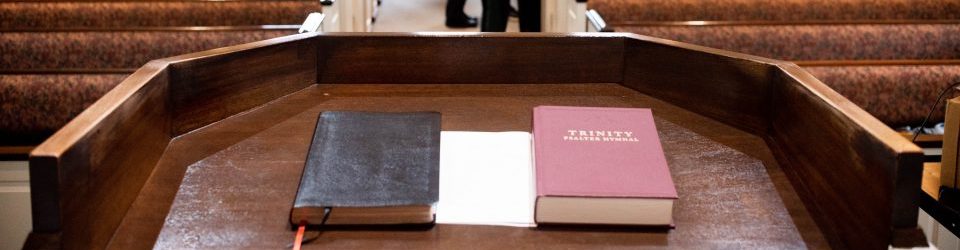

This sermon is from the Rev. Charles G. Dennison sermon archive, part of the “Philippians” series, and was preached at Grace Orthodox Presbyterian Church in Sewickley, PA, during a worship service on Sunday, September 15, 1991.
This is Paul’s letter to Titus, the second chapter, and we begin at verse 11. For the grace of God that bringeth salvation hath appeared to all men, teaching us that, denying ungodliness and worldly lusts, we should live soberly, righteously, and godly in this present world. looking for that blessed hope and the glorious appearing of the great God and our Savior, Jesus Christ, who gave Himself for us that He might redeem us from all iniquity and purify unto Himself a peculiar people, zealous of good works.
These things speak and exhort and rebuke with all authority Let no man despise thee. Put them in mind to be subject to principalities and powers, to obey magistrates, to be ready to every good work, to speak evil of no man, to be no brawlers, but gentle, showing all meekness unto all men. For we ourselves also were sometimes foolish, disobedient, deceived, serving divers’ lusts and pleasures, living in malice and envy, hateful and hating one another. But after that, the kindness and love of God our Savior toward man appeared, not by works of righteousness which we have done, but according to His mercy He saved us by the washing of regeneration and renewing of the Holy Ghost, which He shed on us abundantly through Jesus Christ our Savior, that being justified by His grace We should be made heirs according to the hope of eternal life. This is a faithful saying. And these things I will that thou affirm constantly. That they which have believed in God might be careful to maintain good works. These things are good and profitable unto men.
But avoid foolish questions and genealogies and contentions. and strivings about the law, for they are unprofitable in vain. A man that is a heretic, after the first and second admonition, reject, knowing that he that is such is subverted and sinneth, being condemned of himself.” Then turning over to Philippians chapter 2, Verses 12 and 13. Therefore, my beloved, as ye have always obeyed, not as in my presence only, but now much more in my absence, work out your own salvation with fear and trembling.
For it is God which worketh in you, both to will and to do of his good pleasure. How we need your help our father We need it Lord every day we rise to greet our responsibilities and those duties which you have set upon us and Each day when we rise to the joys of this life, O our God, we need your instruction and your patience and forbearance with us that we might, in fact, live as obedient servants. Be merciful to us, Lord, and may you be merciful to your people throughout the world as they even now, many of them are gathering together to exalt You to glory in Your Son Christ. Hear us now as we pray that we might be well instructed from Your Word and that we might please You in all things. Amen.
We have spent a great deal of time looking at Philippians chapter 2, verses 5 through 11, a very famous text and one that is quite moving indeed. And now we are going on to the subsequent verses, especially verses 12 and 13 in that second chapter in Philippians.
Now if things were somewhat difficult for us in those prior verses, they may become even more difficult for us here. It may be like moving from the proverbial frying pan into the fire. There’s an uneasiness that is associated with these verses because they set before us topics that demand attention and Oftentimes we’re not always prepared to handle the matters that these verses raise for us. Controversies in the previous verses raged over the exact nature of Christ, but here now in these verses, the battles have traditionally raged over the relationship of human responsibility, verse 12, and divine sovereignty, verse 13, and even have gone so far as to be waged over the matter of the relationship between faith and works. Using the text simply, straightforwardly, It has seemed to some that we are here faced with an insoluble problem and even an unbearable tension in the thinking of the Apostle Paul. As we move from one verse to the other, some have suggested to us that we are dealing here with a flat inconsistency.
We’ll note in verse 12 that there is command given to the people of God, this church in Philippi, that it seems that what they are commanded to do in verse 12, God performs in verse 13. And with regard to that thirteenth verse, insofar as God is always bound to accomplish His good pleasure, then what possible force can working out our own salvation have? Say some, we encounter here a bold-faced contradiction to the degree that the sovereignty of God triumphs then our efforts become superfluous, and the notion of judgment inherent in the words seared and trembling in that twelfth verse proves to be nearly hypothetical, if not a downright fiction. And to the degree that we are then called upon to exalt human responsibility in verse twelve, we must hedge in the sovereignty of God and make less of it than what seems to be made of it by Paul here in the plain reading of the text. So thinking about that one matter, that whole question about the superfluity of our own efforts, the notion that judgment inherent in that twelfth verse speaks only of a hypothetical, if not a fictional, judgment. We are brought face to face with problems that seem to afflict people everywhere where the gospel is encountered.
And in this regard, I have in mind that great theologian Bill Mad Dog Matlock, former third baseman of the Pittsburgh Pirates. Now, I don’t know if any of you were reading the series of articles in the Pittsburgh Press this last week, but they were quite interesting. On the sports page we had a series of articles that dealt with the Christian faith of professional athletes. It just so happened that when the evangelical wave came through the National League a few years ago, Bill Matlock was playing for the San Francisco Giants. And there were a number of San Francisco giants who were converted.
Bill was having a little difficulty. He says, their belief in God’s power and sovereignty is so great that they don’t have to go out and do anything. They said, well, if we’re going to win, we’re going to win. If not, then we won’t. He said, I was put out a bit by that.
Well, the problem of which we speak even touches the clubhouses of the National League. The problems here are even more complex, more difficult. Let’s look at verse 12 a little more closely. So say, This verse speaks as if our salvation is still an uncertainty. It’s something future yet to be realized.
Work out your own salvation as if it was still in the balance, something that was as yet undecided. And in light of that, what are we to do then with our traditional confidence that our salvation is an already accomplished fact, an already done deed. Have we not confessed that we have been saved, that we are saved already? Further, what are we to do in light of this text with the doctrine of the perseverance of the saints? We have confessed that, but yet it seems as if something is in the balance, something we must do, as if in fact our salvation was uncertain and our salvation was yet to be realized.
And I might add at this point that a text like this has become a conundrum for many a son of Calvin, or at least one raised within Calvinism, to the point that it forced him out of his Calvinism. And it has caused many more, outside of Calvinism, to throw stones from a distance. God may be sovereign, but, after all, in the end, it depends on us. We’re not done yet. Because there’s more at stake in this text than our Calvinism.
That should be evident from the comments that I made previously about the certainty of our salvation. So if that is up for grabs, in the balance is the very substance of the gospel as we have come to embrace it. After all, do we not confess with the Apostle Paul, who speaks elsewhere, by grace.
He had been saved through faith, and that not of yourselves, it is the gift of God, not of works, lest any man should boast. You know the text. Ephesians 2. Paul speaks additionally in Galatians 2, verse 16, by the works of the law shall no man be justified. And again, most clearly, “…but to him who does not work, his faith is reckoned to him as righteousness.”
Seems to be a lot of working going on in Philippians 2.12, but Paul says, “…but to him who does not work, his faith is reckoned to him as righteousness.” Not only do these verses that we’ve just recited speak about a present possession of uncertainty about salvation, they clearly exclude works.
2 Thessalonians 2.12 introduced uncertainty where Paul elsewhere seems to be so certain, and doesn’t this verse introduce works or working where Paul elsewhere will have none of it?
What then are we to do with the problems of the text? Are we to assume that this text was written late in Paul’s life or that the pressures of prison life got to him and he was collapsing under the mental strain? He wasn’t able to hold up, maintain that wonderful gospel dialectic that he was so adroit at previously in his ministry? Maybe he was becoming a bit weary, mind weary, in his latter years. He wasn’t as nimble of mind as he once was. So now he’s collapsing.
Suggesting to us then in concurrent text, concurrent verses, things that are absolutely contradictory and mutually exclusive. Maybe he was like Clarence Thomas. I understand that Clarence believes in natural law when it comes to political theory. But when it comes to courtroom practice, somehow natural law doesn’t seem to apply. Just as Thomas seems to live in two places at once. Maybe that’s consistent with his Catholicism, I don’t know. You see, they were the ones who proposed a natural grace dualism long ago, that in fact you could live in mutually exclusive terms. Well, you can see I’ve been reading the newspaper this week.
I’m not certain that we can satisfy everyone with regard to these nurses in front of us this morning, but as we work out our own solution, it would be well for us to keep a couple of things in mind, clearly before us. First of all, with regard to the matter of the relationship between faith and works, here is a complex subject. But let us be clear about one thing.
The text in front of us is not talking about justification, it is talking about sanctification. Now we, in this day and age, are not as conversant as our forefathers in theological terminology. But I think For this congregation, there is a grasp of the difference between justification and sanctification. Justification being the act of God wherein He declares us to be righteous for the sake of Christ, whose righteousness is imputed to us, that righteousness we receive by faith alone. Sanctification is a work of God’s free grace. whereby we are renewed in the whole man after the image of God, and are enabled, of course, by His grace, to die more and more to sin and to live unto righteousness. So as we look at the text, let us remember, let us keep in mind that the apostle here is speaking about sanctification, he’s not speaking about justification.
And let’s give him the benefit of the doubt that what he says here is consistent with what he says everywhere else in his epistles. Setting the matter straight, then, properly speaking, this text is not about someone coming to Christ, That is, becoming or getting saved.
This text is about demonstrating a salvation which is already in possession, which is already in hand. There’s an interesting feature of this twelfth verse that you may well want to keep in view. The apostle says, work out your Salvation. It’s a salvation that is already within your hand. It is within your grasp. It is a present position, something that belongs to you. So he’s not here speaking about the acquisition of something you don’t have. He’s speaking here of using something you’ve got. You can’t work out salvation unless you’ve got salvation.
It is also well for us to keep in mind that the works that are here in you in verse 12 are essential to the apostle’s gospel, and no wise jeopardize his position with regard to works in their relationship to justification. As much as works are absolutely excluded from justification, the ground for justification, they are necessarily so in view when it comes to sanctification, and that consistently throughout all of the apostles’ writings.
Did you catch it as we were reading through Titus? That forgotten letter of Paul, that magnificent epistle 10 by him, Would you catch it as we move through our reading of our text from Titus this morning? Verse 7 of that third chapter, that being justified by his grace, we might be made heirs according to the hope of eternal life. And he goes on in verse 8, this is a trustworthy statement And concerning these things, I want you to speak confidently so that those who have believed God may be careful to engage in good works.
The coalescence, then, of justification, which excludes works, and sanctification, which necessarily includes them. But at the same time, we are distancing the Apostle’s doctrine of justification from good works, we are maintaining that good works are not detached even from that doctrine of justification which he espouses. For justification and sanctification are intricately bound to one another. According to the Apostle Paul, then, For one to have that faith which justifies, that faith which is judged to be true faith, one must have an obedient faith. In the very epistles that are usually cited, in order to defend the classic Protestant doctrine of justification, by faith.
There are those statements by the Apostle in which he brings into view his relationship with faith, yes, obedience, and even works themselves. Here the Apostle in Romans 1 verse 5, at the beginning of that epistle, again in verse 26 of the 16th chapter as he concludes it, when he commends to these readers of his in Rome that obedience of faith, that faith which obeys. And hear him once more in the epistle to the Galatians, the fifth chapter, the sixth verse, where he speaks about that faith which works by love. The apostle is saying, if it doesn’t work by love, then it’s not the faith I have in mind. If it’s not a faith that is obedient, that goes on to obedience, then it is not the faith I’m writing to you about.
It is specifically, then, that obedient faith that is in view as the Apostle writes the twelfth verse of the second chapter of Philippians. And that’s how he would have us to understand it. So then, my beloved, he writes, just as you have always obeyed, get that phrase, just as you have always obeyed. And he explains that phrase at the conclusion of that verse with the words, work out your salvation with fear and trembling, as if the latter part of the verse explicates the former part of the verse.
The working out of our own salvation, then, is but the explication of the obedience which has already been mentioned. Will you exclude obedience from your estimation of Christian life and service? Just as obedience offers no contradiction, then, to our faith, neither does our sanctification contradict our justification. And is this not the case with Christ Himself, who is the central figure in all that’s being said by the apostles at this point?
His faith in His Father, does not remove from him his obligation to obey his father. Rather, it enhances that obligation. Do you note? How Paul now is moving from those prior verses, 5 through 11, into 12 and 13. The word he picks up on as he bridges the section is the word obedience. Verse 8, and being found in appearance as a man, he humbled himself by becoming obedient to the point of death, even the death of the cross. So then, my brethren, just as you have always obeyed, you have always been obedient, as it was with Christ. So it is with you. His faith does not then obliterate his concern for faithfulness. And it must not be the case with you either.
Secondly, we need to look at this matter of God’s sovereignty and its effect on human responsibility. Sovereignty being emphasized in the 13th verse and human responsibility being spoken of in the 12th. Is it as some have suggested, the sovereignty of God destroys all human responsibility? Or is it as others have suggested, human responsibility hedges in God’s sovereignty? Does Paul’s doctrine then land him in an insoluble contradiction? Some, in thinking about this text, have now suggested to us that we must adopt a two-track position, in which we must teach that both God’s sovereignty and man’s responsibility are equally ultimate. But as it was in the former case in regard to faith and works, so it is here with regard to God’s sovereignty and man’s responsibility.
The Apostle is absolutely consistent in all of his epistles from beginning to end. He grounds all of the actions of the people of God in the prior action of God Himself. That, for the apostle, is gospel. If God doesn’t act, then there is absolutely no possibility of response on our part. Our response is predicated upon God’s sovereign activity. If God is not at work in us, then we cannot respond. The text assumes that God is at work in us, that he has come to us, that he is presently operative, but that his actions are the prior condition for all of our actions.
His activity, the indicative of his action, is the ground of every imperative of Scripture. And so, therefore, When the apostle or a prophet placed upon the people of God an obligation and they set before them a command, that obligation and command is grounded in God Himself, who has already performed the activity, and that’s what magnifies grace. You’re working out of your own salvation, is merely entering into the arena of God’s own activity on your behalf, so that in the end you won’t congratulate yourself, but you will praise Him. For how thoroughly responsible He is, for we’re told that with Him alone lies the willing and the doing of His good pleasure in us. What there is of us, then, what there is in us of a willing of that which is good and the doing of that which is good is found in Him. God’s sovereign work then does not jeopardize our responsibility, it establishes our ability. So then, you who are beloved of God and called by Him, You in whom God is sovereignly at work, do you not know that He is at work in you both to will and to do of His good pleasure, and the outworking of that will be in you a working out of your salvation? With fear and trembling, since you are conscious of the One who is in you, Well, we’re going to start at working out our own solutions with Fear and Trembling to the conundrums of the text that is before us.
There is more here, much more, for edification. And we will look more deeply into the matter later on. Let’s pray. May we give all praise to you, our God. May we rejoice, Father, in the sufficiency of your blessing in salvation. For indeed, by grace we are saved through faith, and that not of ourselves, Yet as the Apostle so wonderfully proclaims, we are your workmanship, created in Christ Jesus unto good works, that you beforehand foreordained that we should walk in them. Our Father, we are responsive and And in our responsiveness we find indication of the presence of your Spirit with us, yes, convincing us of the sufficiency of the salvation that is found nowhere else but in Christ, but also the sufficiency necessary to do those things that please you, that honor you, that glorify your Son. We thank you from the depths of our hearts for such magnificent grace. Amen.
The sermon text provided above is derived from the sermon audio recording making use of generative tools. It has not been manually edited. While transcription tools have a high degree of accuracy, the output may include generative textual, punctuation, and/or formatting errors.