
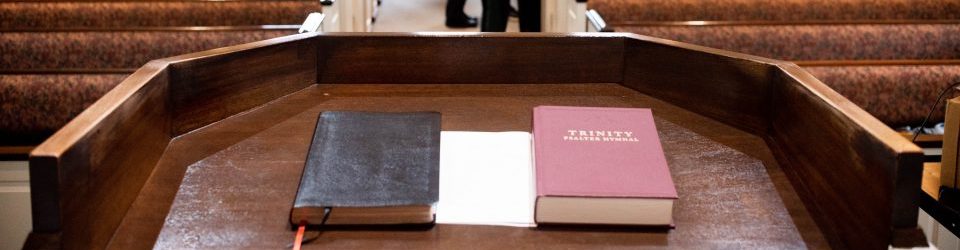

This sermon is from the Rev. Charles G. Dennison sermon archive, part of the “Life of Elijah” series, and was preached at Grace Orthodox Presbyterian Church in Sewickley, PA, during a worship service on Sunday, March 13, 1988.
Tonight we are in James chapter 5 again. And we are looking at verse 13 to the end of the chapter. Specifically because Elijah is mentioned in this chapter. This is James chapter 5. He is anyone among you suffering, let him pray. He is anyone cheerful, let him sing praises. He is anyone among you sick, let him call for the elders of the church and let them pray over him, anointing him with oil in the name of the Lord, and the prayer offered in faith will restore the one who is sick. and the Lord will raise him up, and if he has committed sins, they will be forgiven him. Therefore, confess your sins to one another, and pray for one another, so that you may be healed.
The effective prayer of a righteous man can accomplish much. Elijah was a man with a nature like ours, and he prayed earnestly that it might not rain. and it did not rain on the earth for three years and six months. And he prayed again. And the sky poured rain and the earth produced its fruit.
My brethren, if any among you strays from the truth, if one turns him back, let him know that he who turns a sinner from the error of his way will save his soul from death and will cover a multitude of sins. Lord, for your people who wait upon you, may the word come for the refreshment of their souls, and may we ourselves be refreshed, because your word is heard, and we, Lord, in hearing, are ready to obey. Encourage us in our faith towards you, and Lord, we pray that where there is weakness, we might in fact be strengthened in keeping with your grace and purpose. We ask it in Christ’s name. Amen. I know it’s not appropriate to begin messages with apologies.
There is one seminary student here tonight. This is not a good example. So don’t let me ever hear of you doing this. But this has been a most difficult week for me. A very trying week and one that has taken a great deal out of me. So if my message seems a little bit more devotional tonight than usual, I hope that you’ll understand and endure with me as we move through this message tonight. I’m sort of thinking on my feet, so please hang with me if you will. If I have to go back and regroup and start again, you’ll understand. I’ll say something like, wipe that out. I’m not able to do for you tonight what I had hoped, and that is to look at Elijah particularly within the framework of the theology or the doctrine of James.
I think that you, if you were here last week, realized that I was moving in a certain direction, James in effect is sort of a New Testament Solomon. He is here the expounder of the wisdom that now is ours or now belongs to the church because of what Jesus Christ has done and we have in effect entered into a new era for the people of God in which there is this transcendent wisdom available to us as never before. A wisdom, as James says in his third chapter, that comes down from above. Similarly, we are in an era in which a new temple has been revealed to us and that wisdom operative in our lives in the way in which in ways in which see us then dwelling in that temple and reflecting the wisdom that is a part and which is part and parcel of that administration of God. I was hoping to work out the illustration of Elijah in that regard. But tonight, let’s talk a little bit about prayer generally as it is spoken of here at the end of James’ letter. I would like to ask three questions tonight.
First of all, with regard to prayer, does your disposition matter? Does your disposition matter? Your disposition in prayer? Secondly, does it matter who you are? And thirdly, does prayer change things? Those are the three questions I would like to deal with tonight.
First of all, Does your disposition matter? I think from the temperament tone of James Epistle that that should be apparent to us. Does your disposition matter? Now, you may be thinking, have I not moved into a sort of works mood that then displaces grace. Does it really matter what my attitude is towards God? Does it matter how I am conducting myself in my life? Are those important matters when we reflect upon prayer?
Well, you might recall what James says in his first chapter. The first Um, uh, the fifth verse, but if any of you lacks wisdom, let him ask of God who gives to all men generously and without reproach, and it will be granted to him. Let him ask in faith. Verse six, without doubting for the one who doubts is like the surf of the sea driven and tossed by the wind. in relationship to our prayers. It seems as if that faith is indispensable for a proper disposition in our prayer lines. Yes, faith then at work as we pray. Does our disposition matter?
It seems so. You might note also what James says in the fourth chapter. The third verse, you ask that is you pray and do not receive because you ask with wrong motives so that you may spend it on your pleasure. There, obviously, the whole question of selfishness, self-centeredness, even the pleasure principle being operative. I think the King James there has it that you may consume it upon your lusts. Well, that’s rather direct. rather indicting you might consume it upon your last. So our disposition again brought to the floor.
And you might note how in the fifth chapter, this is emphasized again in that 15th verse, speaking with regard to the operation of the prayer of the elders of the church, the prayer offered in faith will restore the one who was sick. So it seems as if then disposition is important, faith is essential, turning away from self, a renouncing of self, a resistance to that lustfulness, if you will, that selfishness, these are matters that are of great importance. Now, I like to relate this to what we find in the faith chapter, and I’ve been thinking about this a great deal lately, because the sixth verse of that eleventh chapter of Hebrews has become increasingly important to me.
And without faith, it is impossible to please God, for he who comes to God must believe that he is, and that he is the rewarder of those who seek him. Faith, then, being essential. How does God work? It seems that God works through the channel of faith. Where there is faith, then, God is moving upon that faith as if that faith were a road. And that faith is indispensable.
And I don’t think that by this we are saying anything that contradicts the gospel of grace. You cannot move through your Christian life and think that faith can remain dormant in you. It can remain inoperative, non-functional. Faith is something that you must exercise, something that you must bank upon, rely upon, rest in. Faith must be operative in your life.
I think that Protestants have become more and more like Roman Catholics. We have exalted faith in our system of theology. We have exalted faith in our viewpoint with regard to the Christian life. We have contended for the gospel of justification by faith.
And we’ve turned away from a gospel which says that at the center of that gospel are the means of grace, the sacraments, if you will, and the other means that seem to have a power in and of themselves. Remember the doctrines of the Roman Catholic Church with regard to the sacraments. For instance, that these sacraments have a power in and of themselves.
They work of themselves. and accomplish their ends even apart from the faith of those who participate in them. Well, they exalt these means of grace operative in the church as if these means work in and of themselves, but we then take faith as being our central principle, we exalt it, and we seem to think that, well, faith works in and of itself, and if it doesn’t, well, then it’s not faith, and if I have to do anything, then it really isn’t faith, you see.
If I have to be energetically involved in this thing, if I have to sweat a little bit, agonize a little bit, strain a little bit in my faith, then somehow I am contradicting my Protestantism, the cardinal doctrine of my faith. Faith then defeats faith, you see. Well, we are being deceived. we are being deceived. Faith is not inactivity, and faith, to be sure, does not work in and of itself, so that if I have to lift my little finger, I’ve somehow contradicted it, and it’s no longer faith at all. No, faith is very energetic, quite determined. very adamant, it strains and struggles, it fights, it battles, it wars against the flesh, it does all of these things. in your prayer.
Just don’t go through the motions, thinking that by going through the motions, I have somehow satisfied the demands. As if your faith could remain by the sidelines while you go through the formality. Let your faith express itself in prayer. Let your prayers be an expression of your faith. Without faith, it is impossible to please God. Your disposition then matters.
It matters on the level of faith that also matters, because we are told in the sixteenth verse that it is the effective prayer of a righteous man. All right, well, we’re facing the same difficulty, aren’t we? It’s the effective prayer of a righteous man. What does James mean when he says, a righteous man? Does he mean a sinless man, a man without sin? Of course not. He doesn’t mean that at all. He doesn’t mean that when you come to God in prayer, you must be without sin. You have to be, as it were, perfect in and of yourself.
For you see, he has just said in the sixteenth verse, if we confess our sins one to another. So, yes, the righteous man in view here in verse sixteen is not the sinless man. In fact, the righteous man is defined in terms of what has been said in verse sixteen. The righteous man is the one who confesses his sins.
But there’s more here. The righteous man is looked upon as part of a community of faith. For the righteous man is not autonomous, he does not see himself out there by himself alone. He is one who is functioning within the community of faith. For that confession that articulates his righteousness That confession of sins that articulates his righteousness is a confession that is directed towards others. Confess your sins to one another. The righteous man is one who confesses his sins. The righteous man is the one who is living in the community of faith. in which then he is expressing that righteousness in terms of a confession of humility and confessing also the fact that he, in that mutuality with others, is establishing a bond wherein each is praying for the other.
For it is not simply in that sixteenth verse that we hear about confessing sins one to another that we are told that we pray for one another. In fact, you see how the prayer is other-directed. Here is the discipline that comes to you with regard to your own righteousness. You see, not only that confession, but also that prayer for others first. That prayer for others first. Now, I dare say, that you will have to discipline yourself in this regard. The pain is extreme for you. The difficulties are overbearing. How true it is that you, driven by your distress, become preoccupied with yourself and your problems.
But I plead with you, The righteous man is one who puts others first. He prays for them. Not that he doesn’t pray for himself, but his heart is directed towards the good for the people of God. Does your disposition matter? That expounded in terms of faith, expounded in terms of selflessness, articulated here is our understanding of the righteous man who has this promise that his effectual prayer availeth much. That righteous man not sinless, neither autonomous. We recognize this full well. Second question. Does it matter who you are? You may be tempted to think, I’m an unimportant person.
God will surely hear an Elijah, but he will not hear me. After all, who am I when compared to Elijah? But you see, James’s argument, he doesn’t start out with Elijah, extolling Elijah’s greatness and his peculiarity, special relationship to God. Rather, you see, he argues from you to Elijah so that Elijah becomes an illustration of what you are. and what you have, and what is available to you.
See what he says? Elijah, verse 17, was a man with a nature like ours. The emphasis is on the commonality. The fact that Elijah and we are alike. Elijah, despite his standing, despite his office, is just like you and me. Therefore, the message concerning Elijah is meant to be an encouragement to you.
For as God heard Elijah, James is saying, so he will certainly hear you. Was Elijah any more righteous than you? Well, you may be taking that as well, but you see, if you are righteous in the sense in which James speaks of that righteous, no, the answer is no. Elijah isn’t any more righteous than you. He has no advantage over you in that regard. Elijah, in this sense then, is simply an example of the availability of God to us all. Surely you are not to think more highly of yourself than you ought, but James would tell you, please don’t think less of yourself than you ought. For by way of his illustration using Elijah. He has exalted you to the level of the Prophet, and brought the Prophet to your level. Elijah was a man who was like nature as ours.
Well, I’m not encouraging you here to go home tonight and pray that it did not rain for three and a half years. But please don’t think that God hears you any less than he heard Elijah. Or that because Elijah was who he was, he was heard while you are not. That simply is not true.
You feel the power of what Jesus is teaching his disciples, then. You see, the title sonship comes to the followers of Jesus Christ. Well, you might have wanted to call them disciples and call them that forever, but the wonder of the gospel is that the disciples are called sons, and the name that they are given is the name that the son bears. So, as the son has called the father, father, so all the sons of the kingdom likewise call the father, their father.
Amen. Why? It’s better yet. For Jesus was a man of like nature as ours and the title which he has as son means that he has heard of the father always but that title has been given to you you are sons who cry out Abba Father and you are heard just as surely as Jesus, certainly as surely as one. Now if you want reinforced in that, I encourage you to read the entirety tonight, before you go to bed, the entirety of the book of Hebrews. And that ought to set you straight. Alright. Does your disposition in prayer matter? Yes. Does it matter who you are? No. Does prayer change things? Hmm.
Here we go. Here we go. The conclusion of many is that prayer cannot possibly change anything. For being the Calvinists that we are, we believe that God’s will is set. It is absolutely set and unchangeable. The best that prayer can do, therefore, is to offer us a route to therapy. Now, I’m being somewhat pejorative here. The best that prayer can do is offer us a bit of therapy whereby our wills become conformed to God’s. That’s the sole purpose of prayer, that our wills through prayer might be lined up with God’s will. and appropriately appealed to, then, is Christ’s prayer in the Garden of Gethsemane. Not my will, but thy will be done. Well, if we assert that prayer does change things, do we have to abandon our Calvinism? Do we have to give up our confession? Do we have to join another church? Will I not see you here next week? Well, after next week I won’t see Brian. But, look at what James says.
The prayer of faith will restore the sick, he says. In verse sixteen, the consequence of the prayers that have been offered is that you may be healed. Elijah is utilized here in verses seventeen and eighteen in terms of the effect that the prayer has. It is an effectual prayer after all. It’s a prayer that works. It’s a prayer that accomplishes much. And if you read verses 19 and 20 along a certain line, if you read them as an exposition further of prayer and its effect, it brings about the restoration of a strained brother. Does prayer change things?
Moses is faced by God with the threat from God that he is about to destroy Israel. Moses prays. God doesn’t destroy But we can say that God, all along, wasn’t going to destroy Israel anyway. He was just playing a game here with Moses. But is that really what’s happening? I don’t mean in any sense to countermand the absolute, determined will of God. But you see, there’s something operative here that we must appreciate. It is God’s condescension. Even though sovereign, you see, He becomes as one dressed up as a man. As if one’s subject to change. It’s a strange thing.
So that when Moses makes his request, God appears to be the servant of the suppliant. He comes in the form, then, of a servant to the one who is making the request, so that that request becomes the demand made upon him, and he complies. And that’s the love of God operative in response to the prayers of his people. The King, the Lord, becomes servant to your request.
And as you look at the situation, as you see it, it is, you’re convinced of it, a matter of God changing His mind because you ask Him. And doing something differently because you ask Him. The scriptures speak about the Lord repenting. that is changing his mind.
It’s a mystery, but no less a mystery than the Incarnation. No less a mystery than God becoming a servant because of your need for salvation. What then is prayer? Does it countermand the sovereignty of God and His absolute decree? No, far from it. It becomes the expression of it. Prayer is God’s ordained means for change. Prayer is God’s ordained means for change. It is beneath his sovereignty, then, that these changes are effected, and it’s as if the course of history itself is altered. Because you ask, and God heard, and granted.
Now, you may have given up on your prayers. You may be saying, does it matter whether I pray or not? Please don’t think that. Please don’t give up on God. But remember, your disposition does matter. Think about your faith. Think about your selflessness in prayer. Be confident. It doesn’t matter who you are. You are a child of God. And yes, in response to your request, the Lord of the Universe will become your servant to change things for you.
Let’s pray. Lord, we would not then treat our prayers lightly, not even this prayer which we offer now, that our hearts may be moved by the words of James, who speaks by your spirit, inform us even better of the character of prayer and confront us in our character so that we truly would reflect those things which he speaks of. We think, Lord, of the many things that intrude. We are overcome at times with a mountain of discouragement. Yet you are a God who is faithful to the uttermost. We pray that you will build our faith, our sense of selflessness, yet at the same time, our sense of our worth to you. Glorify yourself, our God, in us, and Lord, may we be certain Let you hear us.
The sermon text provided above is derived from the sermon audio recording making use of generative tools. It has not been manually edited. While transcription tools have a high degree of accuracy, the output may include generative textual, punctuation, and/or formatting errors.