
The sermon text provided below is derived from the sermon audio recording making use of generative tools. It has not been manually edited. While transcription tools have a high degree of accuracy, the output may include generative textual, punctuation, and/or formatting errors.
Standing for the reading of God’s Word. This evening we continue considering this section from 1 John, the epistle of 1 John. Tonight we focus on 1 John 2, verses 15 through 17. You will find that on page 1211 in your Pew Bibles, 1 John 2, verses 15 through 17. Dear friends, this is the word of God. Let us hear it with reverence and awe, and receive it with faith.
Do not love the world or the things in the world. If anyone loves the world, the love of the Father is not in him. For all that is in the world—the desires of the flesh, the desires of the eyes, and the pride of life—is not from the Father, but is from the world. And the world is passing away along with its desires, but whoever does the will of God abides forever. Once again, the grass withers and the flower fades, but the Word of our God endures forever.
Let us pray for the Lord to bless the proclamation of His Word. Lord and Father in heaven, once again, we thank You for giving us Your Word. And we thank You for the Spirit, that Spirit who inspired the Word, but who also opens our minds and our hearts, who illuminates us to understand the Word and to see how it applies to us as individual believers and as the Church of Jesus Christ. Lord, we would pray this evening that Your Holy Spirit would bless the proclamation of Your Word. Lord Jesus, be present in the preaching of Your Word and give us the grace to hear, with seriousness, with reverence, with awe, with love, and with faith. And we would pray that we might be indeed transformed by the renewing of our minds through the Word. We ask these things through Christ our Lord, and all of God’s people said, amen.
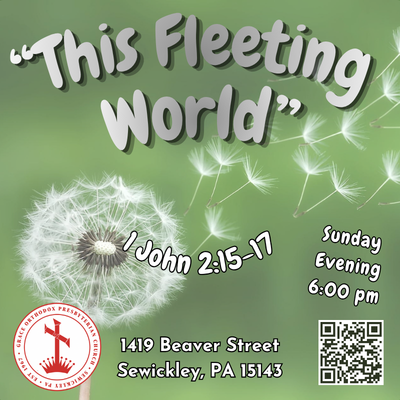
You may be seated. The title of my sermon this evening is This Fleeting World. As your sermon outline points out, there are four key words I would encourage especially the children to listen for in my sermon this evening: world, Father, system, and fleeting.
Well, my dear brothers and sisters in Christ, there is a sense in which we are defined by that which we love. Indeed, there is a sense in which we are defined most by that which we love the most. You see, what we value, what we prize, what we esteem, and what we reverence the most reflects the condition of our hearts. This reveals the direction, the disposition, and the inclination of our souls.
For example, if in your heart, by God’s sovereign grace, you truly love God as He is revealed in the gospel of Jesus Christ, then you will prize, value, esteem, and reverence your God and the truth of His Word as a great treasure—one that you would never want to lose. You will see Christ as your pearl of great price.
But if in your heart you cling to your old sinful ways and pleasures, or if you cling to the approval and acclaim of sinful people, then your love is not directed toward God, the Father, but toward what the Apostle John describes in this passage as the world.
As John, writing under the Spirit’s inspiration, teaches us in this passage, the present world is temporary. It is fleeting, it is fading, and it is passing away. In our text for this Lord’s Day evening, we as God’s covenant people are confronted with an earnest exhortation and with a contrast. The exhortation is to love not the world. The contrast that John gives—John loves contrast—is between love for the world on one hand and love for God, our gracious Heavenly Father, on the other. It is important once again to understand and remember the setting and context of our passage for this evening.
Remember that in this first epistle of John, the apostle John is seeking to confirm, settle, and strengthen the faith of a group of believers in either a single church or a group of churches that were under John’s tender apostolic care. You see, the faith of these Christians was apparently being attacked, upset, and destabilized by a group of heretics and false teachers who had previously been members of John’s church, had previously confessed faith in the gospel, but had committed apostasy. They had abandoned their profession of the true gospel and had left the apostolic church. We get hints of what these heretics were like as John describes them in verses 18 and 19 of chapter 2.
It says, in those verses, John describes them as antichrists. It says, “Children, it is the last hour. And as you have heard that antichrist is coming, so now many antichrists have come. Therefore we know that it is the last hour,” meaning the final eschatological age before our Lord returns in glory. Verse 19, what about these false teachers? What about these antichrists?
John says they went out from us. But they were not of us. They went out from us. That implies they had been part of us. They had made a common confession of faith with us. But they went out from us. But they were not of us. For if they had been of us, they would have continued with us. But they went out that it might become plain that they are not all of us.
We will consider verses 18 and 19 in a future sermon before too long. But this is who John is seeking to refute as he seeks to strengthen the believers to whom he is writing. There are these antichrists, these false teachers seeking to draw the members of John’s church or churches away from the true gospel, away from the true biblical Christ, and toward their false teaching. So that they might be drawn away to follow these false teachers into their heresy. But so far in this letter, John has both warned and encouraged these believers to continue trusting in and confessing the gospel truth about the person and saving work of the Lord Jesus Christ. And so we see his encouragement. We considered that this morning in verses 12 through 14 of this chapter, where John enters into encouragement mode and reminds them of the wonderful blessings of grace that they have received in Christ, especially the blessing of the forgiveness of sins and the blessing of knowing, in a saving and redeeming way, the Father and the Son, and being strengthened by the Word of God to overcome the evil one.
And so, with all of this context in mind, let us turn our attention to our passage for this evening, focusing first of all on verse 15, which tells us that loving the world is incompatible with loving the Father. Loving the world is completely incompatible with loving God, our gracious heavenly Father. It says in verse 15, “Do not love the world or the things in the world. If anyone loves the world, the love of the Father is not in him.”
Now it is important to remember that this is addressed to believers. Believers are still tempted by the world. We are not in the world. You have heard the saying, “We are in the world, but not of it.” That is true. The world surrounds us. The fallen world system surrounds us. We are not of the world, but we are in the world. And because of this, and because we still have the remnants of our sinful nature within us, the old self remains, and the flesh desires what is contrary to the Spirit, while the Spirit desires what is contrary to the flesh. Therefore, we are still tempted by the world. But what does John mean here by “the world”? When he says, “Do not love the world or the things in the world,” what is he telling us not to love? What is meant by “the world,” the Greek term? In the Greek, it is ton kosmon, the world. The term kosmos in Greek can be used in many different ways, depending on the context.
The range of meaning of this word is similar to the range of meaning of the English word “world.” Consider the English term. What does it mean? It depends on the context. If you are speaking scientifically, “world” may mean the globe, the entire earth. But sometimes the term refers to the realm of humanity, and so on. At other times, we speak of the world in more specific ways, such as the world of music, the world of art, the world of entertainment, and so forth. It is similar in the Greek.
So what world is John referring to here? Clearly, John is not speaking about the material world, the physical creation, because if he were, he would be contradicting what the Bible teaches in the Old Testament about the goodness of God’s world.
When God created the world and all its different realms and creatures in Genesis chapter one, what did He say after each day of creation? He said, “It is good.” And after the creation of His image bearers, mankind—male and female, Adam and Eve—what did He say? He said, “It is very good.” Therefore, John is not saying that we should not love the physical creation that God made. No. We give thanks for the creation. The creation is good. We praise God for the material world.
Rather, when John speaks of the world here, he means the world as it exists under the control of the evil one. He refers to humanity under the influence of the evil one. We might call this the world system that is under satanic control—the world system that is in rebellion against God’s created order and against God’s truth. Verse 14 says, “I write to you, young men, because you are strong, and the Word of God abides in you. You have overcome the evil one, and it is the evil one who holds sway over this world system.”
You may ask, what does the world look like today in the twenty-first century? What does this world system under satanic control look like? It is literally all around us, and it manifests itself in many and varied ways. One way the world manifests itself is through false religions, cults, and false ideologies.
For example, religious systems that deny the biblical Lord Jesus Christ—just as the false teachers and heretics were doing in John’s time. These antichrists that John was addressing denied the incarnation of Christ. Influenced by Greek philosophy, they taught that matter is bad and evil. If the human body is bad and evil, then certainly the divine Christ would not have become incarnate. And certainly He would not have died for our sins or risen bodily for our salvation.
And so again, the world is in rebellion against God, and any false religious system that denies the biblical incarnate Christ and his saving work would be part of or a manifestation of the world’s system, including religious systems that teach false views of salvation, such as salvation by works rather than by grace.
Another common manifestation of the world system today is the many ideologies that are rooted in the sexual revolution, but which run contrary not only to the moral law of God, but also to the created order. Ultimately, today’s pervasive gender and sexual ideologies, which influence even the media and politics, are also a manifestation of the world system. The world system also manifests itself in governments that pervert their God-given authority, not to serve their people, but to tyrannize and oppress their citizens and to persecute the church. A clear example of this is a nation such as North Korea, where a dictator demands to be worshipped as a deity and has caused great evil and suffering among his people. There are many other examples of how the world system manifests itself. Living in this fallen, sin-cursed world, we are touched by the world system every day. The temptation is to conform, to get along, and to love the world system.
But again, as this passage teaches us, love for God and love for the world cannot coexist. Again, John writes, “Do not love the world or the things of the world. If anyone loves the world, the love of the Father is not in him.” Now, what does he mean by the love of the Father? Is he referring to the Father’s love for us, or our love for the Father? In the context of this passage, it makes most sense to understand this as our love for the Father. In other words, if you love the world, you cannot claim to love God as your gracious Heavenly Father. All of this reminds us, brothers and sisters, of the truth that when we are born again by the Holy Spirit, love for God as our gracious Heavenly Father is infused into our souls through an act of sovereign grace. Such love for the Father is incompatible with love for the satanic world system. You cannot have fellowship with it. If you are in the light, you cannot have fellowship with darkness. What fellowship does light have with darkness? What fellowship does Satan have with Christ?
Of course, as believers, we do not love our Father in heaven perfectly. In our flesh, in our old nature, we will still have some remaining affection for the old life in Adam. And what are we to do about this? What are we to do with the remnants of the old nature? Can the old nature be reformed? No. The Scriptures indicate that the old nature must be killed, put to death. That is the process of sanctification. It leads us to put to death the sinful nature and to pursue a new obedience out of gratitude for God’s gift of salvation to us in Christ.
But again, the love of true believers will be a love that is fundamentally oriented toward love for God, love for His kingdom, and love for His people, as we view one another in Christ as brothers and sisters in Christ. Dear listener, do you love the Father, or do you love the world? Where is your fundamental love set? What are some of the characteristics of this world system that we are to reject, and that are incompatible with love for the Father?
John describes some of these characteristics in verse 16. This is our second point: the characteristics of the world system. John writes, “For all that is in the world,” and then he lists examples—representative examples of what is in the world. He lists the desires of the flesh, the desires of the eyes, and the pride of life.
This is not from the Father. It does not originate from God the Father, but these things originate from the world. What does he mean by the desires of the flesh? The NIV translates this interpretively. Instead of “the desires of the flesh and the desires of the eyes and the pride of life,” the NIV reads “the cravings of sinful man, the lust of his eyes, and the boasting of what he has and does.” We see these things all around us, do we not? Self-promotion, boasting about what we are, boasting about what we have, and similar behaviors. Regarding the phrase “desires of the flesh,” Kistemacher writes that the word “desire” is used collectively and represents cravings that include sexual desire and covetousness. Regarding the “desires of the eyes,” he explains that the eyes are the channels through which the soul receives impressions. When a person is enticed by lust, the eyes serve as instruments that lead to transgression and sin. What about the pride of life? What does this refer to?
Well, this includes boasting about one’s deeds, one’s wealth, or one’s power, all driven by a desire for status and human approval. An example of the pride of life is when someone tries to promote themselves by slightly exaggerating their qualifications on a resume in order to secure a better job, or by distorting the truth about their experience to appear more accomplished than they truly are.
This comes from a worldly spirit, a spirit of pride. It is a result of the pride of life. Or consider the temptation to keep up with neighbors, or to avoid appearing inferior in the eyes of others. If neighbors are doing something, even if it is sinful, one might feel compelled to follow along simply to fit in. This is a worldly spirit. It is a manifestation of the pride of life. Many other examples could be given. It takes wisdom to examine one’s own life circumstances and to recognize how the pride of life may appear in one’s specific situation.
Again, understand, brothers and sisters, these vices do not come from God, but from the fallen world system that is under Satan’s control. Therefore, we must not love these things. We must resist them, abandon them, and instead pursue love for the Father. And so, beloved, how do we do this?
Well, I like what the apostle Paul has to say about this subject. He urges us not to be conformed to the world system, but to be transformed by the renewing of our minds. I am sure you are familiar with that passage in Romans, Romans chapter 12, verses 1 and 2, where after Paul has spent 11 chapters, for the most part, reviewing the gospel in all of its many facets and implications, he describes the incredible sovereign mercies of God given to us in the gospel of Jesus Christ. What are we to do with that? Paul says in Romans 12:1 and 2, I appeal to you therefore, brothers, by the mercies of God, the mercies that he has been describing in the last 11 chapters. I appeal to you to do what? Present your bodies as a living sacrifice, holy and acceptable to God, which is your spiritual worship, or it could be translated your reasonable service. Then he continues with this exhortation in verse 2: Do not be conformed to this world. What is the alternative to being conformed to this world?
He says, be transformed by the renewal of your mind, that by testing, you may discern what is the will of God, what is good and acceptable and perfect. Let me ask you, brothers and sisters, how is it that our minds are renewed, so that we may not be conformed to this world, but transformed into the likeness of Christ? Our minds are renewed by the word and Spirit of God. This is why it is so important for us to be in the word, to root ourselves and ground ourselves in the word of God, especially in the glorious truths of the gospel of Jesus Christ as revealed in the word. May we indeed not love the world or the things of the world. May we love the Father, and may we seek to resist being conformed to this world by having our minds transformed. And we do that by being in the word, using the means of grace diligently out of gratitude for God’s gift of salvation. Then, returning to our passage as we close our time in the word for this evening, the Apostle John leaves us with an important reminder and also with a promise.
So let us consider finally the temporary nature of this world. The term temporary means short-lived. The temporary nature of this world. Verse 17: “The world is passing away.” Oh, it puts on a strong show. It looks so permanent. It looks so stable. But it is actually passing away. Here, John is giving us an eschatological perspective. He is giving us the big picture, the long-term view. He is reminding us to view life in this present age in the light of eternity. You see, the world is temporary and short-lived. Here, John is giving us a warning. He is giving us a reality check.
That world system, which can be so enticing and tempting, under Satan’s control and in rebellion against God, is passing away. It will not remain forever. It is temporary, impermanent, and fading. Although the world, once again, may display a loud show of power and permanence that impresses many, the present world order under the old Adam has already, in principle, been defeated. You may say, “Wait a moment—this world seems so strong.”
Yes, but it is a defeated foe, just as Satan and our sin have been defeated. How was the world system defeated? It was defeated two thousand years ago when Jesus died on the cross. Christ, when He died on the cross, did not die only to pay the penalty for our sins. That is central to the gospel, and we fully affirm His perfect substitutionary atonement. We discussed this this morning. Praise God, Jesus died for our sins, and it is finished.
But Jesus also conquered Satan on the cross. And by conquering Satan, He conquered the world system that is under satanic control. Therefore, the world, in principle, this world system, has already been defeated at the cross of Calvary. It is fading away, and one day, praise God, it will be no more.
In a few minutes, we will sing the hymn “All for Jesus,” and I love the line in this hymn that says: “Worldlings prize their gems of beauty. Cling to gilded toys of dust. Boast of wealth and fame and pleasure. Only Jesus will I trust.” Let us not cling to gilded toys of dust. Let us cling to Jesus. Let us trust in Him. And let us manifest the love for the Father that He has implanted within our souls.
Thus, there is a warning about the temporary and fleeting nature of the world. But then John closes this section of chapter two with a powerful statement: “And the world is passing away along with its desires.” This is the reality check, this is the warning. But whoever does the will of God abides forever. Whoever does the will of God abides forever.
I believe it was on the last Lord’s Day that I pointed out the importance of interpreting John’s language within the context of his own writings. What does he mean when he speaks of the old commandment and the new commandment? We discovered that he means obeying the commandments of God, believing the gospel, and living out the implications of that belief by loving the Christian brotherhood—loving our brothers and sisters in Christ. So what does he mean here by doing God’s will? Is he saying that only those who perfectly obey God’s moral law, as summarized in the Ten Commandments, will abide forever? Is that what he is saying? No. John is not a legalist. He is not a Pharisee. He is not a Galatianist or a Judaizer.
What he means is that whoever trusts Jesus and loves the Christian brotherhood— which is an inevitable result of that trust—will abide forever. If you are in Christ, if you know Christ as your Savior and are pursuing a new obedience because of His saving work in your life, then this promise is for you.
Whoever does the will of God abides forever. The world is passing away. The world is fleeting. But believers, brothers and sisters in Christ, we who trust Christ and love Him by His grace and seek to live out the implications of that in our lives, will abide forever because we are in His grip and He will never let us go.
Therefore, because Christ has conquered Satan, the evil one, He has also conquered the world system under satanic control. The Word of God, and especially the Gospel, guarantees its ultimate defeat and our ultimate victory, because as we are told in Romans 8, we are more than conquerors through Him who loved us. Praise be to God.
Let’s pray. Our Lord and Father in heaven, sovereign and eternal God, we are often drawn and tempted by the world, the flesh, and the devil. We acknowledge, O Lord, that we still struggle to love you as we ought, and we still find ourselves drawn to the ways of this world. But we know that the world is passing away. We know, O Lord, that your kingdom endures forever. Therefore, we pray, Heavenly Father, give us the grace to fix our eyes once again on Jesus, to set our minds on Christ, who is seated at your right hand. Let us be focused on heavenly things, not on earthly things.
And we pray, Heavenly Father, that you would give us the grace to show love for the Father in our lives by seeking to live according to a new obedience and by loving our brothers and sisters in Christ. We pray all these things, Heavenly Father, in Jesus’ name. And all of God’s people said, amen. Well, let us close our time of worship, and we will rise and sing together number 502, “All for Jesus.”