
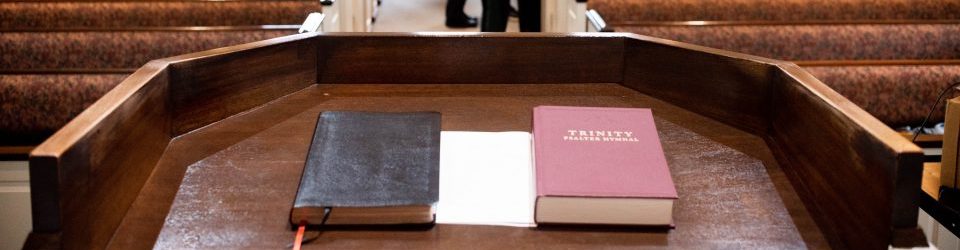

This sermon is from the Rev. Charles G. Dennison sermon archive, part of the “Philippians” series, and was preached at Grace Orthodox Presbyterian Church in Sewickley, PA, during a worship service on Sunday, June 14, 1992.
We are reading this morning Philippians 3 in its entirety, and also going to the fourth chapter, the first verse. Listen to the word of God. This is Philippians chapter 3. Finally, my brethren, rejoice in the Lord, to write the same things to you. To me, indeed, is not grievous, but for you it is safe. Beware of dogs, beware of evil workers, beware of the concision. For we are the circumcision which worship God in the spirit and rejoice in Christ Jesus and have no confidence in the flesh. Though I might also have confidence in the flesh, if any other man thinketh that he hath whereof he might trust in the flesh, I more. circumcised the eighth day of the stock of Israel, of the tribe of Benjamin, and Hebrew of the Hebrews, as touching the law, a Pharisee concerning zeal, persecuting the church, touching the righteousness which is in the law, blameless.
But what things were gained to me, those I counted lost for Christ.” and I count all things but loss for the excellency of the knowledge of Christ Jesus my Lord, for whom I have suffered the loss of all things, and do count them but dung, that I might win Christ and be found in him, not having mine own righteousness which is of the law, but that which is through the faith of Christ, the righteousness which is of God by faith. that I might know him, and the power of his resurrection and the fellowship of his sufferings being made conformable unto his death, if by any means I might attain unto the resurrection of the dead. Not as though I had already attained, either were already perfect. But I follow after, if that I may apprehend, that for which also I am apprehended of Christ Jesus. I count not myself to have apprehended, but this one thing I do, forgetting those things which are behind, and reaching forth unto those things which are before, I press toward the mark for the prize of the high calling of God in Christ Jesus.
Let us therefore, as many as be perfect, be thus minded. And if in anything ye be otherwise minded, God shall reveal even this unto you. Nevertheless, whereto we have already attained, let us walk by the same rule, let us mind the same thing. Brethren, be followers together of me, and mark them which walk so as ye have us.
For an example, for many walk, of whom I have told you often, and now tell you even weeping, that they are the enemies of the cross of Christ. whose end is destruction, whose God is their belly, and whose glory is in their shame, who mind earthly things. For our citizenship is in heaven. For once also we look for the Savior, the Lord Jesus Christ, who shall change our vile body, that it might be fashioned like unto his glorious body, according to the working whereby He is able even to subdue all things unto Himself. Therefore, my brethren, dearly beloved and longed for, my joy and crown, so stand fast in the Lord, my dearly beloved.”
Our Father, we would remember your servants who carry your word. We have prayed for ourselves that our speech may be pure, seasoned with salt, that we might speak with integrity. honestly testifying of the things we know to be true. But Lord, we also ask for those whom you have raised up, who are set in the midst of your people for the declaration of your word, may they declare it with power. And may it please you today, Lord, to use the messages presented to bring many to yourself And may it please you also, Lord, to build up the company of your redeemed, your elect, that they might know even better how great your love is for them and how much they are to love you. We are asking for servants the world over, those who would proclaim your word today in Asia, in Africa, in Europe, in South America, here in North America, throughout all of the continents of this world. And may there be that testimony to your truth, and may men who have loved you proclaim your word with integrity, we pray in Jesus’ name. Amen.
We have come to a point in our messages on Philippians where it might be well for us to take stock of ourselves and where we have been. We have been working with Philippians for quite some time now, and I know that as we’re going through looking at all the trees, we might lose our grip on the forest. In order to put the fourth back in perspective or bring it before our view once more, let’s take a look then at Philippians as we have presented it. First of all, let’s remind ourselves this morning of the situation, the situation that the Apostle Paul encountered at Philippi. that which led up to the production of this letter.
The church at Philippi had been founded by Paul on his second missionary journey. This is the second of three, if you’re familiar with the Book of Acts. The congregation in Philippi had been founded by the Apostle Paul during his second missionary journey. Early in the fifties, this would be about twenty years after the crucifixion of Christ, Paul’s founding of this congregation in the Book of Acts, Chapter 16, and there are certainly a number of passages that you know from that story that are quite famous.
You might recall the Philippian jailer and what happens when Paul and Silas are caught in jail and earthquake strikes. Jailer comes to Paul and throws himself down at his feet and cries out, What must I do to be saved? And Paul’s response to him was, Believe in the Lord Jesus Christ, and thou shalt be saved, and thy house. And we have the salvation then of the Philippian jailer and his household, and surely they’re part of the foundation of that congregation that was established by Paul during his second missionary journey.
Paul visited this congregation more than just that once. On his third missionary journey, he visited at least two more times. We can read about this journey and his visits in Acts 19 and 20. This places us in the mid-fifties now, so we’re moving away from Christ’s crucifixion and towards the sixties and the eventual execution of Paul himself in Rome. Paul had visited then the Philippian congregation after he had founded it. At the conclusion of that third missionary journey, you may recall Paul returns to Israel, he returns to Jerusalem where he is confronted with the Jews, he is arrested, and he is facing trial.
That trial takes about two years to unfold. We are now at the years 57 to 59 AD, and we are looking at chapters in Acts, Acts chapter 21 through Acts chapter 26. You know, the conclusion of Paul’s trial there in Caesarea, the seaport city, he makes appeal to Caesar. And by reason of that appeal, he is then shipped off to Rome, where he will face further trial.
The journey from the land of Palestine to Rome is recorded for you at the end of the book of Acts, chapters 27 and 28, Acts itself ending with Paul’s arrival in Rome. This places us at about the year 59 A.D. Paul is now in prison in Rome, and it is partway through that imprisonment that lasted for a few years that he writes his letter to the Philippians. He usually dates the letter to the Philippians around the year 61 A.D., and this would place it about ten years after the founding of the congregation in Philippi and about thirty years after Christ’s crucifixion. Well, that’s things as they are for the Apostle as we are brought up to the production of this particular letter, this letter to the Philippians. What about the situation for the Philippians themselves?
They were very proud of their city. Their city was one of historic note, situated in Macedonia. It bears the name of Alexander’s father, Philip. It was named for him, he being a great conqueror and then instructing his son in many of the arts of war that helped his son then go off and conquer the world. Philippi was proud of its heritage and its history and it had special status within the Roman Empire, these people having been made citizens outright of the Roman Empire and very proud of that citizenship. Paul was very close to this church that formed in this city. He was very dear to the folks in that church as they were to him.
And because of this close bond that existed between him and these Christians in Philippi, when they found out that he was in prison in Rome, they sent to him an emissary by the name of Epaphroditus. You can find him mentioned in the second chapter, the twenty-fifth verse, and also again the fourth chapter, the eighteenth verse. This man was a leader in the church of Philippi, and we don’t know much more about him. We don’t know how he was converted, how he was brought into the church, but at any rate he was a leader in the church at Philippi, and he now is entrusted with a gift and sent off to Rome to visit Paul who is presently in chains. Now, while he is there ministering to Paul, he remains on the scene in Rome ministering to Paul. While he is there, he reviews with Paul the situation in the Philippian church.
Now, there are encouragements that come to Paul from Epaphroditus’s report that there are also discouraging things as well. The word comes to Paul through Epaphroditus that the Philippians are experiencing persecution and the suffering is somewhat severe. You have reference made to that at the end of the first chapter of Philippians verses 29 and 30.
For to you it has been granted for Christ’s sake not only to believe in him, but also to suffer for his sake, experiencing the same conflict which you saw in me and now hear to be in me.” So the Philippians are hard-pressed presently. They are undergoing a persecution, and that for the sake of their faith. They are suffering as a result of their relationship to the gospel.
Therefore, the apostle is concerned to send to them a message of encouragement, a message of hope. And I think that you will agree as you read through Philippians that here we have an epistle of hope and encouragement par excellence. In fact, many of you might have turned to the epistle to the Philippians when you were especially hard-pressed because you were especially in need of some encouragement. Paul’s words certainly were a blessing to those folks. and they are a blessing to us, as the Spirit is pleased to use those words.
But Paul has not merely received word about persecution and subsequent sufferings that have come to the Philippian Christians. He has also received word that the Philippians, in the midst of this present distress, are turning on one another. They are at each other’s throats. The stress has been great, the difficulty has been extreme, and in the midst of all of this now they have turned on one another.
So while the apostle is giving them this word of encouragement in the midst of their present difficulty, he is also administering to them something of an admonition, a rebuke, if you will, calling them to be like-minded, to be of one mind. Note what he says at the end of the first chapter, the twenty-seventh verse, “…only conduct yourselves in a manner worthy of the gospel of Christ, so that whether I come and see you or remain absent, I may hear of you that you are standing firm in one spirit, with one mind striving together for the faith of the gospel.” Turn down to the second chapter, second verse, “…make my joy complete by being of the same mind, maintaining the same love, united in spirit, intent on one purpose. And of course then you have his encouragement and admonition blended together in verse 5 of that second chapter, have this mind in you which was also in Christ Jesus. The common mind that he would have them express is that which is found in Jesus Christ. Now, the particulars of this strain within the congregation are also brought out to us throughout the letter.
We can infer some things from the conclusion of Chapter 2 that maybe even Epaphroditus was in the midst of things, and his reputation not enhanced all that much now because he’s the tail-bearer who’s gone to Rome and reported all of these things to Paul.
So maybe it’s not going to be such a royal welcome when Epaphroditus returns to Philippi and brings word from Paul to the Philippians and brings his comments with him concerning their condition. In addition, we have mention made in the fourth chapter, the second verse, about the difficulty that has arisen with regard to two women in the church. Erodian sympathy seemed to be at each other’s throats, and Paul is urging them to live in harmony. So you see, the word now that has come to Paul about the Philippians concerns not just the persecution that this Church is undergoing, they then being in need of encouragement, but also it involves the discord that has erupted within the Church so that people are at one another.
And we have then the rebuke that is delivered by the Apostle with regard to their circumstance. Now, there’s one other dimension to this predicament, this situation that the Apostle is addressing, and that is, with the Church in this weakened state, weakened by persecution and weakened by internal discord, they have become easy prey for those who would take advantage of them.
Most specifically, those who are experts in boasting in the flesh. Those who are experts in boasting about their credentials. Those who live for the world. Those who are worldly-minded. Those who really have no place in their consciousness whatsoever for heavenly things, because after all, in their estimation, religion as it is evaluated by them, religion pertains to getting on in this life and making the best of our circumstances and making things good for ourselves regardless of what might be the consequences with regard to the enslavement, the religious enslavement of those whom we profess to serve.
So, we have encouragement coming from the Apostle with regard to the situation faced by the Philippians, the persecution, we have rebuke with regard to the internal discord, and finally we have warning, warning given to them with regard to the threat that is posed. You have Paul specifically speaking about that threat in the second verse of the third chapter where he tells these Philippians, beware of the dogs, beware of evil workers, Beware of the concision, or the mutilators, as he calls them.
Now, that gives you a feel for what Paul is dealing with here in a general way. What about the letter specifically as it works itself out, in keeping with the apostles’ ordinary pattern for letter writing? You have his salutation, his customary salutation in 1st chapter, verses 1 and 2, followed by his thanksgiving and prayer, verses 3 through 11. This thanksgiving and prayer working itself out consistently with what he places before these Philippians later on in the 4th chapter, the 6th verse. He tells them, be anxious for nothing, but in everything by prayer and supplication with thanksgiving, let your requests be made known unto God. When you back up to the first chapter, verses 3-11, and you find there that pattern worked out by the Apostle as he presents to these Philippians his thanksgiving for them, and then his prayer, his supplication on their behalf. This thanksgiving and prayer by the Apostle is followed by what has been called his missionary report in verses 12-26 of that first chapter.
It is a remarkable passage, we spent a great deal of time working through it, but Paul gives a review of his circumstances in Rome, how he too is experiencing persecution and opposition, not just from those who are outside, but even from so-called Christians who are taking advantage of his change and sort of enhancing their own reputations at Paul’s expense. Paul speaks very pointedly about these folks.
He says that they are preaching Christ from envy and strife. They are not preaching Christ out of goodwill. They do not preach Christ out of love. They proclaim Christ out of selfish ambition. They do not have pure motives. They think to cause me distress in my imprisonment.
Paul, though distressed, is not at the point of despair, for he realizes that nonetheless Christ is proclaimed, and because Christ is proclaimed, he will rejoice and continue to rejoice, knowing that even these things that are occurring to him in prison shall work out for his salvation through the prayers and the provision of the Spirit of Jesus Christ. One might well ask, how can the apostle be so sure that he too doesn’t preach Christ of selfish ambition? How can the apostle be so sure that he doesn’t preach Christ out of envy and strife, trying to take advantage of others and build his own reputation at their expense? And that’s precisely what he goes on to prove as you fill out that missionary report. especially verses 21 through 26 of that first chapter.
For to me to live is Christ, and to die is gain, he says. So thoroughly absorbed is he by Christ that personal ambition does not intrude. He is determined to fight that personal ambition at every turn, to suppress it. For to me to live is Christ, and to die is man. This day he comes, the Apostle’s Vindication, as he not only proclaims Christ but lives Christ, lives Christ before the face of the whole Church. He is not seeking advantage. He pursues Christ for the sake of service in his name. The course that he follows is not the gain of life, but rather the losing of life for Christ’s sake.
It’s a marvelous report given by the Apostle. We could hope that missionaries reporting to us would speak similarly. This then, beginning with the twenty-seventh verse of the first chapter, this then is followed by the main body of the epistle, and that main body will continue through the fourth chapter of the first verse, and essentially this is divided into three parts. First of all, there is the call for sanctification, verse twenty-seven in chapter one through the eighteenth verse of the second chapter. What can we say about this call for sanctification. Once more we note that the heavenly mindedness, the citizenship, the heavenly citizenship of the people of God is foremost. That is what is in view in verse 27 of that first chapter as this section begins. It is the working out of that heavenly mindedness, that heavenly citizenship, that is what is coming to expression. That is why unity is so much on the mind of the Apostle. Is there unity in heaven? Yes. What kind of unity? The very unity of Christ. The harmony that is found within Christ.
The Apostle then is pressing home this heavenly consciousness. this expression of heavenly citizenship and it works itself out in terms of a common mind it works itself out also in terms of service for the sake of the other even as Jesus Christ himself forwent his prerogatives in glory Having existed in the form of God, he did not regard that equality a thing to be grasped.
He emptied himself, took upon himself the form of a bondservant, which made him a likeness of men. Being found in appearance as a man, he humbled himself by becoming obedient to the point of death, even death on a cross. Meanwhile, in Philippi, people are grumbling at one another because they don’t particularly like serving each other, and they don’t like serving each other because they don’t like one another.
The apostle reminds them to work out their salvation with fear and trembling, by which he means, may there come to expression in you this heavenly point of view. May there come to expression in you this Christ-likeness. Do all things without grumbling and disputing, he says.
So there is the call for sanctification, the first installment of the main body of the is charged to these people, chapter 1 verse 27 through chapter 2 verse 18. Then there comes the proof of integrity, verses 19 of that second chapter through verse 30 to the end of that chapter. The proofs of integrity. The fact that the Apostle sets forth his integrity. The fact that the Apostle sets forth Timothy and Epaphroditus as Again, proofs of integrity.
They themselves proving their integrity before the Church and specifically with respect to these Christians who are Philippians. And this then being the ground upon which then the Apostle calls for a proof of integrity on the part of the Philippians.
Here you have these people who are living for you, in fact even willing to die for you. What about you then, in light of these? And then the section that we are currently dealing with, the fight for integrity, chapter 3 in its entirety, including 1st, 2nd, and 4th chapter. warning these Philippians about those who will seek to enslave them and rob them of their joy, who will set their minds upon earthly things and rob them of their transcendence.
They will be incapable of getting above the affairs of this world simply because of the religious tyranny that is espoused by these people that are coming in for the express purpose of enslaving these folk religiously. At stake is the gospel, the gospel of freedom, the gospel of liberty. If you let go of that gospel of liberty and its transcendent, namely, heaven and heavenly citizenship, you will in fact be enslaved, and in the end you will be destroyed.
We haven’t reached the end of this epistle as yet. The conclusion begins with the second verse of the fourth chapter, and you have Paul’s final remarks that carry you to the end of the epistle. So that then gives you the outline for the epistle. One more time, the salutation, the first two verses of the first chapter, the thanksgiving and prayer, verses three through eleven. of that first chapter, the missionary report, verses twelve through twenty-six, and the main body of the epistle, verse twenty-seven of the first chapter through the first verse of chapter four in the final remarks, round things up, verse two through verse twenty-three of the fourth chapter. We have then the situation, we have then the epistle and outline. What specifically is the burden? of the Apostle as he writes.
Paul wishes to communicate in the power of the Holy Spirit the reality of that inner strength which is given to him of grace, the inner strength that is found in Jesus Christ, his risen Lord. Paul wishes to communicate through the Holy Spirit the reality of that inner strength that is his in and through the risen Christ.
Why is this so important? We have spoken about the liberty in the gospel which is in the balance. But you know as you read through Philippians, what receives such emphasis in this epistle? Is it not the theme of joy and rejoicing? Fourteen times in this epistle, Paul speaks of joy and rejoicing. In the balance is the joy of the believer, and the Apostle Paul is saying to us that that joy is directly bound to the living Christ.
The living Christ. That means that the apostle is absolutely assured that Christ is presently alive. He is serving a risen Savior. He is serving that one who came out of the tomb on the third day, that one in fact who confronted him on the road to Damascus, He is serving specifically that resurrected Savior. Nothing can undo the resurrection of Christ. Christ cannot die again. And because Christ’s resurrection is permanently set, cannot be undone, because Christ ever lives, The apostle now understands his joy to be unmovable. My joy is as permanent as Christ himself.
Therefore he does not hesitate to call these Philippians to rejoice, even in the midst of their persecution. Nor does he hesitate to describe his own rejoicing he be in the midst of persecution.” And at the conclusion of the epistle, he will underscore it, will he not, when he says in the fourth verse of that fourth chapter, “…rejoice in the Lord always, and again I say, rejoice.” Everybody at Philippi was saying, we don’t have any reason to rejoice, and Paul was saying, you have every reason to rejoice if in fact you have laid hold of the risen Christ, this one who has been raised again, who is the source of your inner strength.
In another context, the Apostle Paul says that though his elder man is passing away, dying, he is being renewed in the inner man day by day. So the burden of the apostle then is to communicate the reality of that inner strength which is his in union with the risen Christ. I am not dislodged in my joy, regardless of what comes, because Christ has been raised from the dead.
Death itself does not have the last word. Now this is not only the rejoicing epistle, it is also the thinking epistle. For as many times as words about joy and rejoicing are used in this epistle, words about thinking and attitude are also used. So this joy that the Apostle puts in front of us is not some sort of mindless mystical trip, it’s not some sort of flight of fancy, or the expression of some sort of effervescence. Far from it, it is a contemplative a reflective, a meditative type of rejoicing. It is a meditation that focuses upon the Christ who is exalted, that one who is at the right hand of God. Have this mind in you, which was also in Christ Jesus. Be of one mind. Think on these things.
All of these than be in places that are lifted right out of Philippians, encouraging us then not to allow our joy to become irresponsible silliness, but rather filled with content, substantive, filled with Christ, the realities that we find in Christ. and the truths of the eternal kingdom that belongs to him.
It is then our meditation upon Christ, our thinking on him, our thinking like him, that works maturity in us, so it would be as the Apostle Paul looks to his beloved congregation in Philippi, that they would mature by such thinking that their joy would be unshakable, that their confidence in the risen Christ would be absolute. Let us pray. Hallowed Father, refresh us with your word and even with this epistle that the Apostle has written to the struggling, sometimes confused and bewildered congregation in Philippi. May we in our bewilderment and confusion also find consolation, encouragement, even rebuke as we need it, and warning as is appropriate. all to the end, Lord, that we might share with the Apostle his joy in the risen Christ. We pray, Father, that we might be immovable in this, that we might be steadfast, that we might abound in joy, because our minds are set upon Christ himself and upon the kingdom which is above. O Lord, we pray for your help. May the very spirit that inspired the Apostle dwell in us so that we would abound with such thinking and with such expressions of joy.
The sermon text provided above is derived from the sermon audio recording making use of generative tools. It has not been manually edited. While transcription tools have a high degree of accuracy, the output may include generative textual, punctuation, and/or formatting errors.