
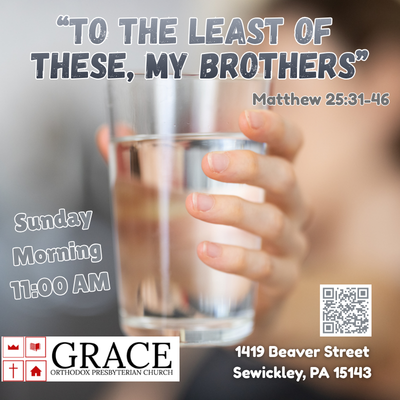
About this sermon
When the Son of Man comes in his glory, he will gather all the nations before him, and he will separate them as a shepherd separates sheep from goats. In this life justice is approximate and often fails, but the final judgment will set everything right. To those on his right the King says, “Come, you who are blessed by my Father, inherit the kingdom.” Their deeds of mercy to the least of his brothers, his disciples, are evidence of the grace they already received, not the ground of their entrance. Those on his left, who did not receive Christ’s people, go away into eternal punishment.
Sermon transcript
Please remain standing for the reading of God’s word. This morning, my sermon text is taken from the Gospel of Matthew, Matthew chapter 25, beginning at verse 31 and reading to the end of the chapter, Matthew 25, verses 31 to 46. You’ll find that on page 988 in your Pew Bible. Let’s hear God’s holy word.
When the Son of Man comes in His glory, and all the angels with Him, then He will sit on His glorious throne. Before Him will be gathered all the nations, and He will separate people one from another, as a shepherd separates the sheep from the goats. And He will place the sheep on His right, but the goats on the left. Then the king will say to those on his right, come, you who are blessed by my father, inherit the kingdom prepared for you from the foundation of the world. For I was hungry and you gave me no food, and you gave me food. I was thirsty and you gave me drink. I was a stranger and you welcomed me. I was naked and you clothed me. I was sick and you visited me. I was in prison and you came to me.
Then the righteous will answer him saying, Lord, when did we see you hungry and feed you or thirsty and give you drink? And when did we see you a stranger and welcome you or naked and clothe you? And when did we see you sick or in prison and visit you? And the king will answer them, truly I say to you, as you did it to one of the least of these my brothers, you did it to me.
Then he will say to those on his left, depart from me you cursed into the eternal fire prepared for the devil and his angels. For I was hungry and you gave me no food. I was thirsty and you gave me no drink. I was a stranger and you did not welcome me. Naked and you did not clothe me. Sick and in prison and you did not visit me.
Then they will answer saying, Lord, when did we see you hungry or thirsty or a stranger or naked or sick or in prison and did not minister to you? Then he will answer them saying, truly, I say to you, as you did not do it to one of the least of these, you did not do it to me.
And these will go away into eternal punishment, but the righteous into eternal life. The grass withers and the flower fades, but the word of our God endures forever. Let’s pray together. Our Lord and Father in heaven, we thank you that we who are believers are united to Christ, that we are identified with him, that we are his brethren, and he is our elder brother, our savior, our king. Lord, as we consider this portion of Holy Scripture, we ask that your spirit would cause your word to find a lodging place in our souls and grant that your word would bear much spiritual fruit unto sanctification and holiness in our lives. Oh Lord, we thank you for your word. It is a lamp unto our feet, a light unto our path, a guide to our way. May we be guided and directed by your word this day, and we would ask, Lord, also, that you would grant to me, your unworthy servant, the grace to declare your word with clarity and power. Indeed, Lord, set a guard over my lips, that I might only speak that which is faithful to your word and edifying to your people and glorifying to your holy name.
We pray these things in Jesus’ name and all of God’s people said. Amen. Amen. You may be seated. Well, this morning, the title of my sermon is The Least of These, My Brothers. And children, I want you to listen for three words in my sermon today. Those words are judgment, vindication, and condemnation. Judgment, vindication, and condemnation.
Well, dear friends, our passage for this Lord’s Day morning is a portion of God’s Word that sadly has often been misunderstood and misused to teach things that our Lord Jesus was in fact not teaching in this passage. And let me just give you one example to offer a recent example of how this passage is sometimes misinterpreted.
I’m sure some of you, if you’ve been keeping up with the news and culture these days, some of you may have heard of James Tallarico. Now, Mr. Tallarico is a professing Christian, and he’s actually a Presbyterian seminarian. He is a seminarian who serves as a Texas state representative, and he is currently a U.S. Senate candidate. Now, I’m not here to comment upon his politics, but I will comment upon his understanding of Matthew chapter 25, because he’s been very public about that. In a recent television interview where Mr. Tallarico was criticizing the so-called religious right, he made the following comments to his interviewer, and I quote him. He says, Jesus in Matthew 25 tells us how we’re going to be saved, by feeding the hungry, by healing the sick, by welcoming the stranger.
Nothing about going to church, voting Republican, It was about how you treat other people. And then he goes on to say, I’ve said before, don’t tell me what you believe. Show me how you treat other people, and I’ll tell you what you believe. Now, I want to be charitable towards Mr. Tallarico and try to find at least some common ground. So I would certainly agree with Mr. Tallarico that Jesus in this passage says nothing about our voting habits or our political affiliation. That was not on his radar screen. And I would also certainly agree that we Christians are to demonstrate the reality of our faith by good works in loving our neighbor and in acts of kindness.
That’s basically what is taught in James chapter two, that faith without works is dead. However, Is it really true, beloved, that Jesus in Matthew chapter 25 teaches that we are saved by doing good works? Good works like feeding the hungry, welcoming the stranger, clothing the naked, and so forth, as Mr. Tallarico seems to believe.
Or to put it in another way, is Jesus our Savior in Matthew chapter 25, is he denying what the Bible and what Jesus himself clearly teaches elsewhere about salvation? Namely, the fact that we are saved not by our good works, not by anything we do, but saved purely by God’s grace alone, through God-given faith alone in Jesus Christ alone, apart from works of the law.
Well friends, as I hope to demonstrate in my sermon for this morning, interpretations of this passage, such as those offered by the likes of Mr. Tallarico, are way, way off base when we consider the actual context of this passage and read it more deeply than merely at a surface level. It’s very easy to misunderstand what our Lord is saying here if we don’t understand him in context and don’t read everything that he’s saying in this passage. Just to mention another popular misinterpretation of Matthew 25. This misinterpretation is summarized well by the biblical scholar, Dr. R.T. France.
Dr. France writes, this passage is often understood to teach that ultimate salvation is based on acts of kindness alone. so that there is nothing specifically Christian about the criteria of judgment. But that, he goes on to criticize that view, he says, that is to ignore the important description of the recipients of this kindness as the least of these brothers of mine. This phrase, the least of these my brothers, suggests that it is not just anyone that the righteous have helped and that others have ignored. It is disciples in need. Jesus’ judgment is based on how they treat those who are his followers, the least of these my brothers, as he calls them.
And many other misinterpretations could be offered. But since there seem to be so many popular misinterpretations and misunderstandings of this portion of scripture, let’s dive into what our passage teaches us for today. And let us dive into this text with open minds and open hearts. We need to understand, first of all, the context of this passage.
Jesus here is wrapping up what the scholars often call his Olivet Discourse. And this discourse emphasizes and focuses on the topic of eschatology, in other words, the end times. And as Jesus is wrapping up this passage of his teaching on the Olivet Discourse, he ends this instruction by giving us a description of the final judgment. And as we will see, the Lord Jesus will preside when he comes again at the final judgment, as he comes again in glory at his second advent.
Now, it’s important to understand this passage has some parabolic elements. Believers are described as sheep. Unbelievers are described as goats. But nevertheless, this is not, strictly speaking, a parable. This is more of a prophecy. This is a description of how things are gonna play out on the day of final judgment.
So here in our text for today, we get a glimpse of the return of the son of man, namely God’s chosen messianic king. And we get a glimpse of his exercise of his kingly power as he judges the nations of humanity. So let’s dive in, brothers and sisters. And first of all, notice the setting of our passage. The setting is the final judgment day. We see that our setting is the final judgment day.
It says this in verse 31. When the Son of Man comes in His glory, and all the angels with Him, then He will sit on His glorious throne. In that one verse, there’s a lot packed into that one verse, and we need to kind of take this language apart and understand it. First of all, we learn here of the presiding judge on judgment day.
And how is this presiding judge described by Jesus here in verse 31? Well, he is described as the son of man. Who is this son of man figure that Jesus is referring to? Well, here Jesus is almost certainly using this terminology of the Son of Man as a messianic title.
In fact, the language that our Lord uses here in this passage, language not only about the Son of Man, but about his coming, about his glorious throne, language about angels and judging, all of this language seems to derive from Daniel chapter seven, verses nine through 14. And I believe it’s very likely that our Lord Jesus has that passage in the background as he is giving this teaching.
So let’s turn to Daniel seven and look at verses nine through 14. Daniel chapter seven, verses nine through 14. It says this in this passage. beginning at verse nine. Again, notice some of the parallels in language between this passage in Daniel and what we’re reading in our passage for today from Matthew 25. It writes, Daniel writes, as I looked, thrones were placed and the ancient of days took his seat.
His clothing was white as snow and the hair of his head like pure wool. His throne was fiery flames. Again, a glorious throne. Its wheels were burning fire. A stream of fire issued and came out from before him. A thousand thousands served him, and 10,000 times 10,000 stood before him. Those would be angelic attendants to his glorious throne.
The court sat in judgment. It’s a judgment scene, it’s a courtroom scene. And the books were opened. I looked in because of the sound of the great words that the horn was speaking, and as I looked, the beast was killed and its body destroyed and given over to be burned with fire. As for the rest of the beasts, their dominion was taken away, but their lives were prolonged for a season and a time. So there’s judgment, there’s fiery judgment.
But then notice, we learn here of the Son of Man beginning at verse 13. I saw in the night visions, and behold, with the clouds of heaven, there came one like a Son of Man, and he came to the Ancient of Days. The Ancient of Days is a reference to God the Father, and clearly this Son of Man figure is a divine figure, a royal figure, a messianic figure. This is a prediction of Jesus. And by the way, in verse 13 in particular, this is a prediction of his ascension, because he doesn’t come from the Ancient of Days, he comes to the Ancient of Days. Nevertheless, he came to the Ancient of Days and was presented before him. and to him was given dominion. He’s a king, he’s royalty, and glory, and a kingdom, and all people’s nations and languages, that all people’s nations and languages should serve him. His dominion is an everlasting dominion, which shall not pass away, and his kingdom, one that shall not be destroyed.
So when Jesus talks about the Son of Man coming, it is very likely, it’s almost certain that he has in view this messianic Son of Man figure, this royal divine Son of Man figure that is predicted by the prophet Daniel. And what’s interesting to notice, if you’ve read the Gospels carefully, one of the things that you will notice about the Gospels is that Jesus refers to himself more frequently as the Son of Man than he does the Son of God. And some might say, well, is Jesus denying his own divinity by referring to himself as the Son of Man? The answer is no. When we understand that term the way Daniel used it, the Son of Man figure is a divine figure. And so Jesus, his favorite self-designation was son of man.
And so Jesus is talking here about himself. When he says, when the son of man comes in his glory, he’s basically saying, when I come in the glory of my second advent. When the son of man comes in his glory and all the angels with him, then he will sit on his glorious throne. The focus and emphasis is on the external glory that will be unimaginable at our Lord’s glorious second advent. That external glory, the glory that attends our Lord’s return will mirror the internal divine glory of His own being.
And then verse 32, before Him will be gathered, who? Who’s gonna be gathered before Him? Is this gonna be a judgment of just believers? or just unbelievers? Is this gonna be a judgment of the Jews or the Gentiles? Are there separate final judgments? No. It’s one coming, one judgment, because it says, before him will be gathered all the nations, and he will separate people one from another, as a shepherd separates the sheep from the goats.
So there is an eschatological coming of the glorious, divine, messianic Son of Man, the Lord Jesus Christ, and he will gather the nations, he will gather them, and he will separate them. Again, clearly Jesus is presented in this Son of Man figure as a royal figure, as God’s chosen messianic king. And clearly this passage teaches that it is our Lord Jesus Christ who will one day preside over the proceedings of the final Judgment Day. And some might wonder, well, why doesn’t God the Father preside over the Judgment Day? Doesn’t the Bible teach that God will judge the nations? Yes, God does judge the nations, but remember, Jesus is also God. He’s true God and true man.
And we learn in the scriptures that the Father has given authority and commission to the Son to conduct judgment. And many places in the New Testament affirm that. Just to give you an example, let’s turn to John 5 and look at verses 24 through 30. John chapter 5, verses 24 through 30. Here again, the Lord Jesus makes it very clear that the Father has entrusted authority to the Son to give judgment.
But Jesus, first of all, says, truly, truly, literally, amen, amen. Truly, truly, I say to you, Jesus speaks on his own authority, because he is divine. He is speaking with divine authority. Truly, truly, I say to you, whoever hears my word and believes him who sent me has eternal life. There’s sola fide, salvation by faith alone.
Jesus himself teaches it. He does not come into judgment, but has passed from death to life. Jesus is not denying there, by the way, that believers will stand before the judgment seat of Christ. He is saying that we as believers, we will not come into the condemning judgment of God because Jesus has already taken that condemning judgment upon himself and we’ve already passed from death to life.
So he says, truly, truly, I say to you, whoever hears my word and believes him who sent me has eternal life. He does not come into judgment. but has passed from death to life.” That makes me want to leap for joy. Doesn’t it make you want to leap for joy? We’ve already passed, brothers and sisters, from death to life. And then he goes on to say, truly, truly, I say to you, an hour is coming and is now here when the dead will hear the voice of the Son of God and those who hear will live.
For as the father has life in himself, so he has granted the son to have life in himself. And notice verse 27. And he, the father, has given him, the son, authority to do what? To execute judgment because he is the son of man. Do not marvel at this, for an hour is coming when all who are in the tombs will hear His voice and come out, those who have done good to the resurrection of life, those who have done evil to the resurrection of judgment. And so we see that the Father has entrusted judgment to the Son, and therefore, the Son of Man who is also the Son of God, Jesus Christ our Lord, He is the presiding judge on the final judgment day that is coming.
But who are the ones to be judged on that judgment day? Well, again, as I pointed out from verse 32, it will be all the nations. Everyone will be there on that final judgment day. All human beings who’ve lived in all ages of human history. This would include Jews and Gentiles, believers and unbelievers. It will include the sheep and the goats. Now, what are some takeaways that we can learn from what we’ve considered thus far in this passage? Well, one of the things we learned, brothers and sisters, is that ultimate accountability is coming.
We live in a time when many folks are almost allergic to personal responsibility. And it’s maddening, isn’t it? Especially as believers, as we look at the world around us and we see so many instances of injustices not being properly addressed. Many folks, you know, justice in this present age is at best approximate and relative and often falls short. And we see instances of people literally getting away with murder. We see corruption in high places and no one being held accountable.
But the doctrine of the final judgment day assures us that ultimate accountability is coming. There will be a final judgment day, a judgment day in which all people will be held accountable for every thought, word, and deed. for all that they have done, said, and thought in this present life, a day when God will ultimately right all wrongs and bring justice to bear.
But that being the case, how should we take that? How should we take to heart that truth in our own lives? Well, dear friends, take to heart that all of us will give an account of himself or herself to King Jesus, the Messianic Son of Man. One day, each and every one of us will stand before King Jesus, and we will look Jesus in the eye, he will look us in the eye, and we will give an account of every thought, word, and deed. Are you ready to answer to Jesus Christ on Judgment Day? If you’re here today and thinking, I’m not sure if I’m ready, how can I know that I’m ready? You can only be ready if you are in Christ.
You see, Jesus came to this earth to die on the cross to pay the penalty for sin. And he rose from the dead so that whoever believes, whoever trusts in him, might not perish but have everlasting life. That’s a promise of God. If you believe, that is trust in the Lord Jesus Christ as your very own Lord and Savior, the word of God says you will be saved, your sins will be forgiven. So dear friend, if you’re here today or you’re listening through the internet and you don’t know Jesus as your Savior, come to Jesus today. He offers himself to you in the gospel. By the sovereign grace of God, may you come to receive and rest upon Christ alone. as your savior from sin. The Bible says, whosoever calls upon the name of the Lord shall be saved. Call upon the name of the Lord Jesus today. Have personal dealings with Jesus today if you’ve never had personal dealings with him before.
And call upon his name. You say, well, what do I say? He’s not interested in your eloquence. He’s interested in your heart. So turn to Jesus and rest in Him, and you will be ready for judgment day, because His blood will cleanse you of all sin. Not only will He wipe the slate clean, He will clothe you in His perfect everlasting righteousness.
See, you need a perfect righteousness to get into heaven, and you and I don’t have it. We lack it. Not only that, we have a sin record that is more than we realize. But not only did Jesus die to wipe the slate clean, He rose and he by his obedience gives us a perfect everlasting righteousness that serves as our title to heaven.
So if you trust Christ as he’s offered to you in the gospel as your savior. He’ll forgive all of your sins, He’ll seal you with the Spirit unto the day of redemption, and He’ll clothe you in Christ’s perfect everlasting righteousness, and He will promise you ultimate salvation. He’ll make it certain. Jesus didn’t just die to make us savable, He died to save, to actually save His people from their sins. Is He your Savior today? May you trust Him today for your salvation from sin.
So we see the setting is the final Judgment Day. But one of the things that we notice in this passage as well, we learn here of the vindication of the righteous on Judgment Day. The vindication of the righteous on Judgment Day. And the righteous are described in this passage as the sheep. How does the Lord, the Son of Man, address the sheep? Well, look at verse 34. Then the king will say to those on his right, come you who are blessed by my father, inherit the kingdom prepared for you from the foundation of the world.
Now it’s important to understand that the judgment of the saved on judgment day will be a judgment of vindication, not a judgment of uncertainty. You see, sometimes the way the Judgment Day is pictured is that there will be many folks standing before King Jesus on Judgment Day who are gonna be shaking in their boots, wondering, I wonder where I stand. Am I in or am I out?
But friends, understand that those who are saved, at least most of them, will already have been with the Lord in heaven. What happens, Christian, when you die? Do you go into soul sleep until the day of resurrection? No. The Bible says to be absent from the body is what? To be present with the Lord. So praise God. When we breathe our last and our soul is separated from our body and our body goes into the grave, where does our soul go? Our soul goes immediately into the presence of Jesus.
And so on judgment day, there will be multitudes of saved on judgment day who will have been with the Lord Jesus for many years, perhaps many millennia. So they’ll already know that their eternal destiny is heaven. And likewise, the wicked, what happens to the souls of the wicked when they die? They go to hell. There’s, again, there’s no evidence in scripture for soul sleep.
I know sometimes the Bible uses the term sleep to describe death, but that’s just describing death as it appears to us. The Bible makes it clear that the soul lives on after death. So again, many of the believers will already have been with the Lord Jesus in heaven for many years by the time the final judgment day comes. In addition, on the final day of judgment, you’ll know where you stand before God by virtue of which group he places you in.
Look at verse 33. It says this, and he will place the sheep on his right. Okay, hope you know your right from your left, right? He will place the sheep on his right, but the goats on the left. So you’ll be able to know where you stand, not only because of where you’ve been, where your soul has been, but also by virtue of where he places you. everyone will know what the outcome will be even before the final verdict is pronounced.
And some might say, well, wait a minute, then why does there need to be a final judgment if the eternal destiny of the judge is already determined before the proceedings of Judgment Day even begin? Well, God has many wise and good and holy reasons for conducting a judgment day. For one thing, the judgment day will be a public vindication of God’s justice in the righteous condemnation of the wicked. And it will also be a public display of his glorious grace. in the gracious salvation of his elect. So God will be glorified through the proceedings of Judgment Day, and his people, his people who so often in this present age have suffered persecution and rejection, his people will be openly and acknowledged, openly acknowledged and vindicated on Judgment Day.
I like how our shorter catechism summarizes this in question and answer 38. You’ll find that on page 970 in the back of your Psalter hymnal. I just want to read this quickly here. It says, in Shorter Catechism, question 38, what benefits do believers receive from Christ at the resurrection? Well, the Bible-based answer to that question is this.
At the resurrection, believers being raised up in glory shall be openly acknowledged and acquitted in the day of judgment and made perfectly blessed in the full enjoying of God to all eternity. We are acquitted in the courtroom of heaven the moment the Spirit brings us to faith in Christ. The moment you believed in Jesus as your Savior, the gavel of God goes down in the courtroom of heaven, declares you justified, and you are justified once and for all and forever.
Justification cannot be added to. There’s not a present justification and a future justification. No, in the courtroom of heaven, your destiny is sealed. It’s been sealed from eternity, actually. because you’ve been chosen in Christ from before the foundation of the world. Yet on judgment day, that secret pronouncement in the courtroom of heaven will be publicly announced to gathered humanity. These are my people. These are my blessed ones. And here is the evidence that they are blessed. They showed the fruit of my grace in their lives. And by the way, the final judgment proves that the righteous are saved by grace, not by works.
I mentioned the misinterpretation of Mr. Tallarico, and those like him focus almost entirely on verses 35 and 36, but they often overlook verse 34. What does Jesus say the king is going to say to these sheep on that day? He says, then the king will say to those on his right, come you who are what? Come, you guys are such good, wonderful, virtuous people. Come on in, you’ve earned this, you’ve merited this, right?
No, he says, come you who are blessed by my father. The language of blessing implies grace, not merit. it implies God’s gracious gift of salvation. He is saying, come you who have been blessed by the Father’s gracious gift of salvation. You haven’t earned it, it’s a blessing, it’s a gift.
And he says, come inherit the kingdom prepared for you from when? From the time you were converted and the time you started showing that you were good enough to stay in? No. Inherit the kingdom prepared for you from the foundation of the world. Christian, do you realize before God created the universe, he planned for you to inherit eternal salvation? Even before you were born, even before you had done anything good or bad, if you are in Christ, you can be assured you’ve been loved with an everlasting love.
That is the only basis for and ground for their entrance into heaven. And so, again, this language here demonstrates that they are blessed with salvation. This is clearly alluding to divine election, sovereign, gracious election. But what’s the fruit and evidence of that election? Well, that’s what brings us to the good works that are mentioned in verses 35 and following.
Jesus says, for I was hungry and you gave me food. Now, he’s not saying, look, here’s how you get into heaven. You gotta check this off your to-do list. You gotta give food to the hungry and clothing to the naked and so forth. Again, the righteous do these things, but they do them Not for personal glory, not for attention, it’s not like those videos you see sometimes online where someone will give a huge tip to a waitress and really be a blessing to them and they’ll film it and they’ll look so virtuous in doing that, no. The righteous give spontaneously out of gratitude because of God’s gift of salvation. The righteous demonstrate the reality of their faith by self-sacrificing service to God’s people without thought of reward or commendation.
That’s why Jesus says, for I was hungry and you gave me food. I was thirsty and you gave me drink. I was a stranger and you welcomed me. I was naked and you clothed me. I was sick and you visited me. I was in prison and you came to me. And what’s the response of the righteous? They say, oh yeah, Lord, we did that, yeah. Pretty good, aren’t we? The righteous are like, what are you talking about, Lord? Look at verse 37, the righteous will answer him saying, Lord, when did we see you hungry and feed you? Or thirsty and give you a drink?
You see, one of the things to realize, the more you grow in Christian maturity, the more of a wretch you will realize you are. The more you grow in Christ, the more sin you see in your own heart, and so, Christ’s brothers, the least of these brothers of His. If you’re in Christ, you know, hey, I’m a wreck. I’m a sinner. I’m a wretch.
I need grace. Each and every day, I’ve never fully arrived. I need His grace. They say, when did we do this, Lord? When did we see you sick or in prison and visit you? What is Jesus’s answer in verse 40? The King will answer them, truly I say to you, as you did it to one of the least of these, my brothers, you did it to me.
Let us realize, friends, that the good works we do out of gratitude for our salvation, they’re not the cause or basis for our salvation, they are fruits and evidences of God’s saving grace in our lives. They are works that we’ve been prepared for, As it says in Ephesians 2 verse 10, for we are his workmanship created in Christ Jesus for good works.
We’re saved by grace through faith apart from works, but we’re saved for good works. God can see your faith, but others can only see your faith by your works. And that’s why the works of believers are brought up on the final judgment day before gathered humanity. Because other people can’t see your faith, but they can sure see your works.
And the key thing here, is what was your attitude and behavior and treatment of those who were disciples of Jesus, followers of Jesus. And notice Christ’s close identification with his people. He says here in verse 40, Truly, I say to you, as you did it to one of the least of these, my brothers. He doesn’t say, as you’ve treated my followers. He says, no, as you’ve done it to one of the least of these brothers, you did it to me, me. Why does he say that? Because he identifies with us and we are in union with him. Jesus uses similar language earlier in Matthew’s gospel in Matthew 10 verses 40 to 42. Let me just read those verses really quickly. Jesus says here in Matthew 10, beginning at verse 40, whoever receives you, receives me.
Whoever receives you, you who are my followers, whoever receives you, receives me. And whoever receives me, receives him who sent me. The one who receives a prophet because he is a prophet will receive a prophet’s reward. And the one who receives a righteous person because he is a righteous person will receive a righteous person’s reward. And whoever gives one of these little ones even a cup of cold water because he is a disciple, truly I say to you, he will by no means lose his reward.
You may say, well, wait a minute, does this mean that Jesus is only commanding us to be kind to our fellow Christians and to ignore the non-Christians in our life? Well, no, of course not. Of course, God’s word commands us to love our neighbor as we love ourselves, not just our Christian neighbor, but all of our neighbors. We are to seek to do good to all, as Paul writes in Galatians 6, verse 10. Insofar as it depends upon you, be at peace with all men and do good to all, especially to those who are of the household of faith.
However, the main point of this passage is that the way we treat God’s people is an indication of our true attitude towards Christ. Because if you hate Christ’s people, doesn’t matter what you say, you actually hate the Christ that they follow. If you love God’s people, that is a sign that you love the God of those people. Do you and I really value our brothers and sisters in Christ? Do we value them enough to be willing to lay down our lives for them just as Christ laid down his life for us?
So we see that for us believers, we need not fear the judgment day. Yes, we must live holy lives and pursue a new obedience out of gratitude for God’s gift of salvation. We need to be careful to guard against sin, but we need to realize there will be no shame for God’s people on judgment day.
Christ took our shame upon himself. And by the way, did you notice when Jesus talks to the sheep, he doesn’t bring up their sins. He only brings up their righteous deeds, deeds done by grace. Because the sin problem’s already been taken care of. Jesus paid the penalty for that sin. And he covers our shame.
But what about the wicked? We see finally the condemnation of the wicked on Judgment Day. Judgment Day will be a judgment of vindication for the sheep of Christ, but it will be a judgment of condemnation for those who have rejected the Lord. The righteous and just basis for their condemnation will be clear for all to see. Now, how are the wicked described here in verse 41?
Jesus says, then he, the son of man, will say to those on his left, that would be the goats, what does he say to them? Depart from me, you cursed, into the eternal fire, prepared for the devil and his angels. Now compare the address of the son of man to the wicked with his address to the righteous. In the case of the saved, what does the king say? He says, come, you who are blessed. But in the case of the unrepentant wicked, what does he say?
Depart from me, you cursed. It’s an opposite address. He’s saying depart from me, get away from me. This is the opposite of the righteous. Why, why are they to depart from him? Why this condemnation and separation? because they did not show love for God’s people, but rather their indifference toward the needs of God’s people demonstrates their unbelief and hardness of heart.
As Jesus goes on to say, for I was hungry and you gave me no food. I was thirsty and you gave me no drink. I was a stranger and you did not welcome me. Naked and you did not clothe me. Sick and in prison and you did not visit me. Again, notice Jesus identifies himself with his people. And he’s saying, you never, showed compassion and kindness to me because you never showed it to my people, the least of these my brothers. And how do the wicked answer? How do they respond? Then they also will answer saying, Lord, when did we see you hungry or thirsty or a stranger or naked or sick or in prison and did not minister to you?
We were good people, we were virtuous, we gave to charity, we recycled, right? We voted for the right political candidates, right? We were such good people. You know, you talk to many folks on the street and you ask people in evangelistic conversations, do you think of yourself as a good person? Well, I’m not perfect, but I am a pretty good person.
So if you were to die tonight and stand before God and he were to tell you why should I let you into my heaven, what would you say? That diagnostic question. Many folks, even many who profess to be Christians would say, well, Lord, I should be let in because I tried my hardest. I tried to keep the golden rule, the Ten Commandments.
If that’s how you would answer, then you don’t know Jesus, and you need to repent of your unbelief. See, none of us can get in by our own bootstraps. It has to be a gift. It’s all of grace. But notice they’re surprised, or at least they pretend to be surprised. They say, Lord, when did we not minister to you? We were good people, we were virtuous.
But Jesus makes it clear. They are dug in on their self-righteousness and self-delusion. Jesus says, he will answer them, verse 45. Truly I say to you, as you did not do it to one of the least of these, you did not do it to me. You did not treat my people, my sheep, the least of these, my brethren, with kindness or compassion because you did not love me or trust me.
And then we read of the eternal destiny of the wicked in contrast to that of the righteous in verse 46. Jesus ends his Olivet Discourse with these sobering words. He says, and these will go away into eternal punishment, but the righteous into eternal life. Now, some would try to say, well, yeah, eternal life, that’s forever in duration, but eternal punishment, that’s just talking about the quality of the punishment, that it’s a punishment of the age to come without necessarily speaking to its duration. But it’s interesting, Jesus uses the same Greek word, ionion, for both eternal punishment and eternal life. The implication is that if the eternal life of the righteous is a life of never-ending duration, then it would make sense to understand the eternal punishment of the wicked to likewise be of never-ending duration. In other words, eternal conscious torment.
This is a sobering and difficult doctrine. I acknowledge that to be the case, but it is what Jesus teaches. Dear ones, there will be no limbo, no third alternative, no second chance, no reincarnation. The Bible says it’s appointed to man to die once and then the judgment. There will be no soul sleep, no ultimate annihilation, and that’s, you know, in spite of the fact that annihilationism is making a comeback in evangelical circles today, that’s not what Jesus taught. See, there is only one of two alternatives. There is only eternal life or eternal punishment. There is only the fate of the sheep or of the goats. Which side will you be on? Are you on the side of Christ?
Let us pray. Our Lord and Father in heaven, we thank you, God, that our Lord and Savior, the Son of Man, Jesus, is coming again. We thank you, Lord, that you have given us this blessed hope. We pray that this hope would inspire courage within us, as well as compassion. And we ask, O Lord, that you would help us by your grace to indeed show love and kindness to the least of these, your brothers, and indeed to all. Give us the grace to do good to all, especially to those who are of the household of faith. In Jesus’ name we pray, and all of God’s people said, amen. Let’s rise and we’ll close our service by singing together 480, I Have No Other Comfort, 480.
The sermon text provided above is derived from the sermon audio recording making use of generative tools. It has not been manually edited. While transcription tools have a high degree of accuracy, the output may include generative textual, punctuation, and/or formatting errors.