
About this sermon
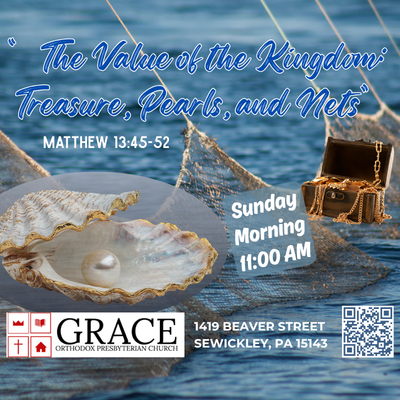
The kingdom of heaven is like treasure hidden in a field, which a man sells all he has to buy, and like a pearl of great value for which a merchant, an expert in pearls, gives everything. Others may not see its worth, but the kingdom is worth everything else. The parable of the net adds that at the end of the age the angels will separate the evil from the righteous. In the end what matters most is not what people think of God but what God thinks of them, though what they think of him shapes where they stand before him.
Sermon transcript
Our text this morning is from the Gospel of Matthew. Matthew chapter 13, verses 45 through 52, which you can find on page 974 of your Pew Bibles there. Matthew chapter 13, verses 45 through 52. Hear now the word of God. Starting in verse 44. The kingdom of heaven is like treasure hidden in a field, which a man found and covered up.
Then in his joy, he goes and sells all that he has and buys that field. Again, the kingdom of heaven is like a merchant in search of fine pearls, who on finding one pearl of great value, went and sold all that he had and bought it. Again, the kingdom of heaven is like a net that was thrown into the sea and gathered fish of every kind.
When it was full, men drew it ashore and sat down and sorted the good into containers, but threw away the bad. So it will be at the end of the age, the angels will come out and separate the evil from the righteous and throw them into the fiery furnace. In that place, there will be weeping and gnashing of teeth. Have you understood all these things? They said to him, yes. And he said to them, therefore, every scribe who has been trained for the kingdom of heaven is like a master of a house who brings out of his treasure what is new and what is old.
Amen. May God add his blessing to the reading of his word. Let’s pray. Lord, we would come into your presence and we would ask you to Give us your blessing. Lord, without your spirit, this word, which is living and life-giving, is death to us. We ask that you would give us your spirit, the spirit that inspired this word, that it might be present and give us ears to hear and hearts to believe and treasure what you have for us this morning. We pray this in Jesus’ name, amen. You may be seated.
On July 2009, an ordinary farmer’s field in Staffordshire, England, quietly surrendered one of the greatest archaeological discoveries in British history. Amateur metal detectorist Terry Herbert, a member of the Blockswitch Research and Metal Detecting Club, was sweeping his detector across Fred Johnson’s field. near Brown Hills when his machine began to sing.
What emerged from the soil was astonishing, more than 1,500 glittering items of gold and silver and precious stones, the largest hoard of Anglo-Saxon treasure ever found in Britain. The pieces dating back to the seventh century were breathtaking in their quality. Most were connected to warfare, ornate sword hilts, helmet fragments, and battle crests, suggesting they once belonged to royalty or high-ranking noblemen.
Terry rushed to tell the landowner, Fred Johnson, exclaiming that he had found a Saxon hoard. Johnson, skeptical at first, laughed it off. But when he saw the exquisite craftsmanship coming out of the ground, he quickly realized this was no ordinary find. It’s better than winning the lottery, Terry had said, and he was right.
The experts were left in awe. Archaeologist Dr. Kevin Leahy, who helped catalog the find, admitted that he was losing sleep over its beauty and historical importance. It’s astonishing, he said. We’ve actually been scared by the responsibility of dealing with this material.
And the horde cast dramatic new light on a powerful Anglo-Saxon kingdom, revealing the wealth and warrior culture of kings at the time. It was valued at roughly 4.45 million in today’s dollars. The treasure was declared property of the crown. The money for the treasure was split equally between the finder, Terry Herbert, and the landowner, Fred Johnson. Museums in Birmingham and Stoke-on-Trent raised the funds to purchase them for the nation to enjoy. Now, if only Terry had kept the secret and bought the field himself, he wouldn’t have had to split the proceeds.
Today, in Matthew chapter 13, Jesus tells three short stories about that kind of discovery, and two short stories about that kind of discovery, and one final story that shows why this discovery matters more than anything else in the world. Jesus compared the kingdom of heaven as we’ve been seeing in our parables to seeds and yeast and fields and fishing nets. But in our passage, Matthew 13, 44 to 52, he focuses on one central question. How much is the kingdom of heaven worth to you? Through these images of hidden treasure, a priceless pearl, and a dragnet at the end of the age, Jesus calls us to see the supreme value of knowing Him.
And He warns us also that what happens if we don’t. We’ll consider our passage this morning under three headings. Number one, the value that others don’t see. Number two, the value worth everything else. And number three, the final valuation. Number one, the value that others don’t see, verse 44.
Verse 44, the kingdom of heaven is like treasure hidden in a field, which a man found and covered up. Then in his joy, he goes and sells all that he has and buys that field. He buys that field for the sake of the treasure. Only he understands the value. His friends and neighbors probably thought he was crazy. He spends his entire life savings, sold all his property to buy some old field.
I mean, having a field might be nice. But if you sell everything that you have just to buy the field, what are you going to do with it? You won’t have any money to build on it, or to plow it, or to do anything else. You’ll own a field and nothing else.
But this man knew something about that field. He knew its hidden value. What was buried in this field was worth more than all of his earthly possessions combined. And in this parable, this man buys something with hidden value. This treasure would allow him to purchase anything he needed after he had sold all that he had. And once he has the field, the hidden treasure, he’s set for life. And knowing that he had made this bargain of all bargains made him ecstatic.
Now perhaps you’re wondering a little bit about the ethics of this transaction. And it seems to have been an occasional practice in that time period for wealth to be stored in the ground. In times of danger perhaps, like an invading army or some other reason, But there was always a chance that the owner would have to flee or might be killed in such a case without retrieving that treasure. Normal people don’t leave maps with clues to the treasure’s whereabouts. So if the owner was killed or forgot about it, the treasure could easily become lost as it was in this field. Now, in a case of unclear ownership, there seems to have been a bit of a finder’s keeper’s rule, as best we can tell in this society. And yet, if this man was digging in a field that was not his own, perhaps he was working for someone else. There might have been a dispute about the ownership.
But by buying the field outright, as Jesus says, the man heads off any claim any ownership claims that might arise from the discovered treasure. He wouldn’t have had to split it with the landowner or lose it altogether. That being said, I still don’t think that Jesus is establishing a precedent for how land purchases and finder’s keeper ought to work.
Jesus’s point is a man’s joyful discovery. Joyful discovery and then his actions to acquire such a treasure. Because notice it says, then in his joy he goes and sells all that he has. Because contrast this with Jesus’ later interaction with a young man in Matthew chapter 19. In Matthew chapter 19 verses 16 through 22, we come to a rather different story.
Here we have another young man, Matthew 19 verse 16, And behold, a young man came up to him, saying, Teacher, what good deed must I do to have eternal life? Jesus said to him, Why do you ask me about what is good? There is only one who is good. If you would enter life, keep the commandments. He said to him, Which ones? Jesus said, you shall not murder, you shall not commit adultery, you shall not steal, you shall not bear false witness, honor your father and mother, and you shall love your neighbor as yourself. And the young man said, all these I have kept for my youth. What do I still lack? Jesus said to him, if you would be perfect, go sell what you possess, give to the poor, and you will have treasure in heaven and come follow me.
And when the young man heard this, he went away sorrowful because he had great possessions. This man found the prospect of selling his possessions provoked sadness and proved to be a barrier, not a path forward. His multitude of possessions, rather than presenting a path to procuring the kingdom, proved to prevent his entrance. The young man couldn’t see the treasure in the field. All he could see was simply an overgrown field that wasn’t worth purchasing.
This young man came to Jesus looking for one final good work to round out his resume and assure himself of eternal life on top of having everything else. But Jesus made it clear to him that eternal life is not something that can be earned or achieved that way. It’s not found in something you can perform. comes from a person, Jesus Christ. The young man was talking to the one who is life, but he missed it because he was looking for a way to earn it. It was a gift. It’s a gift to be desired above all else.
And the young man found that he didn’t value eternal life as much as he thought he did. because he didn’t value it as worth more than all of his possessions combined. He wanted just to purchase it with a few more good deeds. To him, following Jesus looked like loss rather than gain. He wanted eternal life as an addition to his wealth, not something worth more than all of it.
But that is not the case with this man in our parable this morning, who finds the treasure in the field. This man sees the treasure, so he sells everything that he has. Nothing he possesses can compare to the treasure of eternal life. The point of the parable is not that eternal life can be purchased, but it’s the way that the man values it.
He sells everything he owns out of pure joy. One man went away sad because he had many possessions when proved with the prospect of selling them all. One man sold them in pure joy because of what he values. Because if Jesus is everything, once you have Jesus, Even if everything else is taken away, you still have everything left. The man buys a field for the sake of the treasure that’s buried there. And this is a picture of faith. Faith sees something that others can’t see. It saw the hidden riches in the field.
Philippians 4.19, Paul tells The believers there, and my God will supply all your needs according to his riches in glory in Jesus Christ. The buried treasure would cover all of that man’s needs in the parable. So he didn’t need to worry about holding anything back. He joyfully got rid of everything he owned, convinced his needs would be completely provided for with the treasure that he had in the field.
And a Christian is someone who has discovered that Jesus can fulfill all his needs. But of course, especially our greatest need, which is a restored relationship with God. Without Jesus, no matter how much earthly wealth and comfort we accumulate for ourselves, we’re still disconnected from our purpose for living. We weren’t made to be robots running around or animals chasing the next temporary comfort or pleasure. We were made to enjoy God, enjoy true riches.
Which brings us to our next parable about a pearl dealer. Number two, a value worth everything else, verses 45 and 46, we see, Again, the kingdom of heaven is like a merchant in search of fine pearls, who in finding one pearl of great value, went and sold all that he had and bought it. Just a bit of trivia, I learned when studying this passage that the Greek word for pearl is margaritas, which is where we get the name Margaret, which means pearl. I don’t know if we have any Margaret’s in the congregation, but the name Margaret means pearl of great price as we’re looking this morning. The previous parable dealt with a man who discovered an invaluable treasure accidentally, but he was immediately aware of its value.
But in this parable, this second one, we have a man whose whole career is built around the procurement of beautiful pearls. He’s spent his life searching. He knows what he’s looking for and he understands the market value of pearls. His livelihood is built around buying and selling these precious jewels. His career depends upon his ability to understand what each pearl will fetch in the marketplace. But he could have been good at his job, even excellent, and have still no appreciation for the beauty for its own sake. This man could be in it purely for the money. As a merchant, he would still be good at his job.
But as we see in our story, he is clearly not. For him, it’s the exact opposite. Because once he finds that pearl above all pearls, he’s captivated. His heart is caught. And we quickly see that he not only buys and sells pearls, but he is a true connoisseur of pearls, desiring the beauty of them, and especially that one. And this was a parable for me that I often puzzled over in the past. If the merchant was able to purchase the pearl with everything that he owned, why would he want to do that?
He would seem to have netted zero. He didn’t make a profit. The previous parable involved hidden treasure, hidden value, that would make his purchase of the field quite profitable. But here it seems as though instead of liquidating, the merchant is consolidating.
He’s unliquidating his assets and tying them all up into a single possession, a single pearl. Something he could not eat or use. Instead of turning his valuables into cash, he’s turning all his possessions into cash, and then turning that cash into a single, most beautiful, valuable pearl above all pearls. The word describing the valuable pearl is polotimos, which is literally much honor or very valuable.
And it occurs in two other places in the New Testament. Only two other places. We find it in John chapter 12 verse 3 where it’s used to describe the ointment that Mary poured on the feet of Jesus. It says, Mary therefore took a pound of expensive, very precious, very valuable ointment made from pure nard and anointed the feet of Jesus and wiped his feet with her hair. The house was filled with the fragrance of perfume.
In this story, we find a few verses later that Judas remarks that the use of this perfume was not justified. It would have been better turned into cold hard cash since it was worth three years worth of wages, which is today as much as a house. John notes that Judas’ rebuke, however, was based partly in his own intention to skim off some of that cash, supposedly for the poor, for himself. But Jesus also rebukes Judas for thinking purely in monetary value and missing the bigger picture.
Mary valued Jesus so much that she expected the most expensive thing that she owned. upon him to display how much she prized him. The other place that we find this word of very valuable or much honor is in 1 Peter 1, verse 7. To describe the faith of believers, Peter says, so the tested genuineness of your faith, more precious or very valuable than gold that perishes though it is tested by fire. It may be found to result in praise and honor and glory of the resurrection, revelation of Jesus Christ. This faith is our connection to Jesus. And that’s why it’s so precious, Peter says. Nothing else compares the absolute worth of possessing Christ through faith.
You were created to commune with the triune God the creator of the universe. Jesus said in John 17, verse 3, and this is eternal life, that they know you, the only true God, and Jesus Christ, whom you have sent. Eternal life is not merely a life that continues for an infinite amount of time. Plenty of authors of books and stories understand that merely persisting in a life like we have now is not a completely pleasant prospect.
Many fictional characters who possess immortality find it to be a curse rather than a blessing. And one reason for this is because immortality in that sense often involves separation from loved ones who die one by one. Yes, these characters never die, but they soon find that there is more than one way to die. And continuing on forever separated from loved ones feels like less like a blessing and more like a curse.
But that is not the biblical picture of eternal life or definition. Eternal life is not merely continuing in existence. Everyone does that. Death is not the end for anyone. Rather, eternal life is rich, sweet, deep fellowship with the source of all life, Himself, Jesus Christ. And you don’t have to die to wait. You don’t have to wait to die for it to start. Eternal life can start now by faith.
Paul, describing it in Philippians again, puts it this way in Philippians chapter three, verses eight through 11. Paul reflecting on possessing eternal life in Jesus. He says, indeed, I count everything as loss because of the surpassing worth of knowing Christ Jesus, my Lord. For his sake, I have suffered the loss of all things. and count them as rubbish in order that I may gain Christ and be found in Him, not having a righteousness of my own that comes from the law, but that which comes through faith in Christ, the righteousness from God that depends on faith, that I may know Him and the power of His resurrection, may share in His sufferings, becoming like Him in His death, so by any means possible I may obtain the resurrection from the dead.
That’s what Jesus wants us to understand about this pearl merchant who liquidates his entire fortune in order to purchase and consolidate into a single pearl that makes everything else in the world to him seem worthless by comparison. Once the merchant had laid eyes on this one pearl, There was no going back. He lost interest in all other pearls. It didn’t matter how many pearls he had anymore. He had to get this single one. It was worth more than all the others combined to him. The man who bought the field knew that the hidden treasure would be worth more than all he owned and would supply all of his needs. The pearl merchant discovered the pearl, which was so beautiful and valuable. was the only thing worth possessing to him. But then we see Jesus give a third parable, which takes this idea of valuing something, as the first two do, and flips it around a little bit. Number three, the final valuation. Verses 47 through 50.
Again, the kingdom of heaven is like a net that was thrown into the sea and gathered fish of every kind. When it was full, men drew it ashore and sat down and sorted the good into containers, but threw away the bad. And so it will be at the end of the age. The angels will come out and separate the evil from the righteous and throw them into the fiery furnace. In that place, there will be weeping and gnashing of teeth.
The net described here is specifically, we might say, a drag net. It’s a specific kind of net, a net that would have weights that would sink it down to the bottom of the sea while the fishing boats held the top of it and would draw it towards land. The boats would sail towards the shore, dragging the net between them. Once the water was too shallow for the boats, the fishermen would jump on either side and haul the net up onto the shore. And this would, of course, capture all of the fish that were in that area, not allowing any to escape.
It would be the most efficient way of fishing at the time, and many boats and fishermen still use it today. So Jesus is saying this common sight that they would have seen many of his disciples even use themselves as fishermen is a picture of the day of judgment. Someone could easily hear the first two parables and think, well, good for those people, good for them. I guess they got lucky.
But I’m personally not that interested in looking for hidden treasure or valuable pearls. I’ll leave that to them and I’ll live my life now and go on as I please. This type of person today might say, well, religion is nice if you’re into that sort of thing. It’s just not for me.
Frankly, I meet people like this all the time, especially when I’m doing evangelism. But it’s for this type of person that Jesus tells this third parable. Here there’s an ultimate evaluation of every person by God. The first two parables invite us to choose the kingdom, and the third one reminds us that one day the kingdom will choose us. Jesus described a dragnet, the kind that his listeners knew well. It swept everything in its path, the good fish and the bad, and at the shore the fishermen sorted them. The good were kept and the bad were thrown away. And the question is, how will you be evaluated? Are you a good fish or a bad one?
The net will drag everything in. Nothing will escape. The unbeliever tries to comfort himself with the possibility of somehow escaping, avoiding accountability for his crimes. But there will be no escape. The net has no holes. and it covers the entire world. Every last person will be caught up and dragged before the judgment seat. The fish will be sorted. They will be evaluated by the fishermen, not the other way around. The fish aren’t choosing which fishermen they like. You will not be the decider.
Your valuation of God’s kingdom, of Jesus Christ, is irrelevant to his worth. but it is indicative of your own eternal destiny. In the end, what matters not so much is what you think of God, but of what He thinks of you. Is God your friend or your enemy? And yet, at the same time, this does not mean that what you think about God is irrelevant, of course.
It’s highly relevant. It’s simply irrelevant to God’s position but it is of utmost relevance to your position before God, since it is God who will be dragging the net over all the earth to catch all the fish, and it is God who will be sorting each of the fish. And here’s where we see the relevance of the first two parables, because they portray the response of the good fish. The good fish are those who by faith recognize the matchless worth, the dazzling beauty, the unparalleled value of Jesus Christ. Matthew 16, 24 through 27 highlights this for us.
Jesus then told his disciples, if anyone would come after me, let him deny himself and take up his cross and follow me. For whoever would save his life will lose it, but whoever loses his life for my sake will find it. For what will it profit a man if he gains the whole world and forfeits his soul? What will a man give in return for his soul? For the son of man is going to come with his angels in the glory of his father, and then he will repay each person according to what he has done.
As we saw with the parable of the dragnet, the fate of your soul hangs in the balance, eternal life or perishing, saving your soul or forfeiting your soul. It’s pretty hard to put a value on your soul, your eternal destiny. But how could never-ending suffering, forfeiting your soul, ever be worth trading anything that you could possess in this life? Jesus says, don’t trade anything you possess for your eternal state, enduring the wrath of God for eternity. Because in Jesus Christ, he’s made a way to escape the wrath of God. and find eternal life, to have fellowship with God for eternity. And that is something worth giving up everything in this life, even life itself.
Verses 51 and 52, Jesus asks the final question. Have you understood all these things he said to them? Yes. And he said to them, therefore, every scribe who has been trained for the kingdom of heaven is like a master of a house who brings out of his treasure what is new and what is old. Jesus asked his disciples if they’ve understood his teaching. They say yes. And surprisingly, he doesn’t argue. He finishes up with a final parable or an extended simile, at least.
During his ministry towards the end of the Gospels, we see Jesus give very pointed, harsh critiques to the scribes and the Pharisees of his day, who had missed the point of the Old Testament, which they were supposed to be experts in. But he’s not against the idea of scribes generally, just against bad ones.
And here Jesus describes scribes who are trained for the kingdom of heaven. These scribes have understood that the whole Old Testament has been pointing to the culmination of God’s revelation in the arrival of Jesus Christ. And thus these scribes are able to provide insight from the old by looking back and shining the light of the new onto the old. They’re like a master of a house who brings out old and new from his treasures. The Old Testament is not meant to be left behind, but illuminated by the clarity of the new revelation which comes in Jesus Christ. Jesus says his disciples who understand are like scribes of the kingdom.
These are like a wealthy connoisseur of valuable items, perhaps from travels all over the world. who loves to share them with his guests, invites them over and says, look at this one, which I’ve had for a very long time, but also this one that I just picked up from my trip to India or China or some far off region in the world. And I think this is a good metaphor for what we ought to be seeing in preaching today. On the one hand, the same old truths that have always been there, We don’t want to be inventing new doctrines, but on the other hand, it ought to be presented in a fresh way. Good teaching doesn’t invent new truths.
It faithfully brings the old truths of scripture in a fresh, joyful way that points to Jesus. So tying this all together, Jesus this morning has shown us three pictures of the kingdom. Hidden treasure worth selling everything for. A pearl so beautiful it captures the heart. And a final sorting where only what is valuable remains. The question he leaves us with is simple. Do you see its value? Will you respond with joy and wholehearted surrender? One day the net will come ashore. Make sure that when it does, you are found among those who belong to the King.
Amen. Let’s pray. Lord Jesus, you who are the pearl of great price, worth selling everything that we have to have possessed you by faith. We ask that you would give us the faith that we need. Give us eyes to see the hidden treasure. Give us eyes to see the pearl above pearls and to value you for who you are. We ask that you would do this for your own sake, for your glory. In Jesus’ name, amen. In response, let’s turn and sing hymn 538, Number 538, take my life and let it be, and let’s stand as we sing this final hymn.
The sermon text provided above is derived from the sermon audio recording making use of generative tools. It has not been manually edited. While transcription tools have a high degree of accuracy, the output may include generative textual, punctuation, and/or formatting errors.