

The sermon text provided below is derived from the sermon audio recording making use of generative tools. It has not been manually edited. While transcription tools have a high degree of accuracy, the output may include generative textual, punctuation, and/or formatting errors.
If you would remain standing and turn, our text this evening is taken from the Gospel of Matthew, Matthew chapter 22, verses 1 through 14. You can find that on page 983 in your pew Bibles. Matthew chapter 22, verses 1 through 14. Hear the word of God.
And again, Jesus spoke to them in parables saying, the kingdom of heaven may be compared to a king who gave a wedding feast for his son and sent his servants to call those who were invited to the wedding feast, but they would not come. Again, he sent other servants saying, tell those who are invited, see, I have prepared my dinner.
My oxen and my fat calves have been slaughtered and everything is ready. come to the wedding feast. But they paid no attention and went off, one to his farm, another to his business, while the rest seized his servants, treated them shamefully, and killed them. The king was angry, and he sent his troops and destroyed those murderers and burned their city. Then he said to his servants, the wedding feast is ready, but those invited were not worthy. Go, therefore, to the main roads and invite to the wedding feast as many as you find. And those servants went out into the roads and gathered all whom they found, both bad and good. So the wedding hall was filled with guests.
But when the king came in to look at the guests, he saw there a man who had no wedding garment. And he said to him, friend, how did you get in here without a wedding garment? And he was speechless. Then the king said to the attendants, bind him hand and foot and cast him into the outer darkness. In that place, there will be weeping and gnashing of teeth. For many are called, but few are chosen.
The grass withers and the flowers fade, but the word of our God stands forever. Let’s pray. Our father in heaven, Lord Jesus and Holy Spirit, you who have breathed out this word and preserved it for our instruction, we ask now that this evening, you would also be present in the preaching and the hearing of your word, that it might be life to us. We need this, Lord. Without you, without your spirit, we are without hope. So we ask you to send your spirit this evening. For Jesus’ sake, amen.
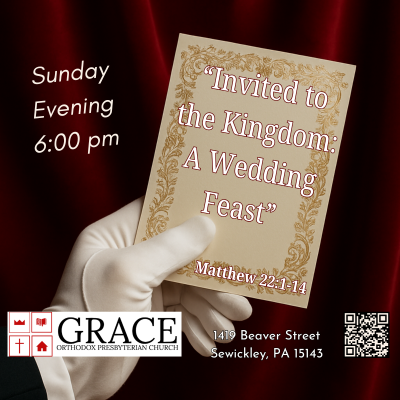
You may be seated. The title of the message this evening is Invited to the Kingdom, a Wedding Feast. And the children can be, and others, can be listening for the words royalty, results, and requirement. Well, imagine you receive a gold-embossed invitation from the president to attend his son’s wedding at the White House. Everything is covered, the flight, the meal, even a custom tuxedo or gown, waiting for you at the door.
But when the final call comes, Everything is ready, come now. You ignore it. Maybe your excuse is, I’ve got to check on my lawn, make sure the grass is growing high enough. Or perhaps you even become enraged and assault the courier. That level of rudeness of response feels a little insane.
And yet Jesus says, this is how we often treat the invitation to the greatest feast in all of history. But before we get there, let’s start with a little bit of context for our passage. As we consider the context of this parable this evening, it comes at the end of three, it’s the third of three parables, which Jesus tells just after his triumphal entry into Jerusalem at the beginning of Matthew chapter 21.
And these parables serve to highlight the fact that the Jewish leaders were being excluded, while those they despised and thought unworthy were actually entering the kingdom. And these parables serve to call out the Jewish leaders. And they got the point, as we see in Matthew 21. But rather than being convicted when they saw themselves portrayed in Jesus’ parables, they only became more intent on destroying him. The context of the parables is Jesus’ second cleansing of the temple on the week of Passover when he is confronted with the Jewish leaders who are challenging his credentials.
They ask him where his authority comes from and after giving them a question, which they refuse to answer, he goes on to expose their rebellion with this trilogy of parables. The first one is Matthew 21, verses 28 through 32, which highlights the obedience that God is looking for.
Jesus tells of two sons with different problems. One refuses to obey initially, but then repents. The other son immediately professes a speedy obedience that fails to materialize. And Jesus then asks the question of the Pharisees, which son pleased his father?
And upon their answer, Jesus spells out his intended indictment of their doubly reprehensible behavior. They refused to believe at first when John came. and then proudly continued refusing, despite the examples of tax collectors and prostitutes repenting all around them. The second parable is in verses 33 through 41, and it’s more extended and more explicit.
Tenant farmers are set up to take care of a vineyard, and they not only refuse the owner’s rightful claim to the produce, but they rise up in absurd rebellion as though they could take the possession of the vineyard by killing the master’s sons and servant. The Jewish leaders miss the point at first, acting like David when he is confronted by Nathan. They eagerly condemn the absurd wickedness of the tenants, saying that they should receive justice. But Jesus then points out that they, more than anyone else around, most closely resemble these absurdly foolish tenants by their own rebellion against God. And on the heels of those two parables comes this third parable that we’re looking at this evening. And here, the kingdom of heaven is compared to a royal wedding feast.
Now while many weddings have challenges with the wedding party, the minister, the caterer, the venue, this wedding has one of the most unlikely difficulties of all, a lack of guests. It’s intended to be a big wedding and instead There are no guests coming. We’ll consider this parable under three headings. Number one, the royally invited guests. Number two, the response to the rude refusal. And number three, the remaining requirement of wedding clothes. Number one, the royally invited guests.
Verses one and two, and Jesus again spoke to them in parables saying, the kingdom of heaven may be compared to a king who gave a wedding feast for his son. This would of course been a joyous and important occasion. The king giving a wedding feast for his son. Jesus has compared the kingdom of heaven to many things so far, but here his comparison is to a royal wedding invitations that get ignored and then vehemently refused. And it highlights the folly of those that fail to enter the kingdom. Because it is like turning down an invitation to the most wonderful party ever. You would have to be almost insane. And yet that is the state of sinful man.
Turning down an invitation to a wonderful party In this parable, the king’s son would be the heir. Before we even get into this parable, knowing what we do from the book of Revelation, for instance, reading from this vantage point, We can see additional significance to the kingdom of heaven being compared to a wedding feast. We see, of course, a picture of Jesus, the son of God and the wedding feast of the lamb, which will of course come at the end of history, which the gospel call is coming and inviting people to the wedding feast of the lamb. But here it is confined to a simple feast in the story. And yet the king sends out his servants, verse 3, to all those who were invited to the wedding feast, but they would not come.
Notice it says those who had previously been invited. It was common practice, we have contemporary sources that also mentioned this, to receive an initial invitation, as we do now of Save the Day. And then, once everything was ready to receive the second call to come to the wedding feast, they were receiving the final reminder. In a time that lacked watches and clocks, it was, of course, helpful to be reminded in this way. And their refusal at this point, after having previously been invited, is utterly unexpected. It’s unnatural and it’s rude.
But the king is not put off. There he sends another servant in verse four. Again he sent other servants saying, tell those who are invited, see I have prepared my dinner. My ox and my fat calves have been slaughtered and everything is ready. Come to the wedding feast.
Despite the rude ignoring of the invitation, the king generously sends his servants back again. And notice the king’s patience displayed in the wording, are invited. The invitation still stands. He has not rescinded his invitation at the first rebuff. He does not retract the invitation, but extends it all the more, attempting to persuade them with the description of what they can look forward to. The king can’t fathom that they turned down the invitation with full understanding of what is being offered.
There must be a misunderstanding. And so he reminds them of the preparations that have taken place, the abundance that awaits them if they simply accept the invitation and come to the feast. Jesus wants us to understand that entering the kingdom of heaven makes as much sense as accepting an invitation to a wedding. It truly is a no-brainer. And despite this, we see two insane responses.
Matthew verse 5 of chapter 22, but they paid no attention and went off, one to his farm, another to his business. In the Luke sort of parallel version, a similar wedding story that Jesus tells in his parable, in Luke chapter 14 verse 18, the guests state explicit excuses. But in this story in Matthew, when Jesus tells the parable, They do not even give a reason. They just completely ignore and wander off without even giving a verbal excuse.
And these reasons are clearly non-urgent. They’re simply everyday concerns. Imagine saying, I didn’t have time to go to the president’s ball when I was invited because I had to wash the dishes. Or I had to check on some paperwork at the office, so I missed my daughter’s wedding. The response is utterly disrespectful. The king himself had sent three invitations by personal messenger to these guests, and they completely ignored all of them.
And the response is the height of disrespect, except for the next response, which tops even the ignoring. Verse six. while the rest seized his servants, treated them shamefully, and killed them. Their first response is bad enough, utter indifference. But the king’s patience shines through. And despite the rudeness, he had sent another wave of servants with even more vivid details. And yet, the responses worsen, despite the king’s generosity.
They treated them as absolutely worthless, treated them shamefully, and then killed them. Of course, the most shameful act of all. Just when we thought that these invited guests could not be any worse, we find that some of them even lash out in an irrational rage against those bringing them an invitation to the party. And this is truly bordering on unbelievable, truly beyond belief.
And yet, Jesus would have his hearers understand that this was precisely the situation between God and his people. Jesus’ previous parable about wicked vineyard tenants highlighted the right of the owner to his own crop. But here, and they had rebelled against the owner asking for fruit from his farm. But here they’re lashing out against a king who is merely inviting guests to a party. Inviting guests to a wedding party and the messengers are killed.
Jesus wanted the Jewish leaders of his day to see themselves here. They, as leaders, part of God’s chosen people, had received a privileged place in God’s history of redemption by virtue of their heritage. They were those who had received an invitation, a repeated invitation, but instead of responding with joy and faith and repentance at John the Baptist and later Jesus coming, they retaliated in rage. In response to God’s gracious invitation, which culminated in the coming of God in the flesh, Jesus Christ himself, the Jewish leaders responded in murderous rage. Israel had killed the prophets throughout their history. And in a short time, these leaders listening to Jesus here would seek to kill him.
This is what I like to call the Cobra Heart. The depraved heart that you and I, everyone, is born with. A rebellious heart that interprets God’s very existence as a threat to our own autonomy. When God brings an invitation of life and freedom and joy, we respond with rebellious hatred, lashing out at him and those who represent him, extending that invitation to us. And that is, of course, why it is so important that we receive God’s promise of a new heart. You and I need a new heart. And until we have that new heart, we will irrationally view God’s invitation as boringly yawn-worthy or ominously threatening. But despite the king’s patience and kindness in extending his invitation for a third time, we see in our passage his patience does have a limit.
So number two, the response to the rude refusal. Verse seven, the king was angry and he sent troops and destroyed those murderers and burned their city. The king is enraged and with good reason. The invited guests had pushed things way too far. Notice none of them even politely declined. There was no neutrality. Both responses that they gave were completely rude refusals to a kind and generous invitation. But a kind king is not a pushover, and he’s not one to be trifled with.
In the previous parable, the Jewish leaders recommended that the sentence be carried out on the wicked vineyard tenants. But here Jesus doesn’t ask them for their indictment. He just swiftly states the king’s response. We read 2 Samuel 10 earlier in the service because this story displays a certain parallel to the parable.
David had sent messengers in kindness to pay respects and to console the new Ammonite king whose father had just died. David was friends with the previous king. who had died and he wanted to show kindness and sought to establish a friendly relationship with the new king. And of course, to David’s great shock, his motives were impugned and his servants were badly mistreated. And the Ammonites soon found, and as we read, that David’s kindness does not mean weakness. And he responded to their disgraceful actions with forceful retaliation. That’s the same type of thing that we see in this parable. The king’s great patience and kindness does not mean that he has no capacity for vengeance.
Of course, this reflects what we find all over the Old Testament as God speaks of his own vengeance and judgment against sin, even against his own people. We could look at, for instance, Isaiah chapter 5, where we find the Lord describing his judgment that he will bring, even against his own people. Therefore, as the tongue of fire devours, verses 24 and 25 of Isaiah chapter 5. Therefore, as the tongue of fire devours the stubble, and as dry grass sinks down in the flame, so their root will be as rottenness and their blossom grow up like dust.
For they have rejected the law of the Lord of hosts and have despised the word of the Holy One of Israel. Therefore, the anger of the Lord was kindled against his people. He stretched out his hand against them and struck them. The mountains quaked. Their corpses were as refuse in the midst of the streets. For all this, his anger is not turned away and his hand is stretched out still.
Jesus is saying we must never think that God’s kindness means he is incapable of judgment. Because as we return to the parable, we see that God is willing, the king is willing to destroy even the city of these rude, refusing guests. But then as we continue moving, we see in our parable that this elimination of his invited guests poses a problem for the king. Verses eight and nine.
Then he said to his servants, the wedding feast is ready, but those who were invited were not worthy. Go therefore to the main roads and invite to the wedding feast as many as you find. The king has a solution. He will send out vast quantities of last minute invitations. So while his army is marching to destroy the rude refusers, he assembles his servants again to ensure that the feast does not go to waste.
The priority of the king here is not the worthiness of the guests. Those previously invited had shown themselves to be completely unworthy. But his priority is whether his party is full. He’s got a lot of empty seats to fill and a lot of food to be eaten. He tells them, bring as many as you find, don’t exclude anyone. In fact, the places that he sends his servants suggest the likely character of his guests that will be brought in. Those hanging about on the streets at the street intersections will not be the wealthy or the noble.
And we see this in the next verse, verse 10. And those servants went out to the roads and they gathered all that they found, both bad and good. So the wedding hall was filled with guests. We see the description of those that come as both bad and good. All sorts of people are brought in to fill the hall. All apparent levels of deserving this invitation were brought in.
I don’t think we’re meant to read too deeply into bad and good here. Yes, all men are sinners before God, and thus would be characterized as bad. But in this case, I think we might think of the difference, perhaps, of convicted felons and those that are not. This description is not meant to be a state of one’s standing before a holy God, but one’s characteristic in society.
It is meant to refer to the extent and the variety of guests who were gathered up and brought in. There’s no discrimination exercised on the part of the servants when extending the king’s invitation. And as many as they encountered, it says, they invited and they brought in to the feast. This is a joyous celebration. The original guests’ rude refusal could not dampen the celebration.
The king’s wedding feast goes on anyway. Now in the Gospel of Luke, as we mentioned, Jesus tells a very similar parable about a wedding feast. It has a similar storyline. And in Jesus’ version in Luke, he ends it with a celebration. The good and bad Those undeserving are brought in and invited to the feast.
But here in the version that he tells, in this case, that Matthew recounts, Jesus isn’t done with his parable yet. He has a further point to make. And so number three, we see the remaining requirement of wedding clothes. The remaining requirement of wedding clothes. Verse 11.
When the king came in to look at the guests, he saw there a man with no wedding garment. The king goes out to survey the guests and finds one who stands out from the rest, and not in a good way. While all of the riffraff that came in from the sides of the highway are wearing wedding garments, one man stands out from the crowd. He has no wedding clothes on. So the king approaches with a question. Verse 12, and he said to him, friend, how did you get in here without a wedding garment? And he was speechless. Notice again, the King’s ongoing kindness throughout this story. His address of friend is a kind and gentle address to this man. A simple question, how did you escape the provided garments?
And yet, as we noted last Sunday evening, the Greek word here for friend, an endearing companion, it only shows up in the New Testament in three places, and those all three are in Matthew’s gospel, and they are used ironically. As we looked last time in the parable of the vineyard workers, The worker who worked all day long and got exactly what he earned and grumbled against the vineyard owner, the owner calls him friend and tells him to depart with what he had earned. And here again, we have the king addressing the guest as friend before kicking him out.
And the third place is when Jesus speaks to Judas Iscariot, calling him friend just before he betrays him. There’s nothing inherently ironic in this word in Greek usage as it shows up in other parts of Greek literature. And yet this makes Matthew’s usage in these two parables and about Judas Iscariot to stand out all the more. In all three cases, friend refers to someone who appeared to be in the right, on the outside, a follower of Jesus, a good guy on the outside, but through his actions was revealed to be the opposite, a betrayer.
And the king’s question combined with the fact that every other last minute guest was wearing wedding clothes implies that the wedding garments that the king asks about were provided by the king for the occasion. We don’t have this stated explicitly, but I believe we’re meant to understand this. We see this implied especially not only by the fact that all the other guests have wedding garments except for this one man, but it’s further implied by the man’s lack of an answer.
It says the man was speechless. We shouldn’t think of this as a mere temporary surprise, leaving the man without an effective comeback. No, this man is unable to give any valid defense for his lack of a wedding garment, which would be because the king had provided them. The man did not give the excuse of, I couldn’t afford one. I didn’t have anything nice to wear. I wasn’t given anything, or even I didn’t know that I was supposed to.
It’s utter silence. The Greek word here has the connotations in other places and can be used sometimes to refer to a muzzle. And so the king’s question is in a sense an indictment of the man. He’s muzzled, he’s silenced by his lack of a defense. By asking the question, the king takes away all justification that the man thought that he had for his actions.
How did you get in here without a wedding garment? He has no good reason for not availing himself of the wedding garment. Quite plainly, he knew that he should have had on the right clothing, and yet he had declined to wear it. The previous invites had declined the invitation entirely, but this man thought he could accept the invitation but decline the clothing. He had somehow sneaked in, knowing he was supposed to be wearing a wedding garment, seeing that they were provided, and still refusing to become suitably clothed with the provided garments. He thought his own clothes were good enough, He thought he could be part of the feast on his own terms, based on his own merit.
In the end, he made the same mistake as the previous guests, who treated the king’s generosity as something to be scorned and ignored. We might speculate, word might have gotten around about why the king was extending such a last-minute invitation to all these unlikely guests. The ingratitude of the original guests was likely spread around the room as the banquet hall was filled. But while scores of the undeserving guests gratefully accepted the king’s invitation and provision for entrance, this man told himself that he didn’t need it.
He didn’t want or need the wedding garments. He was better than the original guests who foolishly refused the invitation, but he wasn’t about to submit to the king’s requirement of wedding clothes. accepted the invitation but rejected the king’s provision. He thought his own clothes sufficed. He was wrong. He was quite wrong. Verse 13.
Then the king said to the attendants, bind him hand and foot and cast him into the outer darkness. In that place there will be weeping and gnashing of teeth. The king’s judgment is swift. There will be no room in his wedding feast for guests who insult him and refuse his provision. And the man suffers a similar fate to those who refuse to come to the feast in the first place. Because even though he accepted the invitation, he stubbornly refused to accept the king’s invitation on the king’s terms.
As the parable concludes, the metaphor fades away as Jesus describes the place of exile as outer darkness, where there’s weeping, wailing, and grinding of teeth. Jesus uses this description repeatedly throughout his ministry to describe the state of those who fail to enter the kingdom. It’s a description of deep unhappiness with an abiding anger mixed with sadness and regret. And this is the fate of those who refuse God’s grace. In the end, there are only two destinations for humanity. You’ll either be celebrating at a wedding feast, or you’ll be weeping outside in outer darkness. There’s no neutral alternative. Either you’re at the feast, or you’re outside.
Jesus caps his parable with a final takeaway in verse 14. For many are called, but few are chosen. Don’t misunderstand. Jesus is not saying that the elect will be a tiny remnant. He’s not saying that the size of the remnant. He’s saying that not all who are called will be finally chosen.
The point is not that there are only a few who are chosen, simply that they are not all, not all the called are chosen. If you think just for a moment at the parable itself, recall the multitude of guests that are filling the wedding hall. And in the parable, only one had no wedding garment and was thrown out of the story. So it would be very strange for the point of the parable to be that there’s a miniscule amount of people that are destined for eternal life.
Jesus’ point is that getting an invitation, hearing the call, is not the same thing as responding to it. Those who hear God’s call and know of his grace must not think that a call is the same as a response. Knowing about Jesus’s death and resurrection, his perfect obedience, meritorious righteousness, is not the same thing as abandoning trust in yourself and in your own efforts and depending upon him alone. You must not only know about God’s grace, you must embrace it, believe it, and trust it.
And this third parable that Jesus tells that we’ve been looking at, he has something to say to the tax collectors, prostitutes, the sinners of society, and even possibly Gentiles who were following Jesus. Jesus had just told two other parables which painted them in a good light. It highlighted them as admirable for their response of repentance and obedience. These were the ones who were inheriting the kingdom. while it was being taken away from the other Jewish leaders, the scribes, the Pharisees, and the Sadducees. But Jesus doesn’t want anyone to entertain false hope.
Merely being invited, even showing up at Jesus’ teaching, showing up at church, does not mean that you’re a Shuin. Qualification remains at the wedding feast. The qualifications have been provided by the king, but they must be embraced. We must accept the garments, which requires humility to acknowledge that what you came with won’t let you in. Strangely for the proud heart, accepting God’s full provision and abandoning self-reliance is so hard that is actually impossible. Only by a divinely granted humility will a person trust in God’s grace of salvation and abandon their own self-reliance. Many are called. The invitation has gone out to the original guests, to the highways and to the byways. And it rings out today through the gospel. Come to the wedding feast of the king. Everything is ready.
The lamb has been slain. but few are chosen, not because God is stingy, but because many refuse the invitation outright, while others only reject it superficially, accept it superficially, but reject the only garment that qualifies them, the perfect righteousness of Jesus Christ, freely provided. Friend, how did you get in here without a wedding garment? If you rely on church attendance, moral efforts, religious heritage, or good enough life, you will stand speechless before the king, just like the man in the parable. But the good news is this, that the same king who judges also clothes.
He provides the clothes that are needed. He offers you his son. his son’s robe of righteousness today. And so put off filthy rags of self-righteousness. Humble yourself. Receive the gift of faith and enter in joy into the feast. The spirit and the bride say, come. Let the one who is thirsty come. Let the one who desires to take of the water of life without price come. Revelation 22, 17. Will you come fully on his terms? Many hear the call. Few respond in a way that shows that they are chosen.
But by God’s grace, may you all be among those who feast with the king forever. Amen. Let’s pray. Father in heaven, we thank you for your great generosity in your gospel call, going forth to the ends of the earth. As we read in Romans this morning, that your call has gone out to the ends of the earth and continues going out. Lord, we pray, we pray that you would give your spirit and choose those that receive that outward call, that they would also be called inwardly They would find that eternal life. He would give new hearts. Lord, we ask that you would give new hearts to all here this evening and give new hearts to those as we extend the call of the gospel, the invitation to the wedding feast of the lamb. We pray this in Jesus’ name, amen. In response, let’s stand and sing hymn 425. Hymn 425. Let’s stand and sing How Sweet and Awesome is the Place, number 425.