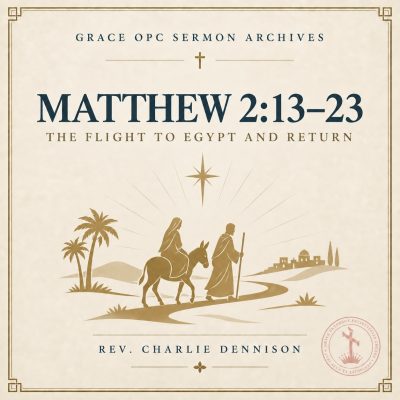
This sermon is from the Rev. Charles G. Dennison sermon archive, part of the “Matthew 2:13-23” series, and was preached at Grace Orthodox Presbyterian Church in Sewickley, PA, during a worship service on Sunday, February 11, 1996.
Jeremiah 31, verse 15, give your attention to God’s holy word. Thus saith the Lord, a voice was heard in Ramah, lamentation and bitter weeping. Rachel, weeping for her children, refused to be comforted for her children because they were not. Thus saith the Lord, refrain thy voice from weeping, and thine eyes from tears. For thy work shall be rewarded, saith the Lord, and they shall come again from the land of the enemy. And there is hope in thine end, saith the Lord, that thy children shall come again to their own border.”
I have surely heard Ephraim demoting himself thus. Thou hast chastened me, and I was chastised as a bullock unaccustomed to the yoke. Turn thou me, and I shall be turned, for thou art the Lord my God. Surely after that I was turned, I repented, and after that I was instructed, I smote upon my thigh, I was ashamed, yea, even confounded, because I did bear the reproach of my youth. Is Ephraim my dear son? Is he a pleasant child? For since I speak against him, I do earnestly remember him still. Therefore my bowels are troubled for him. I will surely have mercy upon him, saith the Lord.
Set thee up, waymarks. Make thee high heaps. Set thine heart toward the highway, even the way which thou rentest. Turn again, O virgin of Israel, turn again. to these thy cities. How long wilt thou go about, O thou backsliding daughter? For the Lord hath created a new thing in the earth. A woman shall compass a man. Thus saith the Lord of hosts, the God of Israel, as yet they shall use this speech in the land of Judah and in the cities thereof, when I shall bring again their captivity. The Lord shall bless thee, O habitation of justice, and mountain of holiness. And there shall dwell in Judah itself, and in all the cities thereof, together husbandmen, and they that go forth with flocks.
And I, for I have satiated the weary soul, and I have replenished every sorrowful soul.” And then turning over to Matthew’s Gospel, the second chapter. Reading from verse sixteen, Then Herod, when he saw that he was mocked of the wise men, was exceeding wrath, and sent forth, and slew all the children that were in Bethlehem, and in all the coasts thereof, from two years old and under, according to the time which he had diligently inquired of the wise men. Then was fulfilled that which was spoken by Jeremiah the prophet, saying, In Ramah was there a voice heard, lamentation and weeping, and great mourning, Rachel weeping for her children, and would not be comforted, because they are not.”
Let’s pray together. Today, O God, your word is proclaimed throughout the world, and Lord, all of us have a participation in that proclamation if it is brought by our gift and by our prayers. But Father, we would sanctify even these by our prayer, that Lord, you would prosper your word, that it would prove most helpful to your people, and quite convicting to those who would be drawn into the assembly of your church. Lord, even here, may you look upon us and may you hear our prayers and answer in your mercy for Christ’s sake. Amen. Rachel is truly one of the great figures of all literature. Not just biblical literature, but all literature. Here is a woman well worth studying.
We meet her first in Genesis chapter 29, She is introduced to us as the daughter of Laban, Laban himself being the grandson of Nahor, Abraham’s brother. Jacob, you will recall, is the son of Isaac, grandson of Abraham, and he has journeyed north from the territory of Canaan in order to escape the murderous wrath of his brother Esau.
In the territory of Padan-Haram, Jacob meets Rachel, she the younger of Laban’s two daughters. He meets her at a well where she regularly brings her father’s sheep in order to water them. Jacob falls in love with Rachel. whom we are told in the Bible who is exquisite in form and beautiful in appearance.
Jacob, as the story goes, promises Laban seven years of hard work for the privilege of Rachel’s hand in marriage, only to be tricked outwitted by Laban, and given the older daughter, Leah, whom Laban contends must be married off first because it is the custom of the territory in which he lives.
Thus we have one of those marvelously crafted understatements from Scripture. And it came to pass that in the morning, behold, it was Leah. But Jacob wanted the beautiful Rachel, not the weak-eyed Leah as she is described in Scripture. So for the price of seven more years of labor, Rachel is also given to Jacob.
Rachel was to Jacob his well-loved wife, while Leah is the spurned. But as unloved as Leah was to Jacob, she is well-loved by God, who in Seeing in her his people, the rejected and the despised, took pity upon her and granted to her many children. Meanwhile, Rachel is barren. And as a consequence, she lashes out against Jacob as against God. because as yet she has not had a child generated in her womb.
Subsequently, Rachel gives to Jacob her maid, Bilhah, so that she might gain children through this maid. And it is from this point that Rachel becomes the most intriguing and most complex figure, truly one of the most instructive figures in all of the Bible. She will name the children gained to her through her maid, Bilhah, in ways that memorialize her struggle with her sister.
The firstborn is Dan. His name means judged. This name, then, as the child himself, a monument in Rachel’s eyes to God’s vindication of her over against her sister, Naptali, the secondborn. bears a name that is related to the Hebrew word for wrestling, of all things. And this name is chosen by Rachel because, as she says, I have wrestled with my sister and I have prevailed. shows herself a woman who lives for the advantage.
Who, because of her incessant drive to best others, to gain the advantage over her sister, who, because of her intense competitive interest, never knows any real peace, let alone any sense of lasting satisfaction. Even when the Lord finally grants to her children from her own body, she continues to express an underlying bitterness. Not even children of her own, from her own body, are enough for her.
Her firstborn is named Joseph. His name means addition. You may be thinking that here is an appropriate name for this child because God has now added to her. Oh no, oh no. She chooses that name because it serves as something of a prayer, a profane prayer, a prayer that God would add to her yet another child.
But Rachel’s drive for the advantage, for the position of prominence, for a position of power, is not reserved for her battles with her sister. It also includes her struggles with her father and with her brothers. When Jacob finally makes a break for it, When he finally escapes from his uncle’s house and leaves the territory of Pat-An-Aram, you may recall from the texts in Genesis that Rachel steals her father’s household gods.
Now, you might be a bit mystified by that action. It may not register on you exactly what the significance of that action is. Where would it be that Rachel would steal her father’s household gongs? You may think, well, maybe she hoped to sell them. Maybe they had value as trinkets. Maybe they were collectibles. But there are many reasons why she steals the household gods. First of all, she had not really forsaken them.
And as the Israelites later carried Egyptian religion with them out of Egypt, and even used the pattern of Egyptian gods for the golden cap that they had made at Sinai, So Rachel now carries her father’s gobs with her. And in this, you see, Rachel stands in direct contrast to another figure that appears later in the story of salvation, the figure of Ruth, who forsakes totally the pagan gods of Moab for the true and living God of Israel. But there’s another reason why Rachel steals her father’s gods, because they are passport for her, in some sense, back home. It is as if these gods are a security for her in the event that things don’t work out in the territory to which she is going, in Canaan. or even better, these gods represent her attachment to the properties of her father, those that she has just left. They are representative of her inability to leave the old life behind and cling to the new, an inability to cling to the god of her husband and entrust herself to that God as she makes her way out of that world of which she has been a part. Just as the Israelites will look longingly back towards Egypt after they have been delivered by God, Rachel will hedge her bets and keep her options open. Thirdly, and most significantly, Rachel steals her father’s gods because in ancient societies such as the one in which she lived, whoever controlled the household gods controlled the inheritance.
They had the final say. And that is why Laban, her father, is so desperate to retrieve those gods. Rachel, therefore, carries with her the supreme prize, the mark of her dominance, the testimony to her victory. and her claim upon the world and its wealth. By stealing those gods, she holds on to life in this world and inheritance in it. That is the object of her life.
Later, Jacob would bury those household gods under an oak tree in Shechem, in the territory and thereby declare that he would seek no imperatence mediated by such gods, nor would he seek any wealth among Rachel’s people. Whatever advantage Rachel hoped to gain is now lost. The gods are buried, they are gone. The satisfaction she should have found in the true God and in his provision for her, she cannot and will not enjoy. In the end, seeking to save her life in and for this world, she loses it. She was not content with God, or with her husband’s love, or with the child that had been given to her, Joseph. She demands more. She is always demanding more. She wants it all.
But her extreme anguish in the end, as she is giving birth to a second child, is more than she experienced in the pangs of childhood. to be sure that second child, who would be called finally by Jacob, Benjamin, would be literally the death of her. That child, Benjamin, would memorialize her sorrow as she, in her last moments, weeps to the realization that all her efforts to gain the advantage, to have the prominence and the power, have been worthless and empty. She dies weeping, unable to be comforted, unable to be consoled. She has lived for the advantage in the world Now she is leaving that world in which she has sought to gain the advantage. And what has been the use of it all? Just as she had left Tad-An-Aram with Jacob, now she leaves this world, the only arena in which she has placed her confidence and her hope. She died, we are told, in Ephra, or Ephratah, another name for the town of Bethlehem.
The prophet Jeremiah resurrects the image of weeping That image appears as we now know because of our reading this morning in Jeremiah chapter 31 verse 15. But you will notice that Jeremiah here, by the inspiration of the Holy Spirit, does a very interesting thing with the image of weeping Rachel. He inverts it. That is, he turns it inside out. In the Genesis story, Rachel died, but her children lived on. But in Jeremiah, Rachel’s children die, but she, as it were, lives on. In the Genesis story, Rachel dies, but the children live. In Jeremiah, the children die, but Rachel lives.
Now, what is the meaning of this inversion? Well, you will note that in either case, the constant is the weeping Rachel. The key to the inversion is found in the weeping, and the reason for the weeping. In the Genesis account, as we’ve already seen, Rachel’s tears fall because of the great sense of futility and hopelessness that has overcome her personally. She, in her death, is leaving the world for which she lived. Thus, she weeps.
But the Prophet’s point is that even weeping like this, as severe and distressing as it is, is not enough. You see, Rachel’s weeping in Genesis, particularly the text Genesis 35, is not desperate enough only to be sure it is tragic and it is indicting of her in her sin. Only it is not tragic and indicting enough. For though Rachel dies, her children live.
And because that is the case, it is possible for there to linger a possibility of hope. Now, you’re really confused, aren’t you? Because it sounds as if I’m preaching a message of hopelessness, and that is exactly what I am doing presently. We will not end there, but it is imperative that you see that in order to get to the conclusion.
That is what God is doing in the story of Rachel. He is taking hope away from you. Jeremiah will accent that. He will play the story out in reverse, in order that the situation may appear to be utterly and completely hopeless. And there is reason for that. Jeremiah, by the inspiration of the Holy Spirit, resurrects the figure of Rachel in order to slay hope.
Consider it. If Rachel thinks for a moment, and from that moment gives birth to an entire philosophy of life, that her children can be those in whom and by whom a hope persists, for gaining not only the advantage in this world, but the world itself, then it is not enough that she die hopeless. It must go on. Her children, in whom she would place her hope, must die as well. God knows that she And the people of God must be stripped of all such hope, because in her and in their sin, they will always come up with the wrong hope.
The right hope cannot be an ambition for a place of dominion and power in this world. It cannot be an ambition for the children that we generate, coming to a place of dominion and power and authority. in this world. Such hope is always misdirected. It is flatly and plainly sinful. To boot, it is based upon human strength, the confidence in that strength and power, and it is born of human pride. The only right hope is God himself for his own sake. a hope that is resting in him, a hope that is true and powerful and living because of him, a hope that is real because it is based upon his power, strength, and majesty.
Jeremiah, the prophet, writes during the time of the exile, Israel has come to the end of its life, much like Rachel came to the end of her life. This picture of the weeping Rachel deals with the complete hopelessness of the situation that Israel faces. As Rachel, through and in her sin, goes down into death in the account of Genesis, So Israel now, through and in its sin, goes down into death in the exile.
The only hope is in the God who raises the dead. You see what the Lord is doing in the course of the Old Testament. He is forcing you to the conclusion that the only hope is a God who can raise the dead. That’s it. And thus it is. As every Calvinist knows, only God can save. Nothing in me, not my boast, not my strength, not my confidence, not even what hope I may generate from within myself. It will not do. It is all tainted by sin. In the end, I cannot accomplish it.
God must do it. And the wonderful truth is that He is pleased to do it. Only He can say, only he can raise the dead. He has to place us in a hopeless position in order to demonstrate his power, as well as his mercy and his love. That’s the way it is, even after The Jews come back from Babylon, you remember? And what is liable to Jewish consciousness now? We went into exile, we survived that, we’re back in the land, we’re populating it again, we’re thriving and increasing. God must now rob them of the boast that has come to them through the restoration from the exile. And thus, Bethlehem, we go back to Bethlehem.
He may be greatly offended by the execution of the children in Bethlehem. You must come to terms with that in your religious life. If you don’t, you are going to end up short of the God of the Bible. You must bow before him, not he before you. But now we’re back to Bethlehem. And even what hope there may have been for Israel on the backside of the exile is being taken away from them. And the only hope is the child whom God preserves baby Jesus and in him your life will be found in the end God will raise him from the dead, and here will be the focus of all true and lasting hope. Is he not the source and substance of your hope this morning?
I pray so. Oh God, left to ourselves, we will construct a hope that is after our own liking. But Lord, how wonderful you are to rob us of that hope which we have made, that we might in fact delight in the hope that you supply. Father, teach us the truth about ourselves, about those we meet in the Bible, about the events, even the shocking events that confront us there. that we, in our confession of the truth, might be found to be your children indeed. And having lost, Lord, a false hope, even, Lord, forsaking this world, may we know that we have been given the hope of glory in Jesus Christ, a child who stands so conspicuously in the verses of Matthew 2, as that one preserved of you, enduring even through death unto resurrection, that our confidence and faith may be full in him. Hear us, Father, for Jesus’ sake, in our pilgrimage unto the end to which we press, even the resurrection from the dead. Amen.
The sermon text provided above is derived from the sermon audio recording making use of generative tools. It has not been manually edited. While transcription tools have a high degree of accuracy, the output may include generative textual, punctuation, and/or formatting errors.