
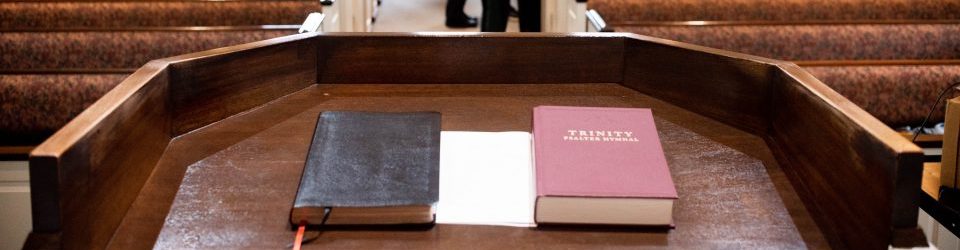

This sermon is from the Rev. Charles G. Dennison sermon archive, part of the “Habakkuk” series, and was preached at Grace Orthodox Presbyterian Church in Sewickley, PA, during a worship service on Sunday, November 19, 1995.
This morning we are reading from Habakkuk 3 for the last time. We’ll begin at verse 8. Did the Lord rage against the rivers, or was thy anger against the rivers, or was thy wrath against the sea, that thou didst ride on thy horses, on thy chariots of salvation?
Thy bow was made bare, the rods of chastisement were sworn, thou didst cleave the earth with rivers. The mountains saw thee and quaked, the downpour of water swept by. deep uttered forth its voice, it lifted high its hands. Sun and moon stood in their places, they went away at the light of thine arrows, at the radiance of thy gleaming spear. In indignation thou didst march through the earth, in anger thou didst trample the nations. Thou didst go forth for the salvation of thy people, for the salvation of thine anointed. Thou didst strike the head of the house of evil to lay him open from thigh to neck. Thou didst pierce with his own spears the head of his throngs. They stormed in to scatter me. Their exaltation was like those who devour the oppressed in secret. Thou didst tread on the sea with thy horses, on the surge of many waters.
I heard, and my inward parts trembled, at the sound my lips quivered, decay entered my bones, and in my place I tremble. But I must wait quietly for the day of distress, for the people to arise who will invade us. Though the fig tree should not blossom, and there be no fruit on the vines, though the yield of the olive should fail, and the fields produce no food, Though the flock should be cut off from the fold, and there be no cattle in the stalls, yet I will exult in the Lord, I will rejoice in the God of my salvation.
The Lord God is my strength, and he has made my feet like hinds’ feet, and makes me walk on my high places, for the choir director on my stringed instrument.” Then Galatians chapter 2, verse 20. I have been crucified with Christ, and it is no longer I who live, but Christ who lives in me. The life which I now live in the flesh, I live by the faith of the Son of God. who loved me and gave himself up for me.
Our God, we are conscious of your children around the world, and how you add to your household by bringing into our company those whom you are redeeming from the ends of the earth, from all of the nations. There is preaching here this morning, but there is also preaching around the globe.
And Lord, it will be your servant who enter into the proclamation of your word from heaven, that there might be that full assembly gathered, and no seat left unfilled. Father, we are also mindful to pray for governments over nations, and for the government that is over us. We pray for our President and for our leaders. Lord, we are asking that there would be the maintenance of righteousness, such as is a restraint to evil, a help to good. We pray that in this manner we may have a peaceful life, that we might be unharassed, and that your servants who proclaim your word around the globe might also wonderfully experience your blessing in this regard. May nations be at peace, and may your word progress. We pray this in Jesus’ name. Amen.
What makes for good preaching? How can you tell good preaching from not so good? Or from that which is just outright horrible? The criteria may not be what you think. Last week, we stated that good speaking ability, personal charm and charisma, the knack for illustration and the gift for inspirational and motivational communication, do not translate of themselves into good preaching.
Paul has told us what stands central for him in his ministry. He speaks of it repeatedly throughout his letters. He tells us that he preaches Christ. His testimony comes to us particularly in the Corinthian epistles. I’m thinking of 1 Corinthians chapter 1, verse 23. Also chapter 2, verse 2. as well as 2 Corinthians 4, verse 5. In each of those texts, the Apostle Paul is telling us that the heart of good preaching is the proclamation of Christ. Good preaching, therefore, above all, is preaching Christ.
But this morning, we want to go on a bit further with this basic commitment in order to make another observation about the nature of good preaching. And once more, the criteria may not be what many think. For instance, fine-tuned use of application. does not translate into good preaching. Nor can we say that good preaching is essentially a matter of adroitly linking up with the congregation along the psychological line, grabbing them in their nor is it cleverly tying in with them in their lives individually, so that there is this immediate recognition from them to you that you know all about them.
There is that kind of preaching that immediately strikes a responsive chord. We are liable to say, in keeping with this kind of preaching that the preacher has gotten inside of my head. He spoke to my heart this morning. He applied the word of God directly to me. Such preaching may seem to us wonderfully practical, direct, easily accessible, just the kind of preaching we want. But let me tell you, for all these things, the immediacy, the application, the easy accessibility, for all these things, the Gentiles seek in their public speakers.
And others, while they may not be Gentiles themselves, don’t seem to know any better. Not that we wish to encourage men toward preaching who lack air sensitivity about the psychological aspects of humanity, or seem to lack all sensitivity to the particulars of the lives of those who are congregated before them. What value is preaching that is out of touch, seemingly obtuse, to such an extent that it communicates, apparently, an indifference to the people. However, merely projecting a spirit of involvement with the congregation, a familiarity with or simply insisting upon a fine method of application does not touch the heart of good preaching. In fact, commitment to these very things and a well-developed style along these very lines can leave you far removed from the dynamics of good preaching. in the genuine biblical sense. Let me state the case straight out. Good preaching does not apply the text to you. Good preaching applies you to the text. Good preaching is essentially proclamation, first of all, of what God has done specifically in Jesus Christ.
But it is also proclamation about your relationship to God’s great saving act and to the history of revelation and redemption as a whole. the latter part of this proclamation enterprise that is concerning us this morning, specifically your relationship to God’s Great Saving Act and to the history of Revelation. Is it as most expressed these days that you stand at a distance from God’s Great Saving or at a distance from God’s Word itself concerning these great saving acts which God has performed?
And is it the preacher’s task, then, to take the Word from its context back there, set in that primal setting, and make that Word relevant and meaningful to you in your own unique time and circumstance? Is that what’s going on in preaching? In other words, is it the case that over there, over there is the word. Speaking to another era, another situation, while you are standing here in 1995, with the preacher’s task of bridging the gap between you and that text by bringing that text to you, and applying it to you, and making it meaningful to you.
I suggest to you that the biblical approach is just the opposite. on the biblical scheme. The Preacher does not take the Word and apply it to you so much as he takes you and applies you to the Word. The Preacher does not then draw the Word into your world. Rather, the Preacher declares to you that the Word is, first of all, drawing you into its world.
Now, by this, of course, I do not mean that you must all go out and buy sandals. And I don’t mean by this that you have to live in houses made of sun-dried bricks, or trade your car in for a camel. What I mean, and what the Bible means, is that the great saving work of God and the history of salvation itself are what define you. As you are made through the power of the word and by the spirit of regeneration, no mere nor no mere inquirer into a distant ancient event, but a participant in that event and in the history of salvation and its great drama. You are not on the outside looking in. You are in it. Now, let me give you two brief illustrations of what I’m talking about. I want you, first of all, to look at Exodus chapter 13, verse 8.
Here you have the revelation of God concerning the Passover. And God is giving instruction here through Moses to the fathers about how the fathers are to communicate to their children the meaning of the Passover. And this is what the fathers are to say to the children. They are to say, this is what the Lord did for me when he brought me out of Egypt. Now, I want you to notice there the use of the first-person pronoun. This is what the Lord did for me.
Now, say we are dealing with a Jewish father who lives 600 years after the Exodus, after the Passover. Or, say we’re dealing with a Jew, a Jewish father who lives 1400 years in the time of Christ, after the Passover, the first Passover. Do you think that that father would speak in the very same words? Do you think that father would say to his children, this is what the Lord did for me when he brought me out of Egypt? Your response might be, well, how can that be? He wasn’t even there. He wasn’t even in Egypt. How can he speak in the first person? How can he say, this is what the Lord did for me when he brought me out of Egypt? He wasn’t even there.
The biblical point is that he was there, that he is a participant, and it is this particular great event of salvation that defines him. It is the preacher’s task to declare that to the congregation. I invite you to read through the book of Deuteronomy. Moses’ final sermon to the people of God in this very light, how he deals with that generation as if that generation, the subsequent generation to the one that had come out of Egypt, is spoken to as if it were a participant in the very events themselves.
Now, the other illustration that I have for you is from Galatians 2.20, the text that we read this morning. Here Paul is doing the same thing that we find in Exodus 13 verse 8. But you’ll notice that now there’s been a change, hasn’t there? For the great saving act from God is not that typical and preparatory act of the Exodus in Egypt, but rather the conclusive final act that has been accomplished by God in Jesus Christ.
Notice now how Paul defines himself in terms of this act by God. He defines himself as if he were present. Paul wasn’t even at the crucifixion. But he talks about that crucifixion and also the resurrection of Christ not just as if he were present, but as if he were a participant in those events.
I am crucified with Christ. Now I live. I live by virtue of the resurrection of Christ. The life which I now live in the flesh, I live by the faith of the Son of God who loved me and gave himself for me. The preacher’s task is to proclaim to you your inclusion in the great saving work of God in Christ’s death, resurrection, and even his return. Your place in the history and the drama of salvation. Now we’re getting to the heart of not just good preaching, but great preaching.
The question becomes for us, in light of this, how do we properly preach Habakkuk? Particularly now, how do we properly preach Habakkuk when it comes to the proclamation of our relationship to the great saving work of God? First of all, we must ask ourselves, what is the great saving work of God for Habakkuk?
You tell me. What is the great saving work of God for Habakkuk? Do you think it’s any different than that father that we spoke about earlier in Exodus chapter 13, verse 8? Do you think it’s any different than what we’ve already commented on with respect to Moses and his great sermon in Deuteronomy? The great saving act of God for Habakkuk is the Exodus. In the Exodus, God came for the salvation of his people.
Now, there is evidence of this throughout the prophecy. We can make reference of a couple of chapters in the first two chapters, but we’re going to go beyond that and look at the third chapter particularly. Here, in the great prayer of faith from Habakkuk, the prophet twice reviews the complexity of events that accompany the exodus and include also the settlement in the promised land. First there is verses 3-7 and then verses 8-14, parallel sections of this prayer which cover the same terrain, the same period of time. But you will note that Habakkuk, in the final analysis, sees himself directly participant in these great saving acts.
He speaks of it in verse 14 particularly. That’s why I interjected the first personal pronoun there in the 14th verse when I read it this morning. Those of you who are following along New American Standard realize I changed the text at that point. Why? Because literally it is the first personal pronoun in that 14th verse.
Habakkuk is interjecting himself into the drama. “…thou didst pierce with his own spears the head of the throng. They stormed in to scatter me.” That’s what the text says, not us. It’s not in the Hebrew. Their exultation was like those who devoured the oppressed in secret.
Habakkik interjects the first personal pronoun because he is a participant in the drama. That’s the way he understands it. He is speaking as one who has experienced himself the onslaught which his forefathers endured when the nation was overrun in the time of the judges.
But further, verse 16, he again speaks in the first person of his direct participation And this in response to what you find in verse 15. That’s why I read verses 15 and 16 together. I don’t separate them, for that 16th verse is the Prophet’s response to what you find in that 15th verse. He is speaking now about his direct participation in the response to the sound of God’s treading upon the Red Sea with his horses that caused that sea to boil, as it were.
So the prophet’s identity is established in relationship to the Exodus, the great saving act of God. But we must also notice, in connection with this, in order to fill out the proclamation of the history of redemption, even from an Old Testament point of view, we must notice that the coming of God in the Exodus which figures so prominently in the consciousness of Habakkuk, is not the only coming of God that Habakkuk speaks about.
There is another coming. There are two comings. You’re starting to get the pattern now, you’re starting to get the feel. There are two comings of God in Habakkuk. There is the coming of God in the Exodus, but there is also the coming that is promised from God through the Chaldeans who are going to overrun the world and overrun Judah. God came and he is coming again, and Habakkuk lives between the two comings. Wait a minute, this is starting to sound awfully familiar. Do you understand? Do you understand what’s going on? He lives between the two comings.
This is what makes Habakkuk gospel. So any proper preaching on Habakkuk must relate you to the first coming of God, in light of the impending second coming of God. That’s what makes good preaching. And it must tell you that your only hope in the second coming of God is your proper relationship to and participation in the first coming.
As things have worked out in Habakkuk, as we’ve surveyed Kim personally, we realize that he doesn’t have a good relationship to the First Coming, and he must be corrected in his attitude and estimations. He hasn’t appropriated it rightly. Now, if I have to spell it out for you at this point, Seeing all of this now in New Testament terms, you understand the parallel.
The Old Testament exodus is to the Chaldean invasion, as the New Testament redemption in Christ is to Christ’s Second Coming. There it is. Now I have some of you sitting there dumbfounded. not knowing whether to write or what to do, I’ll repeat it. The Old Testament exodus is to the Chaldean invasion, as the New Testament redemption in Christ is to the Second Coming. And just as Habakkuk lived between the two comings, you live between the two. There is no proper application of Habakkuk apart from that observation. None. None.
That is what the Holy Spirit is intending you to hear in Habakkuk. Just as Habakkuk is called by God to a true justification by faith predicated upon God’s free and gracious love, to an undeserving people in the exodus, so we are called to a true justification by faith, predicated upon God’s free and gracious love for an undeserving sinful people through Christ’s death and resurrection.
Such faith is not that of self-righteousness. It is not that of a self-righteous Pharisee. be it a self-righteous Pharisee that is on his way to Damascus to arrest Christians, or a self-righteous Pharisee that appears in one of Jesus’ parables congratulating himself that he isn’t like other sinners.” Habakkuk used to be like that Pharisee in the parable. He used to be like that Pharisee on his way to Damascus with orders to arrest the Christians. Instead, such faith is that of the breast-beating publican, such faith to which Habakkuk himself has been brought. Such faith is not that of, say, the elder brother in the parable of the prodigal son. That’s the way Habakkuk used to be.
As he pointed out to God, you will remember God’s gross injustice to him and to Judah, just as the elder brother did in that parable with respect to his own father’s gross injustice at his reception of his sinful son. And such faith as is here set before us in Habakkuk, is not that of the rich, young ruler that regrets the demands of the kingdom—I have to give it up—or grieves over losses that the kingdom brings with respect to the things of this world. that the gospel of that kingdom might confer upon us true riches in glory and God himself. At one time Habakkuk was very much like that rich young ruler, but now he is like Jesus Christ, by whom he is crucified to the world and the world to him, and all for the sake of the true inheritance, God himself.
Truly good preaching places you in the text and within the history of salvation. It declares to you who you are and where you live with respect to God’s sovereign timetable, namely, in the first coming of Christ, looking for the second coming. And it plainly tells you that a life filled with self-justification, anger at God for his injustice, and regret over the loss of the things of this world, cannot stand when Christ returns. good preaching tells you, God mercifully deals with you now, lest you come up before him in that great day with attitudes that prove that you never knew him, and that you never were truly justified by faith. with Habakkuk in tow, I hope that you have been properly preached to today.
Now, our Father, may the message from your prophet work wonderfully in our souls, that we may be challenged with respect to our faith, that we might again assess our relationship to Christ and our participation in his death and resurrection. And Father, we ask for your mercies as we live in these days, that we would realize that we are a people who live between the two comings. And Father, we ask that we as a congregation may be determined to help one another that we may stand brightly, gloriously in the approaching day, and that the fellowship that we have here in this church will never be severed, even through eternity. We pray it in Jesus’ name, who has gone before us, in whom we have our life and being. Amen.
The sermon text provided above is derived from the sermon audio recording making use of generative tools. It has not been manually edited. While transcription tools have a high degree of accuracy, the output may include generative textual, punctuation, and/or formatting errors.