
"resurrection" Tagged Sermons
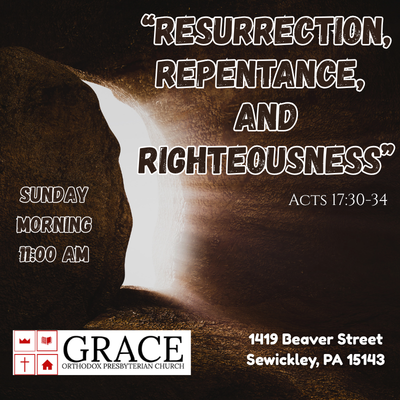
1. God’s Universal Demand for __________________ (v. 30).
2. The Coming Day of __________________ (v. 31).
3. The ______________________: Divine Proof that Christ is God’s _______________ of Final Judgment (vv. 31-34).
1. Abraham’s Parable of ______________________
2. Isaac and Jacob’s ______________________
3. Joseph’s Skeletal ______________________
1. Consider how Ignorant even some of our Lord’s own
_____________ were about His ____________and Saving Work prior to His _____________ (vv. 13-26).
2. All of the __________________ testify of Christ and His Saving Work (v. 27).
3. Only the Resurrected ____________ can open our Eyes to truly Understand who He is and the Reality of His ____________________ (vv. 28-35).
1. The unity and equality of the Father and the Son
2. Christ, the Source and Bestower of resurrection Life (vv. 25-29)
3. God’s Son, the Divine judge (vv. 22, 26-30)
1. Understand the principle of representation. (v. 12)
2. Consider some of the practical implications of this doctrine. (v. 12)
1. Take to heart God’s universal demand for repentance (v. 30).
2. Behold, the Day of Judgement is coming (v. 31)!
3. The resurrection of Christ certifies Him as the agent of God’s judgment on Judgment Day (v. 31).
1. The parallel between the prophet Jonah in the belly of the great fish, and the Lord Jesus Christ in the state of death (v. 40).
2. Christ’s burial and continuation in the state of death for a time anticipated His resurrection (v 40).
3. Our Lord’s resurrection from the state of death ought to lead sinners to repentance (vv. 41-42).
1. We believers have a living hope because we have been “born again” (v. 3a).
2. The objective basis for the new birth: The historic resurrection of Jesus Christ from the dead (v. 3b).
3. Our living hope: An imperishable inheritance (vv. 4-5).