
Sermon Speaker: Rev. Isaiah English

  • Waiting for the Kingdom: Maintaining Lamps

    Waiting for the Kingdom: Maintaining Lamps

    About this sermon

    Ten virgins wait for the bridegroom with their lamps; five wise ones bring extra oil, but five foolish ones do not. When the bridegroom delays, all fall asleep, and at midnight the cry goes out. The foolish ask to borrow oil and the wise tell them to buy their own; while they are gone, the bridegroom comes, and the door closes. Waiting is hard when prayers go unanswered and Christ seems delayed. The critical difference is readiness, which no one can borrow. Believers must be ready through faith in Christ, even if they pass through death before he returns.

    More sermons from Matthew · Browse all sermons

    Sermon transcript

    Our sermon text for this morning is taken from the Gospel of Matthew. If you would like to remain standing and follow along, please turn to Matthew chapter 25, reading verses 1 through 13. It is found on page 987 in the Pew Bibles. Here now, the Word of God taken from Matthew chapter 25.

    Then the kingdom of heaven will be like ten virgins who took their lamps and went to meet the bridegroom. Five of them were foolish and five were wise. When the foolish took their lamps, they took no oil with them. But the wise took flasks of oil with their lamps.

    As the bridegroom was delayed, they all became drowsy and fell asleep. But at midnight there was a cry: “Here is the bridegroom! Come out to meet him.” Then all those virgins rose and trimmed their lamps. The foolish said to the wise, “Give us some of your oil, for our lamps are going out.” But the wise answered, “Since there will not be enough for us and for you, go rather to the dealers and buy for yourselves.” And while they were going to buy, the bridegroom came, and those who were ready went in with him to the marriage feast, and the door was shut. Afterward, the other virgins came also, saying, “Lord, Lord, open to us.” But he answered, “Truly, I say to you, I do not know you.” Watch, therefore, for you know neither the day nor the hour.

    Amen. This is God’s inspired word. Let us pray. Our Father in heaven, Lord God, you have breathed out this inspired word for us to hear, know, understand, and receive life from. Lord, we ask that you would send your Spirit, who inspired the writing of this word, so that we might receive the life that is here. Open our eyes and ears to see and hear, that you might be present with the preaching of your word. May this be to your glory and to our blessing. We pray this in Jesus’ name, amen.

    You may be seated. There were some outlines in the bulletins this morning in case you missed them. If you would like to find them, please look for them now. The title of the message is “Waiting for the Kingdom, Maintaining Lamps.” We are doing a series on parables. The key words to listen for in the points, for children of all ages, are reality, difference, and finality. Good morning, church. Happy Mother’s Day. Does anyone have difficulty with waiting? Yesterday, many of you were at my home for a baby shower for one of the expectant mothers in our congregation.

    There are a few people who understand waiting better than mothers. You wait nine months to meet your child. You wait through sleepless nights until they finally learn to sleep. You wait years, sometimes decades, to see the fruit of all the prayers, tears, discipline, and love you have poured into them. Some of you may still be waiting for a prodigal child to come to his senses and return home. Motherhood is one long, beautiful, exhausting lesson in waiting.

    This morning we come to a parable that is also about waiting. While the kingdom has come in some ways, Jesus has arrived. Yet there is also a significant sense in which we await the full coming of the kingdom. Jesus tells us a story of ten young women waiting for the bridegroom, who was delayed. Some were prepared for the long wait, and others were not. The difference between them was eternally significant.

    Jesus tells this parable at the end of his ministry, as he prepares his disciples for his departure and his eventual return. In Matthew 24, the disciples asked him about the end of the age and his coming. He responds with teaching about the trials they will endure, and then gives several parables about how his followers should live while they wait for him. This is one of those parables.

    And the main message is clear: be ready. Stay spiritually prepared, because the bridegroom will come at an hour that you do not expect. We will look at our passage this morning under three headings. First, the shared reality of waiting. Second, the critical difference—some were prepared. Third, the final outcome—included or shut out.

    First, the shared reality: waiting. Look at verse one. Then Jesus said, “The kingdom of heaven will be like ten virgins who took their lamps and went to meet the bridegroom.” We must begin with a brief orientation.

    As you may have already noticed from the reading, first-century Jewish wedding customs differed from modern Western traditions. In our modern Western traditions, people typically wait for the bride to arrive at the ceremony. The ceremony does not begin until the groom and his attendants are in place and ready. Only then do the bride and her attendants enter, drawing everyone’s attention. We have no detailed records of how Jewish weddings were conducted in a typical first-century context.

    Scholars therefore speculate about the exact details. They only mention that a wedding took place. Everyone assumed they knew how it worked. But fortunately, we do not need to know the exact details of how weddings were conducted in that time to understand this parable. Whether typical or not for the period, the scene is described in sufficient detail for us to grasp its intended meaning. What is clear is that there was an evening wedding celebration that could not begin until the crucial guest—the groom—arrived.

    Most English Bible translations refer to these individuals as virgins who waited for the groom’s arrival. The Greek word is *parthenos*, from which we derive the term the Parthenon, the building in Greece. This term is broad enough to refer simply to a relatively young, unmarried woman. In this context, they are serving as bridesmaids.

    In verse two, five of them were foolish and five were wise. We quickly learn that these bridesmaids, who were waiting, are divided into two groups. One group is described as wise, prudent, or thoughtful. The other group is called foolish. The reason for their classification becomes clear in verses three and four.

    When the foolish bridesmaids took their lamps, they took no oil with them. But the wise bridesmaids took flasks of oil along with their lamps. One group was thinking ahead, beyond the present moment. They had made preparations so that if events did not unfold according to their schedule, they would still be ready. At first, there would have been little noticeable difference between the two groups. However, in terms of what they were actually carrying, there is some disagreement among Bible scholars.

    Although the Greek word is *lampos*, which likely gives us the English word “lamp,” some scholars argue that in this context, these were more accurately torches. In other passages where this word appears, it is translated as “torches” in the New Testament. For example, the Jews came to arrest Jesus in the garden with torches. In the book of Revelation, there are references to torches being cast into lakes and torches burning before God’s throne. All of these uses involve the same Greek word.

    So it makes sense here for the girls to be carrying more than a small oil lamp to welcome the groom, which would have been a candle to the wedding party. These were probably much larger torches that the girls were carrying. But the main point, of course, is that the girls were prepared with extra oil. The wise ones were prepared, and the foolish ones were not. While this difference was unnoticeable at first, by the end, the difference became absolutely monumental.

    Verse five says, as the bridegroom was delayed, they all became drowsy and slept. While we find in the rest of Matthew 24, and in other places, including at the end of this parable, Jesus warning people to stay awake and be watchful. In this case, there does not seem to be any indictment of the bridesmaids for falling asleep during the delay. Both the wise and the foolish slept alike. The wise slept alongside the foolish, indicating that the sleeping in this case was not the problem. Whether they were sleeping or not was not the distinguishing mark of being foolish or wise. All the bridesmaids grew tired because of the delay and eventually fell asleep.

    So as we consider this story, we see many commonalities. All ten virgins took their lamps and went out to meet the bridegroom. They were all invited. They all had lamps or torches. They all expected him. And when he was delayed, all of them became drowsy and fell asleep.

    Jesus is painting here a picture of the Christian life. We are all waiting. Christ has come, died, risen, and ascended. The next great event in terms of redemptive history is his return to judge the world and to fully establish his kingdom. And we live in the in-between time, the time of waiting. We wait in history. Two thousand years have passed since Jesus promised to return. That is a long delay. We also wait personally.

    Even though we have been born again, sin and suffering still remain, even for Christians. The world is broken. We see it all around us. Things are not as they should be. Even within ourselves, our hearts are still waiting to be fully sanctified. The night often feels long and dark. Waiting is difficult for everyone, and it is difficult for Christians. It is hard because we desire to see, not only to believe.

    It is hard because our culture trains us to expect immediate results, while the Kingdom of God operates according to God’s own timetable. I struggle with waiting myself, and the Psalms are full of calls for God’s people to wait upon the Lord. The alternative we see in the history of the kings of Israel and Judah is the example of those who relied on their own strength, their own timing, and their own resources rather than on the Lord. And frankly, I believe we are often tempted to do the same. If God does not bring about what we desire according to our schedule, perhaps we will try to force it. We may attempt to make it happen through our own resources, our own influence, or our own strength, or through some other means.

    Waiting is hard because doubt begins to whisper when the delay continues. One of my greatest temptations is to think that God has become distracted or has forgotten about me. It is easy to begin to believe that God did not foresee all the challenges I am currently facing. Then it becomes easy to lose hope. It is hard when prayers go unanswered for years, when faithfulness brings cost, when our own sins weigh us down, and when we see the evil in the world.

    And yet, here we are—just like the ten bridesmaids waiting, waiting for the groom to appear. We share this common experience of waiting. But as we continue our story, the second point, we see the critical difference—the critical difference. Some were prepared for the bridegroom’s arrival.

    But at midnight, there was a cry: “Here is the bridegroom! Come out to meet him.” In the middle of the night, the cry came that the groom was finally arriving. The moment had come that the bridesmaids had been waiting for all night. This was their time to shine. Verse seven: Then all those virgins rose and trimmed their lamps. The girls woke up, both wise and foolish, and began preparing to welcome the groom.

    The word “trimmed” here refers to the need to adjust the wick of a lamp, but the Greek word is more general and can be translated as “put in order” or “straighten up.” In a different context, one might say “get ready,” but for a torch, it simply means to prepare it and light it.

    Verse eight: And the foolish said to the wise, “Give us some of your oil, for our lamps are going out.” Here we finally see the contrast between the bridesmaids as it becomes significant. As they attempt to relight their torches, the foolish discover that their lack of extra oil means their torches cannot remain lit. They naturally turn to their companions, seeking assistance. This is the most immediate source of oil available for their torches.

    They simply request the wise ones to provide some of their extra oil. That should be possible. But this is not an option, verse nine: “But the wise answered, ‘Since there will not be enough for us and for you, go rather to the dealers and buy some for yourselves.’ What might have appeared initially to be a reasonable solution proves to be impossible.

    The wise have not brought enough oil for two torches. Each has brought only enough to keep one torch lit long enough to welcome the groom. If they share the oil, then all ten torches will burn for only half the time, and all will go out before the groom arrives. They have only enough oil for themselves to each have a burning torch the entire time.

    But being wise, of course, they offer a sensible solution: run out and purchase more oil right now. This is clearly something the foolish ones should have thought of before. But it is not until now that they realize their urgent need for extra oil. The foolish bridesmaids take this advice and rush off. But it is already too late. As we see in this parable, some things cannot be obtained at the last minute.

    And spiritual readiness is one of those things. At the end of the day, you and I, and you, will alone have to give an account for our lives before a holy God. We see this point brought out in the letter to the Galatians. Paul’s letter to the Galatians, he states this at the end, Galatians chapter 6, verses 3 through 5:

    For if anyone thinks he is something when he is nothing, he deceives himself. But let each one test his own work, and then his reason to boast will be in himself alone and not in his neighbor. Each one will have to bear his own load. The boasting that Paul refers to in this passage is not about thinking of yourself better than others, as he makes clear in verse three, but rather whether you are relying on the faith of someone else or your own faith.

    When we speak of a shared faith, what we mean is that we are all trusting the same person, Jesus Christ, to save us, not that we can actually borrow someone else’s faith. I knew a young man several years ago who thought that he was a believer while his mother was alive because he was so close to her and she was such a devout follower of Christ. But it was not until after her early death, leaving him feeling hopeless, that he realized how much he had been borrowing—or trying to borrow—her faith. And it was at that point that he realized he had to make her faith his own. Faith is not something that can be had vicariously. You must have faith yourself. The foolish bridesmaids had to learn this the hard way.

    As we see next in number three, the final outcome. The final outcome included or shut out. Verse 10. And while they were going to buy, the bridegroom came and those who were ready went in with him to the marriage feast, and the door was shut. The foolish bridesmaids had departed, but they were too late. While they were on the way, the groom arrived. The bridesmaids were still in the middle of their preparations. They were following the advice of the wise bridesmaids, but they were too late. The moment arrived and passed, and the girls missed their opportunity. Only those who were present—the wise bridesmaids with fully burning torches—were there to welcome the groom and to go with him into the celebration. Those ready for the groom’s arrival entered, and then the door was shut. But eventually the absent bridesmaids returned from their mission. Verse 11. Afterwards, the other virgins came also, saying, Lord, Lord, open to us.

    They had been delayed in their timing, and their mission had become irrelevant. They had been absent and unprepared for the groom’s arrival. They had completely missed the reason for waiting in the first place. But better late than never, right? Perhaps they could still enter the party despite being late.

    So they came knocking and calling out to the locked door. They addressed the groom directly, asking for entrance into the celebration that they had assumed they were part of. But they heard an answer that was utterly dreadful. Verse 12. But he answered, truly I say to you, I do not know you. They had assumed they had a place in the wedding party, that they had some kind of relationship with the groom. But from inside the locked door, he told them that he did not know them.

    The foolish bridesmaids were not merely late to the party. They were completely excluded and disowned. Not because they left to prepare, but because they were unprepared at the final hour. There is no room for second chances or do-overs in this case.

    Sometimes when I am doing street evangelism and I ask people where they expect to spend eternity, or if they have thought about it, I sometimes hear the answer, “I’ll figure it out when I get there.” Jesus tells this parable to warn against that kind of thinking. Earlier in the Gospel of Matthew, in the Sermon on the Mount, in Matthew chapter 5, verse 25, Jesus says: “Come to terms quickly with your accuser while you are going with him to court, lest your accuser hand you over to the judge, and the judge hand you over to the guard, and you be put in prison.” Jesus is not merely giving legal advice or encouraging general arbitration. He is making a spiritual point.

    Just as in our parable this morning, Jesus is saying that when the time comes, there will be no opportunity to prepare further. The time to prepare is now. The foolish bridesmaids had all night, but they waited until the moment the groom was announced. The lesson is clear in the next verse: “Watch therefore, for you know neither the day nor the hour.” Jesus repeats this point, which he had already stated twice in the previous chapter. The hour is unknown.

    We must not delay becoming ready, and we must not lose our readiness. So the question is, how do you become ready so that even if you fall asleep, you will still be ready at a moment’s notice to welcome the groom? The wise and the foolish both fell asleep. You and I may and very likely will pass through death while waiting for the groom’s arrival. How do we prepare so that even if we die, we are ready to meet him when he comes?

    Very simply, you cling to Christ now and depend on him daily. Faithfulness to the Lord is not about what you are keeping up with, but who you are clinging to. Being prepared and ready is entirely about fully depending on Christ. It is not about looking within to see if you have extra stores of oil. Being ready for the groom’s arrival, Jesus’s return, is measured by your dependence on him. Are you trusting him?

    The wise bridesmaids knew they did not have what was needed to be ready on their own. So they made preparations. You do not need to wait until the last moment to be ready. In fact, as we have seen, this parable was told specifically to keep you from putting anything off. Jesus is saying the time to be ready is now. The wise bridesmaids made provision for the future. They prepared themselves. And you too can prepare yourself by fully relying on Christ.

    Being ready is not about having your life in order, not about the amount of insurance coverage you have, the adequacy of your retirement savings, a record of charitable contributions and donations, or an accumulation of admirable actions.

    Genuine personal faith is the inward work of the Holy Spirit that sustains us in a real relationship with Christ. It is not enough to have the outward appearance of faith, as the foolish bridesmaids did. It is not enough to grow up in a Christian home, attend church, or have a mother who prayed for you. You must have your own living, sustaining relationship with Jesus.

    Mothers, this is relevant today. Many of you have spent years providing oil for your children, teaching them the Scriptures, bringing them to church, modeling faithfulness, and praying without ceasing. We thank you. Your labor is not in vain in the Lord, but you cannot believe for your children or give them oil. That must come from the Lord. Each person must receive their own supply from the Lord. So, mothers, we honor you, even as we remember you this day, and many of you have been wise bridesmaids.

    You have kept your lamps burning through long, dark nights, and you have shown us what faithful waiting looks like. Keep it up. Keep filling your own lamp every day through God’s Word, prayer, and dependence on the Spirit. In fact, all of us, because your faithful waiting has eternal value. To all of us, old and young, mothers and fathers, singles and children, Jesus is calling us to be those who are wise. Is your faith genuine and personal, or are you relying on someone else’s?

    Maintain your lamp daily. This means regular time in the Scriptures, honest confession of sin when the Holy Spirit brings it to your mind, even through the words of others, prayer, obedience, and fellowship with other believers. And of course, remember that the waiting is hard, but the wise prepare for the long night. The good news is this: we do not have to manufacture our own oil.

    Jesus freely gives His Spirit to all who come to Him in faith. The same Bridegroom who will one day shut the door is today inviting us to come in and receive everything we need. To recognize that Christ has done everything you need, and to grab hold of Him, embrace Him, call out to Him for mercy, and trust in Him and depend on Him hourly to be your supply.

    Amen. Let’s pray. Our Lord Jesus Christ, we wait for your coming. We are those who wait wisely in dependence upon you, not in independence upon ourselves. So Lord, we ask you to pour out your Spirit, to give us faith, grace, and hope, that we might wait faithfully and wisely until the end, that we might endure, and that we might be ready. At the very moment that you come again, welcome us into the wedding feast. We pray this in Jesus’ name. Amen. Well, in response, let us continue our worship and turn, in this case, to hymn 390. It is not what is written in your bulletin, but number 390: “Christ is Coming.” And let us stand as we sing.

    The sermon text provided above is derived from the sermon audio recording making use of generative tools. It has not been manually edited. While transcription tools have a high degree of accuracy, the output may include generative textual, punctuation, and/or formatting errors.

  • Invited to the Kingdom: A Wedding Feast

    Invited to the Kingdom: A Wedding Feast

    About this sermon

    A king prepares a wedding feast for his son, but the invited guests refuse to come; some go off to their business, and others kill his servants. The king destroys those murderers and sends his servants to invite everyone they find, good and bad, and guests fill the hall. Yet one guest without a wedding garment is bound and cast into outer darkness. There is no neutral response to God’s invitation, and no one may trifle with him. Those who come must come on his terms, clothed in the righteousness he provides in Christ.

    More sermons from Matthew · Browse all sermons

    Sermon transcript

    If you would remain standing and turn, our text this evening is taken from the Gospel of Matthew, Matthew chapter 22, verses 1 through 14. You can find that on page 983 in your pew Bibles. Matthew chapter 22, verses 1 through 14. Hear the word of God.

    And again, Jesus spoke to them in parables saying, the kingdom of heaven may be compared to a king who gave a wedding feast for his son and sent his servants to call those who were invited to the wedding feast, but they would not come. Again, he sent other servants saying, tell those who are invited, see, I have prepared my dinner.

    My oxen and my fat calves have been slaughtered and everything is ready. come to the wedding feast. But they paid no attention and went off, one to his farm, another to his business, while the rest seized his servants, treated them shamefully, and killed them. The king was angry, and he sent his troops and destroyed those murderers and burned their city. Then he said to his servants, the wedding feast is ready, but those invited were not worthy. Go, therefore, to the main roads and invite to the wedding feast as many as you find. And those servants went out into the roads and gathered all whom they found, both bad and good. So the wedding hall was filled with guests.

    But when the king came in to look at the guests, he saw there a man who had no wedding garment. And he said to him, friend, how did you get in here without a wedding garment? And he was speechless. Then the king said to the attendants, bind him hand and foot and cast him into the outer darkness. In that place, there will be weeping and gnashing of teeth. For many are called, but few are chosen.

    The grass withers and the flowers fade, but the word of our God stands forever. Let’s pray. Our father in heaven, Lord Jesus and Holy Spirit, you who have breathed out this word and preserved it for our instruction, we ask now that this evening, you would also be present in the preaching and the hearing of your word, that it might be life to us. We need this, Lord. Without you, without your spirit, we are without hope. So we ask you to send your spirit this evening. For Jesus’ sake, amen.

    You may be seated. The title of the message this evening is Invited to the Kingdom, a Wedding Feast. And the children can be, and others, can be listening for the words royalty, results, and requirement. Well, imagine you receive a gold-embossed invitation from the president to attend his son’s wedding at the White House. Everything is covered, the flight, the meal, even a custom tuxedo or gown, waiting for you at the door.

    But when the final call comes, Everything is ready, come now. You ignore it. Maybe your excuse is, I’ve got to check on my lawn, make sure the grass is growing high enough. Or perhaps you even become enraged and assault the courier. That level of rudeness of response feels a little insane.

    And yet Jesus says, this is how we often treat the invitation to the greatest feast in all of history. But before we get there, let’s start with a little bit of context for our passage. As we consider the context of this parable this evening, it comes at the end of three, it’s the third of three parables, which Jesus tells just after his triumphal entry into Jerusalem at the beginning of Matthew chapter 21.

    And these parables serve to highlight the fact that the Jewish leaders were being excluded, while those they despised and thought unworthy were actually entering the kingdom. And these parables serve to call out the Jewish leaders. And they got the point, as we see in Matthew 21. But rather than being convicted when they saw themselves portrayed in Jesus’ parables, they only became more intent on destroying him. The context of the parables is Jesus’ second cleansing of the temple on the week of Passover when he is confronted with the Jewish leaders who are challenging his credentials.

    They ask him where his authority comes from and after giving them a question, which they refuse to answer, he goes on to expose their rebellion with this trilogy of parables. The first one is Matthew 21, verses 28 through 32, which highlights the obedience that God is looking for.

    Jesus tells of two sons with different problems. One refuses to obey initially, but then repents. The other son immediately professes a speedy obedience that fails to materialize. And Jesus then asks the question of the Pharisees, which son pleased his father?

    And upon their answer, Jesus spells out his intended indictment of their doubly reprehensible behavior. They refused to believe at first when John came. and then proudly continued refusing, despite the examples of tax collectors and prostitutes repenting all around them. The second parable is in verses 33 through 41, and it’s more extended and more explicit.

    Tenant farmers are set up to take care of a vineyard, and they not only refuse the owner’s rightful claim to the produce, but they rise up in absurd rebellion as though they could take the possession of the vineyard by killing the master’s sons and servant. The Jewish leaders miss the point at first, acting like David when he is confronted by Nathan. They eagerly condemn the absurd wickedness of the tenants, saying that they should receive justice. But Jesus then points out that they, more than anyone else around, most closely resemble these absurdly foolish tenants by their own rebellion against God. And on the heels of those two parables comes this third parable that we’re looking at this evening. And here, the kingdom of heaven is compared to a royal wedding feast.

    Now while many weddings have challenges with the wedding party, the minister, the caterer, the venue, this wedding has one of the most unlikely difficulties of all, a lack of guests. It’s intended to be a big wedding and instead There are no guests coming. We’ll consider this parable under three headings. Number one, the royally invited guests. Number two, the response to the rude refusal. And number three, the remaining requirement of wedding clothes. Number one, the royally invited guests.

    Verses one and two, and Jesus again spoke to them in parables saying, the kingdom of heaven may be compared to a king who gave a wedding feast for his son. This would of course been a joyous and important occasion. The king giving a wedding feast for his son. Jesus has compared the kingdom of heaven to many things so far, but here his comparison is to a royal wedding invitations that get ignored and then vehemently refused. And it highlights the folly of those that fail to enter the kingdom. Because it is like turning down an invitation to the most wonderful party ever. You would have to be almost insane. And yet that is the state of sinful man.

    Turning down an invitation to a wonderful party In this parable, the king’s son would be the heir. Before we even get into this parable, knowing what we do from the book of Revelation, for instance, reading from this vantage point, We can see additional significance to the kingdom of heaven being compared to a wedding feast. We see, of course, a picture of Jesus, the son of God and the wedding feast of the lamb, which will of course come at the end of history, which the gospel call is coming and inviting people to the wedding feast of the lamb. But here it is confined to a simple feast in the story. And yet the king sends out his servants, verse 3, to all those who were invited to the wedding feast, but they would not come.

    Notice it says those who had previously been invited. It was common practice, we have contemporary sources that also mentioned this, to receive an initial invitation, as we do now of Save the Day. And then, once everything was ready to receive the second call to come to the wedding feast, they were receiving the final reminder. In a time that lacked watches and clocks, it was, of course, helpful to be reminded in this way. And their refusal at this point, after having previously been invited, is utterly unexpected. It’s unnatural and it’s rude.

    But the king is not put off. There he sends another servant in verse four. Again he sent other servants saying, tell those who are invited, see I have prepared my dinner. My ox and my fat calves have been slaughtered and everything is ready. Come to the wedding feast.

    Despite the rude ignoring of the invitation, the king generously sends his servants back again. And notice the king’s patience displayed in the wording, are invited. The invitation still stands. He has not rescinded his invitation at the first rebuff. He does not retract the invitation, but extends it all the more, attempting to persuade them with the description of what they can look forward to. The king can’t fathom that they turned down the invitation with full understanding of what is being offered.

    There must be a misunderstanding. And so he reminds them of the preparations that have taken place, the abundance that awaits them if they simply accept the invitation and come to the feast. Jesus wants us to understand that entering the kingdom of heaven makes as much sense as accepting an invitation to a wedding. It truly is a no-brainer. And despite this, we see two insane responses.

    Matthew verse 5 of chapter 22, but they paid no attention and went off, one to his farm, another to his business. In the Luke sort of parallel version, a similar wedding story that Jesus tells in his parable, in Luke chapter 14 verse 18, the guests state explicit excuses. But in this story in Matthew, when Jesus tells the parable, They do not even give a reason. They just completely ignore and wander off without even giving a verbal excuse.

    And these reasons are clearly non-urgent. They’re simply everyday concerns. Imagine saying, I didn’t have time to go to the president’s ball when I was invited because I had to wash the dishes. Or I had to check on some paperwork at the office, so I missed my daughter’s wedding. The response is utterly disrespectful. The king himself had sent three invitations by personal messenger to these guests, and they completely ignored all of them.

    And the response is the height of disrespect, except for the next response, which tops even the ignoring. Verse six. while the rest seized his servants, treated them shamefully, and killed them. Their first response is bad enough, utter indifference. But the king’s patience shines through. And despite the rudeness, he had sent another wave of servants with even more vivid details. And yet, the responses worsen, despite the king’s generosity.

    They treated them as absolutely worthless, treated them shamefully, and then killed them. Of course, the most shameful act of all. Just when we thought that these invited guests could not be any worse, we find that some of them even lash out in an irrational rage against those bringing them an invitation to the party. And this is truly bordering on unbelievable, truly beyond belief.

    And yet, Jesus would have his hearers understand that this was precisely the situation between God and his people. Jesus’ previous parable about wicked vineyard tenants highlighted the right of the owner to his own crop. But here, and they had rebelled against the owner asking for fruit from his farm. But here they’re lashing out against a king who is merely inviting guests to a party. Inviting guests to a wedding party and the messengers are killed.

    Jesus wanted the Jewish leaders of his day to see themselves here. They, as leaders, part of God’s chosen people, had received a privileged place in God’s history of redemption by virtue of their heritage. They were those who had received an invitation, a repeated invitation, but instead of responding with joy and faith and repentance at John the Baptist and later Jesus coming, they retaliated in rage. In response to God’s gracious invitation, which culminated in the coming of God in the flesh, Jesus Christ himself, the Jewish leaders responded in murderous rage. Israel had killed the prophets throughout their history. And in a short time, these leaders listening to Jesus here would seek to kill him.

    This is what I like to call the Cobra Heart. The depraved heart that you and I, everyone, is born with. A rebellious heart that interprets God’s very existence as a threat to our own autonomy. When God brings an invitation of life and freedom and joy, we respond with rebellious hatred, lashing out at him and those who represent him, extending that invitation to us. And that is, of course, why it is so important that we receive God’s promise of a new heart. You and I need a new heart. And until we have that new heart, we will irrationally view God’s invitation as boringly yawn-worthy or ominously threatening. But despite the king’s patience and kindness in extending his invitation for a third time, we see in our passage his patience does have a limit.

    So number two, the response to the rude refusal. Verse seven, the king was angry and he sent troops and destroyed those murderers and burned their city. The king is enraged and with good reason. The invited guests had pushed things way too far. Notice none of them even politely declined. There was no neutrality. Both responses that they gave were completely rude refusals to a kind and generous invitation. But a kind king is not a pushover, and he’s not one to be trifled with.

    In the previous parable, the Jewish leaders recommended that the sentence be carried out on the wicked vineyard tenants. But here Jesus doesn’t ask them for their indictment. He just swiftly states the king’s response. We read 2 Samuel 10 earlier in the service because this story displays a certain parallel to the parable.

    David had sent messengers in kindness to pay respects and to console the new Ammonite king whose father had just died. David was friends with the previous king. who had died and he wanted to show kindness and sought to establish a friendly relationship with the new king. And of course, to David’s great shock, his motives were impugned and his servants were badly mistreated. And the Ammonites soon found, and as we read, that David’s kindness does not mean weakness. And he responded to their disgraceful actions with forceful retaliation. That’s the same type of thing that we see in this parable. The king’s great patience and kindness does not mean that he has no capacity for vengeance.

    Of course, this reflects what we find all over the Old Testament as God speaks of his own vengeance and judgment against sin, even against his own people. We could look at, for instance, Isaiah chapter 5, where we find the Lord describing his judgment that he will bring, even against his own people. Therefore, as the tongue of fire devours, verses 24 and 25 of Isaiah chapter 5. Therefore, as the tongue of fire devours the stubble, and as dry grass sinks down in the flame, so their root will be as rottenness and their blossom grow up like dust.

    For they have rejected the law of the Lord of hosts and have despised the word of the Holy One of Israel. Therefore, the anger of the Lord was kindled against his people. He stretched out his hand against them and struck them. The mountains quaked. Their corpses were as refuse in the midst of the streets. For all this, his anger is not turned away and his hand is stretched out still.

    Jesus is saying we must never think that God’s kindness means he is incapable of judgment. Because as we return to the parable, we see that God is willing, the king is willing to destroy even the city of these rude, refusing guests. But then as we continue moving, we see in our parable that this elimination of his invited guests poses a problem for the king. Verses eight and nine.

    Then he said to his servants, the wedding feast is ready, but those who were invited were not worthy. Go therefore to the main roads and invite to the wedding feast as many as you find. The king has a solution. He will send out vast quantities of last minute invitations. So while his army is marching to destroy the rude refusers, he assembles his servants again to ensure that the feast does not go to waste.

    The priority of the king here is not the worthiness of the guests. Those previously invited had shown themselves to be completely unworthy. But his priority is whether his party is full. He’s got a lot of empty seats to fill and a lot of food to be eaten. He tells them, bring as many as you find, don’t exclude anyone. In fact, the places that he sends his servants suggest the likely character of his guests that will be brought in. Those hanging about on the streets at the street intersections will not be the wealthy or the noble.

    And we see this in the next verse, verse 10. And those servants went out to the roads and they gathered all that they found, both bad and good. So the wedding hall was filled with guests. We see the description of those that come as both bad and good. All sorts of people are brought in to fill the hall. All apparent levels of deserving this invitation were brought in.

    I don’t think we’re meant to read too deeply into bad and good here. Yes, all men are sinners before God, and thus would be characterized as bad. But in this case, I think we might think of the difference, perhaps, of convicted felons and those that are not. This description is not meant to be a state of one’s standing before a holy God, but one’s characteristic in society.

    It is meant to refer to the extent and the variety of guests who were gathered up and brought in. There’s no discrimination exercised on the part of the servants when extending the king’s invitation. And as many as they encountered, it says, they invited and they brought in to the feast. This is a joyous celebration. The original guests’ rude refusal could not dampen the celebration.

    The king’s wedding feast goes on anyway. Now in the Gospel of Luke, as we mentioned, Jesus tells a very similar parable about a wedding feast. It has a similar storyline. And in Jesus’ version in Luke, he ends it with a celebration. The good and bad Those undeserving are brought in and invited to the feast.

    But here in the version that he tells, in this case, that Matthew recounts, Jesus isn’t done with his parable yet. He has a further point to make. And so number three, we see the remaining requirement of wedding clothes. The remaining requirement of wedding clothes. Verse 11.

    When the king came in to look at the guests, he saw there a man with no wedding garment. The king goes out to survey the guests and finds one who stands out from the rest, and not in a good way. While all of the riffraff that came in from the sides of the highway are wearing wedding garments, one man stands out from the crowd. He has no wedding clothes on. So the king approaches with a question. Verse 12, and he said to him, friend, how did you get in here without a wedding garment? And he was speechless. Notice again, the King’s ongoing kindness throughout this story. His address of friend is a kind and gentle address to this man. A simple question, how did you escape the provided garments?

    And yet, as we noted last Sunday evening, the Greek word here for friend, an endearing companion, it only shows up in the New Testament in three places, and those all three are in Matthew’s gospel, and they are used ironically. As we looked last time in the parable of the vineyard workers, The worker who worked all day long and got exactly what he earned and grumbled against the vineyard owner, the owner calls him friend and tells him to depart with what he had earned. And here again, we have the king addressing the guest as friend before kicking him out.

    And the third place is when Jesus speaks to Judas Iscariot, calling him friend just before he betrays him. There’s nothing inherently ironic in this word in Greek usage as it shows up in other parts of Greek literature. And yet this makes Matthew’s usage in these two parables and about Judas Iscariot to stand out all the more. In all three cases, friend refers to someone who appeared to be in the right, on the outside, a follower of Jesus, a good guy on the outside, but through his actions was revealed to be the opposite, a betrayer.

    And the king’s question combined with the fact that every other last minute guest was wearing wedding clothes implies that the wedding garments that the king asks about were provided by the king for the occasion. We don’t have this stated explicitly, but I believe we’re meant to understand this. We see this implied especially not only by the fact that all the other guests have wedding garments except for this one man, but it’s further implied by the man’s lack of an answer.

    It says the man was speechless. We shouldn’t think of this as a mere temporary surprise, leaving the man without an effective comeback. No, this man is unable to give any valid defense for his lack of a wedding garment, which would be because the king had provided them. The man did not give the excuse of, I couldn’t afford one. I didn’t have anything nice to wear. I wasn’t given anything, or even I didn’t know that I was supposed to.

    It’s utter silence. The Greek word here has the connotations in other places and can be used sometimes to refer to a muzzle. And so the king’s question is in a sense an indictment of the man. He’s muzzled, he’s silenced by his lack of a defense. By asking the question, the king takes away all justification that the man thought that he had for his actions.

    How did you get in here without a wedding garment? He has no good reason for not availing himself of the wedding garment. Quite plainly, he knew that he should have had on the right clothing, and yet he had declined to wear it. The previous invites had declined the invitation entirely, but this man thought he could accept the invitation but decline the clothing. He had somehow sneaked in, knowing he was supposed to be wearing a wedding garment, seeing that they were provided, and still refusing to become suitably clothed with the provided garments. He thought his own clothes were good enough, He thought he could be part of the feast on his own terms, based on his own merit.

    In the end, he made the same mistake as the previous guests, who treated the king’s generosity as something to be scorned and ignored. We might speculate, word might have gotten around about why the king was extending such a last-minute invitation to all these unlikely guests. The ingratitude of the original guests was likely spread around the room as the banquet hall was filled. But while scores of the undeserving guests gratefully accepted the king’s invitation and provision for entrance, this man told himself that he didn’t need it.

    He didn’t want or need the wedding garments. He was better than the original guests who foolishly refused the invitation, but he wasn’t about to submit to the king’s requirement of wedding clothes. accepted the invitation but rejected the king’s provision. He thought his own clothes sufficed. He was wrong. He was quite wrong. Verse 13.

    Then the king said to the attendants, bind him hand and foot and cast him into the outer darkness. In that place there will be weeping and gnashing of teeth. The king’s judgment is swift. There will be no room in his wedding feast for guests who insult him and refuse his provision. And the man suffers a similar fate to those who refuse to come to the feast in the first place. Because even though he accepted the invitation, he stubbornly refused to accept the king’s invitation on the king’s terms.

    As the parable concludes, the metaphor fades away as Jesus describes the place of exile as outer darkness, where there’s weeping, wailing, and grinding of teeth. Jesus uses this description repeatedly throughout his ministry to describe the state of those who fail to enter the kingdom. It’s a description of deep unhappiness with an abiding anger mixed with sadness and regret. And this is the fate of those who refuse God’s grace. In the end, there are only two destinations for humanity. You’ll either be celebrating at a wedding feast, or you’ll be weeping outside in outer darkness. There’s no neutral alternative. Either you’re at the feast, or you’re outside.

    Jesus caps his parable with a final takeaway in verse 14. For many are called, but few are chosen. Don’t misunderstand. Jesus is not saying that the elect will be a tiny remnant. He’s not saying that the size of the remnant. He’s saying that not all who are called will be finally chosen.

    The point is not that there are only a few who are chosen, simply that they are not all, not all the called are chosen. If you think just for a moment at the parable itself, recall the multitude of guests that are filling the wedding hall. And in the parable, only one had no wedding garment and was thrown out of the story. So it would be very strange for the point of the parable to be that there’s a miniscule amount of people that are destined for eternal life.

    Jesus’ point is that getting an invitation, hearing the call, is not the same thing as responding to it. Those who hear God’s call and know of his grace must not think that a call is the same as a response. Knowing about Jesus’s death and resurrection, his perfect obedience, meritorious righteousness, is not the same thing as abandoning trust in yourself and in your own efforts and depending upon him alone. You must not only know about God’s grace, you must embrace it, believe it, and trust it.

    And this third parable that Jesus tells that we’ve been looking at, he has something to say to the tax collectors, prostitutes, the sinners of society, and even possibly Gentiles who were following Jesus. Jesus had just told two other parables which painted them in a good light. It highlighted them as admirable for their response of repentance and obedience. These were the ones who were inheriting the kingdom. while it was being taken away from the other Jewish leaders, the scribes, the Pharisees, and the Sadducees. But Jesus doesn’t want anyone to entertain false hope.

    Merely being invited, even showing up at Jesus’ teaching, showing up at church, does not mean that you’re a Shuin. Qualification remains at the wedding feast. The qualifications have been provided by the king, but they must be embraced. We must accept the garments, which requires humility to acknowledge that what you came with won’t let you in. Strangely for the proud heart, accepting God’s full provision and abandoning self-reliance is so hard that is actually impossible. Only by a divinely granted humility will a person trust in God’s grace of salvation and abandon their own self-reliance. Many are called. The invitation has gone out to the original guests, to the highways and to the byways. And it rings out today through the gospel. Come to the wedding feast of the king. Everything is ready.

    The lamb has been slain. but few are chosen, not because God is stingy, but because many refuse the invitation outright, while others only reject it superficially, accept it superficially, but reject the only garment that qualifies them, the perfect righteousness of Jesus Christ, freely provided. Friend, how did you get in here without a wedding garment? If you rely on church attendance, moral efforts, religious heritage, or good enough life, you will stand speechless before the king, just like the man in the parable. But the good news is this, that the same king who judges also clothes.

    He provides the clothes that are needed. He offers you his son. his son’s robe of righteousness today. And so put off filthy rags of self-righteousness. Humble yourself. Receive the gift of faith and enter in joy into the feast. The spirit and the bride say, come. Let the one who is thirsty come. Let the one who desires to take of the water of life without price come. Revelation 22, 17. Will you come fully on his terms? Many hear the call. Few respond in a way that shows that they are chosen.

    But by God’s grace, may you all be among those who feast with the king forever. Amen. Let’s pray. Father in heaven, we thank you for your great generosity in your gospel call, going forth to the ends of the earth. As we read in Romans this morning, that your call has gone out to the ends of the earth and continues going out. Lord, we pray, we pray that you would give your spirit and choose those that receive that outward call, that they would also be called inwardly They would find that eternal life. He would give new hearts. Lord, we ask that you would give new hearts to all here this evening and give new hearts to those as we extend the call of the gospel, the invitation to the wedding feast of the lamb. We pray this in Jesus’ name, amen. In response, let’s stand and sing hymn 425. Hymn 425. Let’s stand and sing How Sweet and Awesome is the Place, number 425.

    The sermon text provided above is derived from the sermon audio recording making use of generative tools. It has not been manually edited. While transcription tools have a high degree of accuracy, the output may include generative textual, punctuation, and/or formatting errors.
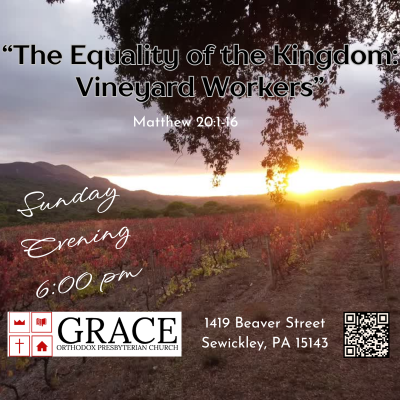
  • The Equality of the Kingdom: Vineyard Workers

    The Equality of the Kingdom: Vineyard Workers

    About this sermon

    A vineyard owner hires laborers throughout the day, from early morning to the eleventh hour, and pays them all a denarius. Those hired first grumble, though they received exactly what they agreed to. The owner answers that he has done them no wrong and may do what he chooses with what belongs to him: “Do you begrudge my generosity?” The parable teaches the great reversal of the kingdom, where the last will be first, warns against the resentment of entitlement, and displays God’s sovereign generosity. No one earns salvation; all receive it by grace.

    More sermons from Matthew · Browse all sermons

    Sermon transcript

    If you will remain standing, for our text this evening, we’re looking at Matthew chapter 20, verses one through 16, which is found on page 980 of your Pew Bibles, if you’d like to follow along with those. So this is Matthew chapter 20, starting in verse one this evening. This is God’s word.

    For the kingdom of heaven is like a master of a house who went out early in the morning to hire laborers for his vineyard. After agreeing with the laborers for a denarius a day, he sent them into his vineyard. And going out about the third hour, he saw others standing idle in the marketplace. And he said to them, you go into the vineyard too. And whatever is right, I will give you. So they went. Going out again about the sixth hour and the ninth hour, he did the same. At about the 11th hour, he went out and found others standing. And he said to them, why do you stand here idle all day? They said to him, because no one has hired us. He said to them, you go into the vineyard too.

    And when evening came, the owner of the vineyard said to his foreman, call the laborers and pay them their wages, beginning with the last up to the first. And when those hired about the 11th hour came, each of them received a denarius. And when those hired first came, they thought that they would receive more, but each of them also received a denarius. And on receiving it, they grumbled at the master of the house saying, these last worked only one hour and you have made them equal to us who have borne the burden of the day and the scorching heat. But he replied to one of them, Friend, I am doing you no wrong.

    Did you not agree with me for a denarius? Take what belongs to you and go. I choose to give to this last worker as I give to you. Am I not allowed to do what I choose with what belongs to me? Or do you begrudge my generosity? So the last will be first and the first last.

    Amen. May God add his blessing to the reading of his word. Let’s pray. Father in heaven, we come and we ask, Lord, we are needy people. We have your word before us and your servant has made preparations, but Lord, without your spirit now with us this evening, these will be dead words falling on deaf ears. We ask that your spirit would be present to make these words of truth and life alive and life to us. Ask that you would pour out your spirit on the hearer and the speaker, that you might be glorified and your people might receive your blessing. We pray this in Jesus’ name, amen. You may be seated. The title of the message this evening is Equality in the Kingdom, Vineyard Workers. And we’re looking at a series of parables as we’ve been looking lately.

    And for children or others, the words you can be listening for is sweeping, self-righteous, and sovereign. Well, have you ever felt like something was deeply unfair? That may perhaps be a child’s favorite phrase. But even when no rules were broken, maybe as you get older, your coworker with happier experience gets the same raise, or a sibling who barely tried gets the same reward you worked for. Group projects are infamous for this type of unfairness.

    And Jesus’ listeners felt this tension as well. In a world that runs on merit, hard work, achievement, and status, he tells a story this evening that we’re looking at that turns that fairness seemingly upside down. Tonight we’re looking at the parable of the vineyard workers. And Jesus said, the kingdom is heaven is like this generous master who’s going out to hire these workers all day long. And even at the very last hour and then pays everyone the same full wage.

    Now, before we get started in our passage, the word for that our passage begins with merits a little bit of context for us this evening. So it’s important that we look back into chapter 19 to find exactly the context that Jesus is giving us here. The reason he’s telling us this parable. So I’ll read actually starting in verse 16 to give us a bit of the context of where this parable is coming in. Matthew chapter 19 verse 16.

    And behold, a man came up to him saying, teacher, what good deed must I do to have eternal life? And he said to him, why do you ask me about what is good? There’s only one who is good. If you would enter life, keep the commandments. And he said to him, which ones? And Jesus said to him, you shall not murder. You shall not commit adultery. You shall not steal. You shall not bear false witness. Honor your father and mother. You shall love your neighbor as yourself.

    The young man said to him, all these I have kept, what do I still lack? Jesus said to him, if you would be perfect, go, sell what you possess and give to the poor and you will have treasure in heaven and come follow me. When the young man heard this, he went away sorrowful for he had great possessions.

    And Jesus said to his disciples, truly I say to you, only with difficulty will a rich person enter the kingdom of heaven. Again, I tell you, It is easier for a camel to go through the eye of a needle than for a rich person to enter the kingdom of God. When the disciples heard this, they were greatly astonished, saying, who then can be saved? But Jesus looked at them and said, with man, this is impossible, but with God, all things are possible.

    And then Peter said in reply, see, we have left everything and followed you. What then will we have? Jesus said to him, truly I say to you in the new world, when the son of man will sit on his glorious throne, you who have followed me will also sit on 12 thrones, judging the 12 tribes of Israel. And everyone who has left houses or brothers or sisters or father or mother or children or lands for my namesake will receive a hundredfold and will inherit eternal life. The many who are first will be last and the last first. Jesus is telling this parable in the context of this statement to illustrate his point that many who are first will be last and the last first.

    We have in this situation a young man who thinks he’s kept all the commandments. There’s no one more diligent than this young man. He may have been self-deceived, but if his life were marked with scandal, he would have hardly insisted that he had kept all those things. There would be plenty of people to call him out.

    And then Jesus reiterates his point to his disciples in that passage, that wealth, which is often a result of diligence, industry, and intelligence, has no bearing or value in acquiring entrance into the kingdom of heaven. All the young man’s riches, his self-righteous commandment-keeping, which made him first, in the eyes of all those around him, certainly in society, in the world, had made him last in the eyes of God.

    And this is the point that Jesus is driving home in our parable this evening. We’ve already seen in our look at the parables, God’s sovereignty in the parable of the soils, the mixed reality of the kingdom in the mustard seeds and weeds. and how the kingdom is worth everything, more than everything, in the treasure and the pearl parables, as well as the fact that we will be evaluated in the parable of the dragnet. And now Jesus shows us another side, equality in the kingdom, which is not equal pay for equal work, but the equality of the kingdom is undeserved grace for all. In the kingdom, equality is not based on what we deserve. It’s based on the master’s sweeping generosity. So let’s examine this evening how this story exposes self-righteous hearts and reveals God’s sovereign grace. We’ll look at this parable in three parts.

    Number one, sweeping opportunity. Number two, self-righteous resentment. And number three, sovereign generosity. Number one, sweeping opportunity. Or I think I have in your notes sweeping reversal. I went back and forth between those points. Sweeping reversal for number one.

    This parable opens with a man seeking to harvest his grapes. He needs workers for the day. And so he goes to the marketplace looking for people who can help. He’s up at dawn in the square, And he finds a group of willing workers and agrees to pay them a standard day’s wage. Denarius was a Roman coin, which was the common amount paid for about a day’s worth of work. Now today, at the minimum wage of $7.25 an hour, for eight hours, the pay would be about $60. But since a day’s work in this time went for about 12 hours, we can think of a denarius as basically a $100 bill, a single unit of money which was worth about a day’s work at minimum wage.

    So the vineyard owner finds workers right at dawn ready and eager to work in the vineyard. And however, as the day goes on in this story, for some reason the vineyard owner wants more workers. And so perhaps he was trying to ensure that all the grapes would get harvested in one day. We’re not told, but either way, every couple hours, he’s back to the marketplace to see if there are any more workers available. And every time, every couple hours, he finds more, sends them into the field, promising to pay them what is right.

    It’s only the first workers that he agrees on a set amount. It’s not stated in our story whether these workers weren’t around because they slept in. or if there was some other reason that he didn’t find them there the first time. But each time he goes back, there are more. And finally, with one hour left to the workday, the 11th hour, which if we calculate the day starting at roughly 6 a.m., which would be the first hour, and the third hour then would be 9, and the sixth hour would then be 12, The 11th hour would then be about 5 p.m. He’s still going out and getting workers. He finds more idle workers looking for something to do.

    And with these last ones, we get a snippet of their conversation in this parable. He asks them why they’re idle. And they respond that no one has hired them. It’s not completely clear whether this is meant to demonstrate that they are undesirable, no one else wants them, or they simply lacked opportunities.

    But the master offers them employment, even though there’s only one hour left of work in the day. So the first thing we can notice is the vineyard owner is offering this opportunity. This is a gift that he’s offering to these workers. Because all day he repeatedly returns to the marketplace seeking people to give them employment. And if it were not for his offer of employment, they would be sitting there all day without income and without purpose. Any of you who have recently been or currently are job hunting, or if you found your job recently threatened, you can appreciate what a privilege employment is, that these workers were happy to have this opportunity.

    The vineyard owner keeps going back, inviting workers to come in until the very last minute. And so we’re meant to see that this opportunity is offered to every worker. Every worker in the marketplace was offered a chance to come into the vineyard. But the main point here is not how badly the vineyard owner needed workers, but the way in which he kept going back and offering and gathering in all that he found, even with one hour left to go, still bringing them in.

    What might have been less clear with the first few iterations of workers is painfully obvious by the time we see the last group. Jesus’ point is not that this master was desperate for workers, but that he was extending the opportunity to all who were there, even those who were last in the world’s eyes. Those that were there with only one hour left to work. No one was turned away. All day the master was inviting his workers to come. And this highlighted This is highlighted by the conversation that we saw with those last workers.

    This is not a man in need of help, but workers in need of opportunity, and a man who is ready to invite even the last, in the world’s eyes, to be first. And at the end of the day, the owner directs his foreman, of course, to pay the workers for their work, but to start with those who came in last. and to work backwards. The last to come into work are first paid, representing Jesus’s illustration, his illustrating principle for this parable. The first shall be last and the last shall be first. Because in the kingdom of heaven, Jesus is saying, there is a sweeping reversal of the expected economy of merit and which brings wealth. Which brings us then to our second point, with which we see the self-righteous resentment of the first workers. The self-righteous resentment. The trouble starts as soon as the money is paid to the workers.

    The workers who were diligently slaving away in the field all day watch as the last-minute workers are paid first, and they receive an entire day’s wage, an entire denarius. Then the workers who only worked three hours, they also receive a denarius as well. And finally, we get to the last group who had worked all day.

    And true, they had made a contract with the owner for denarius. But they’re looking at this guy and he seems to be paying people more than they deserve. And so they started to expect that they deserved something more. The ones who worked all day diligently certainly deserve more than the others who didn’t earn their denarius. So surely the longest workers earned a greater share of greater abundance.

    But when it came to be their turn, instead of being satisfied with what they had received and had agreed to, and should have expected, they are resentful. They felt that the master’s generosity had wronged them. They became entitled. They thought the generous vineyard owner actually owed them more than he had offered them.

    Now, on the one hand, I can certainly understand how that expectation began to build. I even would start to have that idea on my own as I’m reading this story. This master is paying people what they don’t deserve. I expect he’ll give me, above and beyond, what I deserve as well. It’s pretty much human nature to think this way, applying the logic of proportionality.

    The others got more than they expected, so the first workers might expect to receive more than they might have expected. But instead, the workers find that despite the varying amounts of work done by each worker, they all received a full day’s wage. Now, if you were an employee at a company, and you found that the brand new employee is starting out at the salary above or equal to the one that you currently have, You would be a little indignant. I certainly would.

    And there might be a temptation to interpret this parable as though there are some who end up keeping all the rules, really suffering for salvation, while others have to do barely anything and still get in. I’ve heard this parable interpreted in terms of those who have lived a long life in the faith. They did all the right things. They kept all the rules. They came to Christ young. They didn’t fall into scandal. And they didn’t fall away.

    And these are the diligent workers who bore the heat of the day. They’ve come to, and this perspective comes to see the various workers as corresponding to various seasons of life in which a person might come to faith. Some come to faith early, but some suffer much in persistent obedience, while others get the privilege of a last minute deathbed conversion without any prolonged battle with sin, like the thief on the cross. just invited in at the last second, no matter having indulged a life of sin and still getting away scot-free. While the diligent workers slaved away year after year, trying to obey God decade after decade. The last minute workers got the most bang for their buck. They get away with the most money per hour, the least work for the most pay.

    But the application in this case, this interpretation of the parable would be that despite how unfair it feels, we should not begrudge God’s generosity, God’s salvation to those who receive it while having done less to deserve it. But that reveals part of the problem with interpreting the parable this way, as I have heard it done before, because this would be a big mistake. To interpret the parable this way would be to adopt the perspective of the jealous workers who got rebuked. Of course, it is important for us to not begrudge those who receive God’s generous salvation, no matter how undeserved.

    But the jealous workers viewed the situation as ultimately unfair because they had worked and they got what they had earned. They earned what they got, while the others received what they did not deserve. In reality, Jesus’ intention here The workers who grumbled in this story are not diligent Christians who did their best all their lives to keep God’s law and never fell into scandal and who also suffered grievous trials for their faith. The ungrateful workers in our story are those who fail to enter the kingdom entirely.

    These are those who self-righteously try to earn salvation for themselves. This parable catches us off guard, as it’s meant to, because if the diligent workers who earned every penny of their paycheck are actually the bad guys, this throws us off. It’s meant to be a little disconcerting. But how do we know that these are the villains of the story? These are the ones who do not make it in.

    Well, to start with, we see the word friend. If you look in our passage, verse 13, he replied to one of them who was grumbling, friend, do you know wrong? Did you not agree with me for a denarius? Now the gospel writer Matthew only uses this word two other times in his gospel. One is in Matthew 22 verse 12. If you would like to flip over and look at that. Matthew 22 verse 12, which is another parable which we’ll look at next time.

    We find here the king speaks to one of the guests that had been brought in. And he said to him, friend, how did you get in here without a wedding garment? And he was speechless. Then the king said to his attendants, bind him hand and foot and cast him into the outer darkness. So the use of the word friend here is meant to be ironic. This is not a friend, this is one who gets thrown out.

    The other use that we find in the gospel of Matthew of friend is in chapter 26. Chapter 26, verse 50. In Matthew chapter 26, verse 50, we find the scene of Judas coming to betray Jesus. In 49, verse 49, Judas came up to Jesus at once and said, greetings rabbi, and he kissed him. And Jesus said to him, friend, do what you came to do. Judas is obviously not acting like a friend.

    And the term seems to be put in irony. in which his description, this is not a special Greek word that means something else. It means the same thing in English. But we see the use in Matthew’s gospel of the word friend in the other two places of this specific irony. It’s a term of endearment in Greek, and yet Matthew uses it ironically in all three cases. So that would be one thing that would clue us in at first. this use of the word friend here in this passage.

    But then in verse 14, we see that the vineyard owner tells this one to take what is yours and go. It’s also the word that we often find depart. It’s a very curt rebuke. He’s not welcoming him to stay. He’s telling him, depart. Get out of here. Take what’s yours. Take what you earned and get out of here. None of the other workers are sent away in this passage. Only this one group of grumblers. And this group also, we notice that they receive their wages and nothing more. They are not recipients of gracious abundance in this story.

    These are those who are like the hypocrites that Jesus describes in Matthew chapter six. In Matthew six, when Jesus is talking in the Sermon on the Mount, in chapter six, he has three sections where he speaks of giving to the needy, giving alms, of praying and of fasting. And he tells his disciples to not be like the hypocrites, because they do things in certain ways. So in verse two, Jesus warns his disciples, thus when you give to the needy, sound no trumpet before you as the hypocrites do in the synagogues and in the streets, that they may be praised by others.

    Truly I say to you, they have received their reward. And again in verse 5, relating to prayer. Truly I say to you, they have received their reward. And then in verse 16, regarding fasting, he says again, truly I say to you, they have received their reward. This is very much ringing true with what we find in this passage. The Master says, take what you earned and go.

    These are the hypocrites. In their case, as Jesus described in the Sermon on the Mount, these hypocrites, they were giving to the poor, they were fasting, they were doing all these things in order to make others notice and like them. That was the reward they were earning, that they were seeking by their good deeds. They sought to earn the glory of men. And as a result, Jesus says, that’s all they got. They forfeited any glory from God.

    They’re like the workers, slaving away all day just to get what is owed them. And this is called self-righteousness. And it displaces Christ’s righteousness. Those who are self-righteous have no need for Christ’s righteousness. They’re all set. But self-righteousness is false righteousness. It does not measure up to God’s standard of righteousness. It seeks the praise of men, and that is all it gets. And look at what the self-righteousness produced in these workers.

    Resentment. The phrase at the end in verse 15, do you begrudge my generosity, could be more literally translated in the Greek, is your eye evil because I am good. It’s this great contrast between evil and good. And the master’s goodness brings out only evil from the hearts of those who on the outside looked like the most admirable.

    These are the ones who looked like they ought to be first in payment. These are the ones who looked like they actually earned the paycheck. And yet there I was evil because of the Master’s goodness. The Master says to those who are self-righteous, take what you have and go. Take the benefits that you think you’ve earned. Take what merits that you believe you have and depart from me.

    They receive a denarius in the story, but the point is not the amount of money that each one gets, but whether or not he got what he deserved or what he did not. what he had earned. In this parable, we find two categories, two kinds of workers. Those who got what they had earned, and those who got what they had not earned. The point is, you want to be in the group that gets what you do not earn. Because those who get what they have earned are sent away from the presence of God to receive their wages.

    And as Romans 6.23 says, The wages of sin is death. But contrast this, of course, with the gift of God, which is eternal life in Christ Jesus, our Lord. So finally, we see, thirdly, the sovereign generosity of the master.

    Number three, the sovereign generosity There’s no indication that any of the other workers were complaining about the inequality of wages. All except for the last group could have complained that they got less bang for their buck. But it’s only the first group that complained. They had agreed to what they were getting, and yet they complained about what they got.

    But notice that they didn’t complain to the other workers, but to the master, not who made us less. Not who made us, brought us down to their level, but you who brought them up to us. You made them equal to us. It wasn’t that the master had wronged the first workers, but that he had given others what they did not deserve, what they did not earn.

    But the owner of the vineyard invokes his sovereignty over his wealth, which entitles him to distribute it as he chooses. The first workers were paid exactly what they were contracted to get, nothing less. He did them no wrong, as he states. And they were told to take what was theirs and go. While the master asserted his right in our passage to do with what was his as he pleased.

    Verses 14 and 15 again. I choose, or it’s the Greek idea of wishing. I wish to give to this last worker as I gave to you. And we find again restated, am I not allowed to do with what I choose? With what belongs to me? This is the word for wish or for willing here in the Greek, in which we find translated in ESV as choose.

    But Jesus is highlighting the owner’s right to do as he wishes, his own sovereign freedom. And this, of course, is meant to represent God’s sovereign freedom, God’s sovereign free grace in salvation, which is stated in what God declares to the prophet Moses in Exodus chapter 33, verse 19, and which the apostle Paul quotes in Romans chapter 9, verses 15 and 16. Romans 9, 15 and 16. For God says to Moses, I will have mercy on whom I will have mercy. And I will have compassion on whom I will have compassion. So then it depends not on human will or exertion, but on God who has mercy. It didn’t matter how long the workers had worked. What mattered was how much the master wanted to pay them.

    But the Bible’s teaching on the sovereignty of God and salvation makes many people uncomfortable. One reason for this is that people can start to think of God owing salvation to people, to those who are lost. It seems unfair for God to withhold salvation from some people while he gives it to others. How could a loving God withhold such a necessary thing from those who will perish without it?

    But the Bible’s ultimate answer to that question is, God gets to do what God wants to do. He’s free to show mercy to whom he chooses. And he repeatedly insists that his choice has nothing to do with the worthiness of an individual, since all who receive his mercy do not deserve it. In order to avoid the uncomfortableness of this truth, some have tried to place limits on God’s sovereign freedom to do as he pleases. They’ll speak of man’s free will as somehow limiting God’s ability to work in the world or in the hearts of men and women in rebellion against him. But the Bible repeatedly rejects any limits upon God’s sovereignty and salvation. In the end, the choice lies with God and God alone. This is the biblical teaching about God’s sovereign, the sovereign grace of God in all its awesome beauty. There is nothing anyone can do to force God’s hand.

    The choice to show you mercy and to save you is his and his alone. The scary part is you have no say, nothing in yourself that you can leverage against God to constrain him. You have no claim to mercy in yourself. But this is also the comfort. Because a gracious salvation, which you cannot do anything to earn on your own merits, you also cannot lose on your demerits. When God chooses to show you mercy, it had nothing to do with what you could earn. And so there’s no way for you to unearn it either.

    God loved you. And he gave you what you didn’t deserve because of what Jesus earned. It is his riches in Christ Jesus, which he pays out to those who do not deserve a full day’s wage. Your salvation rests upon God’s generous goodness, which never changes. And he gives to the most undeserving. Those who think that they deserve his mercy are the least likely to get it. While those who know fully that they don’t deserve one bit of it, find themselves drowning in riches.

    In the kingdom of heaven, the first will be last and the last will be first. This parable catches us off guard because the good workers turn out to be the villains. Their hard work and long hours become a barrier to them trusting in the master’s kindness. Self-righteousness on their part produces resentment, but sovereign grace, on the other hand, produces gratitude.

    Tonight, if you’re here and you feel offended at how God freely saves late sinners, undeserving people, those that do not deserve God’s grace, examine your heart. You don’t wanna be standing with the grumblers. But if you know tonight for yourself that you have nothing to offer, If you come to Jesus early or late, with a clean past or erect one, you simply receive his mercy. If you know that you are drowning in riches that you don’t deserve, that is the sovereign generosity of God. He has mercy on whom he will have mercy. You cannot earn it, but you cannot lose it.

    The good news is this, that Jesus worked the full day in our place. He bore the scorching heat of God’s wrath, so that the latecomers, those invited after standing in the market all day, and those that were starting at three, at the third hour, could receive the same full reward, eternal life. And the vineyard is still open. The master is still going out. Even at the 11th hour saying, you come into the vineyard too. So come to him today.

    Receive him if you don’t, receive what you don’t deserve. Full forgiveness, full acceptance, eternal life in Christ. In the kingdom, the equality in the kingdom means that everyone gets undeserved grace. Amen. Let’s pray. Our Father in heaven, we thank you that you freely give what we cannot earn, what we do not deserve.

    We thank you that Jesus Christ is our righteousness. We thank you for your sovereign generosity in choosing us in Christ before the foundation of the world. So there’s nothing that we can do to argue for our acceptance. There’s nothing we can do to make you change your mind. We thank you for this in Jesus name, amen. In response, let’s turn and sing hymn 427. Let’s stand and sing hymn 427, I sought the Lord and afterward I knew.

    The sermon text provided above is derived from the sermon audio recording making use of generative tools. It has not been manually edited. While transcription tools have a high degree of accuracy, the output may include generative textual, punctuation, and/or formatting errors.

  • The Value of the Kingdom: Treasure, Pearls, and Nets

    The Value of the Kingdom: Treasure, Pearls, and Nets

    About this sermon

    The kingdom of heaven is like treasure hidden in a field, which a man sells all he has to buy, and like a pearl of great value for which a merchant, an expert in pearls, gives everything. Others may not see its worth, but the kingdom is worth everything else. The parable of the net adds that at the end of the age the angels will separate the evil from the righteous. In the end what matters most is not what people think of God but what God thinks of them, though what they think of him shapes where they stand before him.

    More sermons from Matthew · Browse all sermons

    Sermon transcript

    Our text this morning is from the Gospel of Matthew. Matthew chapter 13, verses 45 through 52, which you can find on page 974 of your Pew Bibles there. Matthew chapter 13, verses 45 through 52. Hear now the word of God. Starting in verse 44. The kingdom of heaven is like treasure hidden in a field, which a man found and covered up.

    Then in his joy, he goes and sells all that he has and buys that field. Again, the kingdom of heaven is like a merchant in search of fine pearls, who on finding one pearl of great value, went and sold all that he had and bought it. Again, the kingdom of heaven is like a net that was thrown into the sea and gathered fish of every kind.

    When it was full, men drew it ashore and sat down and sorted the good into containers, but threw away the bad. So it will be at the end of the age, the angels will come out and separate the evil from the righteous and throw them into the fiery furnace. In that place, there will be weeping and gnashing of teeth. Have you understood all these things? They said to him, yes. And he said to them, therefore, every scribe who has been trained for the kingdom of heaven is like a master of a house who brings out of his treasure what is new and what is old.

    Amen. May God add his blessing to the reading of his word. Let’s pray. Lord, we would come into your presence and we would ask you to Give us your blessing. Lord, without your spirit, this word, which is living and life-giving, is death to us. We ask that you would give us your spirit, the spirit that inspired this word, that it might be present and give us ears to hear and hearts to believe and treasure what you have for us this morning. We pray this in Jesus’ name, amen. You may be seated.

    On July 2009, an ordinary farmer’s field in Staffordshire, England, quietly surrendered one of the greatest archaeological discoveries in British history. Amateur metal detectorist Terry Herbert, a member of the Blockswitch Research and Metal Detecting Club, was sweeping his detector across Fred Johnson’s field. near Brown Hills when his machine began to sing.

    What emerged from the soil was astonishing, more than 1,500 glittering items of gold and silver and precious stones, the largest hoard of Anglo-Saxon treasure ever found in Britain. The pieces dating back to the seventh century were breathtaking in their quality. Most were connected to warfare, ornate sword hilts, helmet fragments, and battle crests, suggesting they once belonged to royalty or high-ranking noblemen.

    Terry rushed to tell the landowner, Fred Johnson, exclaiming that he had found a Saxon hoard. Johnson, skeptical at first, laughed it off. But when he saw the exquisite craftsmanship coming out of the ground, he quickly realized this was no ordinary find. It’s better than winning the lottery, Terry had said, and he was right.

    The experts were left in awe. Archaeologist Dr. Kevin Leahy, who helped catalog the find, admitted that he was losing sleep over its beauty and historical importance. It’s astonishing, he said. We’ve actually been scared by the responsibility of dealing with this material.

    And the horde cast dramatic new light on a powerful Anglo-Saxon kingdom, revealing the wealth and warrior culture of kings at the time. It was valued at roughly 4.45 million in today’s dollars. The treasure was declared property of the crown. The money for the treasure was split equally between the finder, Terry Herbert, and the landowner, Fred Johnson. Museums in Birmingham and Stoke-on-Trent raised the funds to purchase them for the nation to enjoy. Now, if only Terry had kept the secret and bought the field himself, he wouldn’t have had to split the proceeds.

    Today, in Matthew chapter 13, Jesus tells three short stories about that kind of discovery, and two short stories about that kind of discovery, and one final story that shows why this discovery matters more than anything else in the world. Jesus compared the kingdom of heaven as we’ve been seeing in our parables to seeds and yeast and fields and fishing nets. But in our passage, Matthew 13, 44 to 52, he focuses on one central question. How much is the kingdom of heaven worth to you? Through these images of hidden treasure, a priceless pearl, and a dragnet at the end of the age, Jesus calls us to see the supreme value of knowing Him.

    And He warns us also that what happens if we don’t. We’ll consider our passage this morning under three headings. Number one, the value that others don’t see. Number two, the value worth everything else. And number three, the final valuation. Number one, the value that others don’t see, verse 44.

    Verse 44, the kingdom of heaven is like treasure hidden in a field, which a man found and covered up. Then in his joy, he goes and sells all that he has and buys that field. He buys that field for the sake of the treasure. Only he understands the value. His friends and neighbors probably thought he was crazy. He spends his entire life savings, sold all his property to buy some old field.

    I mean, having a field might be nice. But if you sell everything that you have just to buy the field, what are you going to do with it? You won’t have any money to build on it, or to plow it, or to do anything else. You’ll own a field and nothing else.

    But this man knew something about that field. He knew its hidden value. What was buried in this field was worth more than all of his earthly possessions combined. And in this parable, this man buys something with hidden value. This treasure would allow him to purchase anything he needed after he had sold all that he had. And once he has the field, the hidden treasure, he’s set for life. And knowing that he had made this bargain of all bargains made him ecstatic.

    Now perhaps you’re wondering a little bit about the ethics of this transaction. And it seems to have been an occasional practice in that time period for wealth to be stored in the ground. In times of danger perhaps, like an invading army or some other reason, But there was always a chance that the owner would have to flee or might be killed in such a case without retrieving that treasure. Normal people don’t leave maps with clues to the treasure’s whereabouts. So if the owner was killed or forgot about it, the treasure could easily become lost as it was in this field. Now, in a case of unclear ownership, there seems to have been a bit of a finder’s keeper’s rule, as best we can tell in this society. And yet, if this man was digging in a field that was not his own, perhaps he was working for someone else. There might have been a dispute about the ownership.

    But by buying the field outright, as Jesus says, the man heads off any claim any ownership claims that might arise from the discovered treasure. He wouldn’t have had to split it with the landowner or lose it altogether. That being said, I still don’t think that Jesus is establishing a precedent for how land purchases and finder’s keeper ought to work.

    Jesus’s point is a man’s joyful discovery. Joyful discovery and then his actions to acquire such a treasure. Because notice it says, then in his joy he goes and sells all that he has. Because contrast this with Jesus’ later interaction with a young man in Matthew chapter 19. In Matthew chapter 19 verses 16 through 22, we come to a rather different story.

    Here we have another young man, Matthew 19 verse 16, And behold, a young man came up to him, saying, Teacher, what good deed must I do to have eternal life? Jesus said to him, Why do you ask me about what is good? There is only one who is good. If you would enter life, keep the commandments. He said to him, Which ones? Jesus said, you shall not murder, you shall not commit adultery, you shall not steal, you shall not bear false witness, honor your father and mother, and you shall love your neighbor as yourself. And the young man said, all these I have kept for my youth. What do I still lack? Jesus said to him, if you would be perfect, go sell what you possess, give to the poor, and you will have treasure in heaven and come follow me.

    And when the young man heard this, he went away sorrowful because he had great possessions. This man found the prospect of selling his possessions provoked sadness and proved to be a barrier, not a path forward. His multitude of possessions, rather than presenting a path to procuring the kingdom, proved to prevent his entrance. The young man couldn’t see the treasure in the field. All he could see was simply an overgrown field that wasn’t worth purchasing.

    This young man came to Jesus looking for one final good work to round out his resume and assure himself of eternal life on top of having everything else. But Jesus made it clear to him that eternal life is not something that can be earned or achieved that way. It’s not found in something you can perform. comes from a person, Jesus Christ. The young man was talking to the one who is life, but he missed it because he was looking for a way to earn it. It was a gift. It’s a gift to be desired above all else.

    And the young man found that he didn’t value eternal life as much as he thought he did. because he didn’t value it as worth more than all of his possessions combined. He wanted just to purchase it with a few more good deeds. To him, following Jesus looked like loss rather than gain. He wanted eternal life as an addition to his wealth, not something worth more than all of it.

    But that is not the case with this man in our parable this morning, who finds the treasure in the field. This man sees the treasure, so he sells everything that he has. Nothing he possesses can compare to the treasure of eternal life. The point of the parable is not that eternal life can be purchased, but it’s the way that the man values it.

    He sells everything he owns out of pure joy. One man went away sad because he had many possessions when proved with the prospect of selling them all. One man sold them in pure joy because of what he values. Because if Jesus is everything, once you have Jesus, Even if everything else is taken away, you still have everything left. The man buys a field for the sake of the treasure that’s buried there. And this is a picture of faith. Faith sees something that others can’t see. It saw the hidden riches in the field.

    Philippians 4.19, Paul tells The believers there, and my God will supply all your needs according to his riches in glory in Jesus Christ. The buried treasure would cover all of that man’s needs in the parable. So he didn’t need to worry about holding anything back. He joyfully got rid of everything he owned, convinced his needs would be completely provided for with the treasure that he had in the field.

    And a Christian is someone who has discovered that Jesus can fulfill all his needs. But of course, especially our greatest need, which is a restored relationship with God. Without Jesus, no matter how much earthly wealth and comfort we accumulate for ourselves, we’re still disconnected from our purpose for living. We weren’t made to be robots running around or animals chasing the next temporary comfort or pleasure. We were made to enjoy God, enjoy true riches.

    Which brings us to our next parable about a pearl dealer. Number two, a value worth everything else, verses 45 and 46, we see, Again, the kingdom of heaven is like a merchant in search of fine pearls, who in finding one pearl of great value, went and sold all that he had and bought it. Just a bit of trivia, I learned when studying this passage that the Greek word for pearl is margaritas, which is where we get the name Margaret, which means pearl. I don’t know if we have any Margaret’s in the congregation, but the name Margaret means pearl of great price as we’re looking this morning. The previous parable dealt with a man who discovered an invaluable treasure accidentally, but he was immediately aware of its value.

    But in this parable, this second one, we have a man whose whole career is built around the procurement of beautiful pearls. He’s spent his life searching. He knows what he’s looking for and he understands the market value of pearls. His livelihood is built around buying and selling these precious jewels. His career depends upon his ability to understand what each pearl will fetch in the marketplace. But he could have been good at his job, even excellent, and have still no appreciation for the beauty for its own sake. This man could be in it purely for the money. As a merchant, he would still be good at his job.

    But as we see in our story, he is clearly not. For him, it’s the exact opposite. Because once he finds that pearl above all pearls, he’s captivated. His heart is caught. And we quickly see that he not only buys and sells pearls, but he is a true connoisseur of pearls, desiring the beauty of them, and especially that one. And this was a parable for me that I often puzzled over in the past. If the merchant was able to purchase the pearl with everything that he owned, why would he want to do that?

    He would seem to have netted zero. He didn’t make a profit. The previous parable involved hidden treasure, hidden value, that would make his purchase of the field quite profitable. But here it seems as though instead of liquidating, the merchant is consolidating.

    He’s unliquidating his assets and tying them all up into a single possession, a single pearl. Something he could not eat or use. Instead of turning his valuables into cash, he’s turning all his possessions into cash, and then turning that cash into a single, most beautiful, valuable pearl above all pearls. The word describing the valuable pearl is polotimos, which is literally much honor or very valuable.

    And it occurs in two other places in the New Testament. Only two other places. We find it in John chapter 12 verse 3 where it’s used to describe the ointment that Mary poured on the feet of Jesus. It says, Mary therefore took a pound of expensive, very precious, very valuable ointment made from pure nard and anointed the feet of Jesus and wiped his feet with her hair. The house was filled with the fragrance of perfume.

    In this story, we find a few verses later that Judas remarks that the use of this perfume was not justified. It would have been better turned into cold hard cash since it was worth three years worth of wages, which is today as much as a house. John notes that Judas’ rebuke, however, was based partly in his own intention to skim off some of that cash, supposedly for the poor, for himself. But Jesus also rebukes Judas for thinking purely in monetary value and missing the bigger picture.

    Mary valued Jesus so much that she expected the most expensive thing that she owned. upon him to display how much she prized him. The other place that we find this word of very valuable or much honor is in 1 Peter 1, verse 7. To describe the faith of believers, Peter says, so the tested genuineness of your faith, more precious or very valuable than gold that perishes though it is tested by fire. It may be found to result in praise and honor and glory of the resurrection, revelation of Jesus Christ. This faith is our connection to Jesus. And that’s why it’s so precious, Peter says. Nothing else compares the absolute worth of possessing Christ through faith.

    You were created to commune with the triune God the creator of the universe. Jesus said in John 17, verse 3, and this is eternal life, that they know you, the only true God, and Jesus Christ, whom you have sent. Eternal life is not merely a life that continues for an infinite amount of time. Plenty of authors of books and stories understand that merely persisting in a life like we have now is not a completely pleasant prospect.

    Many fictional characters who possess immortality find it to be a curse rather than a blessing. And one reason for this is because immortality in that sense often involves separation from loved ones who die one by one. Yes, these characters never die, but they soon find that there is more than one way to die. And continuing on forever separated from loved ones feels like less like a blessing and more like a curse.

    But that is not the biblical picture of eternal life or definition. Eternal life is not merely continuing in existence. Everyone does that. Death is not the end for anyone. Rather, eternal life is rich, sweet, deep fellowship with the source of all life, Himself, Jesus Christ. And you don’t have to die to wait. You don’t have to wait to die for it to start. Eternal life can start now by faith.

    Paul, describing it in Philippians again, puts it this way in Philippians chapter three, verses eight through 11. Paul reflecting on possessing eternal life in Jesus. He says, indeed, I count everything as loss because of the surpassing worth of knowing Christ Jesus, my Lord. For his sake, I have suffered the loss of all things. and count them as rubbish in order that I may gain Christ and be found in Him, not having a righteousness of my own that comes from the law, but that which comes through faith in Christ, the righteousness from God that depends on faith, that I may know Him and the power of His resurrection, may share in His sufferings, becoming like Him in His death, so by any means possible I may obtain the resurrection from the dead.

    That’s what Jesus wants us to understand about this pearl merchant who liquidates his entire fortune in order to purchase and consolidate into a single pearl that makes everything else in the world to him seem worthless by comparison. Once the merchant had laid eyes on this one pearl, There was no going back. He lost interest in all other pearls. It didn’t matter how many pearls he had anymore. He had to get this single one. It was worth more than all the others combined to him. The man who bought the field knew that the hidden treasure would be worth more than all he owned and would supply all of his needs. The pearl merchant discovered the pearl, which was so beautiful and valuable. was the only thing worth possessing to him. But then we see Jesus give a third parable, which takes this idea of valuing something, as the first two do, and flips it around a little bit. Number three, the final valuation. Verses 47 through 50.

    Again, the kingdom of heaven is like a net that was thrown into the sea and gathered fish of every kind. When it was full, men drew it ashore and sat down and sorted the good into containers, but threw away the bad. And so it will be at the end of the age. The angels will come out and separate the evil from the righteous and throw them into the fiery furnace. In that place, there will be weeping and gnashing of teeth.

    The net described here is specifically, we might say, a drag net. It’s a specific kind of net, a net that would have weights that would sink it down to the bottom of the sea while the fishing boats held the top of it and would draw it towards land. The boats would sail towards the shore, dragging the net between them. Once the water was too shallow for the boats, the fishermen would jump on either side and haul the net up onto the shore. And this would, of course, capture all of the fish that were in that area, not allowing any to escape.

    It would be the most efficient way of fishing at the time, and many boats and fishermen still use it today. So Jesus is saying this common sight that they would have seen many of his disciples even use themselves as fishermen is a picture of the day of judgment. Someone could easily hear the first two parables and think, well, good for those people, good for them. I guess they got lucky.

    But I’m personally not that interested in looking for hidden treasure or valuable pearls. I’ll leave that to them and I’ll live my life now and go on as I please. This type of person today might say, well, religion is nice if you’re into that sort of thing. It’s just not for me.

    Frankly, I meet people like this all the time, especially when I’m doing evangelism. But it’s for this type of person that Jesus tells this third parable. Here there’s an ultimate evaluation of every person by God. The first two parables invite us to choose the kingdom, and the third one reminds us that one day the kingdom will choose us. Jesus described a dragnet, the kind that his listeners knew well. It swept everything in its path, the good fish and the bad, and at the shore the fishermen sorted them. The good were kept and the bad were thrown away. And the question is, how will you be evaluated? Are you a good fish or a bad one?

    The net will drag everything in. Nothing will escape. The unbeliever tries to comfort himself with the possibility of somehow escaping, avoiding accountability for his crimes. But there will be no escape. The net has no holes. and it covers the entire world. Every last person will be caught up and dragged before the judgment seat. The fish will be sorted. They will be evaluated by the fishermen, not the other way around. The fish aren’t choosing which fishermen they like. You will not be the decider.

    Your valuation of God’s kingdom, of Jesus Christ, is irrelevant to his worth. but it is indicative of your own eternal destiny. In the end, what matters not so much is what you think of God, but of what He thinks of you. Is God your friend or your enemy? And yet, at the same time, this does not mean that what you think about God is irrelevant, of course.

    It’s highly relevant. It’s simply irrelevant to God’s position but it is of utmost relevance to your position before God, since it is God who will be dragging the net over all the earth to catch all the fish, and it is God who will be sorting each of the fish. And here’s where we see the relevance of the first two parables, because they portray the response of the good fish. The good fish are those who by faith recognize the matchless worth, the dazzling beauty, the unparalleled value of Jesus Christ. Matthew 16, 24 through 27 highlights this for us.

    Jesus then told his disciples, if anyone would come after me, let him deny himself and take up his cross and follow me. For whoever would save his life will lose it, but whoever loses his life for my sake will find it. For what will it profit a man if he gains the whole world and forfeits his soul? What will a man give in return for his soul? For the son of man is going to come with his angels in the glory of his father, and then he will repay each person according to what he has done.

    As we saw with the parable of the dragnet, the fate of your soul hangs in the balance, eternal life or perishing, saving your soul or forfeiting your soul. It’s pretty hard to put a value on your soul, your eternal destiny. But how could never-ending suffering, forfeiting your soul, ever be worth trading anything that you could possess in this life? Jesus says, don’t trade anything you possess for your eternal state, enduring the wrath of God for eternity. Because in Jesus Christ, he’s made a way to escape the wrath of God. and find eternal life, to have fellowship with God for eternity. And that is something worth giving up everything in this life, even life itself.

    Verses 51 and 52, Jesus asks the final question. Have you understood all these things he said to them? Yes. And he said to them, therefore, every scribe who has been trained for the kingdom of heaven is like a master of a house who brings out of his treasure what is new and what is old. Jesus asked his disciples if they’ve understood his teaching. They say yes. And surprisingly, he doesn’t argue. He finishes up with a final parable or an extended simile, at least.

    During his ministry towards the end of the Gospels, we see Jesus give very pointed, harsh critiques to the scribes and the Pharisees of his day, who had missed the point of the Old Testament, which they were supposed to be experts in. But he’s not against the idea of scribes generally, just against bad ones.

    And here Jesus describes scribes who are trained for the kingdom of heaven. These scribes have understood that the whole Old Testament has been pointing to the culmination of God’s revelation in the arrival of Jesus Christ. And thus these scribes are able to provide insight from the old by looking back and shining the light of the new onto the old. They’re like a master of a house who brings out old and new from his treasures. The Old Testament is not meant to be left behind, but illuminated by the clarity of the new revelation which comes in Jesus Christ. Jesus says his disciples who understand are like scribes of the kingdom.

    These are like a wealthy connoisseur of valuable items, perhaps from travels all over the world. who loves to share them with his guests, invites them over and says, look at this one, which I’ve had for a very long time, but also this one that I just picked up from my trip to India or China or some far off region in the world. And I think this is a good metaphor for what we ought to be seeing in preaching today. On the one hand, the same old truths that have always been there, We don’t want to be inventing new doctrines, but on the other hand, it ought to be presented in a fresh way. Good teaching doesn’t invent new truths.

    It faithfully brings the old truths of scripture in a fresh, joyful way that points to Jesus. So tying this all together, Jesus this morning has shown us three pictures of the kingdom. Hidden treasure worth selling everything for. A pearl so beautiful it captures the heart. And a final sorting where only what is valuable remains. The question he leaves us with is simple. Do you see its value? Will you respond with joy and wholehearted surrender? One day the net will come ashore. Make sure that when it does, you are found among those who belong to the King.

    Amen. Let’s pray. Lord Jesus, you who are the pearl of great price, worth selling everything that we have to have possessed you by faith. We ask that you would give us the faith that we need. Give us eyes to see the hidden treasure. Give us eyes to see the pearl above pearls and to value you for who you are. We ask that you would do this for your own sake, for your glory. In Jesus’ name, amen. In response, let’s turn and sing hymn 538, Number 538, take my life and let it be, and let’s stand as we sing this final hymn.

    The sermon text provided above is derived from the sermon audio recording making use of generative tools. It has not been manually edited. While transcription tools have a high degree of accuracy, the output may include generative textual, punctuation, and/or formatting errors.