
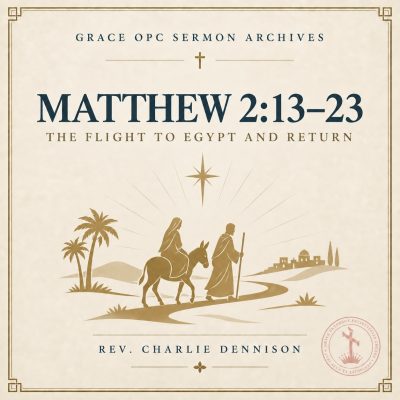
This sermon is from the Rev. Charles G. Dennison sermon archive, part of the “Matthew 2:13-23” series, and was preached at Grace Orthodox Presbyterian Church in Sewickley, PA, during a worship service on Sunday, March 3, 1996.
when he saw that the mark of a wise man was exceeding wrong, forth and slew all the children that were in Bethlehem, and in all the coasts thereof, from two years old and under, according to the time which he had diligently inquired of the wise men. Then was fulfilled that which was spoken by Jeremiah the prophet, saying, In Ramah was there a voice heard, lamentation and weeping, a great mourning, Rachel weeping for her children, would not be comforted, because they are not. But when Herod was dead, behold, an angel of the Lord appeareth in a dream to Joseph in Egypt, saying, Arise, and take the young child and his mother, and go into the land of Israel, for they are dead which sought the young child’s life. And he arose, and took the young child and his mother, and came into the land of Israel. But when he heard that Archelaus did reign in Judea in the room of his father Herod, he was afraid to go thither. Notwithstanding, being warned of God in a dream, he turned aside into the parts of Galilee. And he came and dwelt in a city called Nazareth, that it might be fulfilled which was spoken by the prophets, he shall be called a Nazarene.
Before I begin my message this morning, before we pray, I would like to make mention of the fact that Mike Cummins is waiting for word this week concerning a job. He is one of three finalists for a job, and he would very much like to have this job. If you would remember Mike in your prayers in the coming week, he would appreciate it greatly.
Father, again, it is your word that a triumph for you and surely your Word has triumphed in us. Are we not here this morning, O God, because of your Word, because of the work of your Word in our hearts? We thank you for that work, for the blessing of your Spirit which has made the perpetual, and we ask, Father, that you might be kind to us as we have occasion to be in your word and to hear it as well as to read it. According to our expectations, O God, bless us that we might prove to be your people indeed. We ask this in Jesus’ name, who is himself the living word.
Amen. This morning, we draw to the end of our messages on Matthew 2, verses 13 through 23, a series in which we have attempted to answer this question, how are we to hear and read our Bibles? My encouragement to you has been that as you hear and read your Bible, you let your mind go. That is to say that you listen for the possibilities in the text.
In other words, keeping always before you the overall pattern of the scriptures, we believe we find that in the development of the covenant of grace and its opening up for us the truth of God’s intention, as well keeping always in firm grip our hold upon the Church’s tried and true confession of the content of Scripture. At the same time, we should rightly give ourselves over to the adventure of approaching our Bible with an open mind. a mind alert to the various connections to and associations with other parts of Scripture. Always, as it were then, comparing Scripture with Scripture as we study the Word of God. In this, and with a helpful guide to labor with the Scriptures before God, we will mature not only in our ability to hear the word, but also to live in and from that word.
Thus far we have moved through the first two sections of this passage, verses 13-15 and also verses 16-18. Now we focus on the last verses, verses 19-23. It is important to say at the outset that what we find here is consistent with what we have found in the earlier sections. Thus, as we look at this passage as a whole, we are aware of its cohesiveness. It hangs together.
For instance, We are once more dealing with the Dreaming Joseph here in the latter verses, just as we were in the opening verses, verses thirteen through fifteen. This Dreaming Joseph, of course, is not the only Dreaming Joseph in the Bible. brings to mind the other Dreaming Joseph that we find set before us in the book of Genesis. That one also went down into Egypt, you will recall. But the connection of the Dreaming Joseph forces us to deal not just with the similarities between the two, but with the differences that exist between the two. The main difference is that the Old Testament Joseph dreamed dreams about himself, or so it seems, while the New Testament Joseph dreams dreams in which the child Jesus is the central figure. Our point being that, as we put the two dreaming Josephs together, Even the dreams of the Old Testament Joseph were about that central figure in the dreams of the latter Joseph. The Old Testament Joseph was therefore not dreaming about himself in the final analysis. Rather, he was dreaming about that figure who stood central in the dreams of the latter-day Joseph.
Another connection that we noted earlier is reinforced for us here in the last verses of this chapter, verses 19 through 23. And that is the connection of the Exodus. This is a dominant theme for the entirety of the passage. It gives to the passage an overall movement and development, as we move through the account of the descent of this unique family into Egypt and then out of Egypt. The Exodus connection is therefore evident for us in these latter verses, as Joseph brings the family over which he has been set back into the land of Israel.
But this Exodus connection is also evident in verse 20, where the Lord tells Joseph that those who sought the child’s life are dead. You may let your mind go back to those earlier chapters in Exodus. Think about what is stated there, particularly what is said in Exodus chapter 4, verse 19. For there the Lord tells Moses that all the men who were seeking your life are dead.
There is a parallel between what we find in Matthew 2.20 and what we find in Exodus 4.19, thus linking the two exoduses. The intention of this parallel between the story of Jesus and the story of Moses in their respective exoduses is obvious. Just as Moses was able to return from Midian to Egypt and save his people, so Jesus returned from Egypt after Herod’s death to Israel, where he will save his people. But as in the case of the dreaming Joseph, so also in the case of the two Exoduses. We have the parallel, but we also have stark contrast.
In the New Testament Exodus, the Pharaoh lives in Israel, not in Egypt. And the return of the Deliverer is not to Egypt to effect a social and political salvation for the people of Israel. Rather, the return of the New Testament Deliverer is to Israel itself for the purpose of effecting a greater salvation still, that of saving his people from their sins.
The message should be clear to us. From Matthew’s telling of the story, by the inspiration of the Holy Spirit, by his framing of this story, Israel itself has become an Egypt with its own Pharaoh. The upshoot of this is something along the lines of what we find in Paul’s letter to There is none righteous, no, not one, not even if you be of Israelite descent. Even Israel is corrupt.
Israel is itself in need of a greater exodus through one greater than Moses. For the people of God must be led out of their bondage to sin they must be freed from the wages of their sin, namely death. In all of this, once more you will notice that as the Son of God was the true central figure in the dreams and the experience of the Old Testament Joseph, that the Son of God is also the true and central figure in the life and in the experience of the Old Testament Moses. Moses and the Old Testament Exodus point to and serve the final exodus and the Son of God, through whom that final, consummate, glorious exodus is accomplished.
Here is how you should understand your Bible. Here is how your Bible becomes greatly useful and beneficial to you. As you approach your Bible, and let your mind go, so that as you hear a word in one text, you allow your mind to run to others, and then You work with the connection, drawing out the parallels and also noting the contrasts, and that for your benefit, that you all might be mature in your faith. Yes, hearing the Bible, reading the Bible, studying the Bible, takes concentration, and hard work. Won’t you work at it? These are the words of life for you. Won’t you work at it? Am I speaking mysteries to you today? I hope not.
We’ve been over some of this material. I don’t mean to insult you with it by bringing it up again, but is it obvious to you as we make these connections, we hear of one dreaming Joseph, we remember another. It’s imperative that we work out the relationship between the two.
We see things in a text that remind us of the exodus. We think of the first exodus, do we not? We are driven to it. in order to draw out the connections and then understand the contrasts and work with the entirety to the betterment of our souls, the improvement of our spiritual life, our discernment, that we might be full in and with the Word. of the two Josephs and the two Exoduses, what we find in these latter verses, verses 19 through 23.
And here we’ve made some progress in the history of redemption, in that the language here will remind us of the exile experience of the people of God, and the expectation of restoration for them. Now, already the exile and restoration have been introduced to us. We know the time period in view, do we not? the sixth century B.C. as the territory of Judah is overrun by Babylonians and the children of Israel are taken away into captivity, this event as important for our understanding of this text as the Exodus itself. But already the exile and the restoration have been introduced to us in these verses. first generally in that the descent into Egypt by this family, or for that matter by the Israelites themselves, is seen as a prototypical exile, and the ascent out of Egypt as a prototypical restoration. The two are brought together so that you read them in light of each other. The exodus experience, the going down into Egypt, the coming up out of Egypt, is a prototypical exile and restoration, already telegraphed to us in the past.
Even in the Old Testament, these two events of the Exodus and the exile are joined together. But the exile and restoration are now even more explicitly seen in these final verses in chapter two. First of all, they are more explicitly seen in the last verse. and they came and resided in a city called Nazareth, that what was spoken through the prophets might be fulfilled, he shall be called a Nazarene.”
We have already, in earlier messages, explained this difficult text. We have pointed out that we will not find these exact words, he shall be called a Nazarene, in any Old Testament passage. It doesn’t appear. We also noted that this verse, while not the quotation of any one particular verse from the Old Testament, is actually a compilation or summary of the intention and meaning of many. Particularly, the intention of this statement from Matthew finds its basis in many passages in Isaiah’s prophecy. I have in mind the opening of Isaiah chapter 11, the very first verse. There is an Old Testament word that appears there that is to be connected with this word and title, Nazarene, that we have at the end of chapter 2. That word is Nazir. It is the Old Testament or the Hebrew word for shoot or branch.
Isaiah 11-1 speaks about a shoot springing forth from the stem of Jesse. You see what has happened. In the prophet’s mind, he anticipates the exile and the destruction of the divinic line, the line of Jesse. But he is here declaring that there shall be a shoot that springs forth from the stem of Jesse, a branch that will bear fruit. This language is especially meaningful, therefore, against the background of the common expected exile. Although Israel will go into exile and into death, she will be restored to her true religious purpose in and through the branch, the Maseer.
Later in Isaiah, the Lord will speak about his preserving chair by which he shall rescue a remnant and restore his people from exile. The word that is used repeatedly by Isaiah in those texts is a derivative of this word naseer, shoot or branch. It means protected one or preserved one. It appears specifically in Isaiah 42 verse 6 and again in Isaiah 49 verse 6. The point of this, the point of all of this is as follows, the Old Testament exile finds its true restoration in the preservation of God’s true shoot and branch, his own dear Son. Jesus Christ is the true remnant, preserved and restored. Jesus Christ is the life brought out of the dead stump of Jessica. He is the one in whom judgment and death are brought to an end for the people of God, so that there cannot be any further exile for them.
In this way, the exile and restoration in Jesus Christ stand in contrast to the exile and restoration found in the Old Testament. That exile and restoration were hardly adequate. In fact, they stand painfully short of what Isaiah and other prophets envisioned.
However, the exile and restoration found in Jesus Christ is perfect, for by it we are brought into the eternal kingdom and into enjoyment of its indiminishable blessings. But this matter of the contrast between the two exiles and restorations introduces a second way in which the whole matter of the exile and restoration is explicitly introduced in these latter verses. Here I call your attention to verse 22. And the fact that the child Jesus experiences and exile in miniature after he has returned to.
We could see exile and restoration in his descent into Egypt and his restoration to the land of Israel, but once he comes back into Israel, there’s this further exile. Not only then has he been exiled into Egypt in the previous verses, but now, because of the threat of Archelaus, Herod’s son, he is exiled, as it were, once again, this time into Galilee. Why Galilee? What’s going on? Galilee has special meaning. Turn over to Matthew 4 verse 15. Here you have Matthew quoting from Isaiah once more. He’s quoting from Isaiah chapter 9. Verse fourteen, and this was to fulfill what was spoken through Isaiah the prophet saying. Verse fifteen, the land of Zebulun and the land of Naphtali by way of the sea beyond the Jordan. Galilee of the Gentiles. Galilee is here associated with the Gentiles.
This is the region for the majority of Jesus’ ministry during his life here, an environment touched by Gentiles. It will be the majority position and environment for the ministry of the Church of Jesus Christ as he ministers in the Spirit. Galilee is identified with the Gentiles. It is the region for the majority of Jesus’ ministry during his life here in the flesh. It is that region from which he shall disperse his church. At the end of this very gospel, from a mountain in Galilee, he commissions his disciples and his church in those disciples to teach and to baptize the nations. Here is the point.
The Old Testament exile had as its specific focus the judgment of God’s people. as they are taken away into captivity among the nations. The New Testament exile in Jesus Christ has as its focus the blessing of God’s people from among all the nations as Christ’s Church is sent in Christ unto service unto the ends of the earth. The preservation and success of the branch and remnant of Jesus Christ guarantees the preservation and success of his Church, with whom Christ abides, in whom the Church resides. Here is how you are to listen to the Word of God.
The Word of God is not, first of all, about your personal problems. It’s not, first of all, about what is specifically troubling you. It is about what troubles God. And as it is worked out before you, you are compelled to take seriously the connections which God makes himself within his word that you might understand its depth. And the marvel is that when you understand what God is saying, your own problems seem to be resolved. Here are the greater and grander issues. Be clear about them, and the lesser will take care of themselves.
Well, here is how you are to listen to the Word of God with an open mind, alert to its engaging in an adventure of the soul, to the end that you might grasp better just how your life is in the Word, and how you are to live from it. May God help us all to do just that. And if you are having problems with the connections, or all of the parallels, or any of the statements that I have made this morning about this text, seek me out, and ask me your questions. That’s why I’m here, to help you with the Word. Father, when we step back and we observe the beautiful patterns that are there for us in Scripture, the harmony, the development, how we are pulled from one epoch to the other, and at each step encouraged to see more deeply into who you are and what you are about. Lord, as this is true and as we are involved in learning about your word, Father, we pray for our maturity with respect to the word, that these matters which are so central to the word itself would be central to our lives and to our consciousness. Indeed, O God, may we begin to define ourselves in terms of the definition which the Word places upon us.
May we understand ourselves much better as we understand better the flow of salvation history. Father, we ask that we might also treasure our Savior more and more. For we see that these texts from the Old Testament were truly about Him. Now that is being opened up to us that we might love him more and more and devote ourselves to his service increasingly. Father, do help us then with regard to your word that we might live in it and from it to your glory and to the good of your church. Through Christ we pray, amen.
The sermon text provided above is derived from the sermon audio recording making use of generative tools. It has not been manually edited. While transcription tools have a high degree of accuracy, the output may include generative textual, punctuation, and/or formatting errors.