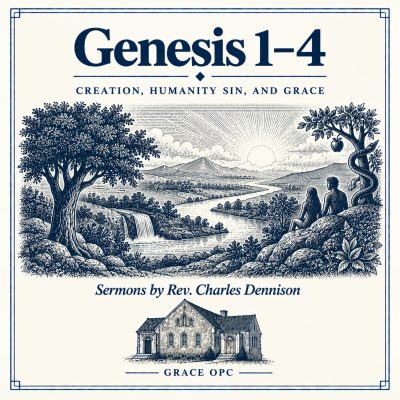
This sermon is from the Rev. Charles G. Dennison sermon archive, part of the “Genesis 1-4” series, and was preached at Grace Orthodox Presbyterian Church in Sewickley, PA, during a worship service on Sunday, February 16, 1992.
Tonight we begin our scripture reading in Ephesians 4, beginning with verse 17. Hear the word of God. This I say, therefore, and affirm together with the Lord. But you walk no longer just as the Gentiles also walk in the futility of their mind, being darkened in their understanding, excluded from the life of God because of the ignorance that is in them, because of the hardness of their heart. And they, having become callous, have given themselves over to sensuality for the practice of every kind of impurity with greediness. but you did not learn Christ in this way. If indeed you have heard him and have been taught in him, just as truth is in Jesus, that in reference to your former manner of life you lay aside the old self, which is being corrupted in accordance with the lusts of the sea, and that you be renewed in the spirit of your mind and put on the new self, which in the likeness of God has been created in righteousness and holiness of the truth. Therefore, leering aside falsehood, speak truth, each one of you, with his neighbor, for we are members of one another.
Be angry, and yet do not sin, do not let the sun go down on your anger, do not give the devil an opportunity. Let him who steals, steal no longer. Rather, let him labor, performing with his own hands what is good, in order that he may have something to share with him who has need. Let no unwholesome word proceed from your mouth, but only such a word as is good for advocation according to the need of the moment, that it may give grace to those who hear. Do not grieve the Holy Spirit of God, by whom you are sealed for the day of redemption. Let all bitterness and wrath and anger and clamor and slander be put away from you, along with all malice. Be kind to one another, tenderhearted, forgiving each other, just as God in Christ also has forgiven you.”
I’m turning back to Genesis chapter 1. Then God said, Let us make man in our image, according to our likeness, and let them rule over the fish of the sea and over the birds of the sky and over the cattle and over all the earth and over every creeping thing that creeps on the earth. God created man in his own image, in the image of God he created him, male and female he created them. God blessed them and God said to them, be fruitful and multiply and fill the earth and subdue it and rule over the fish of the sea and over the birds of the sky and over every living thing that moves on the earth. We come to that point in our messages on creation, and specifically our messages on the sixth day, where we want to consider directly the creation of man. We are looking then at verse 26 of this first chapter, and also those attending passages. In this twenty-sixth verse, we are immediately faced with a problem, and that problem is the manner of God’s address. He says, Let us make man in our image.
And we have here plural pronouns which then raise questions. The use of the plural pronouns, ox and our, at this point have raised questions that have then been given many answers. There is the old liberal side. You do have those who at one time suggested that here is an indication of a residual polytheism, a sort of hark back to the primitivism of Israel’s religious roots, to a time when Israel’s forebears embraced a religion as corrupt and as immature as their neighbors.
We might say that luckily this position has no supporters presently. But there is a popular view held by conservatives and liberals, and that position suggests to us that the plural pronouns used in the 26th verse refer to God and his heavenly counsel, and indicates something of the character of God’s reign. That is, God rules not only over his heavenly angelic host, but he rules in the midst of the counsel of his heavenly angelic host. His rule, then, is pictured, so it is said, as if God were a great king who makes his decisions and implements them through the agency of those who are attendant to him.
There are other examples of this form of expression in Scripture. You find it, for instance, in Genesis 3, verse 22, where God is driving man out of the garden. Then the Lord God said, Behold, the man has become like one of us, knowing good and evil. Now lest he stretch out his hand and take also from the tree of life and eat and live forever, etc. It is also used in Genesis 11, verse 7, where we have the story of the Tower of Babel.
God comes down. Plural pronouns are used there as well. We find it also in Isaiah 6, verse 8. that glorious scene of the vision to Isaiah in the temple, and the subsequent question which God asks, who shall go for us? To which, of course, Isaiah responds, Lord, here am I, send me.
So we have a position which has been developed against the background of these passages that suggest to us that God is speaking of himself here along the lines of an earthly king who has surrounded himself with a council, and he then, in deliberations with this council, arrives at a decision and then implements it through those who are attendant to his will. As I said, this is a position that is held by many conservatives and liberals presently, and it is a very popular position in our time.
But over against this position is the older orthodox view, which suggests in its naivete, that we have here a pre-New Testament suggestion of the Trinity. An intriguing suggestion, to be sure. The older orthodoxy suggested that we have here a revelation of the multiplicity of personality within the being of God. We also have, the older orthodoxy suggests, something of a revelation of the reality of a council. The personalities in view are specifically those of the Father, the Son, and the Holy Spirit, of course, while the council in view is the inner Trinitarian council of the Godhead. Now, I know that with some I might lose my credibility, but I confess here tonight that I lean in the direction of the older orthodoxy on this matter.
If for no other reason than I have a very hard time understanding how man is created in the joint image of God and his angelic counsel. The statement is, let us make man in our image. And if the angelic hosts are in view, it would seem that the image somehow would be related to them. But you will notice, specifically in the 27th verse, that God states that he created man in his own image. There is the exclusivity. And that underlined emphatically that man is created in God’s own image, exclusively, emphatically.
But even more specifically, God gives us here in his record of the creation of man, a window into heaven itself. And by route or way of that window, we have given to us a revelation of the inner Trinitarian we have given to us a record of a conversation that takes place within God himself. This heightens the whole affair with respect to its importance, since we haven’t been given any similar line with respect to any other creature that God has made. and thus the unparalleled significance of man is underscored. In fact, this revelation into the intimate life of the Godhead is in actual fact an unveiling of the affection that exists within the inner life of God.
And this affection is spilling out from God into, or on, man. as the special object of God’s love. Let us make man in our own image. It is not merely a revelation of power and strength that we have here. It’s not only a revelation of God’s intention and purpose. or even the setting of man as the chief over all that God has made. But there is an interconnectedness now between the affection that is breathed out in this inner Trinitarian Council, the affection that is breathed out from that, and what now resides within and upon man by virtue of his special creation. God’s willingness then to bestow, to endow this creation of man, this creation, with his own image is the seal of the unique bond that exists between him and man, and an affirmation of man’s own inherent uniqueness. This uniqueness, I might add, is an extension of the image itself.
Not that we could ever imagine man to be independent of God. After all, he is created in the image of God. How can he be independent of God? But with respect to man’s uniqueness, and that being an extension of the image itself, man now is unique amongst all the creatures. that God has created within the earth, just as God himself is unique over all and in all, including the entirety of his angelic host. Scripture says God made man a little lower than God. This uniqueness of man as the object, the special object of God’s love, the special object of His affection. This uniqueness of man as the unparalleled creature of God emphasizes, again, man’s separateness.
The earth by itself, in and of itself, cannot If this was the case with respect to all the other creatures that God has made, how much more so when we come to man? The earth, that which is already there in creation, cannot of itself generate the man. Nor is man the descendant of any other life-form. Such a doctrine, such as teaching, stands so utterly contrary to the direction and the intent of the revelation that we have been given.
How could God say it any more plainly? It is almost as if man, by virtue of this special creation, is looked upon as the descendant of God, specifically tied to God in his origin. Not that man is an emanation of God or a chip off of God. Rather, man is a son of God. uniquely created and bound to God, destined as heir to those things that God has made. That is the significance of sonship. If sons, then heirs. Isn’t that the way it goes in Romans 8? If sons, then heirs. Man is created uniquely and appears to have this line. to and in God, which makes him then uniquely a descendant of God in such a way that man can be called son of God.
And that is exactly what Adam is called in Luke 3 verse 38. But this revelation into the heavenly council of the Trinity does For now, it is obvious to us just how, deliberately and explicitly, man is tied to that invisible world and to God himself who is invisible. This means, then, with respect to man’s identity, and with respect to his meaning, with respect to his life in this world in which he appears, there is that fundamental link established between him and the world above through the means of faith. This revelation into the heavenly council of the Trinity ties men then deliberately and explicitly to that invisible world and to God himself, who is in the center of that invisible world and is invisible to us. This means, then, that behind and beyond man is God, in whose image we have been made.
This means, then, that man does not find, cannot find, meaning in himself apart from that invisible world and the one who is invisible. This means, then, that man cannot find meaning apart from faith. He will only find his meaning and significance, he will only understand himself in relationship to that one who is invisible, and in relationship to that invisible world where the invisible one dwells specially. It is specifically when man loses sight of this that he falls.
And it is Christ, you see, as the new man. as the image of God restored, who sets things straight, who sees things clearly, who lives as one who is caught hold of the invisible world and the one who is invisible dwelling there specially. This then constitutes the main line of Jesus’ message, as he is at work being the one in whom the image is restored to restore that image in those who have been given to him. This is why Christ, in his ministry, labors so intensely, so strenuously, to assert his very point of view.
And why Jesus remains obscure, misunderstood. Why Jesus is confusing to us, because we simply don’t get it. Even his disciples, even those closest to him, are having severe difficulty. What can the Messiah’s work mean for them but a refurbishing of a kingdom?
What can it mean for them but the re-establishment of power and might in this world, and a security with respect to the things that we see. But Jesus’ ministry is such that it points behind and beyond to the one who is invisible, and to the invisible world in which that one who is invisible dwells specifically. One of the greatest texts comes to us from John’s opening remarks in his gospel. In him was life, and the life was the light of men. The life there pertains specifically to that life which is above, that life which is eternal, That life that belongs to the invisible realm. And it is this life specifically that brings illumination to man. In him was life, and the life was the light that gives illumination to man.
Well, that we might get the point. That we might insist on the significance of that point. We embrace our Savior all the more closely. We surrender our minds to Him that we might be trained by Him with respect to those things which are above. Dearest Lord, we ask we rejoice in the patience of your Son with disciples such as we are. And as he forbears with disciples, we pray our God that the end may be, that the clear light of your revelation may shine in us, that we might not be confused, that we might not misapprehend. but rather understand clearly that we are joined uniquely to an invisible realm and to one who is himself invisible and that our meaning and significance are found in that world and in him. O God, may this be clear to us in the way we live And may it be clear, Lord, with respect to our hope, we ask it in Jesus’ name.
The sermon text provided above is derived from the sermon audio recording making use of generative tools. It has not been manually edited. While transcription tools have a high degree of accuracy, the output may include generative textual, punctuation, and/or formatting errors.