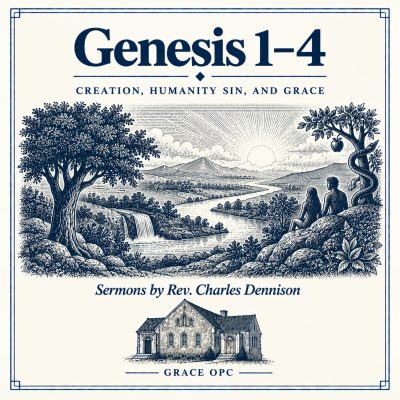
This sermon is from the Rev. Charles G. Dennison sermon archive, part of the “Genesis 1-4” series, and was preached at Grace Orthodox Presbyterian Church in Sewickley, PA, during a worship service on Sunday, December 8, 1991.
Now we are beginning our scripture reading in Genesis chapter 18. Genesis chapter 18 verse 1. Listen to the word of God. Now the word appeared to Abraham by the Oaks of while he was sitting at the tent door in the heat of the day. And when he lifted up his eyes and looked, behold, three men were standing opposite him.
And when he saw them, he ran from the tent door to meet them and bowed himself to the earth and said, My Lord, if now I have found favor in your sight, please do not pass your servant Bob. Please let a little water be brought and wash your feet. and rest yourselves under the tree, and I will bring a piece of bread that you may refresh yourselves. After that you may go on, since you have visited your servant.’ And they said, So do, as you have said.”
So Abraham hurried into the tent of Sarah and said quickly, “‘Prepare three measures of fine flour, knead it, and make bread cakes.’ Abraham also ran to the herd and took a tender and choice calf. and gave it to the servant, and he hurried to prepare it. And he took curds and milk and a calf, which he had prepared, and placed it before them, and he was standing by them under the tree as they ate.
Then they said to him, Where is Sarah, your wife? And he said, Behold, in the tent. And he said, I will surely return to you at this time next year, and behold, Sarah, your wife, shall have a son. and Sarah was listening at the tenth door, which was behind him. Now Abraham and Sarah were old, advanced in age.
It had ceased to be with Sarah after the manner of women, and Sarah laughed to herself, saying, After I have become old, shall I have pleasure, my Lord being old also? And the Lord said to Abraham, Why did Sarah laugh? Shall I indeed bear a child when I am so old? Is anything too difficult for the Lord? At the appointed time I will return to you, at this time next year, and Sarah shall have a son.” Sarah denied it, however, saying, I did not laugh, for she was afraid. But he said, No, but you did laugh. Then turning over to Matthew chapter 17, beginning with verse 14 and reading through verse 20.
A man came up to him, that is, Jesus, falling at his knees before him, saying, Lord, have mercy on my son, for he is an epileptic and very ill, for he often falls into the fire and often into the water, and I brought him to your disciples and they could not cure him. And Jesus answered and said, O unbelieving and perverted generation, how long shall I be with you? How long shall I put up with you? bring him here to me. And Jesus rebuked him, and the demon came out of him, and the boy was cured at once.
Then the disciples came to Jesus privately and said, Why could we not cast it out? And he said to them, Because of the littleness of your faith, for truly I say to you, if you have faith as a mustard seed, you shall say to this mountain, Move from here to there, and it shall and nothing shall be impossible to you.
This evening we want to strengthen our grip a bit. We want to strengthen our hold on the story of creation’s first day. You find the account of creation’s first day in Genesis chapter 1, verses 1-5. In this account, in Genesis 1, we have been introduced to the great and majestic God, the one who precedes his creation, the one who comes forth out of eternity, the one who is from everlasting to everlasting God.
This One, our God, the true God, is clothed in mystery. And while so adorned He creates, He makes what is from that which is not. He forms what exists from that which does not exist. He creates out of and into nothing. Is anything impossible for this God? Who is awesome in His might? When He appears in the creation, He reveals Himself in His might, His awesome might, He reveals himself as the architect, as the master builder, the one who in his incomparable wisdom fashions and forms.
We are told at the beginning of Genesis that he forms the invisible heavenly world, the invisible heavenly world of his throne. with all of its angelic hosts, and he also forms the visible world, denominated as the earth. In the beginning, God creates the heavens and the earth.
The testimony of God’s creative activity is consistent throughout the entirety of Scripture. Time and again we hear about it in the Psalms. It is reflected upon in the wisdom literature of the Old Testament. It is spoken of repeatedly by the prophets and by the priests. It is a fundamental doctrine for Christ himself as he proclaims his gospel. It is apparent in all of the teaching of the apostles. and it is written large even in the last book of the Bible, the book of Revelation.
Here is a text from the Old Testament, that marvelous prayer of confession that we find in Nehemiah, chapter nine. In the fifth verse and following, we have the Levites. They are assembled and they are praying as follows. Nehemiah, chapter nine, verse five.
A wise, bless the Lord your God forever and ever, commanded the priests. O may thy glorious throne be blessed and exalted above all blessing and praise. Thou alone art the Lord, verse six. Thou hast made the heavens, the heaven of heavens, with all their hosts. the earth and all that is on it, the seas and all that is in them. Thou dost give life to all of them, and the heavenly hosts bow down before thee.” In the beginning, God, this mighty, this awesome creates the heavens and the earth. But now, in the second verse of that first chapter of Genesis, the earth is portrayed for us in its primeval state.
And in this state, we have learned that the world in that present form defies any definition of a kingdom. It is formless, that is, it is dominionless. It defies dominion itself, and being empty and void, it cannot be filled, neither can it be ruled. And its face, that is, the surface of the deep, defies recognition, since that face is shrouded in darkness, and rightly called the deep. or the abyss.
Taking this then into consideration, we are confronted with this majestic and powerful God, who in His creating does the impossible. He does what is possible only for Him, but at the same time He makes that which is in itself stamped with impossibility.
Here in Genesis 1 verse 2, we are faced with the creation as encased in impossibility, so as to lack all inherent power, all potential to transform itself, to generate anything new from within itself. A new state of affairs, a new world order, cannot come from the inherent powers of the earth. God’s revelation, therefore, at the very outset of things, humbles his creation by revealing to it its incapability. God’s revelation, therefore, stands over against all of those speculative theories generated out of the world which preach that there is latent potential within the world to organize itself and to bring order for itself out of the chaos.
Only God creates, only God transforms, only God can make new. And this, his work of creation, his work of transformation, his work of renewal, this he does most mysteriously. He does it by subjecting himself He, the immutable God, he does this by subjecting himself to a transformation of sorts in which he becomes something new to his creation which he has made. Formally he had not created, but now doing something new he has. Formally his revelation pertained to himself and was a revelation within himself, but now he reveals himself in and to the world he has made.
At the end of that second verse in Genesis 1, We find, therefore, the Spirit of God hovering bird-like and moving over the unrecognizable deep. The Spirit is present in the dark, empty formlessness, giving himself over to the impossible world which he has deliberately made. so that it is clear that not only does he do the impossible, but he does the impossible from within the impossible. The formlessness, the void, the darkness spoken of in the second verse of Genesis presents us with an impossible situation which only God can remedy.
And the way in which God will remedy that impossible situation is by identifying himself with the impossibility, and thus making it clear just how magnificent and how powerful and how loving he is. How great, then, the power and love of God. The power and love of God unveil themselves even more magnificently when the world is buried beneath the burden of sinful flesh that saints in death’s dark, chaotic tomb from which there is no possibility of escape. God, in his power and out of his love, will invade the world of sinful flesh by taking to himself sinful flesh itself.
He enters this irretrievable world, taking to himself its horror and its shame. He subjects himself to the chaos and brings to it the radiance of the kingdom of God. He gives himself for sin and to the grave, from which there is no possibility of escape.
And on the first day of God’s new creation, he rises. The impossibilities of the spiritual and moral abyss in which the world has sunk are answered finally when Jesus Christ rises from the dead. Here, in the resurrection of Christ, is the apex of God’s testimony to his fallen world. A world, because of its sins, submerged even more completely into an abyss of impossibility than that original creation. And God has given himself witness to this appointed and envisioned end all through his revelation.
A faithful soul named Enoch walks with God, and Enoch was not because God took him. Noah is preserved as the father of a new world. A nation is forged out of slaves who are led in triumph out of Egypt. The Red Sea parts, the people are fed in a wilderness. Water comes forth from a rock. A widow receives back a dead son. A city is saved by the appearance of God and the rumble of His thunder. A prophet is saved from lions. Three children are saved from a fiery furnace.
And finally, a humble maid hears the impossible in the midst of all impossibility. shall conceive and bring forth a son. God in human flesh is manifest, and then blind men see, lepers are cleansed, water turns to wine, dead men are raised, a paralytic receives the forgiveness of sins from one claiming to be divine.
And now, into the midst of your own impossible situation, has come the one who is not ashamed to identify himself with you, for you, and in you. He, by his great power and love, transforms you, makes you new, by the might, by the power, by the law by which he himself was transformed, and by which he is able to subdue all things to himself. This entrance by God, the great God introduced to you in Genesis chapter one, the entrance by God into the impossible world to perform the impossible is at the very heart of this God’s relationship to his creation. And by the very nature of this relationship, there is called forth from his creation the response of faith. Faith as that principal bond between this great God. and his creatures.
What kind of God is it that you worship? What kind of God is it that you serve? The God who in making the impossible, enters the impossible and performs the impossible, thus demonstrating his power. and underscoring his love. As to our faith, what is the testimony of scripture?
Are we not told, Abraham believed God and it was reckoned to him for righteousness, Genesis Sarah laughs at the promise, but the angel says, is anything too difficult for the Lord? Genesis 18 verse 14. The children of Israel do not believe, and they are slain for their unbelief, because they are unacceptable to God, not having faith in him. David trusts the Lord and receives testimony that he is a man after God’s own heart. Habakkuk, the prophet, is chided before the onslaught of the Chaldeans. He is chided with God’s words, the just shall live by faith.
Habakkuk 2.4. Jesus himself is attracted to faith. He is drawn to faith. He commends faith where he sees it, even in Gentiles who express it. And he severely rebukes the lack of that faith, even in those who claim to be closest to him.
Peter, sinking in the sea, is told, O you of little faith, why did you doubt Jesus after dealing with faithless disciples at the foot of the Mount of Transfiguration, tells these disciples, if you have faith as a grain of mustard seed, nothing shall be impossible to you. Matthew 17, verse 20. And Jesus promises later on, everything that you ask in prayer, believing, you shall receive. Who is this God, then, that you have embraced. Who is this God?
The scriptures assure us, whosoever believeth shall not perish, but shall have everlasting life. The scriptures state categorically, whatsoever is not of faith is sin. Whatsoever is not of faith is sin. The apostle declares that we are justified by faith. And the writer to the Hebrews says, it is impossible to please God without faith.
Our faith then is instructed, it is informed by what we find here at the beginning of Revelation in Genesis chapter 1. This faith is more than a confidence in invisible things. It is that which grasps hold of an entirety, of an entire reality. of an entire way of looking at things, of a point of view by which, in the light of which, we see that our God is the incomparable one, the one who works the impossible within the impossible. As it was originally, so it has been confirmed to be by God’s new work in Christ. And so it is established with respect to God’s work in you and with you.
Your circumstance was utterly impossible. You could not save yourself. You were dead in your trespasses and sins. But God, who is rich in mercy, for his love wherewith he has loved us, has made you alive, together with Christ. He has done the impossible. in the impossibility of your heart.
Hallelujah. Praise His name. Amen. May we not give in to the sensibility born of hell in this world. The spirit that tells us that even God cannot do the impossible. We know, our Lord, that you laugh at the pretentiousness of men. and we know that of which you are capable and see the testimony of it all around us in what you have made and also within us in that you have made us to be your children Lord, may we live by faith a faith that grasps hold of the fact that our God is able to do the impossible even within the impossible. We thank you for your glorious light and your magnificent love. May we praise you forever.
The sermon text provided above is derived from the sermon audio recording making use of generative tools. It has not been manually edited. While transcription tools have a high degree of accuracy, the output may include generative textual, punctuation, and/or formatting errors.