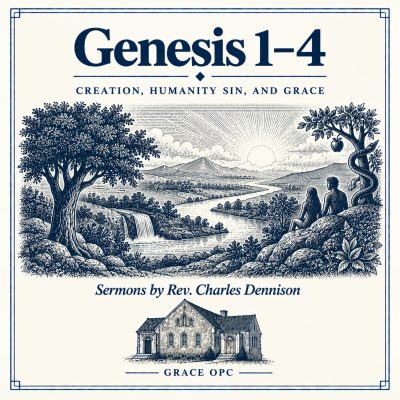
This sermon is from the Rev. Charles G. Dennison sermon archive, part of the “Genesis 1-4” series, and was preached at Grace Orthodox Presbyterian Church in Sewickley, PA, during a worship service on Sunday, December 1, 1991.
Tonight we begin our scripture reading in John chapter eight. John’s Gospel chapter eight. And we begin reading with verse thirty. As Jesus spoke these things, many came to believe in him. Jesus, therefore, was saying to those Jews who had believed in him, If you abide in my word, then you are truly disciples of mine, and you shall know the truth, and the truth shall make you free.
They answered him, We are Abraham’s offspring and have never yet been enslaved to anyone. How is it that you say you shall become free? Jesus answered them, Truly, truly, I say to you, everyone who commits sin is the slave of sin, and the slave does not remain in the house forever. The son does remain forever. If therefore the son shall make you free, you shall be free indeed.
I know that you are Abraham’s offspring, yet you seek to kill me because my word has no place in you. I speak the things which I have seen with my father. Therefore, you also do the things which you have heard from your father.” They answered and said to him, “‘Abraham is our father.’ Jesus answered unto them, “‘If you are Abraham’s children, do the deeds of Abraham.
But as it is, you are seeking to kill me. A man who has told you the truth which I heard from God, this Abraham did not do. You are doing the deeds of your father. They said to him, We are not born of fornication. We have one father, even God. Jesus said to them, If God were your father, you would love me. For I proceeded forth and came forth from God, for I have not even come on my own initiative, but he sent me. Why do you not understand what I am saying? It is because you cannot hear my word.
You are of your father the devil, and you You want to do the desires of your father. He is a murderer from the beginning and does not stand in the truth because there is no truth in him. Whenever he speaks a lie, he speaks from his own nature, for he is a liar and the father of lies. Because I speak the truth, you do not believe me. Which one of you convicts me of sin? If I speak truth, why do you not believe me?
He who is of God hears the words of God. For this reason you do not hear them, because you are not of God. The Jews answered and said to him, Do we not say rightly that you are a Samaritan and have a demon? Jesus answered, I do not have a demon, but I honor my father, and you dishonor me. But I do not seek my glory. There is one who seeks and judges.
Truly, truly, I say to you, if anyone keeps my word, he shall never see death. The Jews said to him, Now we know that you have a demon. Abraham died, and the prophets also. And you say, if anyone keeps my word, he shall never taste of death. Surely you are not greater than our father Abraham, who died. The prophets died too.
Whom do you make yourself out to be? Jesus answered, If I glorify myself, my glory is nothing. It is my father who glorifies me, of whom you say he is our God. And you have not come to know him. But I know him, and if I say that I do not know him, I should be a liar like you. But I do know him, and keep his word.
Your father Abraham rejoiced to see my day, and he saw and was glad. The Jews therefore said unto him, You are not yet fifty years old, and have you seen Abraham? Jesus said to them, Truly, truly, I say to you, before Abraham was born, I am. Therefore they picked up stones to throw at him, but he hid himself and went out of the temple.
And then turning back to Genesis chapter one. Verses two through five. And the earth was formless and void and darkness was over the surface of the deep. And the Spirit of God was moving over the surface of the waters. Then God said, let there be light, and there was light. And God saw that the light was good, and God separated the light from the darkness. And God called the light day, and the darkness he called night. And there was evening, and there was morning one day.
It is as if the account of the first day of creation actually, when plumbed to its depths, sets out for us revelations, first principles. It is as if the account of the first day of creation, when plumbed to its depths, sets out for us revelations, first principles. This means then that the account of the first day of creation sets the tone for an entire world and life view. The Germans call it Weltanschauung, world and life view. Here, at the very opening of Revelation, we have the stuff out of which the Bible’s world and life view is constructed. This means, then, that this presentation in verses 2 through 5 in Genesis 1 does more than give us a mere account, a mere history of what happened on that first day. Actually, we have presented for us here an account of greatest doctrinal and theological significance.
This revelation from God that comes then to us through Moses is set here to answer speculations, to address speculations, to refute speculations. Speculations both primitive and sophisticated. Now, we tend to call primitive speculations mythology. and we tend to call sophisticated speculations philosophy and science. The revelation from God through his servant Moses answers then such speculations as these, both primitive and sophisticated. If we look at the speculations of men, be they primitive or sophisticated, as they express themselves about the world, its order, and even its origins, we find in them a common thread. It is almost as if regardless of how sophisticated those sophisticated speculations are, how much they imagine themselves to be removed from the primitive state of men, and his mythological speculations that when everything is said and done, the perspectives presented are indistinguishable. ancient myths, for example.
At least some of them tend to be earthy and eminently practical, explaining life in practical terms, giving explanations that make sense with respect to the world around those who are given to such mythological reflection. Ancient myths then tend to be earthy and eminently practical on the one hand, yet on the other hand, they are idealistic and esoteric.
One might say that here, even as we investigate mythology, even as we investigate it, we have in basic form the two great motivating impulses of culture. On the one hand, earthy and eminently classical. On the other hand, idealistic and esoteric. These two could be reduced then to Romanticism on the one side and Classicalism on the other. We can even see in these constructs the two respective personality types, not just views of culture, views of the world and life itself, but two distinct personality types. On the one hand, you have people that are tremendously practical. On the other hand, you have those who are terribly idealistic.
But as it is with ancient myths, primitive myths, so it is as well with sophisticated speculations, those speculations of philosophy and science. And it is at this point that we are compelled to look once more with deeper appreciation at the teaching of a figure such as Cornelius Van Til. There is much said about Dr. Van Til in the latest issue of New Horizons magazine. But great help in getting a hold on this profound and influential theologian of our time will be gained if we can see this one point. God’s revelation stands over against man’s speculations. God’s revelation stands over against and answers man’s Speculation.
Many have faulted Dr. Van Til for what they have called his philosophical apologetics. I am reminded of the correspondence between J. Gresham Machen and J. Oliver Buswell, the president of Wheaton College, in November and December of 1936. Dr. Buswell was very upset about the direction of Westminster Seminary. He was already making plans to make a stand against the direction that the seminary was taken, and he was in correspondence with Dr. Machen at that time. His chief complaint was about what he called the philosophical apologetics of Dr. Van Til.
But what Buswell and others failed to realize was that Van Til was being faithful to the genius of biblical revelation by setting God’s revelation in its basic supernatural, redemptive, and historical character over against human speculation. Van Til’s contention was this, the Bible holds the key to answer both mythological and sophisticated speculations that arise from within the heart and out of the mind of men. Applying this a little bit further and deeper in terms of the categories that we have introduced, The Bible, God’s revelation, holds the key to answer, to address both romantic and classical impulses within human personality and culture.
His contention is, the answer to Romanticism is not Classicalism. The answer to Classicalism is not Romanticism. Neither is the answer a combination of the two. Our view of world and life must arise not out of the speculative interests of men, but out of God’s revealed words.
I was reminded of this whole discussion recently in my trip to Corrieville, Pennsylvania, where I had an opportunity to interview Dr. Alan Prey, who was part of the original faculty of Westminster Seminary. He taught Old Testament there, but was a sworn enemy of Dr. Van Til. He sided with Dr. Buswell When the break finally came in 1937, he stood with Boswell and others against Van Till and the faculty of Westminster Seminary. Dr. McCrae’s comment to me in my interview of him, I lay at the feet of Dr. Van Till for blame for the devastation of the separatist movement in the 20th century. Why? because of his philosophical apologetic. Again, what Dr. McRae did not understand was that Dr. Van Til was addressing modern speculation in the spirit of the biblical revelation, the biblical revelation having addressed ancient speculation, and now Dr. Van Til bringing that to bear upon modern speculation in its philosophical dress.
But you may be asking, how does the revelation that we have in Genesis chapter 1, verses 2 through 5, with respect to the first day of creation, bear upon all of it? Well, if we were to analyze a little bit deeper the romantic worldview and impulse I think that we would see that it is this. It contends that the world and humanity have an inner potentiality. Nature and human nature possess an inner capability that presses on toward that to which their potentiality direct them. This perspective has even invaded theology, and most particularly in the area of practical theology, in which we find so much emphasis upon the will of man as that will is driven and shaped by feelings. If we have our eyes open, it is not difficult to see the line running through certain mythologies from ancient times, a line that runs through those ancient mythologies to a philosopher like Aristotle, to certain Latin poets, to later Romantic writers, to religious figures like Pelagius, and even in our own time, Robert Schuller, added to them a host of practical theologians in our own time. The emphasis is continually upon an inner capability which both the world and humanity possess, a potentiality that presses on for expression.
Speculation, then, of this type says, that bringing order out of chaos lies within our power and within the power of a created order in and of itself. God’s revelation says this simply is not so. According to Genesis 1 verse 2, God creates deliberately a world incapable of developing itself apart from him. There is the other side of the coin, however.
We have not just the practical romantic perspective, we have also the contemplative classical approach. And in this approach we hear a great deal about ideals. The ideal is the goal. The ideal pertains to an unseen reality of which our world is a figurative imprint. The true meaning of things is found beyond and behind the appearance of things. Therefore, a refined symbolism of certain ancient mythologies the idealism of Plato, the great Greek philosopher.
The theology and doctrine of certain branches of Christianity all coalesce at this point and pride themselves in being non-materialistic. We are the ones who are committed to unseen reality. We need to remember, however, there is no virtue merely believing in invisible things. Plato believed in invisible things. That does not make him a Christian. That doesn’t gain him entrance into heaven.
Looking at Genesis 1 verse 3, then, we find here the revelation of God speaking of a hidden light, a light that is created that is before the lights that are spoken of in the fourth day later on. there is a hidden, invisible light behind the light created on the fourth day.
But having a system of invisible realities behind the visible realities is of no value unless the One is addressed, unless One is addressed by Him who is utterly transcendent and hidden, behind the light hidden, spoken of in Genesis 3, is the one who is white in and of himself. And unless one is brought to that one who is white in and of himself, merely believing that there is an invisible reality behind the realities that exist is of no value whatsoever. Behind the lights that are created on the fourth day—the sun, the moon, the stars—behind the lights that are created on the fourth day is the light that is created on the first day. The light created on the first day is a hidden light, believe it or not. It is an invisible light, as it were. But behind that hidden light is God, who is Himself light. apart from whom there is no illumination, true illumination, at all.
This is why in the Gospel of John, a gospel that deals so much with light, that the miracles and faith itself are presented in such ambiguous terms. Why, in John’s gospel, it seems as if you can believe and at the same time not believe. You see how the discussion progresses in John chapter 8. In the opening verses of the section we read tonight, we’re told that these Jews believed in Christ, but then Jesus goes on to treat them as if they don’t believe. Well, how is that possible? How is it possible for John, on the one hand, to say they believe, but them to say that they don’t?
We are told time and again in John’s Gospel about how people witness the miracles of Christ and come to believe on Him, but yet Jesus will not entrust Himself to these people who see the miracles and believe because of the miracles. These people who believe, of whom it is said they believe, they are firmly confident that there are invisible realities behind the things that we see, but they are not drawn on to the ultimate reality, that ultimate reality being the light that is found in God Himself, and most particularly in Jesus Christ. Earlier, in John chapter 8, verse 12, Jesus says, I am the light of the world. And it is only coming to conviction with regard to him, believing in the revelation that God gives of himself in his Son, that people then have any understanding whatsoever of what is going on in this world which God has made. So, believing in and of itself isn’t admirable, and even believing in invisible realities isn’t admirable. What finds the favor of God is a belief in the specifics of his revelation, a revelation at the center of which he himself stands.
So as you move from the light that you see in the sun and in the stars of the night, to a light that is invisible and hidden. It is no virtue for you to believe in things that are unseen behind the things that are clearly visible. You must believe in the God who has made the light that is seen and the light that is not seen.
How often we have placed out in front of us, as examples, those who have a spiritual twist to their personality, those who put a spiritual spin on their philosophy of life, as if it were inherently commendable to believe in invisible things. And that this somehow automatically qualifies you for a special place in God’s faith. Not so. Not so.
Holy Father, we pray for a world and life view that is based well upon the revelation you have given of yourself, a revelation that answers the speculations of men. We ask, Lord, that we may be satisfied with you and also diligent so that we would not be seduced by vain philosophy or led astray by that which seems to be so spiritual, so religious. We pray our God that we would not be deceived by the formal similarities between the faith that is true and the faith that is false. May we press on our God, giving ourselves no quarter. May we press on, O Lord, as we would make our calling and election sure within that faith that is true, satisfied that we believe in the one who is invisible and is light in himself. We ask it in Jesus’ name.
The sermon text provided above is derived from the sermon audio recording making use of generative tools. It has not been manually edited. While transcription tools have a high degree of accuracy, the output may include generative textual, punctuation, and/or formatting errors.