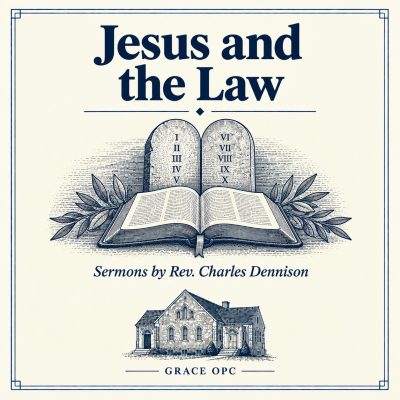
This sermon is from the Rev. Charles G. Dennison sermon archive, part of the “Jesus and the Law” series, and was preached at Grace Orthodox Presbyterian Church in Sewickley, PA, during a worship service on Sunday, June 8, 1986.
This morning we are reading from Exodus chapter twenty. You could probably recite it: verses one through seventeen. And God spoke all these words, saying, “I am the Lord your God, who has brought you out of the land of Egypt, out of the house of bondage.
You shall have no other gods before me. You shall not make for yourself a carved image, or any likeness of anything that is in heaven above, or that is in the earth beneath, or that is in the water under the earth. You shall not bow down to them or serve them.
For I, the Lord your God, am a jealous God, visiting the iniquity of the fathers upon the children to the third and fourth generation of those who hate me, and showing mercy to thousands of those who love me and keep my commandments. You shall not take the name of the Lord your God in vain, for the Lord will not hold guiltless the one who takes His name in vain.
Remember the Sabbath day, to keep it holy. For six days you shall labor and do all your work, but the seventh day is the Sabbath of the Lord your God. In it you shall not do any work, you or your son or your daughter, your manservant or your maidservant, your livestock, or the stranger who is within your gates. For in six days the Lord made heaven and earth, the sea, and all that is in them, and rested the seventh day. Therefore, the Lord blessed the Sabbath day and made it holy. Honor your father and your mother, that your days may be long upon the land which the Lord your God gives you.
You shall not murder. You shall not commit adultery. You shall not steal. You shall not bear false witness against your neighbor. You shall not covet your neighbor’s house. You shall not covet your neighbor’s wife, nor his manservant, nor his maidservant, nor his ox, nor his donkey, nor anything that is your neighbor’s.”
And then, from Matthew’s Gospel, chapter eleven, first of all, verse thirteen: “For all the prophets and the law prophesied until John.” Then, from verse twenty-five to the end of the chapter. At that time, Jesus answered and said, “I thank You, O Father, Lord of heaven and earth, because You have hidden these things from the wise and the prudent and have revealed them to little children. Even so, Father, for so it seemed good in Your sight.”
All things have been delivered to Me by My Father, and no one knows the Son except the Father, nor does anyone know the Father except the Son and the one to whom the Son chooses to reveal Him. Come to Me, all you who labor and are heavy laden, and I will give you rest. Take My yoke upon you and learn from Me, for I am gentle and lowly in heart, and you will find rest for your souls. For My yoke is easy and My burden is light. Father, not our word, not the word of man, but Your word.
That is our need and our dream. And with it, Lord, we would be satisfied. So now, feed us, we ask, that Your people might be filled. We pray in Jesus’ name. Amen. Our project is the law. And that project may not be as simple as a mere reading of the commandments, as we have done this morning.
For you see, the law—its reality, its truth, its power—whatever we can say about the law, it now must be related to Jesus. So the question is, Jesus and the law—not just the law, but Jesus and the law. And the reason we frame the issue in this way is because, as I have contended with you, nothing is the same since Jesus came. Nothing is the same since Jesus came, including our understanding and our appropriation of the Lord. Jesus and the Lord. Jesus and the commandments, then. Jesus and His first commandment: “You shall have no other gods before Me.”
Now, in order to begin, it is necessary to understand this matter clearly by setting aside certain attitudes—attitudes that may be our own, attitudes that we may have developed over time. For example, when considering the relationship between Jesus and the law, between Jesus and the commandments, should we say that Scripture is primarily concerned with what we have come to call ethics—the study of behavior, the philosophy of conduct, the system of moral values? Is that the main purpose of Scripture? Unfortunately, this is precisely the approach taken by many. It is the approach of many within the Church, as if the purpose were the construction of a moral philosophy.
So comprehensive that it includes all aspects and details of life. Ironclad. Rigorous. Precise. Applicable to every aspect of existence. Almost in the manner of rabbinical interpretation. Scripture, concerned with ethics—the study of behavior, the philosophy of conduct, the system of moral values. Many approach this matter in this way. And many within the Church approach it in this way.
How was I taught in seminary? Was my introduction to ethics given through a specific course called Ethics? Was my introduction to ethics first of all based on the unique characteristics of Scripture itself, or was it through extracting from this science, this philosophy of conduct, facts, realities, and ideas that were universally agreed upon? What is ethics, after all? In ethics, one must determine facts, values, and also those things related to the moral self.
And having then spelled out all of these matters in a careful philosophical manner, we ask the Bible to be integrated into this framework. This is not to say that the Christian cannot be interested in ethics as a discipline. It is not to say that the Christian will not be permitted to engage in a philosophy of conduct or to develop a system of moral values. But what is essential is that we maintain the biblical perspective at all times. The Christian is, first of all, bound to revelation and to the nature of revelation. These realities shape his life and his thinking.
Therefore, it must be understood that the purpose of revelation is not to introduce a new world of thought, no matter how carefully constructed or systematically presented. The intention of revelation is not to provide ideas about moral behavior, nor even to organize such ideas. Rather, the intent of revelation is to make known the God who has definitively acted in the events that He has described in and through His Word. The emphasis, you see, is on the historical, not the philosophical. On the living reality where God meets humanity—where God has acted on behalf of humanity and spoken directly to them.
If there is something else that needs to be said at this point, and I hope that you will not misunderstand me as I continue, I have said that the Scriptures are not primarily concerned with ethics, or with a philosophy of moral values. But similarly, the Scriptures are not primarily concerned with theology.
I did not say doctrine. I said theology. Theology as an abstract system, a philosophical approach to religion that deals with questions and issues that arise from human reflection. I say this not to diminish theology. I believe theologians have led us into a difficult situation, but nonetheless… Nonetheless, I do not say this to diminish theology.
Theology, like ethics, has its place, and Christians must be busy with it. They must be rigorously busy with it. We would not be responsible if we avoided it. The issues that theology presents to us are brought before you. But looking at the commandment, this first commandment that is before us now, take stock of it.
You see, the Bible here, as you read it, has no interest at this point, despite what is generally believed, in abstract claims about monotheism as opposed to polytheism. Neither is it interested in the abstract question of God’s existence. It is not asking whether God exists. Those issues, important to theology and to a system of belief, are not under consideration.
They are not. Here. I might add. The course of this commandment is not even directed against a denial of the existence of God or a denial of the existence of other gods, even if they were so numerous. Rather, you are introduced to a living circumstance. A living circumstance in which people were to be participants. Not observers, not spectators, but participants. Not removed so as to ask their abstract, but important questions, but directly in God.
You see, this first commandment, like all the other commandments, comes in the light, the brilliant light of the great and wonderful act of God, what He has done in redeeming His people from their enemy. I am the Lord your God, who brought you out of the land of Egypt, out of the house of bondage. That is how the commandments are introduced, not with a system of thoughts finely presented, but with the story of God’s mighty workings on behalf of His own, in which they then are presently involved.
Because of this saving act, we understand that nothing can ever be the same again for Israel. If we had said this with regard to Christ, Christ comes and everything changes. Here, it is as if there is a premonition of it all. It is as if the giving of the commandments marks a definitive moment. It is the transformation of the life of these people. Life will never be the same for them again.
It is almost as if, in this circumstance, the law functions in the way the gospel does in the later sense. Because of this saving event, nothing will ever be the same again for history. Because of this saving act performed by the great God, Israel is to have no other gods than this one—the one who saves. This Lord, this God, is their King, proven victorious. And in His Kingdom, there is to be no violence. No violence. But the Lord who is present is not calling Israel to a mere confession. That says there is only one.
He is binding them to the concrete historical reality in which it has been clearly demonstrated that He is their God and that they are His people. So it is. The magnificent work of God which then binds Him to those whom He saves and those whom He saves to Him. Covenant, King, and people, nation and land, bound together—not by the world of thoughts and ideas, but by a concrete act of God for His own. And the exclusivity of this relationship. Between. The language here is not explicit, but we can affirm that.
The exclusivity is not exhausted by speaking only of kings and their peoples, for here the binding is such that as we go on through the commandments, we hear about the faithfulness of this God. The language then pushes the bond to its greatest limits of intimacy, so that you see it is not just King and people, but husband and wife.
Thou shalt have no other gods before me. God is not Mary. It is keeping these things in mind that helps us as we move on to consider the latter-day act by God. Remembering that the focus is on the powerful deed of God. And also the bond which now claims for itself an exclusivity. No one is to trespass upon it. It is utterly sacred. You see, the finite was not an end in itself. And I dare say to you that the administration that emanated from that mountain was no end in itself either.
For the prophets and the law prophesied until John. Christ comes, as that one to whom even this administration is pointed. And the ultimate value of that administration, in and through Moses, that administration of the law from Sinai. The objective was Christ, and Christ is preached by it. It is lacking in fulfillment until Christ himself comes, until He appears. And so it is. God acts once more.
And that finally, in a conclusive way, by sending His Son into the world. Here then is that new act of which the former act was but a shadow—a new act of God. That act is resuscitated, for the law of that former administration suffers a fatal weakness, a weakness it suffers because of the flesh to which it has been addressed. But in this new act of God, we now find one who, though in the flesh, is not weak in the flesh. He keeps the law, and He keeps it perfectly.
The significance of that temptation in the wilderness, the 40-day period of testing, corresponds to the 40 years of Israel’s wandering. Jesus is the answer to Israel. All of her failures, all of her shortcomings, even the golden calf at the base of the mountain, by which she compromised herself—these are all answered in Him and by Him. I shall worship the Lord my God in Him alone. Shabbat shalom. But this new act, this final act, as if it were the only act, this new and wondrous act by God. In this act, redemption is accomplished—not merely from enemies, not merely from the flesh, not from an army led by Pharaoh, not from the very forces of hell, not from spiritual wickedness, not merely from death and its effects, but from sin in its effects and death above all.
This new act of God surpasses all others in wonder. It renders wholly inadequate any service performed to God in terms of the previous act. I have pledged nothing but the presence of Jesus Christ, even the commandments. A Jew, if he could, keeping the first commandments perfectly, would still be disobedient to God’s new law of the New Testament, which God has established. Whether he is ever so devout in offering himself to the God of Abraham, Isaac, and Jacob, who will do so?
He cannot walk in satisfaction or peace, for he has not fulfilled his obligation before the Lord. Even if he does it perfectly, he has failed, because he does not understand or embrace that final, conclusive act of God and Christ. And this is the last act, as recorded in Judges 4 and 5.
But what God will it be? Before whom you would have no other. Certainly not a general sense of deity. Not one who simply presents the possibility of monotheism over a sense of polytheism. Much less will it be a God described in such grand and glorious language as The God of Abraham, Isaac, and Jacob. Now, you see, it is only the God and Father of our Lord Jesus Christ. The exclusivity of this God. And besides Him, the Lord shall be one. But no God limited to a single nation tucked away in the corner of the Mediterranean world. This God, this Lord, explains His purposes to the ends of the earth.
And marriage to Him comes through baptism into the name of the Father, the Son, and the Holy Spirit. That bond by which we are identified. Therefore, there are issues arising from the obligation of obedience, known by His name, He having been joined to us, that we observe everything that He has commanded, certain of His presence with us to the close of the age. Jesus and the law, and Jesus and His first commandment. Not ethics, not even theology, but God’s deeds, which make all of it. Not that latter day, or that quantity, but yes, the latter. That deed which God has accomplished at the close of the age.
Now, everything is transformed, and my obedience is in the will of the Father, Son, and Holy Spirit, by whom I have been saved, for whom I have been redeemed. Strengthen us in our knowledge of your word, that we may see plainly and clearly that you have acted on our behalf. And Lord, may we see the incomparable glory of your work in Christ, which surpasses in glory even the administration established at Zion. And may we understand that the obedience you require is based on the act you have performed and on the bond you have established between us and yourself. You, the great God, Father, Son, and Holy Spirit. And we are unworthy sinners, reclaimed by you for service in your name. Amen. Let us stand and sing together.
The sermon text provided above is derived from the sermon audio recording making use of generative tools. It has not been manually edited. While transcription tools have a high degree of accuracy, the output may include generative textual, punctuation, and/or formatting errors.