
The sermon text provided below is derived from the sermon audio recording making use of generative tools. It has not been manually edited. While transcription tools have a high degree of accuracy, the output may include generative textual, punctuation, and/or formatting errors.
Luke chapter 18, verses 9 through 14, we will be looking at this evening. Luke chapter 18, beginning in verse 9. He also told this parable to some who trusted in themselves that they were righteous and treated others with contempt. Two men went up to the temple to pray, one a Pharisee and the other a tax collector. The Pharisee, standing by himself, prayed thus: God, I thank you that I am not like other men—extortioners, unjust, adulterers, or even like this tax collector. I fast twice a week. I give tithes of all that I get. But the tax collector, standing far off, would not even lift up his eyes to heaven, but beat his breast, saying, God, be merciful to me, a sinner. I tell you, this man went down to his house justified, rather than the other. For everyone who exalts himself will be humbled, but the one who humbles himself will be exalted.
Let’s pray. Our God and our Father, Lord, we come to you needy. We do not have within ourselves what we need to hear your words of life and receive the life that is in them. So Lord, as you have inspired, preserved, and given us your word, we ask this evening that you would also give your Spirit, that we might be opened, attuned, that we might hear and receive the life that is within your word, that you would be present in the preaching. You would feed your people on Christ. We pray this in Jesus’ name, amen. You may be seated.
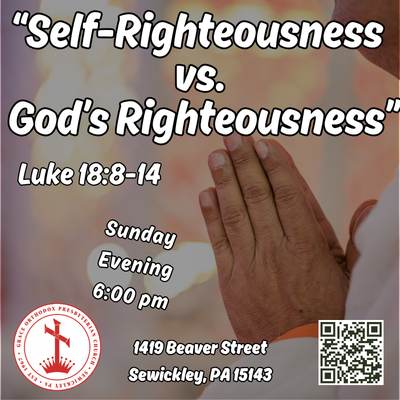
While we continue our discussion, this evening’s message in our series on parables is titled “Self-Righteousness vs. God’s Righteousness.” We are moving from one of the more difficult and perhaps obscure parables to one of the more popular and widely understood parables. Luke presents this parable a few chapters later to address what it means to be justified. Most of us, I would say, may have a mental record of our own moral standing quietly operating in the background of our thoughts or lives. We may look at the people around us—those who are messy or hypocritical, those who struggle with sins that we have largely overcome—and feel a quiet sense of relief. At least I am not like that. We may even express this in spiritual language: God, I thank you that you have helped me grow beyond that. I am not like those people anymore. This may sound like gratitude or humility, but the underlying tendency can be something far more dangerous: the confidence that we are fundamentally acceptable on our own. Even as we speak words of thanks to God, we begin to place our confidence in ourselves. Jesus told this parable to the Pharisees, those who trusted in themselves. The audience here in Luke is specifically described as people who considered themselves righteous and looked down on others. He says, “Two men went into the temple to pray: one was a respected religious leader with an impressive spiritual record, and the other was a tax collector, a despised member of society, clearly a sinner, the kind of person everyone knew was a traitor. By every religious and social standard of that time, the first man should have been declared justified, and the second should have been condemned. Yet we see Jesus reversing the expectation.”
So this evening we are going to look at the deadly difference between self-righteousness and God’s righteousness. We will notice how self-sufficiency sometimes disguises itself as devotion, and how true penitence actually appears when standing before a holy God, and why only one of the men went home justified before God. So this evening, our three points are the self-sufficiency of self-righteousness, number one; the plea of penitence, number two; and the resulting reward, number three.
Number one: the self-sufficiency of self-righteousness. As we come to our passage, we may have our own expectations about how we think the Pharisee should be the bad character. Perhaps we have read the Gospels and seen how often the Pharisees are condemned.
But we need to remember that in the society of Jesus’ day, the Pharisees were respected. Their movement began as a reform, a restoration, a return to the law of God, which had been disregarded and ignored. We sometimes group various religious leaders into a single category, but the Pharisees were, in many ways, opposed to the Sadducees. The Sadducees were the priestly class at the time of Jesus’ day.
They had turned the priestly office into a position that could be bought with money. They were clearly those who were no longer keeping the law. They were seen as compromisers. They were collaborating with Herod and the Romans in various ways in order to gain status and to appear respectable in the eyes of others. The Pharisees emerged as a movement of reform.
They came along saying, “You are ignoring the law of God.” The Sadducees had reached the point where they hardly believed in the supernatural. They had abandoned belief in the resurrection. We see them trying to trap Jesus with that question: how can a woman be married in the resurrection if she has married several men in succession, since the Sadducees had rejected belief in the resurrection and even in angels.
And yet the Pharisees came with a movement of reform—back to the law of God. Paul, the apostle, in his former life called himself a Pharisee of Pharisees. They would have memorized large portions of the Torah, perhaps even the entire text. These were the ones calling people back to the Word of God and back to God.
Yet, in the midst of this, things had become twisted. In the time of Jesus, although he found some things to commend in them, by and large we find Jesus speaking sharply, using pointed words to criticize the Pharisees, making them increasingly angry. This anger grew so great that, by the time of the Gospels, they even joined forces with one of their most hated enemies, the Herodians. The Herodians were those associated with Herod who had collaborated with the Romans—an absolute abomination to the Pharisees. Yet they found themselves joining with the Herodians in order to eliminate Jesus, because of the way Jesus came and began exposing their righteousness as a sham. But in this context, as Jesus tells this parable, his audience would still have seen the Pharisees as the good ones, as those to be admired.
And so when he tells this parable, two men go into the temple to pray, one a Pharisee and the other a tax collector. The audience would immediately think, we know who will be heard by God and we know who will not. We know who certainly ought to be there and who certainly ought not. We know who will be declared righteous by God and who will not.
We might hear this prayer as completely arrogant and self-righteous. As we listen to the prayer, “God, I thank you that I am not like other men—extortioners, unjust, adulterers, or even like this tax collector. I fast twice a week. I give tithes of all that I get.”
But we would do well to understand that this prayer is not so far from Psalm 26. If you would like to turn in your Bibles to Psalm 26, verses 1 through 5, where we find a prayer that is not so different from what the Pharisee is praying. Psalm 26, verse 1: “Vindicate me, O Lord, for I have walked in my integrity, and I have trusted in the Lord without wavering.”
“Prove me, O Lord, and try me. Test my mind and my heart. For your steadfast love is before my eyes, and I walk in your faithfulness. I do not sit with men of falsehood, nor do I consort with hypocrites. I hate the assembly of evildoers, and will not sit with the wicked. I wash my hands in innocence and go around your altar, O Lord, proclaiming thanksgiving aloud and telling of all your wondrous deeds.” So, of course, David begins this prayer with trust in the Lord, but he continues in a way that is not so different from what we find in the Pharisee’s prayer.
And we also would do well to remember that in Judaism, the law was often understood as something external. They largely ignored the thought life of the law. We find that Jesus had to confront this understanding. If you recall the Sermon on the Mount, in Matthew, chapters 5 through 7, especially chapters 5 and 6, Jesus repeatedly addresses false ideas. He says, “You have heard that it was said.” He is not quoting Scripture there. Some of those commands sound like passages from Scripture, such as the Ten Commandments. But what he is quoting is the tradition of the Pharisees and the Rabbis. In those instances, Jesus consistently points out, “You have focused on the deeds, but I tell you about the heart. God’s commands apply to the heart as well.” In Judaism, this understanding was commonly accepted and still is today. If you speak with thoughtful Jews, most will emphasize that the law is entirely external. The Pharisee in our passage, and other Pharisees of that time, believed it was possible to keep the law. Consider the rich young ruler who approached Jesus. Jesus confronted him with the Ten Commandments. We might naturally assume that he was thinking about how he had broken them in thought. Yet he was convinced that he had kept them all since his youth, because he had maintained outward appearances and kept his actions at a certain level. We find this same mindset in the Apostle Paul. He describes his life as a Pharisee in the book of Romans. In Romans chapter 7, beginning in verse 7, Paul says, “What then shall we say?”
That the law is sin? By no means. Yet if it had not been for the law, I would not have known sin. For I would not have known what it is to covet if the law had not said, You shall not covet. But sin, seizing an opportunity through the commandment, produced in me all kinds of covetousness. For apart from the law, sin lies dead. I was once alive apart from the law, but when the commandment came, sin came alive, and I died. The very commandment that promised life proved to be death for me. For sin, seizing an opportunity through the commandment, deceived me, and through it killed me. So the law is holy, and the commandment is holy, and righteous, and good.
And Paul goes on to continue to elaborate. But the point that we see him bringing out there is the way that he thought he had kept the law as a Pharisee. He had been keeping the deeds, the outward actions. He was not an extortioner, not unjust, not an adulterer, not a tax collector. He kept up with tithing, going above and beyond, fasting twice a week, going even beyond what he thought the law required. And yet, when he came to the tenth commandment, the focus on the heart made Paul realize where he had been going wrong.
But the Pharisee in our parable is not there yet. He is not at that point and he merely sees himself as keeping the law. Romans chapter 4 speaks of the justification of faith. Paul is making the point about how justification works. And in Romans 4, verse 2, Paul makes the point: For if Abraham was justified by works, he has something to boast about, but not before God. And yet the Pharisee in our passage sees himself as justified by his deeds, as having completed the law, and thinking that he has something to boast about before God. He starts out his prayer with thanksgiving.
And that can be the deception. It reveals the self-deception that self-righteousness leads us into. Self-righteousness does not always appear as though one is a law unto oneself, as though one does not need God or God’s law. I believe this is the point we want to emphasize at the beginning: the deceptiveness of self-righteousness.
The Pharisee in this passage is thanking God for the righteousness which he believes he possesses within himself. He has begun to view himself as self-sufficient. God, You helped me become this wonderful, righteous person. He is thanking the Lord for it, but his trust is no longer in the Lord. His gratitude is directed toward the way he believes the Lord must be pleased with his obedience to God’s commandments.
He begins sounding so thankful, starting with this parable of a prayer of thanksgiving. Yet concealed within that thanksgiving is a pious-sounding gratitude and a sneering self-righteousness. He has fallen into the trap of comparison. He has begun to take his eyes off heaven and God’s holy law, the standard, and has started comparing himself with others.
This is the trap that, honestly, all of us can fall into. It is very easy for us to begin looking at others, looking around, and saying, You know, I am not that bad. I have areas in my life where I need to grow, certainly, but I am much better than these other people in terms of patience. Or I might have a terrible temper, but I am very generous. As soon as we begin comparing ourselves in these ways, comparing ourselves with others, we start to build ourselves up and think of ourselves as more righteous than we are. We begin to compare ourselves with others and become self-sufficient. We start to believe we are not that bad. Our sins are not as bad as others’.
And the danger, the great danger of self-righteousness, is that it displaces Christ’s righteousness. It fails to crucify the flesh. The flesh, our old sinful nature that remains within us even after we have received a new heart from Christ and new life, is the old man who dwells within us. This old nature feeds on self-righteousness. Self-righteousness constantly strengthens it, reinforcing the flesh, until at last it tears through and destroys our life completely.
It can be so easy. Self-righteousness desires to appear righteous to others. It relies on comparison, asking, “How can I make a shortcut to appear righteous before others?” When we stop being concerned about how we appear before God and begin to focus primarily on how others see us, that is what we see in the Pharisee here.
He says, “I am not like other men.” He is proud of how others perceive him, proud that he is not like others. All of us can be tempted to present our best appearance before others. That is not wrong in itself to present our best face before others. The problem arises when this outward appearance no longer matches what is truly inside, no longer matches how we appear before God.
That is why we need God’s righteousness, not self-righteousness. Natural man, our natural selves, believes we can save ourselves, that we do not need any external help. We believe we are self-sufficient. So the Pharisee comes and offers no plea for God’s mercy. His entire prayer is a thanksgiving: “Thank you, Lord, that I am so wonderful. Thank you that you made me so wonderful.” There is no awareness of his need, no recognition of his own need to ask the Lord for mercy.
Well, that is where we see the contrast with the plea of penitence. The tax collector comes and says, standing far off, and would not even lift up his eyes to heaven, but beat his breast, saying, “God, be merciful to me, a sinner.” In great contrast to the Pharisee, we see a tax collector who is not self-deceived.
All he can see is his need. His great need for true righteousness. Because he is looking at himself in relation to God. He is not deluded. He may have some areas in which he is even better than the Pharisee, but what he can see is himself in comparison to God. He is not comparing himself to other people. It certainly helps that if he were to compare himself, there would be much to be discouraged about. But his eyes are on the Lord. That is where his focus is. And when he is looking there, he sees his own emptiness and his need for the Lord. Natural man, our flesh, does not recognize that he needs the Lord. But we do. We desperately need the Lord.
And so we see this call for mercy, and he says, “God, be merciful to me, a sinner.” Now, looking at it in English, it is certainly powerful, and we can glean much from it. But if you were able to see this in Greek, there is actually much more going on that is beautiful and complex.
For one, in the Greek, the tax collector does not refer to himself merely as a sinner, but it has the definite article, which could be a reference to the sinner. “God, be merciful to me, the sinner.” And here we would hear an echo of the way that Paul describes himself as the chief of sinners. The great apostle Paul, with all of his godliness, saw himself in the end before God as the chief of sinners. And we see this tax collector with the same view of himself, indicating his own degree of awareness of his sin. And unlike the Pharisees’ parade of virtues before God, this tax collector appeals solely to God, who can offer him mercy.
Because the other thing that is interesting here is the word mercy. Be merciful to me. There are several Greek words that are translated as mercy. The common word used throughout the New Testament is not the one used here. This is a more specialized word that belongs to a group of words used in reference to the Day of Atonement and the Old Testament sacrifices. The only other place this word appears is in Hebrews 2, verse 17, where it speaks of Jesus fulfilling the duty of the High Priest by atoning for the sins of the people in the Holy of Holies in the temple.
Thus, even as Luke uses this word in our passage, in this prayer, we see that the tax collector is not merely calling out for mercy, but is calling upon the Lord’s salvation, the sacrifice of atonement, and the expiation of his sin. And so, ironically, in Jesus’ parable, we see that it is the tax collector who ends up in the position of priest, seeking true atonement from God for his sin.
Because he is seeking true atonement, the Pharisee was seeking to justify himself. The tax collector seeks only justification from God. The tax collector had no sense of his own goodness to trust in or to rely upon. Therefore, he was not tempted to believe that he was anything other than a desperate case. This led him to place his full hope and trust in God’s mercy, as revealed through the atonement. And so, number three, we see the resulting reward.
Jesus says, “He who exalts himself will be humbled, and he who humbles himself will be exalted.” In this passage, he speaks of being justified. Those at the beginning who trusted in themselves that they were righteous. In verse 14, the man who went down to his house justified rather than the other. Justification, of course, means to be declared righteous. This is not to be righteous, but to be declared righteous in a forensic sense. In the great courtroom of God, there is a declaration of being declared righteous. And this is truly at the heart of the gospel, the heart of what it means to be saved.
In our union with Christ, Christ in his sacrifice came dying for our sakes, and lived a perfect life, so that, as 2 Corinthians 5:21 says, “He made him who knew no sin to be sin for us, so that we might become the righteousness of God,” so that we might be declared righteous based on the work, not of our own, which is what the Pharisee was trusting in, but based on the work of Christ alone.
Because the mercy of God in justification, the justification of God in his great mercy, is only given to those who do not possess righteousness in themselves, who do need it. It is not given to those who think that they do not need it. The mercy of God is not given to those who do not need it. Jesus said, “It is not the healthy that need a doctor, but I have come for the sick.” And so Jesus is saying, as we see in our passage, it is not those who think they do not need it who receive God’s mercy, but those who know deeply that they need it.
And so everyone, he says, who comes, knowing, asking the Lord for mercy, will receive it. He says, “I tell you, this man went down to his house justified rather than the other.” Our own self-humility, lowering ourselves before God and before others, will be rewarded with true justification.
Two men went up to the temple to pray. Only one went home declared righteous. One declared himself righteous, and God declared him not righteous. The other declared himself unrighteous and was declared righteous on the basis of another. The Pharisee left with his spiritual record intact. His comparisons confirmed, his self-confidence undisturbed.
He had thanked God but never asked for mercy. He measured himself against other people and found himself acceptable. Because he saw no need for grace or mercy, Jesus says, he received none. The tax collector, on the contrary, left with nothing. He came with nothing to offer but a confession of his need. He did not compare himself to others. He compared himself to God. That contrast drove him to his knees. And yet, Jesus says, humility is what sent him home, declared righteous, accepted. And this is the heart of the gospel.
God’s righteousness is not given to those who think that they already have what they need. Mercy is not poured out upon people who think they do not need it. Justification is not awarded to the self-sufficient, but given to us who are empty-handed, who look to Christ alone. So the most dangerous spiritual posture is not the open rebel who knows he is far from God, but the respectable person who has quietly replaced the righteousness of Christ with a carefully curated version of his own.
The one who believes in himself cannot be saved by the one who came to save sinners if he believes he is not one. So where is your confidence this evening? In your record, in your growth, in your relative goodness compared to others, or in the finished work of Jesus, who alone can make the guilty clean? Everyone who humbles himself will be exalted, but the one who exalts himself will be humbled. The one who humbles himself stops defending, stops comparing, stops performing.
Simply cries out for mercy. He will be exalted, not by his own effort, but by the sheer grace of God. So come. Come to him empty and leave justified. This is the only way to ever be reconciled to God. Let’s pray. Lord Jesus, we thank you that you have filled our great need. You have opened our eyes to see our spiritual poverty. As you told the church in Laodicea, “You are wretched, pitiful, poor, blind, and naked.” When they recognized their own poverty and blindness, they could come to you and receive everything they needed.
Lord Jesus, we ask you to open our eyes even wider to see our great need, so that we might receive everything we need from you, and be rich in your mercy and your grace for everything we need to stand before God fully justified in your sight. We pray this in Jesus’ name. Amen. In response, let us turn to hymn 457, “Jesus, Thy Blood and Righteousness.” Let us stand and sing hymn 457.