The sermon text provided below is derived from the sermon audio recording making use of generative tools. It has not been manually edited. While transcription tools have a high degree of accuracy, the output may include generative textual, punctuation, and/or formatting errors.
Please remain standing for the reading of God’s word. We’re not back to Isaiah yet, but we’re going to consider a passage that deals with issues that were certainly issues among God’s people in Isaiah’s day. Deuteronomy chapter 18, verses nine through 22 is our passage for this morning. You’ll find that beginning on page 190 in your Pew Bibles. Deuteronomy chapter 18, beginning at verse nine and reading to the end of the chapter. Let us hear, my friends, the word of our God.
When you come into the land that the Lord your God is giving you, you shall not learn to follow the abominable practices of those nations. There shall not be found among you anyone who burns his son or his daughter as an offering, Anyone who practices divination, or tells fortunes, or interprets omens, or is a sorcerer, or a charmer, or a medium, or a necromancer, or one who inquires of the dead, for whoever does these things is an abomination to the Lord. And because of these abominations, the Lord your God is driving them out before you. You shall be blameless before the Lord your God, for these nations, which you are about to dispossess, listen to fortune tellers and to diviners. But as for you, the Lord your God has not allowed you to do this.
The Lord your God will raise up for you a prophet like me from among you, from your brothers. It is to him you shall listen, just as you desired of the Lord your God at Horeb on the day of the assembly when you said, let me not hear again the voice of the Lord my God or see this great fire anymore lest I die. And the Lord said to me, they are right in what they have spoken. I will raise up for them a prophet like you from among their brothers. And I will put my words in his mouth and he shall speak to them all that I command him.
And whoever will not listen to my words that he shall speak in my name, I myself will require it of him. But the prophet who presumes to speak a word in my name that I have not commanded him to speak, or who speaks in the name of other gods, that same prophet shall die. And if you say in your heart, How may we know the word that the Lord has not spoken? When a prophet speaks in the name of the Lord, if the word does not come to pass or come true, that is a word that the Lord has not spoken. The prophet has spoken it presumptuously. You need not be afraid of him.
The grass withers and the flower fades, but the word of our God endures forever. Once again, let’s pray for the Lord’s blessing upon the preaching of his word. Lord and Father in heaven, your word is living and active, sharper than any two-edged sword. We pray that the sword of your word would pierce our souls this morning, and that it would give us light, that it would give us guidance, that it would give us direction. Open our minds and our hearts to behold wondrous things from your word. And we pray, heavenly Father, that we might hear the voice of Jesus speaking to us through your inerrant scriptures this day. We pray that you would give me the grace to speak forth only that which is faithful to your word, and we pray that you would give us open and receptive hearts, and by your spirit cause us to put into practice that which we learned this day.
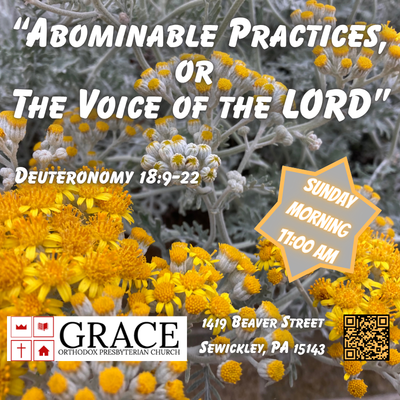
We pray these things through Christ our Lord and all of God’s people said. Amen. You may be seated. The sermon title this morning is Abominable Practices or the Voice of the Lord. And I’d encourage the children to listen to our three key words today. The words are guidance, profit, and distinguish.
How can I find God’s personal will for my life? How can I make sure that I am in the center of God’s will? Friends, when I was a young man, young in my faith, that was one of the pressing questions that haunted me. And I suspect that this is a pressing question for many Christians, especially many Christian young people who have their lives ahead of them and are wondering, well, what does the Lord want me to do? Where does he want me to go? And so forth. For example, This was a particularly pressing issue for me when I was a college student and had my whole life before me.
And I wondered to myself questions such as, well, does God want me to pursue marriage or to serve him in a state of singleness? I’m kind of glad for how that turned out. In terms of vocation, I wondered, should I seek to serve the Lord in some form of full-time Christian service, perhaps as a pastor or as a missionary, or should I serve the Lord in a secular vocation? Both options are honorable biblical choices.
And the list went on and on and on. And I remember, at the time, I wasn’t reformed in my convictions. I was more in the broadly evangelical camp, and I was, at the time, under the influence of the charismatic and Pentecostal movements. Believe it or not, yes, your pastor used to speak in tongues, or at least that’s what I thought at the time.
In any case, because I was under the influence of charismatic and Pentecostal teaching at the time, when it came to the kinds of advice I was hearing at the time in terms of how to find God’s will for your life, I remember I was not pointed to the Scriptures alone as the soul-sufficient guideline for understanding and living out God’s revealed will.
Instead, I was told that, yes, you need to read the Bible, you need to study the Bible, you need to seek to obey the Bible, but you can do all of that and still miss God’s plan A for your life, God’s perfect will for your life. And that frustrated me. Because at the time, instead of being pointed to the objective standard of Scripture as the sole guide for living out the will of God, the revealed will of God, I was often pointed by my teachers inward to my own subjective feelings, my own mystical intuitions in order to discover God’s will.
I was counseled, for example, well, make sure that you have peace in your heart. Make sure that you feel the Lord guiding you in this direction or in that direction. And whenever I would try to make a decision, I would find myself thinking, well, have I really read God’s, have I read the tea leaves right? In other words, have I really discerned God’s will correctly, or have I perhaps misinterpreted His will for my life? Or I was directed to look for special providential signs in my life. Perhaps you’ve heard the advice that if you have an important decision to make, you need to put out a fleece like, the Judge Gideon did in the days of the judges. But friends, in hindsight, I realize now that the methods that I was using at that time to try to discern God’s personal will for my life really amounted to a mystical, Christianized version of sorcery. In other words, of trying to pry my way into the secret counsel of God.
And what does the scripture say about that? Well, perhaps you’re familiar with that passage in Deuteronomy 29, verse 29. The secret things belong to the Lord our God, but the things that are revealed belong to us and to our children forever, that we may do all the words of this law. Notice there’s only two categories there. There’s God’s secret will, that’s his sovereign decorative will that is not known to us, and then there is his will that he has revealed through his word. There’s not a third personal will of God that is somehow distinct from the revealed will of God.
Oh, how much stress that would have saved me if I’d known that at that time in my life, that as long as you’re following the word of God prayerfully and to the best of your ability and looking to Jesus, you’re free to make godly decisions as long as they’re not in conflict with the word of God or sinful decisions. Well, friends, I share this personal experience with you to highlight the relevance of our passage from God’s Word that we are considering today. And in order to really profit from this passage of God’s will, God’s Word, we need to do what we always do as we approach any text of Scripture, and we need to understand its overall context.
Well friends, in terms of the overall context of our passage within the book of Deuteronomy, we need to remember that in Deuteronomy, the prophet Moses is addressing the Israelites as they are preparing to go in and to conquer the promised land. This is at a stage of redemptive history when the children of Israel had been wandering in the wilderness for 40 years. That original generation, the Exodus generation, had died off for the most part in the wilderness. And now a new generation had arisen and was waiting and getting ready to go in and to conquer the promised land. Now in previous passages in Deuteronomy, God through Moses had made provisions for the civil and judicial and religious institutions that Israel was commanded to observe in the promised land.
But aside from the divine guidance that Israel would receive from the law of Moses, and aside from the ceremonial directions of the priests and the Levites that they would offer to the people, how would God’s people get the special guidance that they would need in specific future situations that they would face in their future as a theocratic nation?
Again, we need to remember where the people of God were at in this particular point in redemptive history. Remember that at this time in redemptive history, God’s people did not have the full, complete canon of scripture like we have it today. They did have what was sufficient for them at that time under the old covenant, but they didn’t have all of God’s word. And so later on, God would raise up prophets to give new and fresh divine revelation to the people at that time. But at the time when Moses spoke these words to the gathered Israelites, at that time, the only word from God they had was that which we now have in the books of Moses, the Pentateuch. And even then, Deuteronomy was still in the process of being written. So again, they would need ongoing divine guidance from the Lord in order to maintain the integrity of their covenantal identity and their faithfulness to the Lord.
Well, in answer to the question, though, Moses first makes it clear to the people where they are not to seek for such supernatural guidance. Namely, they are not to seek divine guidance through following the detestable pagan and occultic practices that the Gentile nations of Canaan used for seeking such guidance. Israel was to listen to the prophets whom God would raise up, prophets like Moses, whom God would raise up from among their own brethren. In other words, instead of heeding the voice of pagan sorcerers, and sorcerer and abominable practices, God’s people were to heed the voice of Yahweh their God. And that voice, that word of God would come to them through a series of prophets and ultimately through one final and ultimate prophet, namely the promised Messiah, Jesus of Nazareth, our Lord and Savior.
So let’s turn our attention to our text for today, and let’s first of all consider from verses 9 through 14, illegitimate means of seeking supernatural guidance. The first thing that Moses draws our attention to, or that the Spirit through Moses draws our attention to, are the things that God’s people are to avoid, the kind of practices that they are to avoid, illegitimate practices. Here the Lord instructs his people to avoid seeking supernatural or divine guidance through occultic or pagan practices. He says this in verse nine, when you come into the land that the Lord your God is giving you. Let me just pause there and note a couple of things. He doesn’t say if you come into the land. He says when you come into the land.
The Lord had promised to give them the land. And so this is a certainty. This is God had covenanted this land to the people. And notice it is the land that the Lord your God is giving you. Yahweh your God is giving this land to you. It’s a gift. It’s not something that they earned or deserved. Deuteronomy itself, throughout Deuteronomy, God makes this very clear to the people. He tells the people, it’s not because you’re more righteous or more numerous than the surrounding nations that I’m giving you this land.
It’s simply because the Lord your God loves you and is fulfilling his covenant promises. So this land is a gift of God’s grace. bestowed upon his people. But that does not take away the responsibility of the people to live faithfully within the land. When you come into the land that the Lord your God has given you, you shall not learn to follow the abominable practices of those nations.
We don’t really understand or fully appreciate today the strong temptation that God’s people had in that ancient setting. All around them, all of their Gentile neighbors were immersed in pagan idolatry. They were immersed in occultic practices. They consulted soothsayers and mediums and spiritists and necromancers and so forth. They followed all of these ways.
And the Lord is saying to his people, look, It’s gonna be tempting, but don’t you dare follow the practices of your pagan neighbors. Again, what he’s saying to them is do not learn to follow the ways of this sinful, fallen world, and thus also do not rely on worldly wisdom.
Instead, this is basically Moses’ way of saying what the Apostle Paul says, instead of being conformed to this world, be transformed by the renewing of your mind. And that renewal comes, as we will see, through the word of God. In fact, as we compare Scripture with Scripture, if you want to turn to Romans 12, verses 1 and 2, I know this is very familiar to many of you, but we need to hear this again and again. after Paul has explained and expounded upon the glorious gospel of Jesus Christ in the first 11 chapters of Romans, he then gets practical, although theology is, of course, supremely practical, but he brings it down to earth, so to speak, and he says this, I appeal to you, therefore, brothers, by the mercies of God, the mercies that he’s been writing about, in the first 11 chapters, I appeal to you to present your bodies as a living sacrifice, holy and acceptable to God, which is your spiritual worship or reasonable service as it could be translated. In other words, by bodies, the body represents the whole self. Present your whole self to God in view of his mercy to you. And then he says in verse two, do not be conformed to this world, this fallen world with all of its pagan practices, including occultic practices, such as Moses refers to in our passage for today.
Do not be conformed to this world, but be transformed by the renewal of your mind, that by testing, you may discern what is the will of God, what is good and acceptable and perfect. How are our minds renewed, brothers and sisters? They are renewed by the Word of God. The Word of God is absolutely sufficient to renew our minds and thus to give us the guidance that we need for living faithful and godly lives.
Now, the Word of God doesn’t tell you when you get up in the morning what you are to wear. Well, you know, you’re supposed to wear this pair of slacks and wear the brown pair of socks and not the blue pair of socks. No, God entrusts to you the freedom and liberty to make those kinds of decisions. As long as you’re not making sinful decisions or decisions that go against the Word of God, you are at liberty to use your godly scripture-informed wisdom in those things. And this is because the Bible is sufficient to give us divine guidance.
Remember what Paul wrote to Pastor Timothy. in that very familiar passage of 2 Timothy 3, verses 16 and 17. In fact, let me back up a little bit and begin reading in verse 14. But as for you, as for you, Pastor Timothy, Continue in what you have learned and have firmly believed knowing from whom you learned it and how from childhood you have been acquainted with what? With the sacred writings. Timothy had been acquainted with the scriptures even from childhood, which is able to make you wise for salvation through faith in Christ Jesus.
But not only is the Bible sufficient to make us wise for salvation, not only does the Bible reveal to us the way of saving grace, that’s the fundamental heart of what the scriptures teach. But it goes on to say, all scripture is breathed out by God, theopneustos, breathed out by God, God breathed. and is profitable for what? For teaching, for reproof, for correction, and for training in righteousness that the man of God may be complete, equipped for every good work.
The Scriptures completely equip us. Scripture is sufficient. The Word of God is absolutely sufficient. It’s sufficient for a minister of the Word, such as Pastor Timothy. And if it’s sufficient for those who are called to be servants of the Word in the church, it is certainly sufficient for all of God’s people, for faith and life, for all that you need to know about God’s will in your life and mine. Getting back to our text for today, we are again urged not to follow the practices of the world. But then Moses goes on to make it clearer. He says in verse 10, he gives examples.
He says, there shall not be found among you anyone who burns his son or his daughter as an offering. That’s an awful pagan practice that was very common, sadly, in the land of Canaan and among Israel’s neighbors. They would seek to appease the gods and the goddesses. They would seek to appease their deities, sometimes by sacrificing, burning alive their own children on pagan altars.
The Lord says don’t do that, but the sad history of God’s people. later on shows that they fell even into this horrible practice. But don’t do that. Why did they do that? They did that to seek the Lord’s blessing and to seek rather the blessings of the gods and to seek prosperity and so forth. But the Lord says, don’t do that. That’s terrible.
There shall not be found among you anyone who burns his son or his daughter as an offering. And then he goes on to say anyone who practices divination or tells fortunes or interprets omens or a sorcerer or a charmer or a medium or a necromancer or one who inquires of the dead.
Now we could spend a lot of time looking at these different categories of individuals and practices, these various occultic practices, but the point is these terms describe various occultic and pagan practices which involved attempts to gain divine or supernatural guidance without relying upon the word of the true and living God. Instead of seeking the voice of the Lord through his chosen prophets, These practices are an abomination to Yahweh because they involve idolatrous attempts to gain secret and supernatural knowledge by illegitimate means, by means other than seeking that guidance from Yahweh’s word, the word of the Lord. In effect, these terms have the effect of prohibiting all kinds of occultic and pagan practices. And I would suggest to you that this would include even supposedly innocent or fun practices, like consulting your horoscope, or using a Ouija board, or tarot cards, and so forth.
You say, well, what’s wrong with that? Well, look at verse 12. Verse 12 says, for whoever does these things is an abomination to the Lord. And because of these abominations, because of these pagan occultic and idolatrous practices, because of these abominations, the Lord your God is driving them out before you. Here, my friends, is a stern warning. Those who unrepentantly engage in such practices are regarded by the Lord as an abomination in his sight. And it is because of such abominable practices that God was driving out the nations of Canaan in judgment.
As Matthew Henry puts it in his commentary, he says, let those who give heed to fortune tellers or go to wizards for the discovery of things secret that use spells for the cure of diseases are in any league or acquaintance with familiar spirits or form a confederacy with those that are. Let them know that they can have no fellowship with God while they thus have fellowship with devils. You can’t commune with demons than commune with the Lord at the one and the same time. And then verse 13, Moses goes on to say this, which you are about to dispossess, listen to fortune tellers and to diviners.
But as for you, the Lord your God has not allowed you to do this.” Again, here is a call to be blameless of such pagan and occultic activities. And I would suggest by way of extension, by way of implication, this would also prohibit us from Christianized versions of such practices as well, as we seek legitimately to discern God’s direction in our lives. So why, that raises again the question, why is it wrong for believers to dabble in the occult?
Well, first of all, because God says not to do it. And God knows best. Our Heavenly Father knows what is best. Even if we can’t know or understand why He would tell us not to do it, if God says don’t do it, you better not do it. He’s got good reasons for prohibiting you from such activities.
It is also prohibited, I would suggest, because seeking for secret knowledge and seeking for special powers that belong only to the Lord, that’s what the occult is about. It is seeking special knowledge, like predicting the future, you know, fortune-telling as one example, or looking at a crystal ball. You’re trying to get secret, special knowledge that is only accessible to the Lord, and it’s only His right to have that knowledge. Or you’re seeking special powers, that only God can exercise. It also, such activities, such occultic and pagan activities also involve its participants in fellowship with demons.
I would have us turn to 1 Corinthians 10, verses 18 to 22. In 1 Corinthians, the Apostle Paul is addressing, of course, the church in Corinth, and the church of Corinth included, among its membership, many former pagans, former idol worshipers. But some of these former pagans, apparently, were tempted to go back to their previous pagan ways. Paul is exhorting them, especially those who would participate in idol feasts within the temple, actual idol worship. He says this, consider the people of Israel.
Are not those who eat the sacrifices participants in the altar? What do I imply then, that food offered to idols is anything or that an idol is anything? No, I imply that what pagans sacrifice, they offer to demons and not to God. Let me pause there. Idol worshipers who bow down before a block of wood or a statue of gold, they’re not worshiping real gods, but behind those false deities are demonic spirits. Idol worship is communion with the demonic, and that is why you can’t follow Jesus and openly and willfully worship idols at one and the same time. It’s impossible.
Paul says, No, I imply what pagan sacrifice they offer to demons and not to God. I do not want you to be participants with demons. You cannot drink the cup of the Lord and the cup of demons. You cannot partake of the table of the Lord and the table of demons. Shall we provoke the Lord to jealousy? Are we stronger than he? We belong to Christ. He is our Lord. How dare we then, having confessed his name and having communed with him in the word and worship and in the Lord’s Supper, then to go and participate in pagan or occultic activities. So we are not to dabble in occultic or pagan activities.
But the main thrust of this passage here, friends, is that the voice of the Lord speaking in the Holy Scriptures is all that we need. for a godly life. And since we, especially now today, in this stage of redemptive history, we have the completed canon of Holy Scripture. Indeed, we have all that we need for Christian faith and Christian living in the Word of God. For all the divine guidance that we need is found in this book.
And you can rest in that. If you are in Christ, if you are seeking to walk with Jesus in true faith and repentance, seeking to order your life according to the revealed will of God, you’re not gonna miss God’s plan A for your life. You’re already at the center of his will because you are seeking to walk with him. And if you go off the path, he always welcomes you, the prodigal, back home. I’m reminded of that hymn that we will sing a little later. What more can he say than to you he has said, to you who for refuge to Jesus have fled. So we’ve seen the illegitimate practices that the people of God are to avoid.
But next, as we consider verses 15 through 19, we consider next the promise of a future prophet like Moses, the promise of a future prophet like Moses. Moses goes on to say this, the Lord your God will raise up for you a prophet like me from among you, from your brothers. It is to him you shall listen.
Now Moses, remember, Moses is not gonna be allowed to go in with the people to the promised land. So some of them, and he’s told them that, he said, the Lord has prohibited me from going into the promised land. So the people might have been thinking, well, what are we gonna do without Moses? And Moses is assuring them, the Lord is going to continue to go with you and he is gonna continue to give you prophets like me who will speak my word to you. the Lord your God will raise up for you a prophet like me.
It is to him you shall listen just as you desired of the Lord your God at Horeb on the day of the assembly when you said, let me not hear again the voice of the Lord my God or see this great fire anymore lest I die. In other words, God is not gonna directly reveal his himself to you through this, the glorious means that he used on Mount Sinai, which caused the people to tremble, to say, Moses, you speak to us. Don’t let the Lord speak to us or we’ll die. He’s assuring them that God will continue to provide the divine guidance that they need.
But does this promise here, here’s an interpretive question that commentators have struggled with. Does this promise of Moses here refer to a future succession of Old Testament prophets? Is it exclusively a prophecy that is fulfilled only in Jesus Christ? Or is it a combination of both? Does this promise a future succession of Old Testament prophets, but a succession of prophets that will culminate in the ultimate messianic prophet, namely our Lord and Savior, Jesus Christ? Well, friends, I believe that it is this latter view that is the correct one given the context of this passage and also within the broader context of later revelation from God.
Kyle and Delitzsch make the point that just because Moses mentions a prophet in the singular, that doesn’t necessarily mean only one prophet. They say it by no means follows from the use of the singular, a prophet, that Moses is speaking of one particular prophet only. But the idea expressed is this, that at any time when the people stood in need of a mediator with God like Moses, God would invariably send a prophet.
But again, I think Matthew Henry puts it better when he says this. Whether a succession of prophets be included in this promise or not, we are sure that it is primarily intended as a promise of Christ and it is the clearest promise of him that is in all the law of Moses. In other words, this is a quintessential messianic prophecy here. Henry goes on to write, It is expressly applied to our Lord Jesus as the Messiah promised.
And he references Acts 3, 22 and Acts 7, 37. And the people had an eye to this promise when they said concerning him in John 6, 14, this is of a truth, that prophet that should come into the world. And it was his spirit that spoke in all the other prophets. 1 Peter 1, verse 11. makes it clear that the Old Testament prophets spoke by the Spirit of Christ. The Holy Spirit is the Spirit of Christ, so Christ was speaking through the Old Covenant prophets.
Let’s take a look at what the Apostle Peter says about this in Acts 3, verses 22 to 24. Acts 3, The apostle Peter is preaching the gospel in the temple in Solomon’s portico. And as he’s preaching the gospel, he reminds the Jews whom he’s preaching to of this. He says this beginning in verse 22.
Moses said, the Lord God will raise up for you a prophet like me from your brothers. You shall listen to him in whatever he tells you. In the context of this sermon, Peter’s making it clear that this prophecy that is part of our text for this morning, this prophecy It’s about Jesus, it is fulfilled in Christ. And he goes on to say in verse 23, and it shall be that every soul who does not listen to that prophet shall be destroyed from the people.
And all the prophets who have spoken from Samuel and those who came after him also proclaimed these days. So again, this is applied to Christ. This predicts Christ. So friends, what does that mean for us today? That means we need to heed the voice of Jesus. And where do we hear the voice of Jesus? The voice of Jesus, our good shepherds, speaks to us, his sheep, in the scriptures, the word of God. Are you, my friend, heeding his word, his gospel?
But that brings us to the final section of our passage for today and the final point I wanna make, and that is how we are to distinguish between a true and a false prophet. How do we distinguish between a true prophet of God and a false prophet? Well, the Lord through Moses makes that very clear in verses 21 and following, or verses 20 and following.
First of all, we learn that a false prophet will speak in the name of other gods, or will, by implication, spew forth false doctrine, even if he’s speaking in the name of the true God. Bringing a false message, claiming to be from the true God, but which is not a message from the true God, that is just as bad as speaking in the name of other gods. As it says in verse 20, but the prophet who presumes to speak a word in my name that I have not commanded him to speak, or who speaks in the name of other gods, that same prophet shall die. Under the old covenant, false prophets were to be not just excommunicated, but executed. That was the old covenant form of excommunication in the Old Testament theocracy.
This reminds us also of what the Lord through Moses had said earlier about false prophets in Deuteronomy 13, verses one to four, where Moses says, if a prophet or a dreamer of dreams arises among you and gives you a sign or a wonder, and the sign or wonder that he tells you comes to pass. And if he says, let us go after other gods, which you have not known, and let us serve them, you shall not listen to the words of that prophet or that dreamer of dreams, for the Lord your God is testing you to know whether you love the Lord your God with all your heart and with all your soul. You shall walk after the Lord your God and fear him, and keep His commandments and obey His voice, and you shall serve Him and hold fast to Him. Even if that false prophet gives you a seeming miracle, performs a miracle, if they’re telling you, counseling you, giving you a supposed message from the Lord that contradicts what is found in the word of God, that leads you in a different direction, you are not to listen to them.
So false prophets will speak in the name of other gods or by implication they will spew forth false doctrine. But another test that he gives is found in verses 21 and 22. And we learn in these verses that a false prophet will make predictions that do not come to pass. How do you know that someone’s a false prophet? Well, if they’re giving predictions. You know, you think of folks who say, well, you know, the Lord told me Jesus is coming back on a certain date, and then that date comes and goes, and then often the false prophet will say, well, actually, you know, that’s to be interpreted spiritually. They make excuses for their false predictions.
But what does Moses say about that? Look at verses 21 and 22. And if you say in your heart, how may we know the word that the Lord has not spoken? When a prophet speaks in the name of the Lord, if the word does not come to pass or come true, that is a word that the Lord has not spoken.
Got that? It’s pretty clear, isn’t it? You listen to, and there’s many like this today who claim to be prophets or prophetesses or even apostles, and they’ll give predictions. I remember a number of years ago, I think it was before the 2020 election, that there was a particular self-professed prophet of God who was predicting that, yes, Donald Trump was gonna be elected again in 2020.
Well, we know, of course, that that did not happen. But I believe that so-called prophet is still going, still making predictions. By the standard of God’s will, God’s word, he is not a true prophet of God. Anyone who makes a false prediction is by definition a false prophet, no matter how correct the other things that they say may be. Verse 22, when a prophet speaks in the name of the Lord, if the word does not come to pass or come true, that is a word that the Lord has not spoken. The prophet has spoken it presumptuously. You need not be afraid of him.
And brothers and sisters, As we close our time considering this section of God’s Word, let us heed the scriptural call to exercise discernment between the true and the false. This is actually a duty, a Christian duty, to exercise discernment. You are not honoring God if you give one penny, for example, to use a hypothetical scenario, I don’t think any of you would do this, but if you give even a penny to support a charlatan like, say, Kenneth Copeland, who is a snake, you give even a little bit of money to support such false teachers, you are dishonoring your God. And you are, by implication, denying the sufficiency of his word to guide you. Beloved, let us heed the scripture call to exercise discernment. And how do we exercise discernment again? 1 John 4, verses one through six. Let me read this passage again.
Beloved, do not believe every spirit. And John there is referring to teachings, spiritual teachings. Do not believe every spirit, but test the spirits. You have a responsibility to test the spirits, to test the teachings. How? By the word of God. Why must we test the spirits? For many false prophets have gone out into the world. By this, you know the Spirit of God.
Every spirit that confesses that Jesus Christ has come in the flesh is from God. In John’s day, there were false teachers, Gnostic teachers, who were denying the full humanity of Christ. They were denying that the divine Christ had come in the flesh, which is a denial of the gospel. So anyone who denies the gospel is not from the Lord. Every spirit that does not confess Jesus is not from God.
This is the spirit of the Antichrist, which you heard was coming and now is in the world already. Little children, you are from God and have overcome them. And he who is in you, for he who is in you is greater than he who is in the world. They are from the world. Therefore they speak from the world, and the world listens to them. We are from God. Whoever knows God listens to us. Whoever is not from God does not listen to us. By this we know the spirit of truth and the spirit of error. Do they speak according to this word? Then they are of the truth. Do they speak contrary to or in contradiction to this word? Then they are false prophets, false teachers. But the only way to have the ability to exercise that discernment is to be indwelt by the Spirit of God. And you can’t have the Holy Spirit unless you know Christ.
Do you know the Lord Jesus Christ as your savior from sin? Is he your great prophet, priest, and king? Christ who died on the cross to pay the penalty for sin and rose from the dead so that whoever believes in him, trusts in him alone for salvation from sin, might not perish but have everlasting life. flee to Jesus, receive and rest upon him alone for your salvation. The spirit then, you can be assured then that the spirit indwells you and he is the spirit of truth and he will lead you and guide you into all truth and will grant you the grace of discernment.
Amen. Let’s pray. Heavenly Father, We thank you that you have given to us clear guidance. We need not follow the ways of the nations of this fallen world in seeking divine guidance or supernatural guidance, for you’ve given us that guidance in full in the scriptures. So help us, Lord, give us wisdom by the illumination of your spirit to apply your word with godly wisdom to our own particular lives and circumstances. And we pray, Heavenly Father, that you would help us to test the spirits and to affirm that which is good, that which is in accord with your gospel. In Jesus’ name we pray, and all of God’s people said, amen. Let’s close our time of worship today by rising and we’ll sing hymn 243, How Firm a Foundation, 243.