
The sermon text provided below is derived from the sermon audio recording making use of generative tools. It has not been manually edited. While transcription tools have a high degree of accuracy, the output may include generative textual, punctuation, and/or formatting errors.
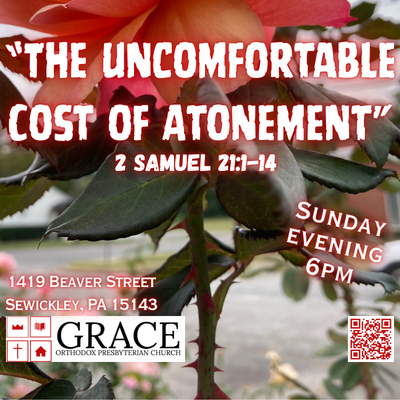
Well, if you would turn this evening, our reading, our text this evening is from 2 Samuel, chapter 21, and you can find that on page 321 of your Pew Bibles. You may be a little bit surprised to not find us in Hebrews. We do have one more message from Hebrews and that will be next week, but didn’t have time with all of Presbytery and everything to prepare a further message from Hebrews. So tonight we’re looking at an obscure passage in the book of 2 Samuel. that may be a bit uncomfortable, but I think it has an important lesson for us if we really understand what’s going on here. So this is from 2 Samuel 21, verses 1-14. Hear now the word of God.
Now there was a famine in the days of David for three years, year after year. And David sought the face of the Lord, And the Lord said, there is blood guilt on Saul and on his house because he put the Gibeonites to death. So the king called the Gibeonites and spoke to them. Now the Gibeonites were not of the people of Israel, but of the remnant of the Amorites. Although the people of Israel had sworn to spare them, Saul had sought to strike them down in his zeal for the people of Israel and Judah.
And David said to the Gibeonites, what shall I do for you? And how shall I make atonement that you may bless the heritage of the Lord? The Gibeonites said to him, it is not a matter of silver or gold between us and Saul or his house, neither is it for us to put any man to death in Israel. And he said, what shall, what do you say that I shall do for you?
They said to the king, the man who consumed us and planned to destroy us so that we should have no place in all the territory of Israel, Let seven of his sons be given to us, that we may hang them before the Lord at Gibeah of Saul, the chosen of the Lord. And the king said, I will give them. But the king spared Mephibosheth, the son of Saul’s son, Jonathan, because of the oath of the Lord that was between them, between David and Jonathan, the son of Saul. The king took Two sons of Rizpah, the daughter of Iiah, whom she bore to Saul, Armoni and Mephibosheth, and the five sons of Merib, the daughter of Saul, whom she bore to Adriel, the son of Barzillai, the Maholothite. And he gave them into the hands of the Gibeonites, and they hanged them on the mountain before the Lord.
And the seven of them perished together. They were put to death in the first days of harvest, at the beginning of barley harvest. Then Rizpah, the daughter of Aiya, took sackcloth and spread it for herself on the rock from the beginning of harvest until rain fell upon them from the heavens. And she did not allow the birds of the air to come upon them by day or the beasts of the field by night.
When David was told what Rizpah, the daughter of Aiya, the concubine of Saul, had done, David went and took the bones of Saul and the bones of his son Jonathan from the men of Jabesh-Gilead, who had stolen them from the public square of Beth-Shan, where the Philistines had hanged them on the day the Philistines killed Saul on Gilboa. And he brought up from there the bones of Saul and the bones of his son Jonathan, and they gathered the bones of those who were hanged. And they buried the bones of Saul and his son Jonathan in the land of Benjamin in Zella, in the tomb of Kish, his father. And they did all that the king commanded. And after that, God responded to the plea for the land.
Amen. May God add his blessing to the reading. Let’s pray. Our Father in heaven, Lord God, we ask that you would send your spirit who has preserved this text and inspired it, that you might come now in the preaching and hearing of the word, that you might be present so that this might be to our benefit and to your glory. We pray this in Jesus’ name, amen. You may be seated.
Where does meat come from? My cousin-in-law, who has a farm in Georgia now, he told me about growing up in Farmville, Virginia, and he had one friend who told him with a straight face that he didn’t eat meat that came from animals. Instead, he got his meat from the grocery store. While we can laugh at this lack of understanding, the world in which we live in in America today has made it easier than ever to forget where things like meat come from. We live in a world that tries to sanitize everything. Our food comes neatly packaged, without blood. Our entertainment avoids the graphic.
Even our faith can become so refined. that we forget that the cross was a place of torture, agony, and blood. And then we open up to 2 Samuel 21 and read about a famine that lasts three years, a broken ancient covenant, and seven men handed over to die in a public display of divine justice.
This is not a feel-good story. It’s raw, disturbing, and bloody. And precisely because it’s so uncomfortable, it forces us to confront a truth that we often, or sometimes at least, avoid. God takes sin seriously. Atonement is not cheap. And the gore of Golgotha was the only way to lift the curse from people like you and me. Our passage this evening is a very difficult text.
It’s very troubling because it involves a gruesome story of death, but even more troubling because the killing appears commanded by God. Some scholars looking at this text have suggested it presents a regress into more pagan times when Israel misguidedly believed that God desired human sacrifice, like in the time of the judges. in Jephthah, for instance. But when we really understand what’s going on in this passage here, instead of merely a gruesome story of death of seemingly innocent people, we’ll be reminded of the cross and the cost of Calvary, the gore of Golgotha, which results in satisfaction for our own covenant breaking and the banishment of our blood guilt. I hope that by the end you’ll see the beauty that shines through the cracks of this sordid story.
Because God takes sin seriously, we must understand the cost involved in the atonement required for our own sin. Just as the offspring of the covenant breaker in this story stood in Saul’s place to atone for his sin, So the first Adam’s offspring would one day keep the covenant that Adam broke and pay the ultimate price to free us from the blood guilt of Adam’s transgression. We’re going to look at our passage this evening under three headings.
Number one, the cancelled covenant. Number two, the prerequisite punishment. And number three, the accepted atonement. Number one, the cancelled covenant. The first thing that we see in this passage is the cancelled covenant. The scene opens in the midst of a famine. One year, it might have been a little bit problematic.
Two years, it’s starting to get serious. But by year three, David is convinced that this must be a judgment from God. He seeks the Lord as we’ve come to expect David to do. And the Lord confirms what David had suspected. This famine is a judgment as was prophesied in response to breaking God’s covenant.
Saul has brought guilt upon the nation of Israel through his actions as king while he was living. This story takes place after Saul has already died. But God says that the guilt remains on him and his house. What had Saul done? Killed some people called the Gibeonites? What about all the other people that Saul had killed?
What would be special, what is special about the Gibeonites? Well, we learn in the book of Joshua that the Gibeonites were one of the nations that were living in the land of Canaan at the time that Israel invaded. Israel was told to completely wipe out the Canaanite nations as God’s judgment on Canaan’s wickedness, as well as prevention against idolatry. Israel was called to be God’s idolatry disinfectant on Canaan. They were told to kill all the nations living there and take over the land for themselves. And apparently, God’s directive to Israel became well known to the Canaanites.
After Jericho fell, the people of Gibeon, also called the Hivites, said, if you can’t beat them, join them. But they had a problem because Israel had been forbidden by God from making a covenant with any nation in the land of Canaan. And the Gibeonites knew this. So they pretended to originate from outside of Canaan in order to procure a covenant of security with Israel. Judah, Joshua, and the elders of Israel failed to consult God at that point. And they went ahead and made a covenant with Gibeon.
In Joshua chapter 9 we read about it and in verse 19 and 20 we find the conclusion. But all the leaders said to the congregation, We have sworn to them by the Lord, the God of Israel, that we, and now we may not touch them. This we will do to them. Let them live. lest wrath be upon us because of the oath that we swore to them.”
Even though they disobeyed God to make the covenant in the first place, God prohibited Israel from breaking the covenant with Gibeon. In fact, Israel was almost immediately required to defend Gibeon at great cost from the rest of the Canaanites. As soon as word got out that Gibeon had made a deceptive covenant with Israel, the other nations in Canaan set out to destroy Gibeon. They called for help and they asked Israel to honor the covenant that they had just made with them. And at God’s directive, Israel did save Gibeon under the command of Joshua, risking the lives of many Israelites. Despite the morally murky foundation of the covenant with Gibeon, The leaders of Israel understood that to break this covenant would be, as they said, invoke wrath upon us because of the oath that we swore to them.
So that’s the background for our story. Fast forward to our passage in 2 Samuel chapter 21. We find David dealing with another aftermath of Saul’s reckless disobedience. throughout his reign. Saul’s reign was marked by a general failure to disobey God.
For instance, when he was commanded to wipe out the Amalekites, he failed to destroy their king and he kept some of the plunder for himself. And in response, Samuel told Saul that his days as king were numbered. Apparently, Saul didn’t just spare people that he shouldn’t have, like the Amalekites, But also as we find in our passage, he killed people that he should not have. Now we don’t know when Saul carried out this campaign against the Gibeonites that’s referenced in our passage. We’re only told in 2 Samuel 21 verse 2b that although the people of Israel had sworn to spare them, Saul had sought to strike them down in his zeal for the people of Israel and Judah. It’s possible after being censured for failing to destroy the Amalekites, Saul later was trying to overcompensate by killing the Gibeonites, who were not natives of the people of Israel.
Or perhaps he was at a low time favorability rating and was trying to boost his popularity among the people of Israel. We know that he considered David’s popularity to be threatening. Whatever Saul’s reason, for killing, attempting genocide on the Gibeonites. It was wrong.
And in our passage, it reminds us that although the Gibeonites were not part of Israel, Israel had made a sworn covenant to protect them. So Joshua and the leaders of Israel understood that trying to cancel this covenant would bring wrath from God upon them. So then decades after Joshua made that covenant, when Saul tried to cancel it, Israel is reaping the consequences as we find in 2 Samuel 21. Saul broke the covenant and David finds himself holding the bag. Israel had made a covenant with the Gibeonites and it was Saul’s duty as king to uphold Israel’s covenant that they made before God with them. and breaking Israel’s solemn covenant before God demanded justice.
- The Prerequisite Punishment The act of breaking Israel’s covenant required punishment. King Saul went to his grave without making restitution. for his crime of breaking Israel’s covenant with Gibeon before God. Saul had broken this covenant with impunity and it seemed like he had gotten away with immunity. However, God saw and God knew. Moreover, the Gibeonites who escaped Saul’s sword also knew.
After being directed by God to the source of the famine upon Israel, David consults the aggrieved party, the Gibeonites. Verse 3, David said to the Gibeonites, what shall I do for you now? And how shall I make atonement that you may bless the heritage of the Lord? David’s asking the right question. He doesn’t come out telling the Gibeonites, just get over yourselves. or asking, are you mad, bro? This is not a private spat here. This is about divine justice and atonement. While this conversation is taking place horizontally between David and the Gibeonites, it ultimately has vertical dimensions.
And David’s famous assertion in Psalm 51.4 holds true here, where he says, Ultimately, all sin is targeted against God. And the horizontal effects on others is actually collateral damage. It’s the side effects. Adultery, for instance, is a sin against God that also hurts those around us. It is God who has the ultimate right to forbid adultery, and yet it hurts those around us. And we could go on down the line with lying, killing, stealing, envying, disobeying parents, et cetera.
Joshua and Israel’s leaders didn’t just uphold their covenant with the Gibeonites because they wanted to preserve their reputation. They understood that the consequence of breaking the covenant would be divine punishment. And we see that it is God who directs David to contact the Gibeonites.
They do not initiate the interaction. and they seem reticent to ask for retribution. Verse 4, the Gibeonites said to him, it is not a matter of silver or gold between us and Saul or his house, neither is it for us to put any man to death in Israel. The Gibeonites say, we’re not looking for monetary compensation, and nor are they attempting a retributive rampage.
We don’t know how many years had passed since Saul had done this, But even if Saul had done it late in his reign, and this story happened early in David’s reign, it was at least several years, if not a decade or more. And yet they had not sought revenge. But if they’re not out for money, what do they want?
Verses four through six. And he said, what do you say that I shall do for you? And they said to the king, the man who consumed us and planned to destroy us so that we should have no place in all the territory of Israel, let seven of his sons be given to us so that we may hang them before the Lord at Gibeah of Saul, the chosen of the Lord. And the king said, I will give them.
While the Gibeonites appear restrained and polite, it doesn’t take away the gruesomeness of the request. David has to press the Gibeonites hard for an answer. And when it comes, we find ourselves shocked. Seven sons of the perpetrator of the violence. While the Gibeonites’ request might puzzle our modern Western minds, David seems to understand its justice. But not only does this request make us squeamish, It presents us with a real scriptural question, a dilemma.
What about the prohibition in Deuteronomy chapter 24? If you would like, you can turn to Deuteronomy chapter 24, particularly verse 16. In Deuteronomy chapter 24, verse 16, we read, Fathers shall not be put to death because of their children, nor shall children be put to death because of their fathers. Each one shall be put to death for his own sin. Is this a case of Saul’s sons being put to death for the sin of their father? How do we resolve this? One approach is to assert that David was wrong to honor this request.
He was violating Deuteronomy 24.16.
Some scholars have tried to say that the proper way to interpret this is to simply write it off as bloodthirsty Gibeonites tricking or blackmailing David into killing some of Saul’s offspring. Some unbelieving critical scholars have even suggested that we ought to consider this a whitewashed political purge, with David making up an excuse to get rid of Saul’s house and to establish himself. But some of these approaches not only wrongly call into question the Bible’s inerrancy and authority, as the critical scholars do, but none of these approaches does justice to what the inspired text tells us. Because in our text, we see God direct David to contact the Gibeonites, and by the end, God responds by ending the famine.
Well, what about Deuteronomy 24, 16? Well, God cannot contradict himself and he gave the law and he also gave this command to David. I think what makes the most sense to understand these is one commentator’s suggestion. that while Deuteronomy 24 legislates in criminal cases in an individual basis, what we have in 2 Samuel 21 in this case is a national offense against God.
It was not the Gibeonites who were punishing Israel, it was God. God required a representative number from the line of the offending party for the breaking of the covenant oath by Israel’s national representative at the time, who was Saul. The number seven is not random. It’s the biblical number of completion.
David understood that peace with God was worth more than anything else. It was more important than anything else. No matter how great the cost, he must have peace with God. Because if God was the enemy of Israel, nothing else was worth having. A question worth considering this evening is do you share that perspective with David? Do you understand in your own life the importance of having peace with God? Are there any sins in your life you’re trying to gloss over, hide in the corner, ignore at the expense of enmity with God? Or do you value peace with God so that you’ll repent and put away every sin within your heart?
Now, despite this justification of the request of the Gibeonites and David fulfilling it, we cannot escape the horror of this passage. David gives seven descendants of Saul for the Gibeonites to appease the wrath of God on Israel. The curse that was on the nation could only be propitiated by the curse falling upon a representative individual or individuals. Instead of the entire nation of Israel being killed with famine or worse, God accepted a sacrifice of judicially executed representative individuals.
We should be aghast, but not because it was wrong. but rather because atonement is gory and gruesome. If you had seen an Israelite pulling his bull up the path to the tabernacle and then slitting its throat, catching the blood, skinning it, washing its guts, and then burning it up on the altar in a filthy, sticky, bloody mess, you would understand atonement is messy. Or if you’d been there on Passover Eve with your young, innocent, spotless white lamb, just a couple of years old, walking up to the priest as he mercilessly slits its throat and gives you a bowl with its blood, you would realize, be very aware that atonement doesn’t come cheap. Because without the shedding of blood, there’s no remission of sins.
Additionally, notice that these seven descendants of Saul were killed in a particular way. They were killed by hanging before the Lord. While it is unlikely that the rope hanging that we think of was the particular method by which they died, this practice of hanging bodies up in the tree signified that they were cursed by God. We find this in Deuteronomy chapter 21. Deuteronomy 21 verses 22 through 23. And if a man has committed a crime punishable by death, and he is put to death, and you hang him on a tree, his body shall not remain on the tree all night, but you shall bury him the same day, for a hanged man is cursed by God.
These seven descendants of Saul became a curse in order to redeem the people of Israel. They were put to death for the sins of another to take away the wrath of God against God’s people. And so the final third thing that we see in our passage is the accepted atonement. Number three, the accepted atonement.
In the midst of David selecting individuals for judgment, we see that he is particular to spare Mephibosheth, Jonathan’s son. David is not about to break his covenant with Saul’s son, Jonathan, in the process of atoning for Saul’s covenant breaking. The contrast between Saul and David is clear. Saul breaks covenants, but David keeps them.
And this is the covenant which preserves an otherwise likely candidate for slaughter. Mephibosheth, Jonathan’s son, was a cripple. And under other circumstances, he might have been more expendable, a convenient choice for an atoning sacrifice. And yet David’s pre-existing covenant with Jonathan preserves him from destruction.
He’s loved. and spared for the sake of the covenant with his father Jonathan, despite what his grandfather Saul had done. Now, although David honored his covenant with Jonathan in our passage, he seems to have ignored or forgotten God’s directive in Deuteronomy 21 about not leaving the bodies up. Because after choosing the victims and handing them over to be killed, David seems to think he’s done. Whether he simply forgot about Deuteronomy 21 or had other reasons for ignoring the bodies, David seems to have left off supervising the execution or subsequent lack of burial. Apparently thinking his part was done, David neglected the poor souls whose bodies have been left out in the open to be desecrated by the wild birds and beasts. So Rizpah steps in, in our passage, to do what David had neglected, It says, she watched over the bodies until the rains came.
Now there are differing opinions as to what the significance of this detail is. Does it mean to tell us how long she was out there? If so, some see it as a reference to the fact that the famine was, some see it as a reference to the rains which often come in September, which would mean she was potentially out there five or six months. However, I think it makes more sense to see it as a reference to the fact that the famine was ending. If the rains coming in this passage only meant to signify how long she was out there, then what would be the point of saying this in the midst of a famine? It seems to miss the context in that case. If the rains were withheld largely for three years, noting that they came at the usual time would seem strange. It makes more sense to view this detail as a reference to the ending of the famine, the withheld showers.
This was an ending, the appeasement of God’s wrath. And David hears about the amazing example of this woman. Because once again we see God using women in his story of redemption to display amazing strength and kindness. While Rizpa must have been unfathomably grieved at losing her only two sons, there’s no indication she attempted to thwart the justice that God required. Yet that did not prevent her from sacrificing sleep and comfort for the sake of honoring the bodies and their memory. Such an act of devotion and sacrifice on top of her already having given up her sons to death was enough to put David to shame.
And when David heard what she had done, how she had quietly and submissively done this to honor the dead, he appears to have been embarrassed that he had not even remembered to honor Saul and Jonathan by burying them with their father. This was an act of great respect in Israel to bury the sons in the grave of their father. Remember Joseph’s urgent request that he be carried out of Egypt to be buried in the land of Canaan next to Abraham, Isaac, and Jacob. This was of course both demonstrating the faith of Joseph and his certainty that the exodus would happen as well as the importance that he placed and Israel placed on being buried in the Promised Land with his fathers. So David takes notice in our passage of the sin and the dishonor that has occurred with the grandsons of Saul being left out after having atoned for the sin of Israel. So he not only takes those seven bodies down to give them an honorable burial, But we read that he retrieves the bodies of Saul and Jonathan from Jabesh Gilead and he lays them all to rest in honor in the tomb of Saul’s father, Kish.
So what are we to make of this gruesome and strange story? The lesson that stands out most starkly, as we said before, is that God takes covenants seriously and atonement is not clean or cheap. Our God is a consuming fire. He will not let the guilty go unpunished.
It’s quite easy in our modern, sanitized society to forget the gruesome justice which our own sins require. We can almost fall into the idea that it’s pagan religions that require sacrifice, while Christians have a nice, clean faith in Jesus. Just like our packaged, sanitized grocery store cuts of beef, pork, or chicken, we can forget that our bloodless worship services are celebrating a gruesome, bloody, substitutionary atonement. The reason we don’t offer sacrifices, especially human sacrifices, here in worship is because he already offered himself once for all.
One commentator sees the point of this passage, sums it up as reminding us of what our peace with God cost Christ. He says, from slicing the bull’s throat in Leviticus 1, all the way to Calvary, God has always said atonement is nasty and repulsive. Christians must be aware of becoming too refined, longing for a kinder, gentler faith. He says, if we’ve grown too used to Golgotha, perhaps Gibeah can shock us back into truth.
Atonement is a drippy, bloody, smelly business. The stench of death hangs heavy wherever the wrath of God has been quenched, end quote. Let me close with this story. Richard Wormbrand, a Romanian pastor in the mid-1900s, who was tortured for his faith, but eventually escaped and founded the Voice of the Martyrs ministry, tells this story early on in his ministry. He says, when I was living behind the Iron Curtain, I met a Russian captain.
He loved God, he longed after God, but he had never seen a Bible. He had never attended religious services. He had no religious education. And he had loved God without the slightest knowledge of him. I read to him the Sermon on the Mount and the parables of Jesus. And after hearing them, he danced around the room in rapturous joy, proclaiming, what a wonderful beauty. How could I live without knowing this Christ? It was the first time that I saw someone jubilating in Christ.
Then I made a mistake. I read to him the passion and crucifixion of Christ without having prepared him for this. He had not expected it. When he heard how Christ was beaten, how he was crucified, and then in the end he died, he fell into his armchair and began to weep bitterly. He had believed in a Savior and now his Savior was dead. I looked at him and I was ashamed that I had called myself a Christian and a pastor. A teacher of others, I had never shared the sufferings of Christ as this Russian officer now shared them.
Looking at him for me was like seeing Mary Magdalene at the tomb, at the foot of the cross, or at the empty tomb. And then I read to him the story of the resurrection. And when he heard this wonderful news that the Savior arose from the tomb, he slapped his knees and shouted for joy. He is alive. He is alive. And again, he danced around the room, overwhelmed with happiness.
Sometimes we lose the joy of our salvation because we’ve sanitized the horror of the cross. The cross was a symbol of cruel torture in the Roman Empire, but the early Christians found comfort and joy in knowing that their Savior had borne that death in their place.
And this troubling passage from 2 Samuel, in which innocent substitutes bore the curse of God for the wrath of others, for the sins of others, should point us to the truly innocent Son of God, who bore the sins of his ancestor Adam, who died in the place of Adam’s descendants, so that all who put their trust in him might be free and truly have peace with God. Amen. Let’s pray. Our Lord Jesus, we thank you for the cross, for your cross that you took up gladly bearing, the nails that you bore in your hands and feet, the suffering and death that you endured for our sake, knowing every sin that we would commit and choosing to atone to die in our place so that we might be free, free from guilt, have true fellowship with you, with our triune God. We thank you for this and we ask that you would give us the joy of our salvation by remembering the cost of the cross. We pray this in your name, Lord Jesus, amen. One response, let’s turn to hymn 337, hymn 337. And let’s sing and let’s stand as we sing hymn 337.